
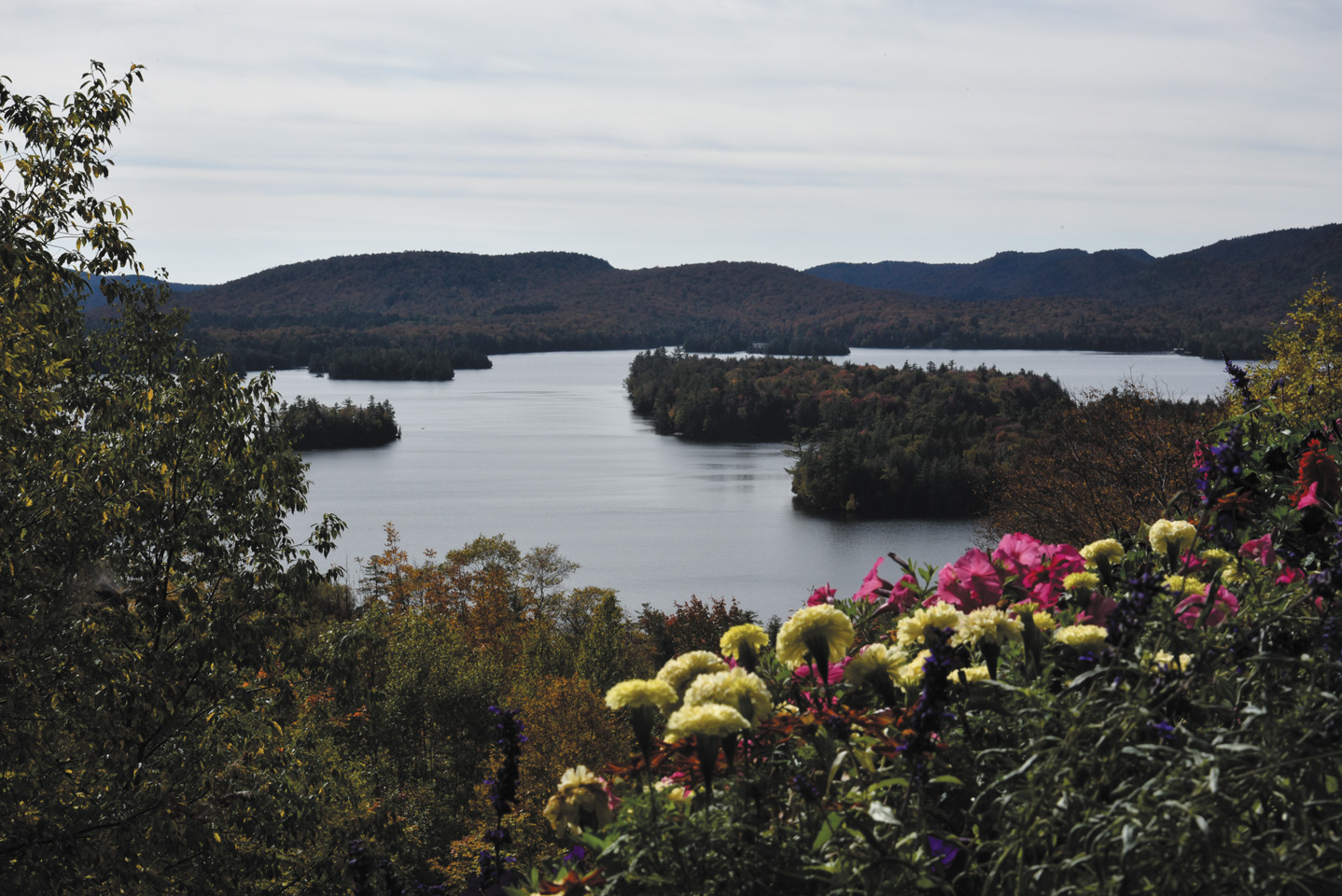
Two expansive properties in upstate New York celebrate the area’s natural history, human interaction, and the roles they play today.
By Anna Lee Braunstein
March 2021
About five million years old, the Adirondack Mountains in upstate New York were carved from some of the oldest rocks on our planet. Today its forests abound with maples, oaks, pines, and more. Rivers, lakes, and streams tumble and flow. Hundreds of species of animals dwell on the land and in the water. Humans arrived near the end of the last ice age, some 15,000 years ago, leaving small but significant imprints upon the area. Two outstanding facilities — Adirondack Experience and The Wild Center — tell the stories of these mountains and their many occupants.
Adirondack Experience, The Museum On Blue Mountain Lake
Also known as ADKX, Adirondack Experience presents an opportunity to immerse oneself in the story of humans and animals of this area. Its 121 acres within Adirondack Park include exhibit buildings, trails, ponds, gardens, and multiple locations to just gaze at the surrounding beauty. The museum provides opportunities to learn the history and sense the joy of this vast land.
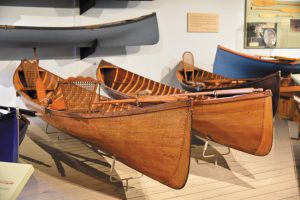
The “Boats and Boating in the Adirondacks” display at ADKX features 50 vessels.
The main exhibit, “Life in the Adirondacks,” is also the largest. Before touring its five galleries, guests start at the Wilderness Stories Introduction Theater for an overview of the land and the people who live in or visit the Adirondacks. The first gallery, “Call of the Wilderness,” recounts stories of the diverse people who came to the area. Luxury trains, vintage automobiles, and early RVs used by vacationers are displayed.
“A Peopled Wilderness,” the second gallery, relates personal accounts of indigenous peoples. Artifacts, videos, and music present both the historical and current culture of native Mohawk and Abenaki tribes. An interactive learning station introduces their languages.
Exhibits in the “Roughing It” gallery range from primitive campsites to the so-called “Great Camps” of wealthy visitors in the 19th century. A virtual guideboat provides a ride along area waterways. Guideboats, used for work and recreation, originated here and are a specialty of the area. The cabin of author and naturalist Anne LaBastille is also on display, filled with her furnishings and selections from her extensive book collection. Ms. LaBastille received acclaim for her Woodswoman series of books. She also was an ecologist, an advocate for the environment, and an Adirondack Park Agency commissioner. Her writings continue to be major sources regarding the Adirondacks. Inspired by her work, many followers come to the area to pay homage.
Early life and work in the Adirondacks were grueling; the fourth and fifth museum galleries give visitors a glimpse of this life. “Adirondack Tough: Working in the Wilderness” tells of the men and women who settled here for mining, logging, ice harvesting, and maple sugaring. To feel a bit of the risks workers encountered along the waters, try to guide and break up a virtual log jam. The fifth gallery, “Our Adirondack Park,” recounts the history of the park itself. Visitors learn the story of humans’ positive and negative effects on the land. A media experience delivers viewpoints of people who have lived in or visited the area, and of those working to protect the land.
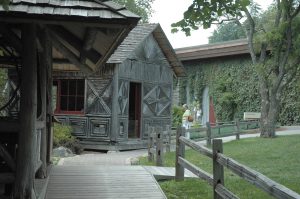
Sunset Cottage at Adirondack Experience.
In 2018 the museum acquired and relocated a small wooden shack, now known as Fulton Fryar’s Closet. It served as “home” to Fulton Fryar, a young tenor who was accepted for opera training at the Seagle Music Colony. The year was 1957, and because he was African American, he was not permitted to live with the white students. Instead, director John Seagle built Mr. Fryar a 12-foot-by-6-foot bedroom next to a laundry building and near a bathroom.
In addition to his beautiful voice, Mr. Fryar possessed artistic skills. He painted artwork on the walls, and he built sets for music production.
The rest of the museum offers a wide range of permanent exhibits. A new exhibit titled “From Wilderness to Warfront: The Adirondacks and World War II” honors WWII participants and their Adirondack connection.
One display of note is the Congressional Gold Medal awarded posthumously to Roland M. Brown Sr., a Tuskegee Airman, for his valorous service during WWII. His father, Dewey Brown Sr., was a PGA golfer whose membership was abruptly terminated in 1934; many believe that occurred when PGA officials learned he was African American. The elder Brown later bought and managed a golf course in the Adirondacks, where he raised his family, including Roland. Dr. Roland M. Brown Jr. donated his father’s medal to ADKX in 2011.
Boats and their construction have played major roles in occupational, transportation, and recreational activities since humans settled in the area. Canoeing was a means of transportation between human settlements and continues as a popular recreational activity. An exhibit titled “Boats and Boating in the Adirondacks” contains about 50 vessels. Skeletons of partially completed boats detail the design and construction of these watercraft.
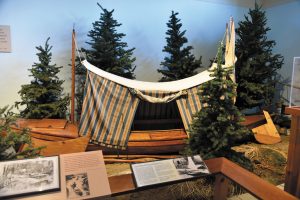
A “cruising canoe” at ADKX.
Follow the Minnow Pond Trail to the boathouse, where certain watercraft are more than 100 years old. Some of these boats can be rented for use on Minnow Pond.
The “Work in the Woods” displays illustrate the hardships involved in logging — an industry vital to the development of the Adirondacks. Workers lost limbs and lives logging and transporting lumber downstream to meet the demand for homes and furnishings. Their stories are told with somberness and wit.
Throughout the park are still more interesting structures. These include Bull Cottage and Artist’s Cottage, filled with rustic furniture dating from the 1880s to the mid-1900s.
Children can dress up and play games from times past in both the Reising Schoolhouse and the Kids’ Cabin. Laundry buckets and scrubbing boards are available for them to hand wash clothes. They also can hop aboard an engine once used on the Marion River Carry Railroad. A climb up the Whiteface Fire Tower, first erected in 1919, affords a sense of the vastness of the area and what it was like to be a fire ranger.
The Lake View Café, which overlooks Blue Mountain Lake, is a perfect spot to enjoy lunch or a snack. Be sure to climb up on a “big” Adirondack chair. Other spots to relax, eat, and enjoy a spectacular view are scattered throughout the museum campus.
The Wild Center
Thirty-three miles north of Blue Mountain Lake, visitors can immerse themselves in nature at The Wild Center, a 115-acre property in Tupper Lake, New York. The center provides close-up encounters with animals, including some that are good at avoiding humans.
Opportunities to view and learn about the plants and animals of the area start in the “Hall of the Adirondacks.” The slowly melting Glacier Wall emits a chill. Open the drawers of The Naturalists Cabinet and examine wonders found in nature. The Flammer Theater presents movies and programs that raise awareness of the beauty and impact of nature.
At “Otter Falls,” a naturalist explains the life of otters as they swim before you, awaiting a chance to nab some fish. The “Big Wolf Great Hall” provides more occasions to be close to and learn about snakes, porcupines, skunks, and other creatures. Many of the animals at the center have been rescued.
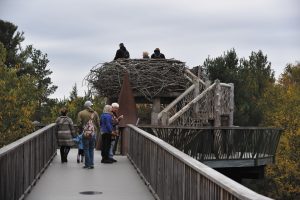
Visitors can become “birds of a feather” in The Wild Center’s oversized bald eagle nest.
In the “Planet Adirondack” exhibit, the NOAA Science on a Sphere presents a very distant panorama of Earth. The globe receives information from satellites about what is occurring on the planet right now. At the touch of a button, weather patterns, animal migrations, air flights, and much more are displayed. Visitors also can travel the solar system with views from the Sphere. Whether touring the area independently or with a guide, children and adults receive a rare, close-up look at our world.
Daily activities at the center include Creature Feature sessions and an outdoor classroom for animal viewing. Behind-the-scenes tours provide even more insight into the operation of the center.
Take a break and enjoy lunch or a snack at the Waterside Café. Another tasty opportunity is local maple syrup, which is offered for sale in the Wild Supply Co., along with myriad gift and activity items. You also can browse through a large collection of local recipes outside the theater.
The “wildest” adventure at The Wild Center is Wild Walk, which also has been called the “High Line of the Forest,” a reference to the High Line elevated rail line in New York City. This 1,200-foot-long suspension trail of bridges rises above the trees and bushes, providing a lofty vantage point from which to peruse the natural setting of the area. This winding walk is accessible to strollers and wheelchairs.
Along Wild Walk, both the visual and the physical capture your attention. Birds soar and perch at Feeder Alley, an enclosed, upward-sloping catwalk filled with bird feeders. Visitors are tempted to soar as they get a bird’s-eye view from the 10-foot-wide, 3-ton replica of a bald eagle’s nest. Careful walking or lying on the giant spider web gives a sense of hanging by a thread 25 feet above the ground.
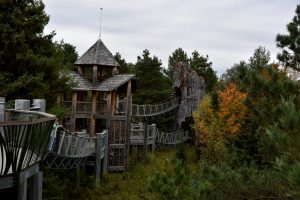
The Wild Center’s elevated Wild Walk leads to the “snag,” a replica of a hollowed-out white pine tree.
Children and adults alike will enjoy the Wild Walk’s “snag,” a replica of a hollow white pine tree that stretches four stories high, with a stairway up its middle. White pines — the tallest trees in New York state — tend to attract lightning, which ultimately results in the giant trees hollowing out, providing food and a home to small animals and insects. Though this snag is fabricated, its “rotting” center and its bark seem full of life.
Back on the ground, trails at The Wild Center can be enjoyed on your own or guided by a naturalist. One self-guided trail near the start of Wild Walk leads to the Oxbow on the Raquette River. Its bends, loops, and watery turns feature a marshy habitat that draws wildlife and birds.
Additional activities at The Wild Center include canoeing and guided stand-up paddle trips on the Oxbow. The short Pond Loop Trail around Greenleaf Pond leads to a butterfly garden. And as you wend along the Forest Music path, 24 speakers surround you with a symphony of music that blends with the sounds of insects, birds, and the wind. In the Pines Wild Play Area, piles of sticks, a toppled tree, and log drums attract young visitors to make their own creations; adults can join in or relax and watch.
The vast expanse of the Adirondacks is rich in nature and history. Time spent within the area is enriching, educational, and entertaining — especially at Adirondack Experience and The Wild Center.
More Info
Note: Before visiting either facility, check their websites for current information, including schedule changes or closures that may be in place in response to COVID-19.
Adirondack Experience, Museum On Blue Mountain Lake
9097 State Route 30
Blue Mountain Lake, NY 12812
(518) 352-7311
www.theadkx.org
The Wild Center
45 Museum Drive
Tupper Lake, NY 12986
(518) 359-7800
www.wildcenter.org
Campgrounds
Blue Jay Campsite
1339 State Route 30
Tupper Lake, NY 12986
(518) 359-3720
www.bluejaycampsite.com
Little Wolf Beach And Campground
105 Little Wolf Road
Tupper Lake, NY 12986
(518) 359-8370 (October-April)
(518) 359-3000 (May-September)
bit.ly/littlewolfbeach