
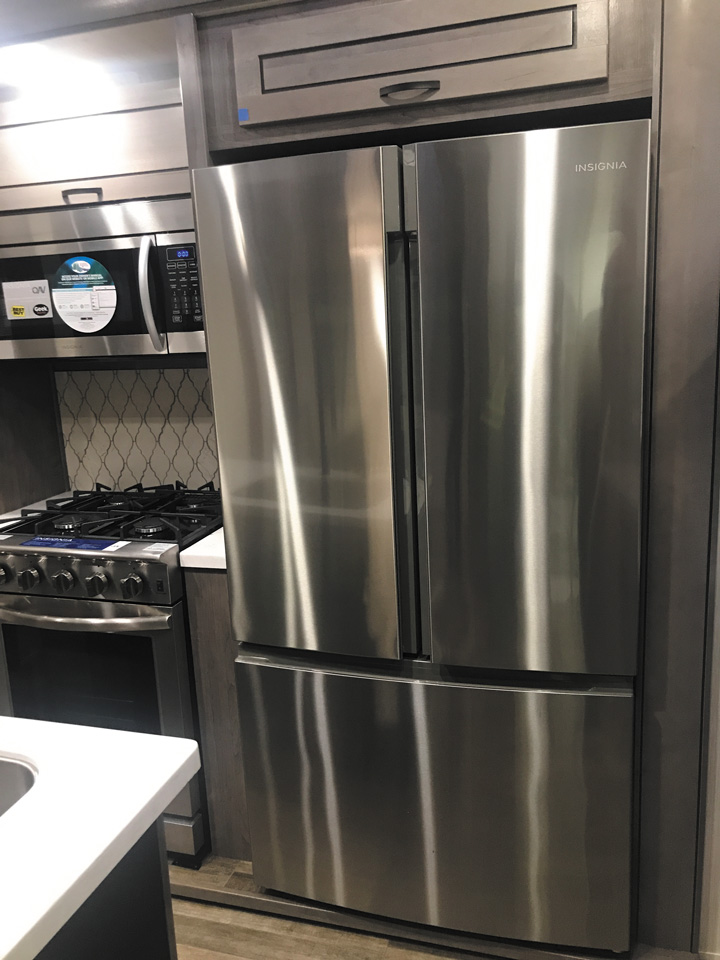
A primer regarding conventional RV refrigerators and an exploration of the pros and cons of residential-type units.
By Steve Froese, F276276
May 2021
Keeping food cold or frozen while traveling is something RVers tend to take for granted. But a lot has to happen behind the scenes in order to keep your milk and eggs from going bad. In this article, I examine a bit of the history and the current state of RV refrigeration.
The technology behind absorption refrigeration hasn’t changed much since its invention, which typically is credited to French scientist Ferdinand Carré in 1858. However, refrigeration as we know it today began to see commercial production in 1923 by a company called AB Arctic, which was purchased by Electrolux in 1925. Fast-forward to the 1960s, when recreation vehicles became more common in North America. The need for refrigeration in RVs led to a high demand for absorption refrigerators, since compressor-type refrigerators (also known as vapor-compression or “residential” refrigeration systems) were not viable, largely because of AC power limitations. To respond to this demand, Electrolux created a subsidiary company tasked with manufacturing refrigerators for RVs. This company was named Dometic Sales Corporation, and it marketed RV refrigerators under the Dometic brand.
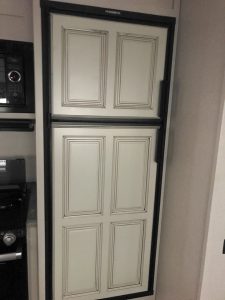
Conventional RV refrigerators are still the standard.
Absorption refrigerators in RVs use propane or an electric element to create the heat energy used to drive the cooling process. Three other substances are involved: ammonia, hydrogen, and water. The ammonia performs the actual evaporative cooling, and the water acts as the absorbent. The hydrogen is a carrier gas used to maintain constant pressure throughout the system, as well as to allow the ammonia to evaporate at a lower pressure than it normally would. At room temperature, the water and ammonia mix together in a liquid state. Turning on the refrigerator adds heat and causes the ammonia and water to separate and rise as vapor, starting the cooling process.
Absorption refrigerators have two primary advantages over vapor-compression refrigerators. One, absorption fridges have no moving parts other than the fluids themselves, and, two, they require only heat to drive the cooling cycle.
The steps involved in absorption refrigeration are as follows:
- Evaporation: Heating of the ammonia into a vapor (evaporation) causes it to absorb heat (energy) from its surroundings, which in this case are the refrigerator and the freezer compartments.
- Absorption: After the ammonia has completed its vaporization cycle through the refrigerator cooling tubes, the water absorbs the vapor, creating the strong liquid ammonia solution to start the process again. This solution starts its travels in the absorption chamber (the large black cylinder on the back of your refrigerator at the bottom of the coils).
- Regeneration: The ammonia/water solution is heated all over again, starting the process anew.
At idle, the absorption chamber contains a strong liquid ammonia solution in water, with hydrogen vapor occupying the space above it. When the refrigerator is turned on and heat is added, hydrogen and liquid ammonia rise into the evaporator inside the refrigerator cabinet. Entering the larger evaporator causes an increase in volume of the mixture. Thanks to Boyle’s Law, this increase in volume results in a decrease in pressure of the liquid ammonia. The ammonia begins to evaporate, taking heat energy from the liquid ammonia. The colder liquid absorbs heat from inside the refrigerator compartment through the evaporator fins. The ammonia and hydrogen gases exit the evaporator and return to the absorber, where the ammonia gas is absorbed into the water (as strong aqueous ammonia solution), and the hydrogen returns to the vapor space above the solution.
To separate the ammonia from the water to start the process, the heat source causes the solution to rise up the burner tube. Since ammonia has a lower boiling point than water, the ammonia turns to vapor, while the water runs back down to the absorber. Any water that remains suspended in the ammonia gas bubbles is removed through a series of bumps and obstacles in the piping, which pop the bubbles and allow the water to drain. The pure ammonia vapor then enters the condenser, which transfers its heat to the outside air through the fins on the top of the cooling unit. The liquid ammonia then runs back down to mix with the hydrogen gas, starting the process again.
This is a simplification, but it is intended to provide you with an overview of how the system works. Because an RV refrigerator has no mechanical moving parts, it is very reliable, more so than a compressor-type refrigerator. It is important to note that absorption refrigerators do have a finite life, mostly due to eventual failure of the cooling unit and/or its contents. Little maintenance is required on an absorption refrigerator, but it is important to keep it clean, including the back of it. This can be accessed by removing the lower vent panel on the outside of the RV. Don’t forget to have your propane system inspected annually, as I have mentioned in many of my articles. This helps extend the life of your refrigerator and other appliances.
Many modern luxury coaches now utilize vapor-compression refrigerators instead of absorption ones. While there may be more pros than cons to a residential refrigerator, many of the cons are critical considerations, mainly related to RV power consumption. If you are considering purchasing a coach with a residential refrigerator, or are considering replacing your absorption refrigerator with a residential one, carefully weigh these pros and cons before deciding which way to go.
To help with that decision, check out the table outlining the primary pros and cons of residential refrigerators versus absorption.
RESIDENTIAL VERSUS ABSORPTION REFRIGERATORS
| Residential Pros | Residential Cons |
| Runs on AC power only – no propane or 12 volts DC. | |
| More food storage capacity | Off-grid requires a dedicated pure sine wave inverter and a large battery bank. Problematic while dry camping. |
| More consistent at staying at temperature given different ambient conditions. | Loss of efficiency due to <100% inverter efficiency. |
| No outside vent.
(But smaller access panel) |
Much higher electricity draw. |
| Less humidity inside fridge. | Generally noisier. |
| More efficient at higher elevation, hot, or humid climates. | Inverter must be left on to avoid defrosting fridge. |
| May require less frequent defrosting. | Can’t be used in propane mode to drastically reduce power draw. |
| Leveling not as critical. | |
| Food loading not as critical | |
| Less expensive to replace | |