
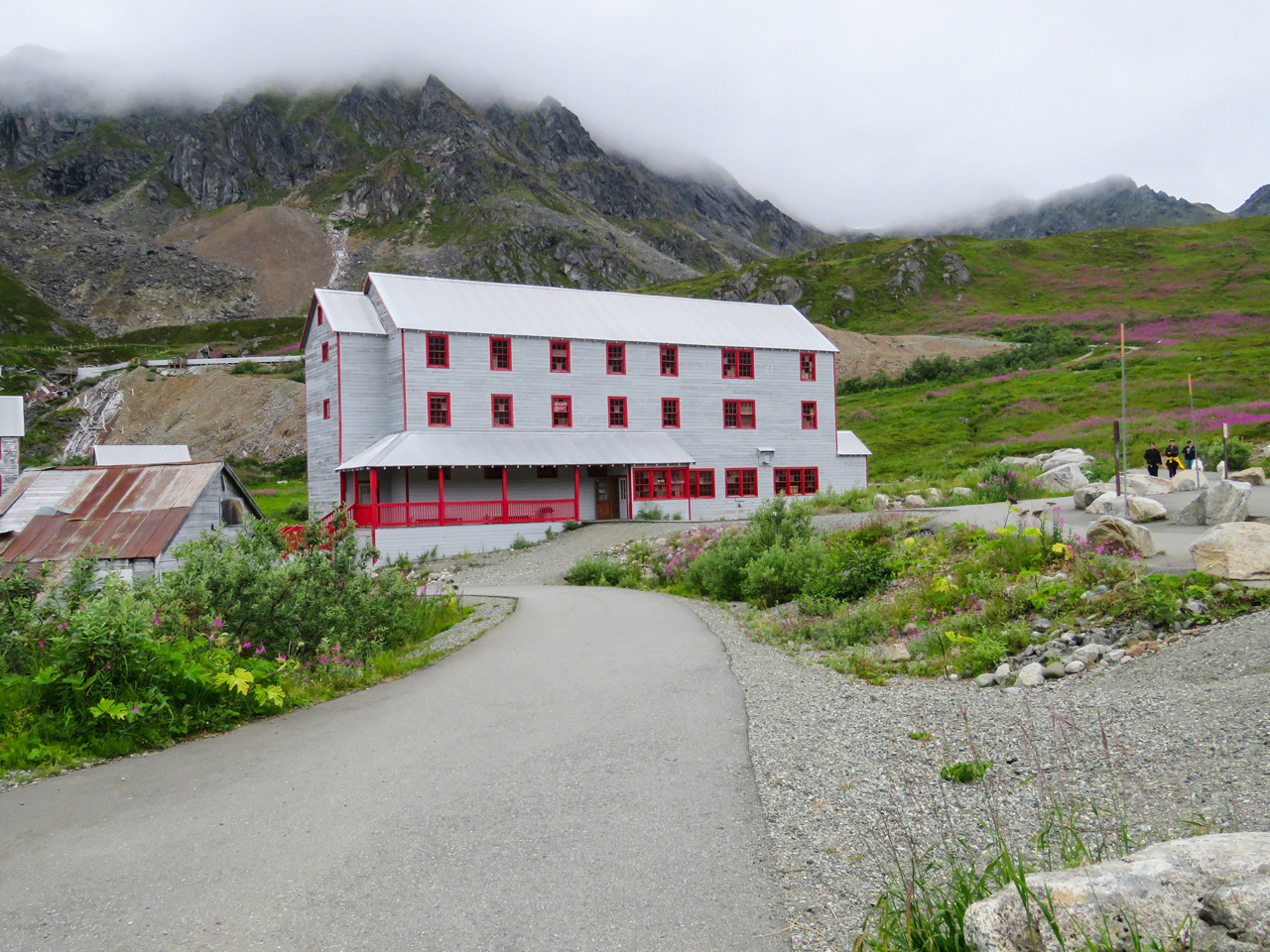
Independence Mine State Historical Park, set in the scenic Talkeetna Mountains, preserves the history, culture, and natural beauty of what was once one of the most productive lode gold mines in the state.
By Mary Taylor
May 2021
The deep-green summer grasses that cover the ground of the Willow Creek Valley rise upward, blending seamlessly into the granite-gray peaks of the surrounding Talkeetna mountain range. Streams flow down from the mountains, which keep a firm grip on their snowpack until late in the season. As visitors drive up Hatcher Pass Road for the first time, they note the alpine scenery, seemingly unending — until it is oddly interrupted by a collection of silver-colored buildings. Here, in south-central Alaska — 68 miles northeast of Anchorage and 20 miles from the nearest small town, Palmer — lie the remains of a once-bustling mining camp that played a role in the quest that helped to forge the state’s history: the search for gold.
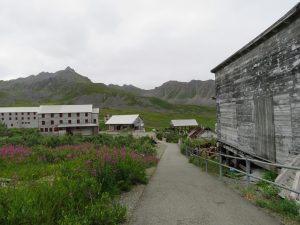
Independence Mine State Historical Park preserves structures once part of a productive gold mining camp.
While Nome and Fairbanks are better known for being the center of the gold rush that drew thousands of prospectors up to the cold, harsh wilderness, the Willow Creek Valley can easily stake its claim as one of the state’s golden hot spots, producing more than 34,000 ounces of gold in a single year at its peak. Today, the old camp is known as Independence Mine State Historical Park, which falls under the direction of the Alaska Division of Parks and Outdoor Recreation and provides visitors the opportunity to learn what it was like to live and work in a successful gold mine camp.
The park, which is listed on the National Register of Historic Places, was originally two separate hard-rock mining operations, but in 1938 they were brought together under Alaska-Pacific Consolidated Mining Company and the camp was created. Whereas most historical gold mines were founded in the late 1800s or early 1900s, Independence Mine provides an opportunity to visit a more contemporary operation. Some of its silver-colored buildings are restored, and others stand in their natural state. Along the edges of the old camp, the bleached debris of collapsed structures are scattered upward over the slopes toward the area where the processing plant, mine, and water tunnel of this abandoned gold mine once existed.
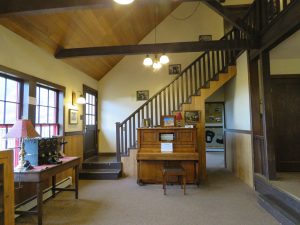
Built in 1939, the restored Manager’s House serves as the visitors center.
Visitors may take self-guided tours or pay to join a tour led by local guides. Information boards in various places provide details and present a personal look at the history by focusing on many of the individuals who made this a successful operation.
The mine manager’s house now serves as the visitors center. It features a simulated mining tunnel, displays regarding gold-mining methods, and other exhibits. From the center, Hardrock Trail leads visitors past other restored buildings: a timber shed, a warehouse, a collapsed mill, mess halls, and bunkhouses. The assay office now is a museum with displays related to mining techniques. Climbing the trail to the water tunnel portal provides a great view of the entire complex.
The original mining complex sits at about 3,000 feet elevation and in the early days was only a seasonal tent town. The gold ore, found in quartz veins, was extracted from mine shafts higher up the mountain and moved to the processing equipment via aerial tram and later by a water tunnel. Ultimately, about 10 miles of tunnels were created, on several levels.
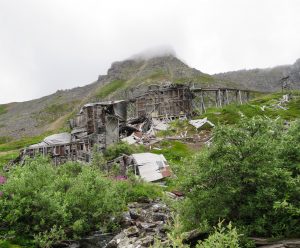
The Mill Complex now lies in ruins, scattered along the hillside.
To support this effort, the company built the camp — two three-story bunkhouses; the manager’s house; an assay office; a commissary; an engineering office; a warehouse; a mess hall; and a series of construction/repair shops, among them plumbing, electrical, and sheet-metal facilities in the area just downhill from the mill. The Mill Complex contained the power mill, the sorting plant, and the powerhouse.
Since some of the workers were married, management created Boomtown, a nearby area where families could build individual small homes on company property so long as they followed floor plan, material, and construction guidelines. At its peak, Boomtown had about 20 homes. And to accommodate the families, a territorial school was squeezed into one of the existing company buildings.
Rather uncommon for that time and location, management made sure the employees had fair working conditions and were treated well. “Talkie” movies were shown twice a week for only 25 cents. Getting groceries from Palmer involved an all-day trip, so families were permitted to purchase bread and meat from the cookhouse and canned goods at the camp commissary.
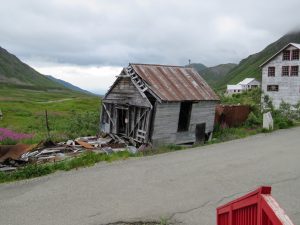
Remnants of the timber framing shop are visible.
The mine operated from 1937 to 1943, when it was closed as a result of World War II. It reopened in 1949 but closed again in 1951 because of poor economic conditions. It was one of the largest producers in that area and quite profitable during the original period when the price of gold was fixed at $35 an ounce and costs tallied $19 an ounce. In total, approximately 180,000 ounces of gold were extracted from deep underground at the mine.
The former mining camp became an Alaska state park in 1980. The Alaska Division of Parks and Outdoor Recreation has an ongoing plan to conserve and interpret Independence Mine State Historical Park’s cultural, historic, and natural resources for future generations.
If you want to enjoy a few fun and interesting days, do more than just spend time at Independence Mine. Take advantage of the opportunity to explore this area. Try hiking some or all of the 8-mile (16-mile round trip) Gold Mint Trail, which begins at the trailhead located at mile 13.7 on Hatcher Pass Road and climbs approximately 2,900 feet as it follows Little Susitna River back up to its headwaters at Mint Glacier. Or go blueberry picking at the Fishhook trailhead parking lot (located at mile 16.5 on Hatcher Pass Road) in late summer. You’ll be glad you did.
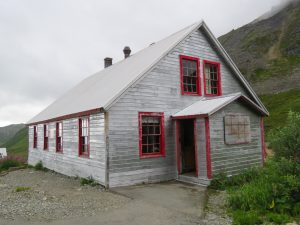
The Apartment House, built in July 1937, was one of the first buildings added at what had been a tent camp.
Camping
If you don’t mind staying in parking lots, try the Gold Mint Trail or Fishhook parking lots near the end of Willow-Fishhook Road. A list of state park campgrounds and private RV parks in the area can be found at www.alaskavisit.com/lodging/campgrounds-rv-parks.
If You Go
For more information about Independence Mine Historical State Park, visit http://dnr.alaska.gov/parks/units/indmine.htm. The visitors center address is 23264 Gold Cord Road, Palmer, AK 99645 (approximate address for Google Maps); phone (907) 745-3975. The park typically is open from mid-June to Labor Day.
Note that some roads leading to Independence Mine State Historical Park are not suitable for RVs. So, RV owners should consider traveling via their towed or towing vehicle. If traveling via RV, be sure to plan the route carefully and check with local authorities regarding road conditions before heading out.