
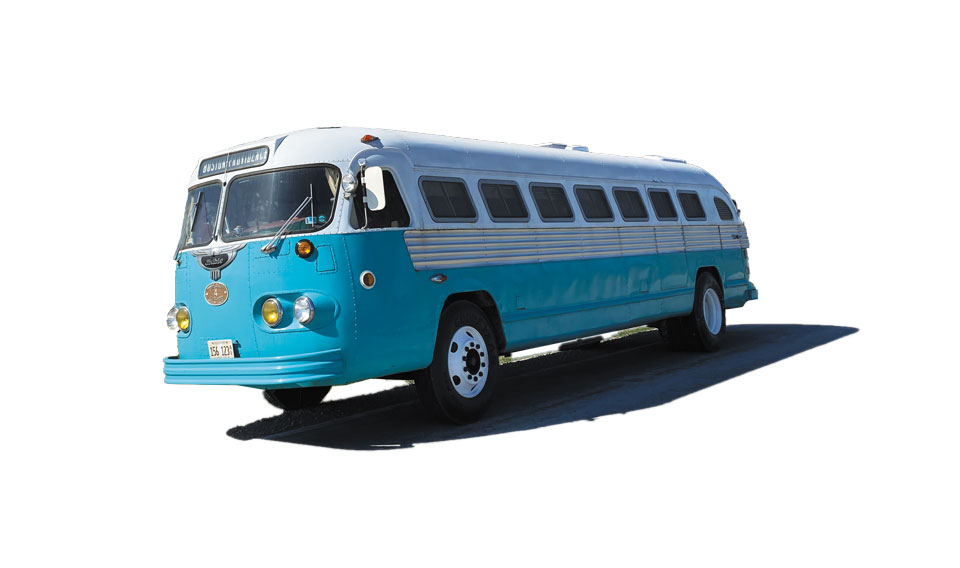
In 1952, Ray Fritz, who later served as FMCA’s second president, converted a retired public transportation bus — Flxible Clipper 8227 — into a motorhome. Today, 69 years later, the bus has a new owner and a bright road ahead.
By Skip Tate, Associate Editor
July 2021
Bus number 8227 rolled off the assembly line of the Flxible Company factory in Loudonville, Ohio, in late September 1947. It was prepped and delivered on September 30 to Deerfleet Lines in Walpole, Massachusetts, a small town that sits between Boston and Providence, Rhode Island.
By all accounts, there really wasn’t anything special about bus 8227. It was one of thousands of buses made by Flxible that were shipped all over the world. Bus 8230 — three back from bus 8227 on the assembly line —was put on a ship and delivered to the Zaidan Kroury Trading Company in Cairo, Egypt. Bus 8269 went to Flint, Michigan, where it became the team bus for the Flint Arrows, a minor league baseball affiliate of the Detroit Tigers. Bus 8301 was shipped to Warner Brothers Pictures in Burbank, California.
Bus 8227 wasn’t bound for glory. Deerfleet Lines was a public transportation company, and its intentions were to use the bus as a shuttle for businesspeople and local residents making the hourlong trip between Boston and Providence. The bus was even delivered with a “Boston-Providence” marquee sign above the front window.
Officially, bus 8227 was a Flxible Clipper, Airporter model. Flxible made several models of the Clipper —a suburban bus, an innercity bus, a sightseer version. The Airporter was designed to provide deluxe service between hotels and airports, with seating reduced from 29 to 23 so the seats could be extra wide for comfort.
For five years, bus 8227 provided deluxe service between Boston and Providence, keeping passengers comfortable while rambling past Foxborough, Walpole, and Pawtucket. And then, for reasons that aren’t entirely clear, Deerfleet decided to pull bus 8227 off the route in the fall of 1952 and put a new sign in the marquee scroll over the front window: “For Sale.”
***
J. Raymond Fritz was a toolmaker during World War II, building precision tools and instruments at the Naval Torpedo Station in Newport, Rhode Island, just eight miles or so from his hometown of Portsmouth. Ray, as he was known, loved working with his hands. He could build just about anything, including the house in which he and his wife, Anna, raised their two daughters. After the war, he put his craftsmanship skills to work by teaching woodworking at a high school in Newport. The free afternoons and weekends gave him plenty of time to tinker in the carpentry and machine shops he built at his home, and the open summers allowed him the chance to travel.
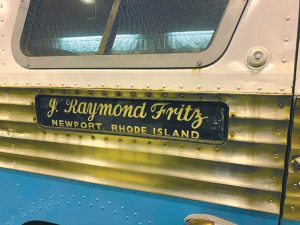
The conversion included creating a sign identifying Ray Fritz as the owner.
Ray loved to travel, and he had spent the previous 30 years doing so by boat or travel trailer. However, when he saw the notice about bus 8227, he called Deerfleet. He had an idea. The two worked out a price, and on Thanksgiving day 1952, Ray set about converting bus 8227 from a 23-seat shuttle into a motorhome.
He gutted the old Clipper and then spent more than 1,600 hours after school and on weekends converting it into what he called a land cruiser. He added a couch, kitchen area, bathroom, and bedroom. Its maiden voyage took place eight months later, in July 1953.
The conversion included enhancing the dashboard, which he loaded up with 20 gauges; 25 indicator lights; and 36 switches, push buttons, and control levers. People would tell him it looked like the cockpit of an airplane, but he didn’t mind the comparison. He loved the details, considering it an information center for the heart of the bus. “I refer to every one of them constantly when under way,” he wrote in a June 1964 article in Family Motor Coaching (now Family RVing). “They give me a feeling of security by warning me of impending trouble before any damage results from oversight or failure of mechanical parts.”
In July 1963, Ray drove bus 8227 to Hinckley, Maine, for the charter meeting of what would become the Family Motor Coach Association — a name he suggested. He was one of 26 families from eight states and Canada that traveled in their coaches to attend a weekend gathering on the grounds of the Hinckley School. At the meeting, he was elected the association’s inaugural vice president. He also helped to write the constitution. He was assigned membership number F4, and he securely mounted his membership plaque where everyone could see it: on the front of bus 8227, just under the Flxible logo.
Ray went on to serve as second president of the fledgling FMCA in 1965-1966. He played a key role in granting more power to individual chapters so they could elect their own national director. He wrote articles for Family Motor Coaching about what it takes to convert a bus, and his own experience with bus 8227, including the time in 1962 when he was visiting Fundy Park in Canada and the old Buick engine threw a rod and left engine parts scattered behind him on the road.
He also helped design the oval FMCA logo, although there’s a debate as to whether the Flxible Clipper used in the logo is, in fact, bus 8227.
While he eventually touched every inch of bus 8227 in some way, Ray left one item unchanged: a metal coin changer attached to the wall next to the driver’s seat. It was no longer needed, but a nice nod to bus 8227’s utilitarian past.
***
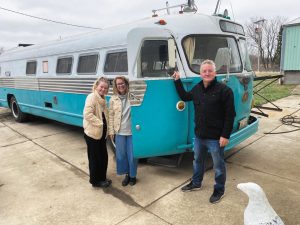
Bus 8227’s current owner Steve Cramer (with wife, Shelli, and daughter Kady).
Steve Cramer is a professional lobster fisherman in the Florida Keys, a hard job in an easygoing area. He spends his days on the water but spends his daydreams cruising and camping in vintage vehicles. When the weather turns warmer and tourists flock to the Keys, he and his family head north, away from the water and into the woods.
“I get lost in the woods,” he said.
For six weeks each summer, when Florida’s commercial lobster fishing season is put on hold and his wife, Shelli, has time off from her teaching job, they load up one of their two classic trailers and spend their days on the road. Most often, they pack up their 1958 Airstream, which Steve spent 13 years rebuilding so it looks like it just rolled off the assembly line. They’ve towed it to Las Vegas, the Grand Canyon, the Carolinas.
They also own a 1967 Eriba Puck, a tiny, two-person caravan designed to look like and be towed behind a Volkswagen Microbus. VW initially sold the Pucks as an accessory. Steve loves pretty much any vehicle made by Volkswagen.
“They have a look of happiness.”
His next goal is to purchase a Volkswagen Thing, a two-wheel- drive, four-door convertible that has an uncanny resemblance to a WWII German staff car. It has a tiny 46-horsepower engine, a separate heater, and a fold-down windshield. They weren’t big sellers back in the day, but — like its distant cousin, the Beetle — developed a cult following, Steve Cramer among them.
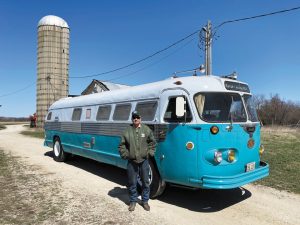
George Kaforski owned bus 8227 for 17 years.
His desire is to tow the Thing behind a vintage motorhome. He had been on the lookout for such a coach for years, even flying to California to look at two, a Flxible and a GMC 3751. They were okay, but something told him to hold off. Then, as he was looking at the website of the Tin Can Tourists, a vintage trailer and camper club, he saw an ad.
“1947 Flxible Bus Motorhome,” the ad read. “Excellent condition (five stars). Looks brand new. No signs of wear. New tires. Maintained very well. Flaw-free body. Clean title.”
It was bus 8227.
The owner was George Kaforski of Serena, Illinois, a farm town about 75 miles southwest of Chicago. George collects and restores vintage vehicles, including a rare 1907 Model H White Steamer. He keeps his collection in a large, temperature-controlled garage on his farm, which is where bus 8227 had been resting for the past 17 years. George put only about 2,000 miles on it during that time but used it almost every day. When he would take a midafternoon break from working on his cars, he would climb into bus 8227, make his lunch in the kitchen, and sit at the table and eat.
The appreciation for the quality of the conversion, though, was not lost on George. As a collector and restorer of old vehicles, he knows all too well the difficulty of the details of what Ray Fritz accomplished.
“He modified almost every mechanical system on the bus, and his woodworking skills were excellent,” George said. “And considering that this was done in the early 1950s, it seems amazing. He had air conditioning, hot and cold running water, complete bathroom facilities, dash lights that told him the status of every system on the bus. He also installed a Kohler power system for 110 volts, which he could start from the back of the unit or from the driver seat 30 feet away. He was, to say the least, a true gadget guy.”
George first saw bus 8227 in a local Fourth of July parade, and he spent a month tracking down the owner and convincing him to sell.
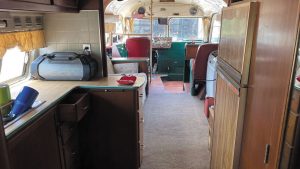
Steve says he wants to keep the interior as Ray Fritz created it.
The previous owner was Linzie Coffey of Yorkville, Illinois. Coffey was the proprietor of two local pizza businesses and a rather eccentric fellow. He once tried to purchase an old jail and turn it into a pizza parlor; later, he put up for sale a painting he owned by mass murderer Richard Speck after his wife refused to let him hang it in the house. Coffey owned bus 8227 for two years after acquiring it from another Yorkville resident, Jim Treest, in a trade for a Mercedes-Benz automobile.
Jim, a car buff, bought the coach from Robert O. Davis of Ligonier, Pennsylvania. Davis purchased it from Homer W. Painter of nearby Mount Pleasant, Pennsylvania, who acquired it from a man known only as Mr. Sherman of Jamestown, Rhode Island. Sherman purchased it from the Fritz estate in 1987 after Ray’s death on November 6, 1986, at the age of 84.
While bus 8227 passed through a lot of hands in the past 35 years, Steve Cramer said that has come to an end.
“I’m not letting go of it until I die.”
Like many homes in the Keys, Steve’s house is built on stilts, because of flooding issues during hurricane season. What he now calls Fritz’s Flex resides in an enclosed space under the house to keep it out of the harsh heat and salty air of the Keys — and to give him a place to tinker with it.
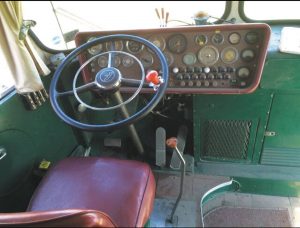
Steve also plans to keep the dash Ray designed.
“This has an incredible interior,” he said. “I might leave it as a little time capsule at first just to let people see the way it is, although I have to add a newer fold-out couch, and it’s missing the dinette. The only big thing is, I may have to upgrade the motor so it goes 65 to 70 mph. Now it maxes out at 55 mph.
“But eventually this will be brought back to when it was first converted. And it will be used. What I restore, I use. It will return to the road.”
Who knows? Maybe bus 8227 really was bound for glory.