
Supplemental braking systems are vital for safely towing a vehicle behind a motorhome, but with so many options and types, research is required to find the best one for you.
By Mark Quasius, F333630
November 2021
It’s rare these days to see a motorhome on the road that isn’t towing a car, truck, or SUV behind it. Having an additional vehicle available to take tours of an area or to run errands is a great asset, and just about every motorhome comes with a trailer hitch and prewired lighting connectors that make it possible. The towed vehicle still needs to be set up with a base plate to connect to the tow bar, as well as a lighting system that plugs into the motorhome’s connector, but those are basic components that can be added by any service facility. However, when towing a vehicle, one additional component that is separate from the towing package is important to have installed: a supplemental braking system.
Motorhomes have a gross vehicle weight rating (GVWR), which indicates the maximum allowable weight of a loaded motorhome. They also have a gross combination weight rating (GCWR), which is the key measurement related to towing a vehicle. The GCWR includes the maximum weight of the motorhome as well as any trailer or towed vehicle. This weight accounts for the ability of the engine and transmission to safely pull that load, but it also assumes that whatever is being towed has brakes as well. A supplemental braking system works in conjunction with the motorhome’s brakes and provides additional stopping power to accommodate the weight of the towed vehicle.
Questions often arise about both the necessity and the legality of towing without a supplemental braking system. After all, the towed vehicle is often so light compared to the motorhome that it’s some-times hard to tell it’s back there.
Laws related to a supplemental braking system requirement vary from state to state. Many laws also are written specifically for trailers, and it may be difficult to determine whether they apply to a towed vehicle. Some states and provinces define a towed vehicle as a trailer, while others do not. But regardless of what the printed law states, the law of physics shows that it’s just plain smart to have a supplemental braking system on a towed vehicle.
A supplemental braking system makes a huge difference. In a study conducted by Roadmaster, a 34-foot motorhome traveling at 50 mph took 132 feet to come to a complete stop. When a medium-sized car was connected to the motorhome, the stopping distance increased to 209 feet. After a supplemental braking system was added to the towed vehicle, this distance decreased to 137 feet. Those extra 72 feet can make the difference between safely stopping or being involved in an accident.
Another reason for a supplemental braking system is protection during a breakaway situation. Some supplemental braking systems include a breakaway connection, which consists of a switch mounted on the towed vehicle that is connected to the motorhome via a small steel cable. Should the tow bar fail, or the towed vehicle somehow become disconnected from the motorhome while driving, the cable activates the breakaway switch, and the supplemental braking system automatically applies the towed vehicle’s brakes, safely bringing it to a stop and preventing a runaway.
I had one tow bar failure when our Jeep became disconnected from our motorhome while traveling on a two-lane highway. We heard a bang and felt a sudden jerk at the back of the coach. When I looked at the rear camera monitor, I noticed the Jeep was pretty far back and was being dragged by the safety cables. Because the breakaway switch had applied the Jeep’s brakes, I was able to slow down and pull off the road to correct the problem. If I did not have a supplemental braking system with a breakaway switch, the Jeep would have impacted the rear of the coach once I tried to slow down, causing damage to both vehicles.
Breakaway connections come standard on some supplemental braking systems and are optional on others; regardless, this is an important safety feature to consider including.
Types Of Systems
Since just about every motorhome and towed vehicle combination has its own requirements, there is no one-size-fits-all supplemental braking system. Some systems work better with diesel pushers equipped with air brakes; others are better suited for gasoline-powered coaches that do not have air brakes. Certain systems are designed to be portable so they can be used on multiple vehicles; some are permanently installed onto a specific vehicle. Each system has its pros and cons, so it’s important to choose the type that best meets your needs.
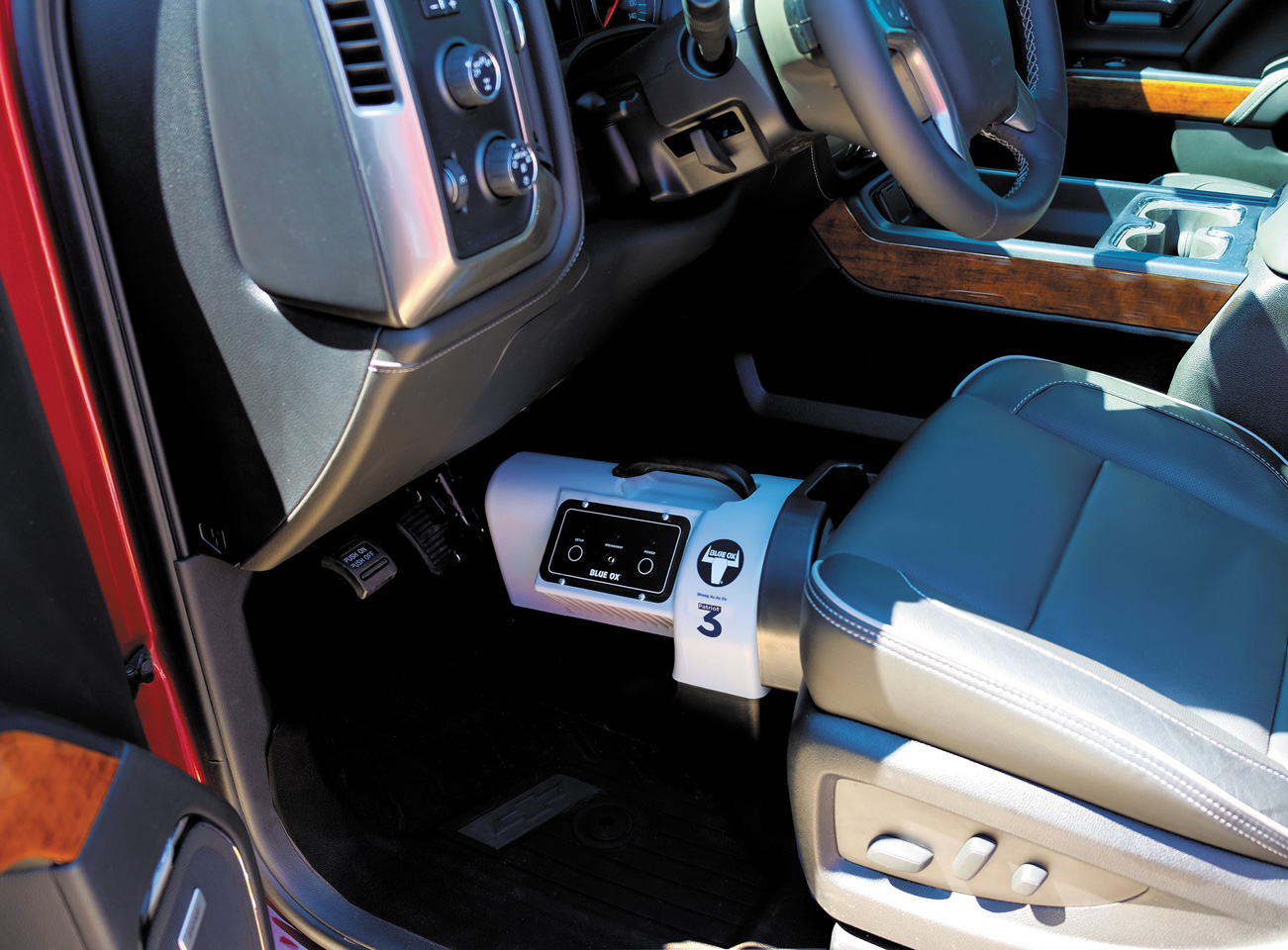
Portable systems. Portable systems typically are placed on the floor of the towed vehicle in front of the driver’s seat. The unit has a large push rod and clamp that attaches to the brake pedal. Generally, such systems are equipped with an accelerometer that senses when the unit is slowing down as the motorhome’s brakes are applied and then applies pressure to the towed vehicle’s brakes. The unit may be secured to the floor with a mounting bracket, or it may just rest on the floor and rely on the seat cushion to hold it in place. Electrical power generally is supplied by a 12-volt cord that plugs into a power receptacle.
The benefit of a portable system is offset by having to set up and remove the unit before and after each use, storing the unit when not in use, and the tendency of some units to apply the towed vehicle’s brakes on downgrades because of the inertia sensors.
Permanent systems. Another type of braking system is one that permanently attaches to the tow bar. This is basically a surge brake system that senses the forward pressure of the towed vehicle under braking. As the module moves, it pulls on a steel cable that runs through the towed vehicle’s engine compartment to the area around the brake pedal. This cable attaches to the brake pedal and applies pressure to the pedal in response to the pressure applied to the tow-bar-mounted actuator.
A wide selection of other systems are designed to be permanently mounted on the towed vehicle. Most require a more extensive installation process, but once they are installed, there is little, if anything, that the operator needs to do when getting ready to tow. These systems can be of two basic designs — either electrically powered or powered by air pressure from a motorhome’s air brake system.
Electrically powered systems. Gasoline-powered motorhomes don’t have air brakes, so electrically operated systems generally are selected for this application. These systems function by using an electric solenoid motor to operate a steel cable or push rod that is connected to the brake pedal. The solenoid can be controlled by either inertia sensors or variable voltage sent from a controller mounted inside the motorhome. Some systems use a hybrid method, with inertia sensing in combination with a signal from the coach. This signal is passed to the towed vehicle via one of the conductors in the six-wire trailer lighting umbilical cord. These systems also can be used on motorhomes equipped with air brakes, if desired.
Air-powered systems. Diesel-powered coaches equipped with air brakes have a number of available options. In addition to the aforementioned systems, they can use systems designed to work in conjunction with the motorhome’s air brakes. In air-powered systems, an air hose connects to the coach’s air brake system and provides air to a module installed in the towed vehicle. The module proportionately applies the towed vehicle’s brakes in harmony with the coach’s brakes. This eliminates false signals produced by inertia sensors, which can lead to brakes being applied on a downgrade when the coach is just coasting or is using the engine brake. It’s also a simple connection, using a quick-disconnect air hose to join the towed vehicle to the motorhome when the tow bar is hooked up. These systems do require a bit more time to install, but they are basically hands-free once the installation is complete.
So, what is the best system for your coach and towed vehicle? It depends on several factors. Is portability an issue? Do you need to utilize the system on multiple towed vehicles? If so, a portable system may be your best choice. If you plan on towing only one specific vehicle, then a permanent installation eliminates the repeated setup process required with a portable system. If you are mechanically handy, you can install many of these systems yourself. If you don’t have the ability to do this, or need to tap into the coach’s air brake system, an RV dealer can perform the installation.
Electrically operated systems can be used on both gasoline and diesel-powered coaches, while pneumatic systems that tap into the air brake system offer true proportional braking that matches the motorhome braking and prevents false readings from inertia sensors.
Regardless of which system you prefer, it’s important to have a good supplemental braking system with a breakaway switch to be safe when towing. The following are brief summaries of some of the most popular braking systems available. Manufacturer’s suggested retail prices are listed, but prices can vary depending on current sales and promotions.
Blue Ox Patriot 3
Blue Ox
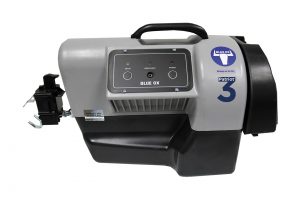
Blue Ox’s Patriot 3 is a portable system that rests on the floor of the towed vehicle, in front of the driver’s seat, and includes a push rod that clamps onto the brake pedal. The system’s internal inertia sensor detects deceleration and applies the brakes accordingly. The only installation required is for the breakaway switch and wiring. When it’s time to tow, you place the unit in front of the seat, plug in the 12-volt
Remote control for the Blue Ox Patriot 3
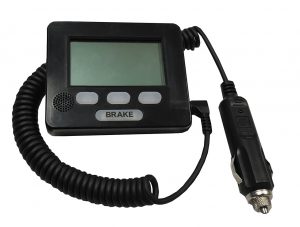
power cord, calibrate it, and connect to the preinstalled breakaway switch. This latest model from Blue Ox features a 3-amp draw when operating and a super-capacitor lifetime battery. A wireless remote control is placed in the coach’s cockpit and automatically checks brake pressure during setup and continuously monitors it during towing. It also can be used to manually apply the towed vehicle’s brakes if desired. The Patriot 3 sells for $1,595.
Blue Ox, C2903*
(800) 228-9289
www.blueox.com
Brake Buddy
Introduced in 1996, Brake Buddy is the originator of the portable braking system. The company offers two portable models — the Classic 3 and the Select 3 — as well as a permanent model, the Stealth.
Brake Buddy Select 3
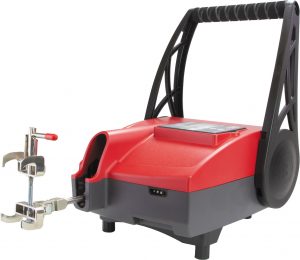
Both the Classic 3 and Select 3 provide proportional braking. They rest on the floor in front of the driver’s seat and connect to the brake pedal with a clamp arm. An internal accelerometer senses deceleration and applies the brakes accordingly. A breakaway switch mounts to the front bumper of the towed vehicle, and wires run to the driver’s compartment. Both systems include AutoStart, which automatically performs diagnostic system checks and cycles the brake pedal, preventing flat spotting of the tires. They also have a 15-amp battery charger that charges the towed car’s battery and adjustable legs so the unit matches the height of the brake pedal.
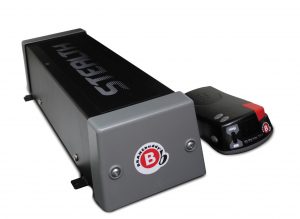
Brake Buddy Stealth
The Select 3 also includes a wireless remote control that can be placed in the coach’s cockpit to monitor the unit, adjust sensitivity, and switch between full and proportional braking. In addition to featuring both full and proportional braking modes, the unit includes a simplified one-touch setup mode that can be operated from the remote display in the coach. The Select 3 sells for $1,499. The Classic 3 sells for $1,149.
The Stealth can be mounted under the seat, in the trunk, or any other place that is out of the way. It consists of an electric motor that connects to the towed vehicle’s brake pedal via a single cable, along with a controller that mounts in the cockpit of the coach. This is a dual-control unit that also can be used to operate conventional electric trailer brakes, so if you switch between a stacker trailer and towed vehicle, this dual-mode controller simplifies things. A low-profile adapter on the front of the towed vehicle facilitates connection to the motorhome. The Stealth sells for $1,200.
Brake Buddy
(800) 470-2287
www.brakebuddy.com
Demco
Demco offers three systems — Air Force One, Stay-In-Play Duo, and Delta Force — that were formerly found under the SMI brand. All three systems can be monitored with Demco’s wireless CoachLink, which plugs into the motorhome’s power port and provides visual feedback and an audible tone indicating that the braking system is working. The CoachLink is included with the Delta Force system, but is an option with the other two systems and costs $293.
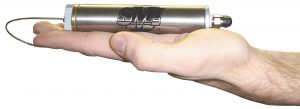
Demco Air Force One
The Air Force One is a permanently mounted system designed for motorhomes with air brakes and uses the air from the coach to deploy the brakes on the towed vehicle. The system includes the air supply tank, coach protection valve, and other components necessary to create an isolated air supply for the towed vehicle that safely protects the motorhome’s air brake system in the event of a breakaway or failure in the supplemental braking system. A control module is located in the engine compartment of the towed vehicle and houses a vacuum generator for the vehicle’s power brake booster. Connections between this controller and the coach are accomplished by a quick-disconnect air hose. The controller is also connected via a small-diameter air line to the actuator cylinder that is mounted to the brake pedal arm and proportionately responds in relation to the coach’s braking level. A breakaway system is included. The Air Force One sells for $1,463.
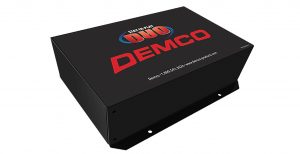
Demco Stay-In-Play Duo
The Stay-In-Play Duo is designed for motorhomes with hydraulic brakes. It utilizes a module permanently installed in the vehicle’s engine compartment that also contains an air compressor, which connects to an air actuator and a vacuum pump; the pump tees into the vacuum booster line to provide a fully charged brake vacuum booster when towing. An adjustable accelerometer is placed in the towed vehicle’s driver compartment to sense the level of braking required. The Stay-In-Play Duo also monitors the motorhome brake lights and applies immediate full braking power during a panic stop rather than trying to compute the rate of deceleration based on inertia, which can eat up valuable time and braking distance. A compact actuator is attached to the brake pedal arm to operate the pedal. Interfaces with a breakaway switch and the coach lighting socket are connected under the hood, and no wiring inside the coach is needed. This system requires a bit of installation, but once in place, it is ready to tow, with no setup. The Stay-In-Play Duo sells for $1,286.
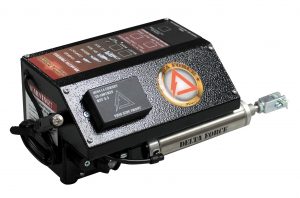
Demco Delta Force
The Delta Force is a portable proportional braking system with a unique design. An air compressor connects to the main unit with a flexible ball-and-socket connector. The other end of the actuator attaches to the brake pedal with a clamp. The entire unit connects to the firewall with a cable tether, so it does not rely on the driver’s seat for support. Like the Stay-In-Play Duo, the Delta Force uses a dual-signal system that is activated by inertia and brake lights. A breakaway switch is included. The Delta Force sells for $1,403.
Demco, C2262*
(800) 543-3626
www.demco-products.com/rv-towing
M&G Engineering
M&G Engineering offers two permanent-installation systems designed for diesel pushers with air brakes — the Original Brake System and the M&G 2.0 System — as well as an optional Power Pack for motorhomes with hydraulic brakes or air-over-hydraulic brakes.
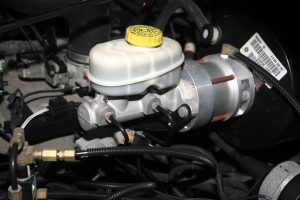
M&G Tow Brake
The Original system utilizes an air cylinder that is placed between the towed vehicle’s brake master cylinder and a vacuum booster. An air pressure line then connects the air cylinder to the motorhome’s air brakes, providing true proportional braking by directly activating the brake master cylinder. It only deploys when the brakes are in use and not when coasting or when the engine brake is being utilized. The air pressure line has a quick-disconnect feature, and once the line is disconnected, the system does not affect the towed vehicle’s normal braking systems. An optional breakaway kit provides a small air reservoir, solenoid valve, and breakaway switch and sells for $199. The Original Brake System sells for $685.
The Original system doesn’t fit in every vehicle. The under-the-hood real estate is so tight in some vehicles that there isn’t enough room to mount the air cylinder and vacuum booster. M&G countered by offering the 2.0 Brake System, which bypasses the connection to the brake master cylinder and uses a remote actuator that is mounted somewhere in the engine compartment. The actuator, which is connected to the motorhome via an air hose with quick disconnect, is then linked to the brake pedal via a cable assembly. Like the Original system, when disconnected, the 2.0 Brake System does not impact the normal braking system. The M&G 2.0 system sells for $700.
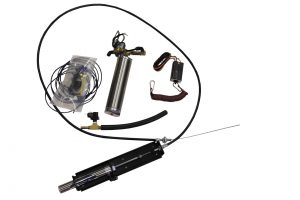
M&G 2.0 Tow Brake
M&G’s optional Power Pack is available for motorhomes with hydraulic brakes. The Power Pack consists of a 12-volt air compressor, an accumulator tank, and a proportioning valve, all mounted on the motorhome. A T-fitting is installed in the coach’s brake system, and a brake line connects it to the proportioning valve. The valve activates the air compressor, which runs to an Original or 2.0 system installed in the towed car. The Power Pack with the Original system sells for $1,099. The Power Pack with the 2.0 system sells for $1,150.
M&G Engineering , C3896*
(903) 675-2812
www.m-gengineering.com
NSA RV Products
NSA offers three products: the Ready Brake system, which is a hydraulic surge brake that mounts in the hitch receiver and connects to a separate tow bar; and the Ready Brute Elite II and the Hercules Tow Bar, both of which are tow bars that incorporate the Ready Brake’s built-in hydraulic surge brake. With all three systems, when the motorhome’s brakes are applied, the forward motion of the tow bar compresses a spring and a shock absorber. That, in turn, activates an arm connected to a cable tied to the towed vehicle’s brake pedal. The Ready Brake requires no electrical connection other than a remote indicator lamp that can be located on the motorhome’s dash to signal when the system is being used. It’s a true mechanical surge brake system. The Ready Brake sells for $610, or $650 with a custom-fitted ball stinger. The ready Brute Elite II sells for $1,370 and $1,590 depending on which connectors are used for attachment to your base plate. The Hercules Tow Bar costs between $1,200 and $1,420. An optional breakaway kit sells for $140.
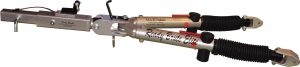
NSA Ready Brake
NSA RV Products, C8568*
(620) 365-7714
www.readybrake.com
Roadmaster
Roadmaster offers three braking systems: Even Brake, BrakeMaster, and InvisiBrake. All three include an emergency breakaway system and work with virtually any motorhome and any vehicle with power brakes.
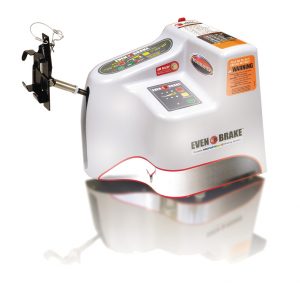
Roadmaster Even Brake
The Even Brake is a portable system that rests on the floor in front of the driver’s seat and connects to the brake pedal via a push rod and pedal clamp. It offers proportional braking by varying the amount of braking pressure applied to the vehicle. To install, plug in the breakaway wiring harness and power plug, calibrate the unit, and it’s ready to go. It automatically levels itself to adjust for uphill or downhill grades and has automatic brake protection to avoid excessive brake wear. It also has adjustable feet to match the height of the brake pedal. A wireless monitor in the motorhome cockpit shows the Even Brake’s status, and also warns of a low battery condition in the towed vehicle. The Even Brake sells for $1,500.
Roadmaster BrakeMaster
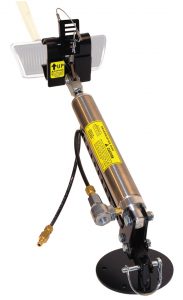
The BrakeMaster is a hybrid system in that most of the components are permanently mounted. The pneumatic cylinder that actuates the towed vehicle’s brake pedal attaches to a vehicle-specific seat bracket but can be removed by releasing a small pin and a quick-disconnect air hose fitting. The air hose connects to the motorhome’s air brakes and provides true proportional braking. An LED monitor can be installed in the coach to monitor activity, but this does require a hard-wired connection between the coach and towed vehicle. A universal wireless brake monitor is also an option for $190. For motorhomes equipped with hydraulic brakes, an air compressor kit can be added to the motorhome. This kit includes a proportioning valve that tees into a hydraulic brake line to provide proportional braking. The BrakeMaster 9160, which is designed for coaches with air brakes, sells for $800. The BrakeMaster 9060, which is for motorhomes with hydraulic brakes and includes the air compressor and proportioning valve, sells for $1,250. A seat adapter for the system sells for $75.
Roadmaster InvisiBrake
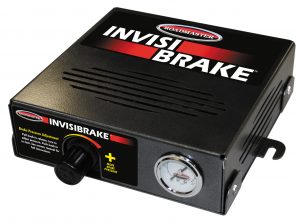
InvisiBrake is a permanently mounted “progressive” braking system. The InvisiBrake controller is compact, can be mounted almost anywhere inside the towed vehicle, and can remain in place when driving. It only applies the brakes when the motorhome’s brake lights are on. The controller connects to the electrical system but also uses an inertia sensor to determine how much braking effort to apply. An adjust-able dial and pressure gauge on the controller are used to initially calibrate the unit to the towed vehicle’s weight and braking capacity. The controller also contains a small vacuum pump that provides vacuum to the power brake booster on the towed vehicle. In addition, it supplies a trickle charge to the towed vehicle’s battery, and it includes automatic brake protection that releases the brakes if they are on too long. The InvisiBrake sells for $1,200.
Roadmaster Inc., C2952*
(800) 669-9690
www.roadmasterinc.com
RVibrake3
RVibrake3
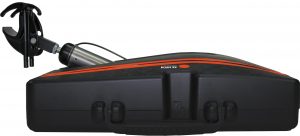
The RVibrake3 is a portable system that was developed by the inventor of the original Brake Buddy. No wiring or installation is involved. The low-profile unit utilizes the rise in the floor pan, where the driver’s seat is mounted, for positioning. Its One-Touch Auto Positioning system makes sure it is in the correct spot. It uses accelerometers to sense inertia under braking to know how hard to push on the brake pedal. Slope-sensing software helps isolate long downgrades from sudden stops, preventing brake drag when coasting down a hill; it also monitors the system when traveling uphill. A breakaway system is included.
RVibrake3 wireless Command Center
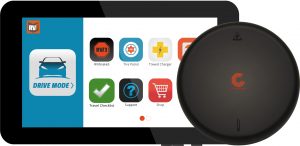
A 7-inch wireless remote Command Center that is mounted in the motorhome utilizes Wi-Fi technology to keep tabs on the system and allows for manual braking if desired. Optional Tire Patrol sensors can be added to this system to allow the command center to monitor tire pressures, with or without the RVibrake in place. The RVibrake3 sells for $1,350. It can also be ordered without the Command Center for $1,085.
RVibrake/Danko Manufacturing, C12186*
(800) 815-2159
www.rvibrake.com
*FMCA commercial member