
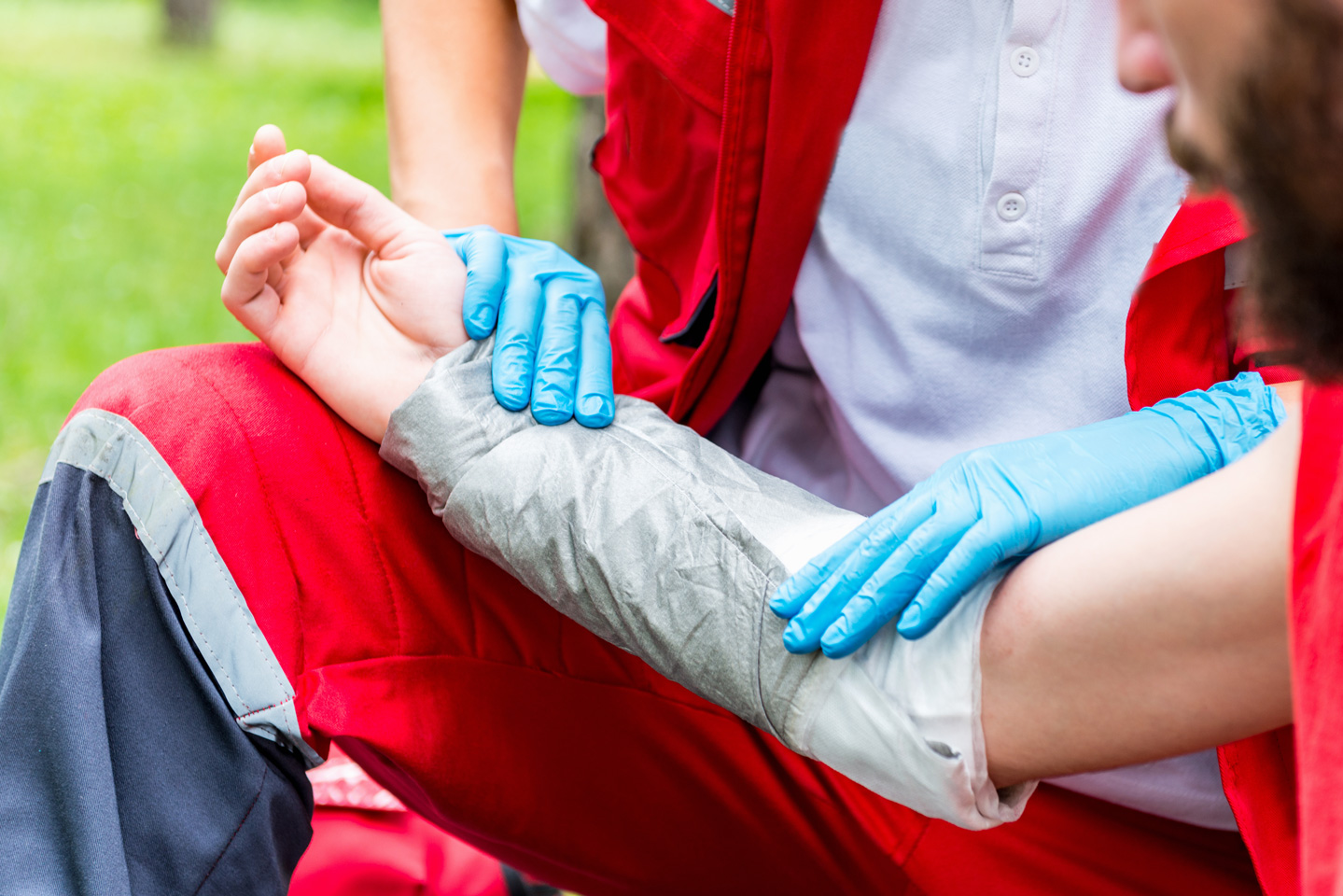
Burns can range from simple to complex, but some small steps can make a big difference when treating the heat.
By Randy Davis, F471978
December 2021
When it comes to burns, an ounce of prevention is worth pounds of pain! Burns hurt, and they often are avoidable. Burns usually happen when we are inattentive while exposed to a potential burn source. So, please be observant. But if a burn does occur, here are some things to know.
Causes Of Burns
There are five primary causes of burns:
Heat (or thermal burns) from hot objects, fire, or steam.
Chemicals such as acids and alkalis.
Electrical/lightning caused by high temperatures from arcing.
Photo (or light burns) such as sunburns or burns that come from intense light sources, including lasers or arc welders.
Radiation such as nuclear sources.
Classifications Of Burns
First-degree burns are limited to the top layer of skin.
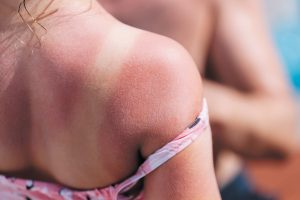
First-degree burns are limited to the top layer of skin.
Burns are classified by their depth, which determines their severity, along with the amount of body area burned and which parts of the body are affected.
First Degree: These are superficial burns that are limited to the top layer of skin (epidermis). Redness and swelling are visible, and the pain is usually mild to moderate. Mild to moderate sunburns are included in this classification.
Second Degree: These are partial thickness burns that involve the epidermis as well as the dermis, the next skin layer down, which is sandwiched between the epidermis and layers of muscle and fat. These burns are characterized by red and possibly even white skin, along with swelling and blisters. The pain is moderate to severe.
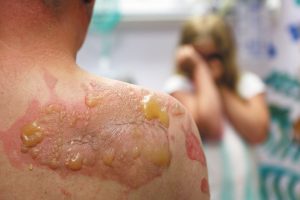
Second-degree burns involve deeper skin layers and produce blisters.
Third Degree: These are full-thickness burns that extend through all layers of skin and may involve muscle or fat tissue. Charring (black soot) of the skin may be noted, and there may be no pain at the site of the burned tissue.
Determining what percentage of the body is burned as well as which parts of the body are burned also impacts the classification. A burn covering a large area of the body makes the situation more severe or even critical. Depending on the part of the body that is burned, long-term effects can result.
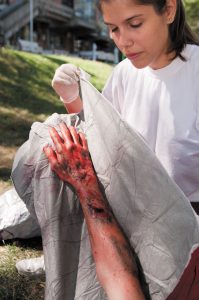
Third-degree burns extend through all skin layers and may include charring.
The size of the burn is determined by using the victim’s palm. Count the number of the victim’s palms (their hands, not yours) it would take to cover the burn, and report that number when you call for help. This is called the rule of palms and is useful for larger burns.
If genitalia, palms of the hand, or soles of the feet are burned, it can lead to more complicated issues, even in the case of first-degree burns. If the face is involved; the victim was in a high-heat, enclosed area; or you see black material or soot in the nose or mouth, the victim’s airway may be involved and swelling can soon block the airway. You may also hear a high-pitched sound (stridor) with breathing that indicates the airway is closing. Get help for this condition right away! Be sure to let a 911 operator, EMT, paramedics, or other medical professionals know what areas of the body are burned.
Treating Burns
Never put oils or butter on a burn. That creates the “French fry effect” by holding in the heat. After a burn has cooled, creams or gels may be applied, but only to first-degree burns. Seek medical attention for all second- and especially third-degree burns. Burns over large areas of the body, completely around a body part such as an arm or leg, or that involve the body parts mentioned above should be assessed and treated by a physician.
While you do cool and cover all burns, sometimes the source of the burn influences how the burn should be treated. To treat a thermal or heat-source burn, the general rule of thumb is to “put wet stuff on red stuff.” Cool the area with clean water and, of course, always extinguish any fire.
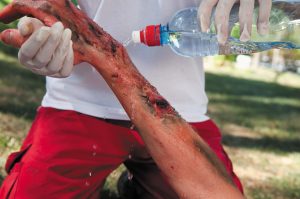
Burn treatment varies depending on type and severity, but cooling and flushing a burned area with water is usually a safe strategy.
Be careful if the burn is extensive, as you could produce hypothermia by making the victim too cold while attempting to cool the burned area. Also, be careful when removing burned clothing. If it is not easily removable from the burned area, leave it alone. After a brief period of cooling, dry and cover the extensively burned victim with a blanket to keep him or her warm. After cooling the burned area, cover the burn with a clean and dry dressing, and give the victim an over-the-counter pain reliever, if needed. If fingers or toes are burned, keep them separated with sterile gauze pads. You should also remove jewelry or restrictive clothing, as swelling may occur with burns. With second-degree burns, never “pop” the blisters, but do cover them with dressings.
With chemical burns, always remove the chemical — but take precautions to protect yourself from it. Remove clothing that may contain the chemical. If the chemical is dry, simply brush it off. Flush liquid chemicals off the body, but be careful not to flush the chemical onto unburned skin, the eyes, nose, or mouth. Also be aware that some substances can react to water, so try to find information regarding the chemical or call Poison Control at (800) 222-1222. If in doubt, flush it out using copious amounts of clean water.
Never touch a victim of an electrical burn until the power is turned off. Then, treat burns as you would a thermal burn. Be aware that the heart may be affected, so be prepared to start CPR.
A victim of a radiation burn (and you) should be moved as far away as possible from the radiation source. Any clothing should be removed and left behind. All radiation burn victims must be examined by a physician.
Your skin is a natural barrier to infection. Second- and third-degree burns remove this protection, so post-burn infections are common and require antibiotic therapy.
Burns can be simple or complex, but in all cases, removing the victim from the source of the burn and cooling the area are the keys to fast first aid.
Randall J. (Randy) Davis is a nationally registered paramedic licensed in Missouri and Kentucky. His EMS career has spanned more than 40 years, first as an EMT in 1979, then as a paramedic beginning in 1981. He has presented numerous life-support classes for the American Heart Association, the American Academy of Pediatrics, and other nationally accredited education programs.