
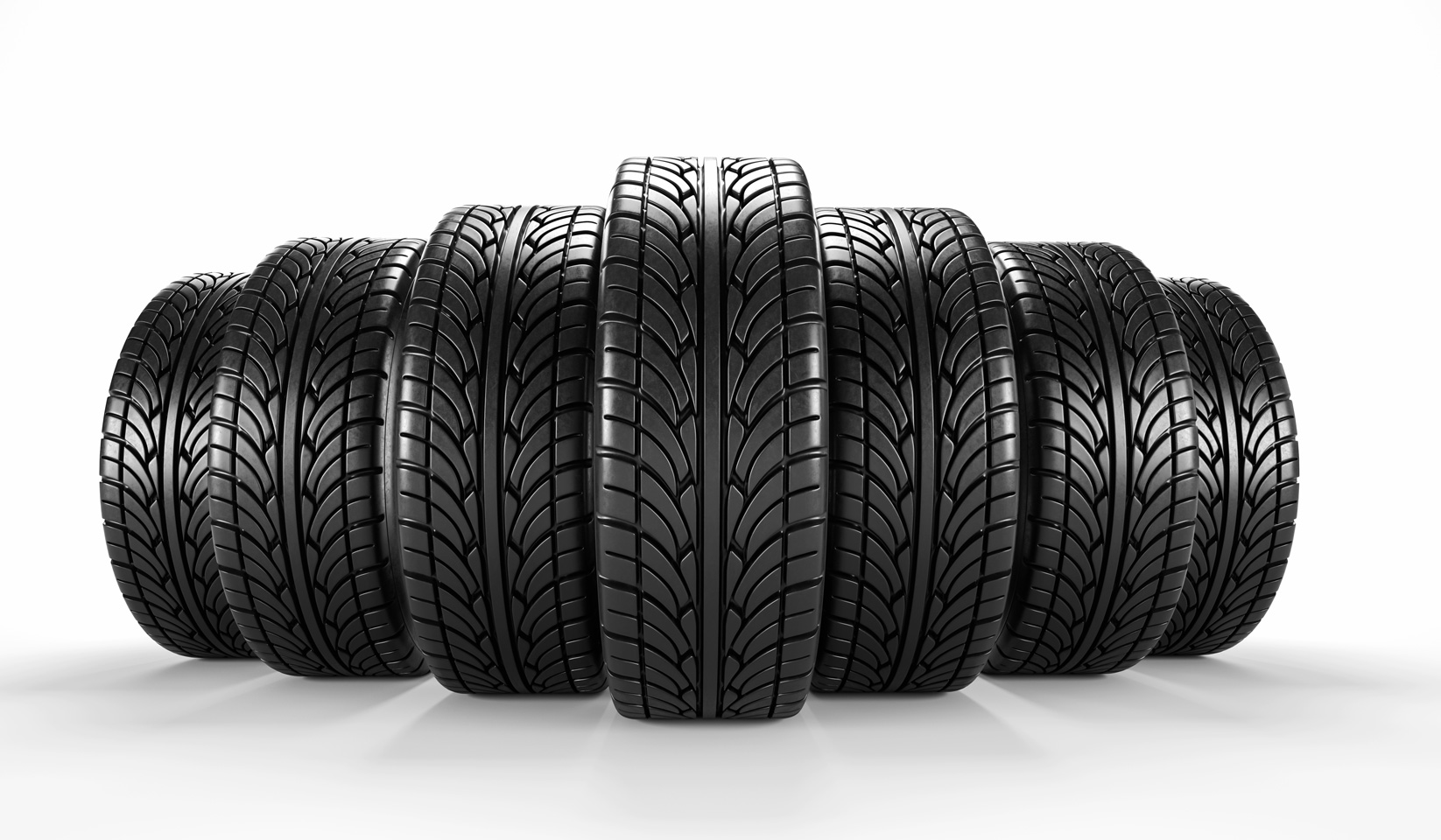
A guide to deciphering a tire description and how the information relates to type, physical dimensions, and strength.
By Roger Marble, F399427
April 2022
Whenever you ask a question about tires — be it related to price, load capacity, or inflation — the first reply may be, “What size is it?” The answer you give should not be, “It’s a 22.5-inch” or “It’s a 225-R-15.” These are just partial answers and indicate to many that you don’t really understand all you should about your tires.
The reason you need to provide the complete tire description is simply because so many variations exist. Narrowing down the information will help the person assisting you to provide you the correct answer —not just a wild guess. Deciphering a complete tire description can be confusing, and sometimes it seems as though we tire engineers and government agencies have con-spired to make things difficult. What you need to remember is that three basic features must be established first: tire type, physical dimensions, and strength.
This article covers several types of tires. Please do not skip over any part, as the knowledge provided builds on previous information.
Let’s start off with type. This usually is a function of application. For most tires, a letter code is the first part of a complete tire identification. The majority of tires sold in the United States use the code “P” for passenger, “LT” for light truck, or “ST” for special trailer. No preceding letter is used for commercial or heavy-duty tires. Tire engineers sometimes call these commercial sizes “TBR” type, which is short for truck-bus radial.
There are, of course, many other types of tires: “OTR” for off the road; “AG” for agricultural; “AT” for all terrain; “M” for motorcycle; and more. For this article, I will focus on the type, size, and strength of tires used in various RV applications.
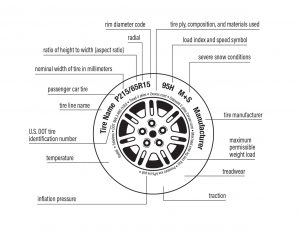
Passenger Tire Sidewall
First, we will cover “P”-type tires. Most of us own or have owned some form of passenger vehicle that came with P-type tires. Older and smaller travel trailers may also come with P-type tires as original equipment from the manufacturer. When our car requires replacement tires, we seldom need to think about proper size nomenclature, as it is the responsibility of the tire dealer to confirm the appropriate type and size tire needed.
Our car tires probably would be identified as P195/75R15 94S or a similar combination of letters and numbers. The 195 that follows the P provides the “width in millimeters” — not the tread width but the maximum width, as measured from one sidewall to the other. The 75 is the “aspect ratio” — a ratio of the tire height from the wheel to the tread as a percentage of the tire width. “R” stands for “radial.” (Since very few nonradial — “D” or “diagonal” — tires are in use today, we don’t need to go down that road.) The “15” indicates the “wheel size in inches.” Next comes the “service description,” which is a combination of “load index” number, 94 in our example, and “speed rating,” S in our example. The load index designation is used for a grouping of tires that have similar but not identical load capacities and is supposed to make selecting alternate tires easier. In the United States, the speed symbol is an indication of the level of handling capability or steering response, with increased handling potential as we move from Q to R, then S, followed by T, U, H, V, W, Y, and finally Z. Unlike in Europe, where replacement tires must have the same speed symbol, those of us in the North American market have the option of changing to tires with a different rating. However, we should expect the steering response to get slower if we opt for tires with a lower speed symbol.
One final bit of information concerning the use of P-type tires in RV applications: When using a P-type tire on a truck, trailer, or “multipurpose vehicle” (SUV or station wagon), according to tire industry design standards, the load capacity of a P-type tire must be reduced by dividing by 1.10.
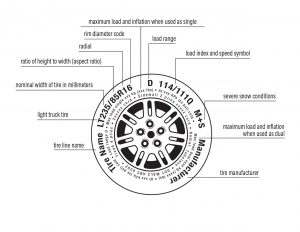
Light Truck Tire Sidewall
The next type of tire is “LT,” or light truck. These are found on Type B and C motorhomes, and possibly a few small Type As. Since these RVs are larger and heavier than the typical passenger vehicle, they generally have tires that are physically larger in size and have a stronger or higher load range. For example, a popular tire for a Type C motorhome might be an LT225/75R16 115/112 LR-E. The double number 115/112 respectively reflects the different load index for single (front) application and for dual (rear) application where two tires are mounted side by side. Note that some travel trailers have two axles, one in front of the other. This is called a “tandem” axle — not a “dual” axle — and when looking up the tire loading capacity in the tire tables, the “single” rating should be used for tandem axle applications. Again, the load index number can be applied to a group of tires that have similar but not identical load capacities. When replacing tires, you should not go to a lower load index number.
In LT-type tires, the abbreviation LR, for load range, is used. Think of the load range as a replacement for the ply rating. For an RV application, you will see that load range starts at C (old 6-ply rating) and moves through D, E, F, G, and higher. This is an indication of the strength of a tire to hold the inflation pressure, not the ability of a tire to support additional load. It is important to remember that the inflation pressure and not the tire construction is what supports the load. This is why we have load and inflation tables, not load and tire construction tables. You should not move to a lower load range than that selected by the RV manufacturer.
The load range, along with the original-equipment tire size, type, and minimum inflation, is shown on the RV certification label. Basically, the load range identifies the highest level of cold inflation to be used, starting at 50 psi and moving up to 100 psi or even higher as identified on the sidewall of your tires. Note that you should never move to a lower load range than that specified by the RV manufacturer.
Do you know where the certification label is for your RV? If not, you can contact your RV dealer or post the question on almost any RV forum on Facebook. For instance, the tires on the RV in the accompanying chart are load range C. I know this based on the inflation level. Ideally, a more complete sticker would have included the load range information, such as ST205/75R14 LRC. The owner of these tires also could read the information molded on the tire sidewall.
The label/sticker includes important safety information, and once you find it, I suggest you take a picture of it and keep a copy with important papers such as your vehicle registration and insurance card.
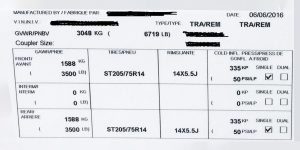
The certification label lists original-equipment tire size, type, minimum inflation, and load range.
Next, we will cover “ST” or special trailer tires. This is a special type of tire, unique to the U.S. and Canadian markets. It was developed and introduced in the late 1960s for exclusive use on trailers. In fact, it is against safety rules to use ST-type tires on vehicles designed to carry passengers.
In this category, we might find an ST205/75R15 101K LR-C. For these tires, the ST205/75R15 101K designation is similar in meaning to what we saw in the passenger-type tires. The primary difference is that the speed symbol K, L, or R is lower for these applications than for a passenger-type vehicle.
Because ST-type tires are expected to carry higher loads at higher inflation levels, the trade-off is the restriction to be operated at lower speeds. The load formula used by tire engineers when designing ST-type tires is based on a stated upper operating speed of 65 mph. While highway speeds today can be significantly higher than 65 mph, we should remember that when ST tires were introduced, we had a nationwide speed limit of 55 mph, so a tire design limit of 65 mph was not unreasonable. Conversely, the K on a P-type tire indicates it is rated for up to 68 mph.
While on the topic of speed rating, people need to understand that the test is designed for passenger car tires and requires that a new tire be capable of running up to the stated speed only for 10 minutes while running a reduced load of 88 percent of the tire-stated max, but with the sidewall inflation number.
You should be aware that in 2002, the DOT test and durability requirements for both P and LT tires were significantly updated and improved by requiring more durability for those tires. However, ST tires need only pass the same tests as developed in 1970.

Tire sidewalls list the materials and quantity used for the body of the tires and the tread.
Many consider this increase in performance and durability testing as desirable, as it can sometimes be considered a measure of “quality.” When it comes to ST-type tires, only a few are made in the United States. When asked how to estimate the quality or durability of an ST-type tire, I can only offer an observation that tires that incorporate a nylon or aramid fiber layer above the steel belts seem to perform better than tires without such a layer. You can confirm whether your tires have this belt by reading the sidewall, as the materials and quantity used for both body and tread area are listed on the sidewall.
Finally, we move to truck-bus radials, also known as “TBR,” tires seen on all the heavy trucks on the highway and on most Type A motorhomes. Generally, these are considered commercial-type tires and not a consumer-level product. If you have and need this type of tire, it is expected that you possess a deeper level of knowledge about tires. Most of these tires come on 19.5-inch or 22.5-inch wheels. They do not have a letter preceding the size description, and the designation may be something like 255/70R22.5 139/134 LR-G.
These tires do not all come with a speed symbol, but if you review the data book from the tire companies that make TBR tires, you will see that they specify 75 mph as the maximum operating speed. The double load index numbers 139/134 in the example designation relate to the single and dual application, and the load range letters continue to identify the normal upper level of cold inflation pressure. Again, I suggest that you look at the actual load capacity numbers in pounds, as the “index” is a range, and you could end up with a slight loss in load capacity.
Much more information about tires is available in tire data books and from industry standards organizations. Since “TBR” or commercial tires generally are not considered consumer products, you may need to educate yourself more about the load, inflation, and speed ratings for these tires, unless you replace tires with the same brand, size, and load range with which the RV originally was equipped.
You do need to be careful about the source of the information you are relying on. I have found errors in some listings on the internet. Consider the person you are ordering tires from. If you are ordering via the internet and not from an actual tire store, that person may not have much or any hands-on experience with tires. Some internet sellers are not much more than order takers.
Technical data is available in tire industry publications and normally can be relied upon as accurate, but even there, the information may not be aimed at the specific and sometimes unique needs of the RV community.
Note that forums on the internet are frequented by hundreds of self-appointed experts. We need to be careful; just because someone has used or sold tires for decades does not mean all the information from that person can be relied upon as 100 percent accurate.
Recently I noted the introduction of 17.5-size tires on a couple of large fifth-wheel RVs. The tires were 235/75R17.5 LR H with a speed symbol of L (75 mph max). If you are considering a move to 17.5, be sure you get the correct tires, as some in that size are rated for only 62 mph max, which would be a J speed symbol. There might be others at K (68 mph max).
Please remember that if you are changing to a tire of a different size or load range, you must do additional research to ensure you are getting the tires you want and need. If you are going from 16-inch LT-type tires to a TBR 17.5 tire, you also will be changing wheels, which introduces another level of complexity, because wheels have several critical measurements other than diameter and width. One must also be aware of offset and center bore. Even the lug nuts might need to be changed.
If you have questions about tires for your RV, you also can visit the “Tires” section of the FMCA Forums: https://community.fmca.com/. I frequent this section of the Forums and will gladly answer questions.
About the author. Roger Marble is a retired tire engineer, with 40-plus years of experience, and a member of FMCA’s Technical Advisory Committee.