
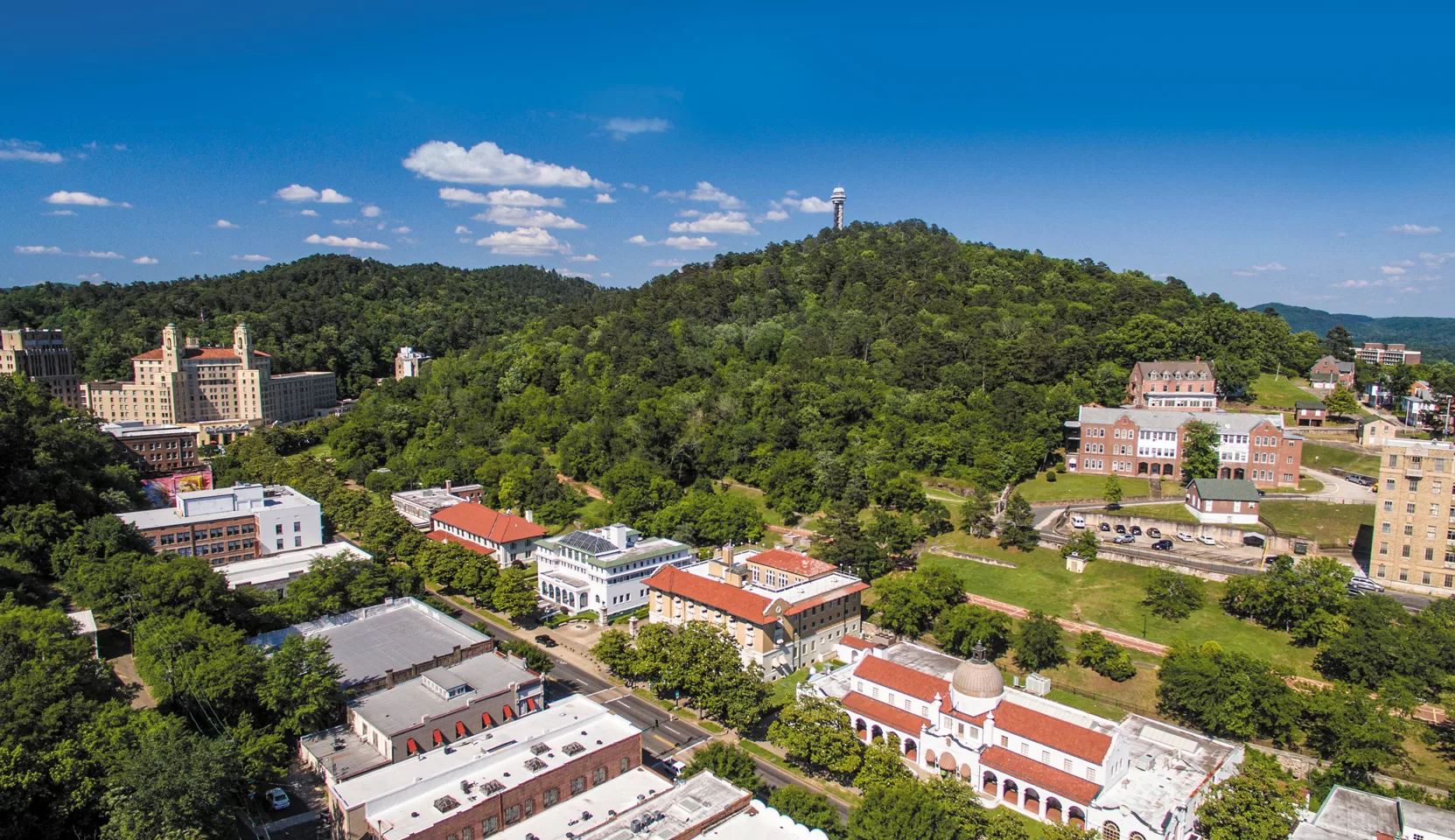
Famous for its thermal waters, and nestled within and adjacent to a national park of the same name, Hot Springs has been attracting visitors for centuries.
By Kathleen Byrne
March 2023
Hot Springs, Arkansas, is a conundrum. A large portion of this city in the central part of the state lies within the bounds of a U.S. national park. Hot Springs gained national park status in 1921 and, at just under 5,500 acres, is one of the smallest within the system. Debate exists as to whether it is the oldest, though. In 1832, 40 years before Yellowstone National Park was established, President Andrew Jackson designated Hot Springs as the first federal reservation. So, Hot Springs became the first federally protected land.
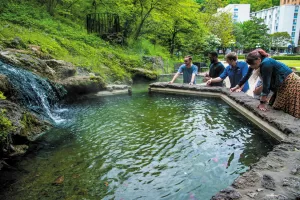
At the Hot Water Cascade, visitors can touch the thermal water.
Hot Springs is known for an abundance of mineral waters, naturally pumping out of the ground throughout town at approximately one million gallons a day by some estimates and with an average temperature of 143 degrees Fahrenheit. The reservation/park flourished over the centuries because of its niche as a spa and the notion that the springs had restorative healing properties.
The area has always served as a spa. From the dawn of time, Native Americans used the waters in what they called the “Valley of the Vapors.” In the mid-1500s, Spanish explorer Hernando de Soto took a long soak there.
Shortly after the Civil War, Hot Springs began welcoming thousands of sick and injured visitors needing relief from arthritis, consumption, and stress-related symptoms. Crude structures made of lumber and canvas were erected over individual springs or reservoirs along what now is known as Bathhouse Row. More luxurious Victorian bathhouses were built between 1880 and 1888, but because of fire hazards, many were replaced with masonry and steel structures.
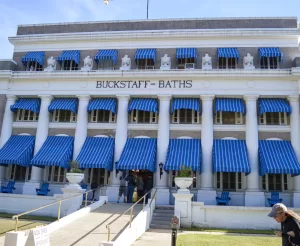
Buckstaff is one of eight bathhouses built atop natural thermal springs along Central Avenue in Hot Springs.
Eight opulent bathhouses built along Hot Springs’s Central Avenue between 1892 and 1923 remain today; one, the Fordyce, serves as the national park headquarters and contains an outstanding museum of a bygone era. The Buckstaff is the only bathhouse still offering a traditional bathing experience today and has been in continuous operation since it opened in 1912. Quapaw also offers visitors the opportunity to soak in thermal springs, along with modern spa services. Other bathhouses contain hotels, restaurants, and various tourist-related businesses. Superior Brewery, on the ground floor of the former Superior Bathhouse, is the only known brewery originating and operating in a national park. All eight of these ornate buildings are part of a National Historic Landmark District designated in 1987.
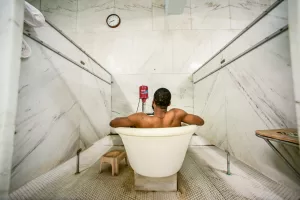
The Buckstaff Bathhouse has been in continuous operation since it opened in 1912.
With all the sudden wealth came other elements. During Prohibition and the 1920s, notable names in crime found their way to Hot Springs for activities other than soaking in a spa. Al Capone was known to rent out entire floors in the Arlington Hotel for his prostitution and gambling enterprises. Capone bought a struggling dairy farm outside the town and turned it into a moonshine factory, moving his distillate about the country on tanker railroad cars. Today, a statue of Capone sits along Central Avenue, handcuffed to a bench and smoking a cigar.
Bugs Moran, Lucky Luciano, and other known mobsters frequented Hot Springs, making deals, enjoying a massage, and betting on horses at the newly opened Oaklawn Racetrack. Though violent and feared in their respective hometowns, most of these thugs were known to be quiet, respectful, and great tippers while visiting Hot Springs. Murders and mayhem were not brought to Spa Town.
The Gangster Museum of America in downtown Hot Springs is a must-see attraction. Here, the infamous are brought back to life through their weapons, vintage gambling paraphernalia, personal effects, and a mesmerizing documentary.
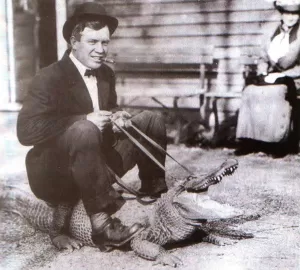
Hall of Fame centerfielder Tris Speaker rode a stuffed alligator at the Alligator Farm during spring training.
Hot Springs has a long, involved history with baseball. The first city to host spring training for baseball players, from approximately 1886 to the 1940s or ’50s, Hot Springs saw anyone and everyone. Lou Gehrig, Joe DiMaggio, Cy Young, Honus Wagner, the Dean brothers (Dizzy and Daffy), Hank Aaron, Jackie Robinson, and the effervescent Babe Ruth were regulars in town. Ruth made history there by hitting the first ball over 500 feet, from the Whittington Park baseball field into a pond at the alligator tourist attraction across the street.
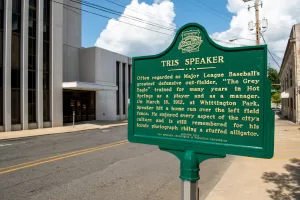 Nearly 50 percent of the hallowed names in the National Baseball Hall of Fame at Cooperstown, New York, spent spring training time in Hot Springs.
In 2012, on the first day of Major League Baseball spring training, the city officially opened the Hot Springs Historic Baseball Trail. This unique pathway explains Hot Springs’ role in the sport with 32 markers located throughout the city. They tell the story of the different baseball camps and activities. Smartphone users can access audio narrations at each station via an app, QR code, or phone call.
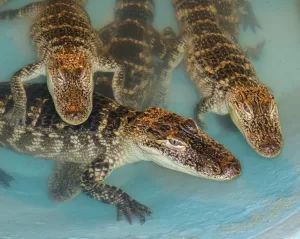
The Alligator Farm and Petting Zoo continues to welcome visitors today.
The Alligator Farm and Petting Zoo where Babe Ruth’s record-breaking ball is reported to have landed is a self-guided family-fun attraction. Miniature goats, bunnies, emus, and more cute and exotic creatures are waiting for a dose of love and a piece of bread from anyone willing to give it. The number of alligators, housed in a back building, is startling. Multiple large penned-in areas each contain dozens of the scaly reptiles; from their large, submerged pools, the gators barely move, but their hooded eyes warily give visitors a thorough look. Guests have an opportunity to hold a baby alligator or feed an adult via a long pole. In business since 1902, the Alligator Farm and Petting Zoo is always popular with children.
Popular with adults is Oaklawn Racing Casino Resort. Oaklawn — one of the premier racetracks in the United States and home to both the Racing Festival of the South and the Arkansas Derby — has a storied history. Hot Springs had several racetracks during the late 1880s, but by 1920, only Oaklawn remained.
Billed as a “Gentleman’s Resort of the Highest Class” in a 1901 newspaper ad, Oaklawn has strived to maintain an elite status. By 1904, the track included a glass-enclosed, heated grandstand that reportedly could seat 1,500, one of the first racetracks to offer such luxuries.
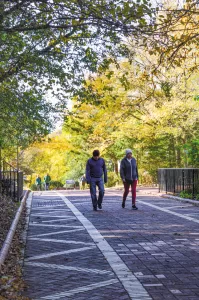
The Grand Promenade, a National Recreation Trail, runs behind the bathhouses on Bathhouse Row.
Throughout the years, any jockey of notoriety has had a mount at Oaklawn. The same with horses. Many beloved equines have crossed the finish lines here, including Whitmore, Zenyatta, Cigar, Nadal, Curlin, Smarty Jones, and 2015 Triple Crown winner American Pharoah.
Today the casino is a bright, sparkly place with floors of restaurants, bars, gaming opportunities, and good times.
Nature lovers will appreciate the peace and quiet on the hiking trails both inside the wooded national park and along the Grand Promenade, which parallels sections of Central Avenue. The shade is welcome on hot days; the trees are magnificent in spring and fall; and the views are expansive on every segment of the half-mile-long trail.
Outside town, numerous lakes are full of fish, surrounded by hiking trails, and adorned by brilliant sunrises and sunsets.
Hot Springs is a special, forward-thinking town with a diverse history that cannot be matched. In this friendly spot, every visitor can find a niche and a particular interest that could lead to cherished lifetime memories. With seven full-hookup RV parks in the Hot Springs area, ranging from 2.5 to 13 miles out of town, it is easy and convenient for RV owners to make those memories, and to do so soon.
Further Info
Visit Hot Springs
www.hotsprings.org
(501) 321-2277
Hot Springs And The Eclipse
You might recall the 2017 total solar eclipse, the first to touch the lower 48 since 1979 and the first to span the United States from coast to coast since 1918. Well, on April 8, 2024, we’ll be treated to another one, with the path stretching from Mexico to Canada. While many people in North America will be able to view a partial eclipse that day, depending on the weather, of course, the best spot to be is within the path of totality. And, as it turns out, the path will pass right over Hot Springs National Park, making it an ideal place to be for this upcoming celestial event. Visit www.totaleclipsearkansas.com to join the countdown and for information to help plan a visit. Check out www.eclipse.aas.org to learn more about the eclipse.
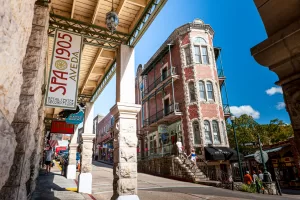
Eureka Springs boasts interesting architecture, plus fun shops and restaurants.
Eureka Springs, Arkansas
Eureka Springs is a vibrant town tucked in the northwest corner of Arkansas. At the base of the Ozark Mountains, this area of the state is hilly, forested, and situated between two large, clear-blue lakes: Beaver and Table Rock, both with numerous coves, islands, and fingers. This is an outdoor lover’s paradise, particularly in the autumn, when the surrounding hills are brilliant with color.
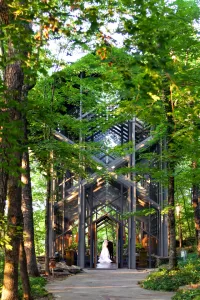
Eureka Springs’ magnificent Thorncrown Chapel.
If nature isn’t your thing, head into town. Designated a “Distinctive Destination” by the National Trust for Historic Preservation, the city screams “Victorian.” Hundreds of Victorian-era homes and buildings decorate the streets, from minute cottages to enormous mansions, including one designed by Frank Lloyd Wright. Many are private homes, but most serve as gift shops or restaurants. This is the place for shopaholics — and for the hungry, as the food scene likely will satisfy everyone. Lunch at Nibbles Eatery should include their homemade soup and a delicious grilled cheese.
With hundreds of streets that meander throughout the town and intersect only at one right-angle spot, Eureka Springs is confusing for both drivers and pedestrians. There are zero traffic lights. The flow is constantly up, down, and around. More than 50 miles of old limestone walls, most of them built in the 1880s, define the streets’ shapes.
Nicknamed both “The Little Switzerland of America” and “The Stairstep Town,” Eureka Springs, like Hot Springs to the south, gained prominence in its early days for restorative springs thought to cure or improve myriad diseases. Look for the bubbling pools as you stroll the winding streets.
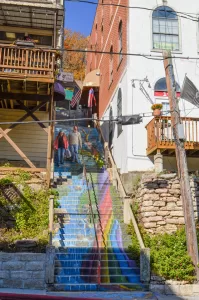
A colorful staircase in Eureka Springs.
Eureka Springs also has been dubbed “The Wedding Capital of the South.” With more than 4,000 weddings performed each year, this area offers many venues to accommodate any size event. Several unique glass chapels are built into the hills and forests. None is more dramatic than Thorncrown Chapel, a steel and glass building that showcases nature and simplicity. At least 250 weddings take place at Thorncrown each year.
There are many reasons to head to delightful Eureka Springs, and numerous RV parks are found in the area, predominantly hugging the lakes. However, the roads to the city are difficult — two-laned, narrow, and twisting. Expect to take a minimum of one hard hour if approaching town from Interstate 49, or the better part of a day if heading north from Little Rock.