
Properly maintaining these energy storage devices can help to avoid frustration and potential travel disappointments.
By Mark Quasius, F333630
March 2023
Batteries are the heart of any RV. Without them, you wouldn’t be able to run lights, the water pump, fans, or anything else that requires 12-volt-DC power. RV batteries act as storage units for electricity — or, technically, for the chemical energy needed to produce electricity — which they gradually deliver to various electrical loads. When a battery starts to run out of power, it will need to be replenished via some form of battery-charging system. Batteries do require a bit of maintenance, and if neglected, they can be a source of frustration that could derail an RV trip.
Battery Types
Different types of batteries exist. Among them are the typical lead-acid automotive batteries found in most cars and trucks. If you have a motorhome, you’ll have one or two of these to start the engine and run automotive accessories such as the headlights, windshield wipers, dash heat, etc. But the house portion of a motorhome and any towable RV will have its own separate battery bank. This powers the interior lighting, fans, water pump, and possibly even an inverter to provide 120-volt-AC power. This separate bank is made up of deep-cycle batteries, which differ from starting batteries. Starting batteries are engineered to deliver a large amount of power over a short period of time. Once the engine is running, the vehicle’s alternator will provide power for the automotive accessories and will recharge the battery. Deep-cycle batteries are designed to deliver their capacity over a longer period rather than in short bursts. They provide the capacity for small loads such as interior lighting or inverters over time and are perfect for RV applications.
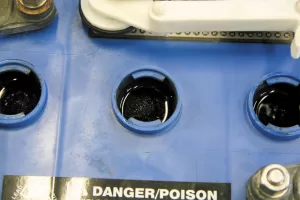
Flooded batteries require ongoing checks of the electrolyte level in each cell, adding distilled water to any cell as needed.
Flooded batteries are used as chassis starting batteries and to supply house power in RVs. They also are referred to as wet-cell or lead-acid batteries. They contain a liquid electrolyte — basically, a sulfuric acid solution that interacts with the lead plates in the battery. While the battery is charging, the lead plates receive a charge from the electrolyte, and the battery delivers this electrical energy to the load. As the electrons leave the battery and become discharged, the sulfur in the electrolyte is deposited as sulfate on the battery plates. The electrolyte gradually turns to water and eventually loses its ability to produce any power. Recharging the battery will restore its output capacity by burning the sulfate off the plates so it can recombine with the electrolyte and bring the battery back up to its full state of charge.
The recharge cycle is sensitive to voltage. Excessive charge voltage will cause the hydrogen in the electrolyte to outgas and leave the battery, so you’ll need to keep these batteries in a vented area away from any electrical sparks. You’ll also have to monitor their water level.
AGM batteries are a step up from flooded batteries. AGM stands for absorbed glass mat. These batteries are similar to flooded batteries in that they also have plates and electrolyte, but the electrolyte is in gel form rather than liquid. AGM batteries are a hybrid between lead-acid batteries and gel batteries. Their electrolyte is absorbed into fiberglass mats that wrap around the battery plates. They are sealed and have built-in valves, which eliminates outgassing and the need to monitor water levels. You also can draw these batteries down a bit further than flooded batteries before reaching the critical voltage level, so you get a bit of a gain in available amp-hours. Amp-hours is measurement of battery capacity and, as the name suggests, tells you how many amps a battery can deliver in one hour.
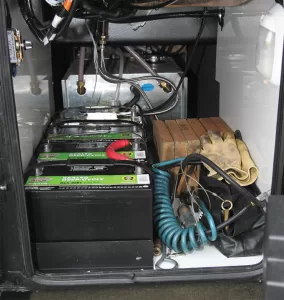
Absorbed glass mat (AGM) batteries don’t outgas and thus can be mounted in unvented compartments.
Lithium-ion batteries are the next big step up in batteries. These batteries are pricey, and they come with a few caveats; however, unlike AGM batteries, which are useful to about 50 percent of their capacity, lithium-ion batteries deliver useful current until they are completely depleted.
In many cases, a couple of lithium-ion batteries can replace a bank of eight flooded or AGM batteries to deliver the same amp-hours. Plus, lithium-ion batteries are lightweight, and if you combine that with the ability to use fewer batteries, you will realize weight savings in your RV. Lithium-ion batteries also have a much longer life than flooded or AGM batteries.
In order to function properly, lithium-ion batteries must be protected from freezing, so they’ll need battery heaters. In some cases, the heaters are built right into the battery, with electronics to manage them. These batteries do not do well when it comes to excess charging voltage, either; so, you’ll want a battery management device to prevent the battery from receiving excess voltage from the vehicle’s alternator or from a solar panel array. It’s best to consider lithium-ion batteries as part of a system and not try to just drop them in to replace your flooded batteries without installing some additional components.
Maintenance
When flooded batteries just aren’t doing the job anymore, it’s time to perform some tests on your system. The first step is a voltmeter test. If your batteries are fully charged, you should be able to see 12.6 volts at each battery. Now, testing voltage will not tell you whether the battery is good. It will only tell you if it is charged up. That has no bearing on the ability of the battery to pass the rated number of amps when demanded of it. However, your batteries do need to be fully charged when testing, so this is the first step.
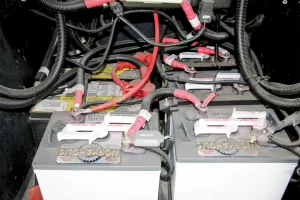
Battery terminal connections should be kept clean and free of corrosion to maximize current flow.
Once the batteries are fully charged, disconnect any loads from them and stop the charger. A battery that has just been charged will have a surface voltage of 13.2 volts or more. This is a false voltage, so the surface charge needs to be removed before testing. If you totally disconnect all of the battery cables or physically remove the batteries, it will take up to 10 or 12 hours for the surface charge to dissipate. However, you can leave the batteries in place and simply turn on your high-beam headlights for 30 seconds, or apply a load from a carbon pile load tester for 15 seconds to remove the surface charge and allow you to proceed with the test. The voltage should stabilize around 12.6 volts. If you cannot achieve 12.6 volts, then it will be necessary to proceed to the next step and test each battery.
As noted, the next step is to check the state of each battery. When battery electrolyte is fully charged, its specific gravity increases. Specific gravity is the ratio of the density of the electrolyte in comparison to the density of water. When the battery is discharged, the specific gravity lowers, because the liquid basically is water, instead of the heavier acid. You can use a hydrometer to test the specific gravity, but refractometers are much more accurate and most do not require temperature compensation. Plus, a refractometer can be used to test antifreeze as well as battery electrolyte, so it’s a handy tool for any RVer to own.
Every cell in a battery needs to be up to snuff or the battery will not perform adequately, much like a weak or broken link in a tow chain. Remove each battery cap and take a small sample of electrolyte with your hydrometer or refractometer. Refer to the accompanying chart to see the state of that cell. If the battery is perfectly charged, the specific gravity should be around 1.277. The main thing to check is that the specific gravity is fairly equal in all cells. If you have one dead cell, the battery won’t perform; again, it’ll be like a tow chain with a broken link. Similarly, if you have two 6-volt batteries connected in series, neither battery will be able to pass current with that one bad cell in the chain.
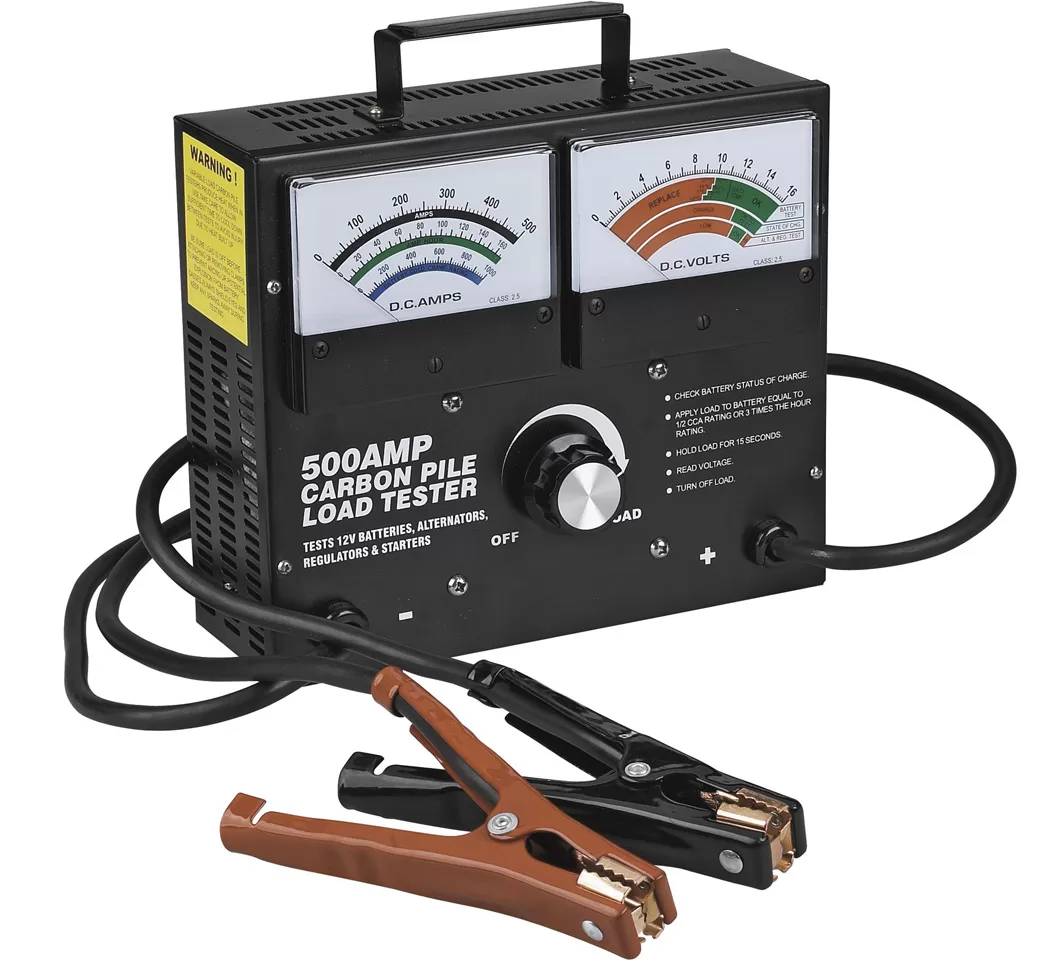
Once you have determined that the batteries are fully charged and that each cell is within tolerance, the next step is to perform a load test. To ensure accuracy when load testing deep-cycle batteries, it’s best to use a tester designed for that purpose, such as a carbon pile tester. This device starts with a dead load that can be varied by turning a knob. An ammeter and voltmeter are supplied to monitor battery performance. A typical test consists of adjusting the control until the ammeter reads three times the rated amp-hours of the battery. Hold this for a few seconds and monitor the voltmeter. If the battery voltage drops into the red zone, your battery is no longer capable of performing at its rated capacity.
At this point, you may need to replace your batteries, but there is one last trick you can try to recover them. Battery plates become sulfated over time, and the sulfur no longer recombines with the electrolyte when recharged. At this point you can try to equalize your batteries to see whether you can restore some life to them.
Equalizing involves applying a higher voltage to the batteries to boil the electrolyte and hopefully cook off any sulfate that has attached itself to the battery plates. Equalizing functions can be handled by most modern converters and inverter/chargers, but be sure to refer to the owners manual for specific instructions. When equalizing, it will be necessary to disconnect any RV loads from the batteries to prevent any damage to them from the higher voltage used during the equalization process. Many manufacturers recommend equalizing flooded batteries annually as a preventative measure. Note that under normal conditions, AGM batteries do not need to be equalized, because the rate of sulfation is low.
In addition, it’s important to check the external condition of your batteries. Electricity requires a path to conduct its current to where it needs to go. Corrosion is not a good conductor. Your electrical system might not be performing as desired, but it may not be the battery’s fault. Battery connections are typically copper, and copper is susceptible to galvanic corrosion, especially when on a lead battery terminal. Galvanic corrosion is an electrochemical process that occurs when two different metals are in contact with each other and immersed in an electrolyte. This will be especially prevalent on flooded batteries where the acidic outgassing accelerates this process.
Any annual inspection should entail checking these connections and cleaning them up. Spray cans of battery terminal cleaner are available at any auto parts store. The cleaner attacks corrosion and dissolves it so that it can be rinsed away with water. A mixture of baking soda and water also can be used to clean the terminals. The best procedure is to remove those terminals and clean them with a small wire brush, because the cleaner can’t get everywhere. Safety note: Be sure to wear eye protection and gloves during this process to avoid contact with corrosive battery acid.
Batteries themselves need to be kept clean. Batteries with top posts are inclined to conduct electricity between those posts. If the top of the battery is dirty or has a film, it can hold moisture, which will allow the battery to slowly discharge as the moisture conducts electricity and creates a current path between the posts. This is why many auto manufacturers now use side-post batteries. Keeping the battery top clean will prevent this discharge.
In the case of AGM batteries, you need to take one more precaution. AGM batteries don’t outgas like flooded batteries do, but the cases are still vented with small valves to allow for expansion. If you hose them off and water gets into the case, it will harm the batteries. It’s best to use a spray cleaner instead. My preference is Windex with Ammonia-D, which cleans up the battery quickly. Just spray the Windex on a paper towel and wipe off the dirt.
Series, Parallel, And Sizing
The same battery system won’t work for every RV. You’ll need to determine your needs in order to devise the proper battery setup for your situation. Remember that batteries are nothing more than storage boxes for electrical energy. They won’t hold a charge forever, so you must match your load demand to the ability to recharge them.
A battery bank can be made up of either 12-volt or 6-volt batteries. Most larger banks utilize 6-volt batteries, because they have thicker plates that allow for more current capacity versus a single 12-volt battery. If 12-volt batteries are used, they will be connected in parallel. When 6-volt batteries are used, a pair of them is connected in series to produce 12 volts. The 6-volt batteries must always be installed in pairs, so if you decide to upgrade from two 6-volt batteries, you’ll need to add two more. Multiple pairs often are used and connected in parallel to deliver the most power.
When batteries are connected in parallel, the voltage remains the same, but the amp-hours increase. So, a pair of 85 amp-hour 12-volt batteries will deliver 170 amp-hours at 12 volts. When batteries are connected in series, the voltage increases, but the amp-hours remain the same. A pair of 6-volt batteries rated at 220 amp-hours that are connected in series will deliver 220 amp-hours at 12 volts.
A series-parallel configuration can combine numerous 6-volt batteries into series-connected pairs, which are then connected in parallel to achieve a 12-volt battery array. For example, four 6-volt 220-amp-hour batteries will provide 440 amp-hours, while an eight-battery bank is capable of 880 amp-hours.
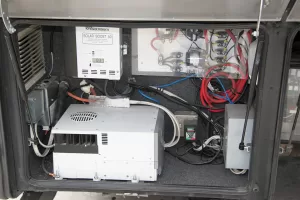
Today’s inverter/chargers and converters use a three-stage charging system to minimize battery water loss and outgassing.
Flooded and AGM batteries should not be drawn down below 50 percent or the battery life will be shortened drastically. Battery life is related to cycles, not years. You can drain them down and recharge them a given number of times before they are no longer serviceable. But this is rated on a curve, so, for example, discharging a battery to only 50 percent charge level will more than double its life. If it is discharged even less than 50 percent, those cycles will multiply greatly. So, the best situation is where you keep the batteries topped off and don’t drain them any further than necessary.
Charging
Multiple ways to recharge a battery exist. As you are driving, your vehicle’s alternator will recharge your house batteries. This is done via a charge solenoid on a motorhome. On a towable RV, a charge wire can be utilized in the seven-pin umbilical cord for the trailer lights. Once you arrive at a campsite and plug the RV into shore power, the RV’s converter or inverter/charger will provide charging power to the RV battery bank.
In some cases, solar panels may be helpful. Small single panels may not do much, but a larger array can provide a bit of battery charging power if the demand isn’t too high. Of course, this all depends on weather, including the amount of sunlight and the temperature. If you are dry camping, you need a battery bank large enough to last until the next time you can recharge the batteries. Solar panels can help to extend that interval, but eventually you’ll need to recharge the batteries using a more powerful method. If your stay exceeds your battery capacity, and you have an auxiliary generator, you’ll need to operate it to allow the converter or inverter/charger to bring the battery bank back up to full capacity. Larger battery banks offer more flexibility in choosing when to recharge.
If you treat your batteries right, with proper maintenance and use, you should be able to get the maximum life out of them, allowing you to enjoy many hours of trouble-free RVing.