
Is your RV refrigerator giving you trouble? They don’t last forever, so you eventually will have to decide whether to fix, upgrade, or replace it.
By Steve Froese, F276276
August 2023
Previously, I mentioned the failure of my aging RV refrigerator and noted that I’d be covering that topic in a future issue. I’ve decided to devote the next couple of columns to discussing repair and replacement options should you encounter an RV fridge failure of your own.
I was expecting my fridge to fail, especially since it is 17 years old. On average, RV absorption refrigerators tend to last 15 to 20 years. We really value the 12-cubic-foot storage capacity of our four-door fridge, but given its size, it would be extremely expensive to replace. For the most part, regardless of what make and model you have, replacement absorption refrigerators and cooling units are available. Another option would be to replace your absorption fridge with a residential or RV compressor-type unit, but that is not covered in this article.
When we arrived at our first night’s destination, I turned the fridge on in the evening before we retired for the night. The next morning, we noticed the fridge was not cold, and the dreaded “NoCo” error was showing on the display with the accompanying beeping, which my wife heard during the night. I went outside, removed the exterior lower vent cover, and took a look.
As an RV technician, I know exactly what to look for in the case of a failed cooling unit. The flue tube was hot to the touch, but the rest of the tubing seemed to be at ambient temperature. That meant the heated ammonia vapor was not circulating through the system.
If you have problems with your fridge not cooling, first check to make sure you have 12-volt-DC power and that either the propane or 120-volt-AC energy source is functioning. Then carefully feel the main vertical flue tube, which is the large sheet-metal-wrapped tube that sits above the propane burner. Exercise caution, because it may be hot. If it is not hot to the touch, the issue may lie elsewhere, such as a power or control problem. If the flue tube is hot, feel the large coil of tubing just above
the ammonia accumulation tank; it should also be warm. If the flue tube is warm but the tubing is not, it likely either has a blockage or has lost ammonia. Both generally require a refrigerator or cooling unit replacement to resolve the issue.
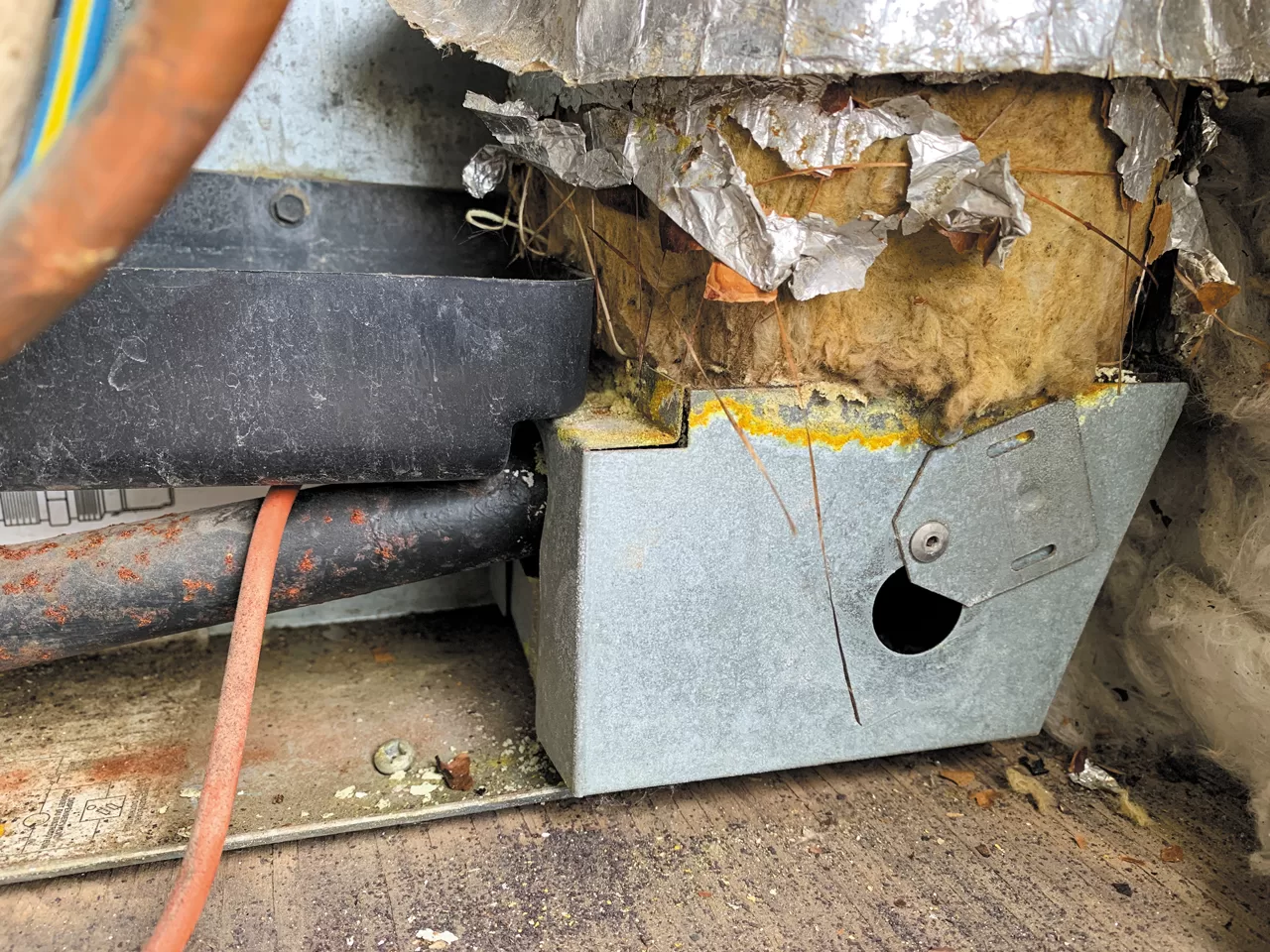
In my case, I carefully examined the bottom of the flue tube, the area around the propane burner, and the surrounding floor at the rear of the fridge. Sure enough, I saw yellow crystalline deposits and staining in all three areas. This is a telltale sign of RV refrigerator failure. The yellow crystals were the sodium chromate used to protect the inside of the tubing from the ammonia. You can usually smell the ammonia when a cooling unit fails. But, in this case, that odor was not present, likely because the failure had occurred much earlier at the RV storage lot. The ammonia had obviously had time to fully dissipate. This could be considered a good thing, since the smell of ammonia is not a welcome odor.
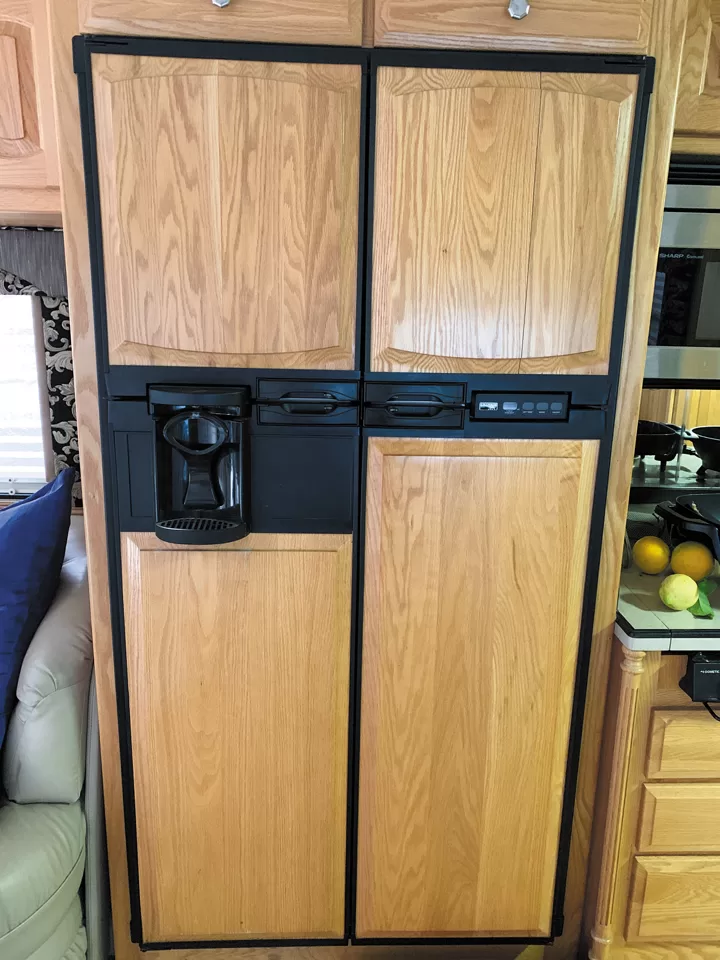
The author’s RV refrigerator will soon be outfitted with a replacement cooling unit.
If you own an aging RV (ours is a 2006 model), it is not a matter of “if” your fridge will fail but rather “when.” This is true regardless of whether you have an absorption-type or residential fridge. When failure occurs, you must assess whether to replace the entire fridge or just the cooling unit. The decision should be based on several factors. For me, the determination was easy. Absorption fridges are quite expensive, and ours is among the largest available; therefore, it’s one of the most costly. Also, given its size, it could have been difficult to remove from the RV. During factory installation, some RV fridges are put in the RV before the walls are added or are passed through a window opening prior to installing the glass and frame. Therefore, there is no guarantee that larger fridges will even fit through an RV door. Often, they do fit, but sometimes they must be brought in sideways or have the doors or handles removed.
I did not measure my door opening or fridge width, but if it did fit, it would have been an extremely tight squeeze. I may have had to remove some trim from around my RV door, or even possibly the entire RV door. Also consider the layout of the route your fridge must take to the door of your RV, as there may be tight turns to make around seats, cabinetry, the dashboard, etc.
The cost of a new fridge and potential problems with getting the old fridge out and the new one in factored into my decision-making process. My next consideration was installing a new cooling unit instead. That involves several questions. First, what is your comfort level with installing a new cooling unit versus a new fridge? What is the cost difference between a cooling unit and an entire fridge? And how does the quality of a new cooling unit compare to a new refrigerator?
In my experience, if you are comfortable installing a new fridge yourself, replacing the cooling unit is not much more difficult, although it does require a higher level of mechanical aptitude. If you aren’t comfortable installing a fridge, you should seek professional help. Also note that a cooling unit replacement will take longer than a fridge replacement.
In terms of price differences, let’s look at my scenario. The average cost of a new Norcold 1200 series refrigerator is around $5,000. An “Amish”-built (more on this later) cooling unit costs around $2,000. So, for me, it was a no-brainer. Also, I had replaced several cooling units before, so I was not worried about performing the repair.
To summarize replacement considerations when you are faced with this decision, here are the primary issues:
- Cost of cooling unit versus complete fridge.
- If you are replacing the entire fridge with a different make, model, or type, you will need to consider possible cabinetry
and wiring modifications. - Ease of refrigerator removal from the RV. When replacing a cooling unit, you don’t need to remove the fridge from the RV, as the cooling unit replacement can be done inside the RV. For fridge replacement, take careful measurements when determining clearances.
- Whether you are planning to do the work yourself. Fridge replacement is fairly straightforward, and I would rate this as a 2.5 out of 5 for technical difficulty. For a cooling unit replacement, I would rate this as a 3.5 out of 5. Instructions are available for new cooling units, and in this article series, I will describe the process and try to provide some clarity where the published instructions might not be as clear. If you are planning on having the repair done professionally, the labor to replace the cooling unit will likely be higher than having the entire fridge replaced. However, the cost savings in purchase price between a cooling unit and an entire fridge will more than make up for this difference.
Next month I will start to detail the cooling unit replacement procedure and discuss Amish-built cooling units. Another reason to have the cooling unit replaced rather than the entire fridge is that the Amish-built cooling units are reported to
be superior to the OEM versions. As an example, the steel tubing is thicker, and the welding is done by hand instead of a machine. The machine welding weakness was one of the main points of failure on the original cooling units and caused the massive safety recall a few years back.
Send your troubleshooting questions to Steve Froese at techtalk@fmca.com. The volume of correspondence may preclude personal replies. Not all responses will apply in every instance. Some situations may require a visual inspection and hands-on testing. If you choose to follow any procedures outlined in this column, first satisfy yourself that neither personal nor product safety will be jeopardized. If you feel uncomfortable about a procedure, stop and make an appointment with an RV service facility.
You may also want to consult the FMCA Forums (https://community.fmca.com) to see whether your question has already been addressed or, if not, to post it.