
Knowledge Is Power
Learn about the 30-amp and 50-amp electrical systems used in RVs.
By Steve Froese, F276276
I previously wrote about GFCI receptacles, but I’ve received questions about other aspects of RV electrical systems, so this month I will discuss 120-volt alternating current (VAC) wiring as it pertains to RVs. This article will not go into great detail, but it will cover the basics of how both 30-amp and 50-amp RVs are wired, including generators.
Let’s start with 30-amp RVs, which covers smaller trailers and motorhomes. Intuitively, the mention of 30A simply refers to the total current available in the RV when plugged into 30-amp shore power. All RV alternating current (AC) systems and appliances operate at 120 volts AC, but they draw different amounts of current. Consider your air conditioner, 120-volt-AC fridge, items plugged into wall receptacles, 120-volt-AC water heater element, microwave, hair dryer, etc. In order to not overload your total available power, it is important to understand how much current each appliance consumes.
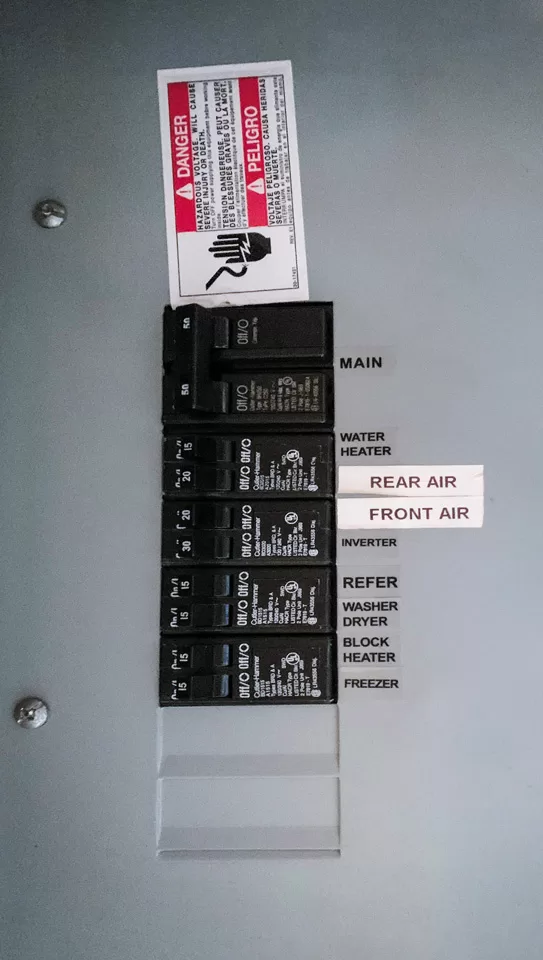
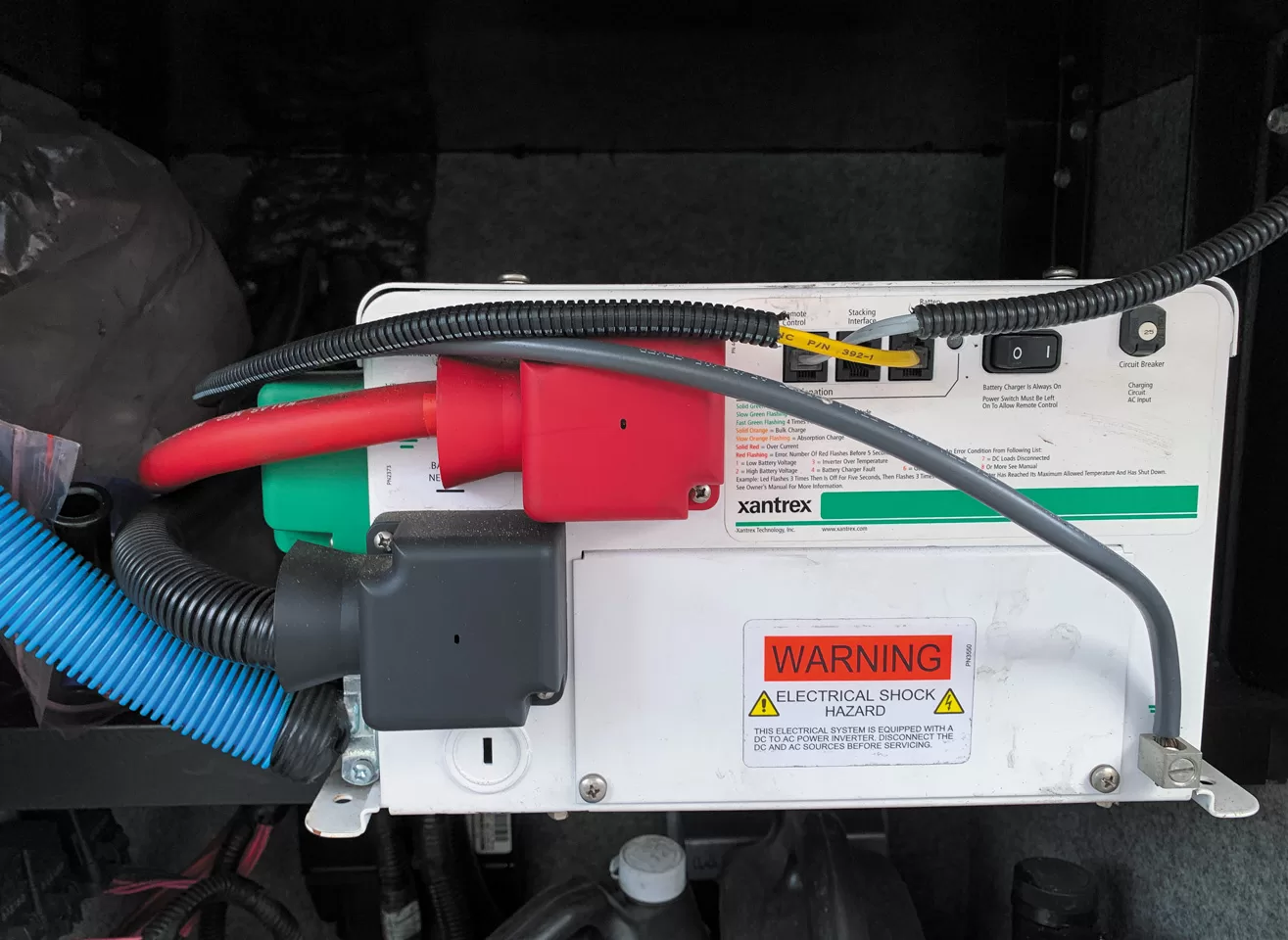
An RV with a factory-installed inverter/charger will likely have two breaker panels. The main panel is fed from the shore power cord, or generator via a transfer switch, and allows for branch circuit power distribution.
A 30-amp shore cord has three legs: hot, neutral, and ground. Let’s look at the possible ways AC power enters your RV. If your RV has a generator and an inverter or inverter/charger, as many do these days, there are three possible sources of AC that can be used to generate electricity for your RV. You may have all three of these, two of them, or just one (shore power).
The shore-power-only scenario is very simple. The shore power cord connects directly to the main breaker in the breaker panel; then, this power is distributed to the individual branch circuits through a buss bar and branch breakers in the panel. If you have a generator in your RV, you either will utilize a transfer switch or will plug the shore power cord into a receptacle wired to the generator. Each power source (local power grid, generator, and inverter) introduces separate single-phase AC power. Without going into detail, it is extremely important to not combine multiple independent power sources. This is a situation that can lead to equipment damage or even personal injury. Without isolating the individual sources, consider the scenario where the generator is running while shore power is energized. This results in both the generator and the shore power providing electricity to the RV at the same time. However, the two sources are not likely to be in phase with each other, which would create a dangerous situation. In other words, the two resulting AC sine waves are not occurring in phase with each other — i.e., they are not superimposed but rather are offset from each other. This is why either a transfer switch or an isolation receptacle must be used.
Based on the above, if you have both a generator and shore power, a single main power feed line will likely enter your breaker panel from the output of a transfer switch. The transfer switch will have two inputs, which are the outputs from the shore power and the generator. The transfer switch ensures that only one of these sources feeds the output at a time. Transfer switches give the generator priority. If the generator is running and providing power, the transfer switch will send that output to the RV mains. This is true even if the shore power is plugged in. If the generator is not running, shore power will be sent (as long as the shore power is energized). In this wiring scenario, you will have both the shore power and the generator output wired to the transfer switch inputs, while the single transfer switch output will feed the main 30-amp breaker in the breaker panel. From there, the 30 amps are distributed to the branch circuits and protected by the individual circuit breakers.
It is unusual for transfer switches to fail, but it does happen occasionally, generally the result of pitting or carbonization of the high-current relay contacts caused by arcing during switching.
As mentioned earlier, this 30-amp main feed into the RV is distributed to all the branch circuits in the RV, so the total available is 30 amps. You will not be able to run more than one air conditioner from the 30-amp service. Some RVs have energy management systems that will automatically shed loads in a given priority if the current draw exceeds 30 amps. With experience, you will learn which loads can be operated simultaneously in your RV. You can also perform some simple math to determine how much current each load draws by applying Watt’s law: Watts (W) = Volts (V) × Amps (A). Most appliances list either the current draw or, more typically, the power in W. V is always 120 volts, so the calculation is simple to determine the total current draw by dividing the listed W output by 120. For instance, a 1,200-watt heater would draw 10 amps of current. Also consider that not all appliances draw continuous current. For example, the fridge will draw current when it is actively cooling, and the water heater will draw only when it’s heating. But if the fridge and water heater are working at the same time, there may be considerable current draw. Such loads are sometimes overlooked.
Never use an extension cord in combination with an RV shore power cord unless it is specifically designed for either 30-amp or 50-amp RV use. Household or even commercial extension cords will heat up, resulting in reduced cur-rent capacity at the least, but also possibly a fire hazard.
Now, let’s turn our attention to 50-amp RVs. 50-amp wiring utilizes four conductors: two hot, one neutral, and a ground. It is important to mention again that 50-amp RVs are wired to provide 120 volts AC, which is the voltage achieved by tapping from either of the hot legs to neutral. If the RV were wired to allow both hot leads to be wired together, this would result in 240-volt AC. While houses and businesses allow for this wiring in the case of clothes dryers, ranges, etc., it is used in RVs only in certain limited situations.
50-amp service allows for a total of 100 amps to be available in the RV. This may seem counterintuitive, but if you are familiar with 50-amp RV service, remember that the main RV power is protected by two 50-amp circuit breakers — one for each hot leg. Therefore, the total power available is 100 amps, in two branches of 50 amps each. The wiring leading up to the main panel is the same as for a 30-amp RV, except the 50-amp RV has two hot wires instead of just one. This means the transfer switch has an extra relay to support the extra hot leg.
For a 50-amp RV with two rooftop air conditioners, each one would be wired to separate buss bars, allowing for both to be operated at the same time on 50-amp service. Most of the RV loads are connected to one of the buss bars, while a few large loads, such as a second air conditioner or a washer-dryer, would be connected to the second buss bar.
This article has discussed RV 120-volt power at its highest and most fundamental level in hopes that you may have a better understanding of the basics of your 120-volt-AC RV service. As always, if you have specific questions about your RV, or require some troubleshooting assistance, please feel free to reach out to me at techtalk@fmca.com, or seek guidance in the FMCA forums, where I act as moderator.
Send your troubleshooting questions to Steve Froese at techtalk@fmca.com. The volume of correspondence may preclude personal replies. Not all responses will apply in every instance. Some situations may require a visual inspection and hands-on testing. If you choose to follow any procedures outlined in this column, first satisfy yourself that neither personal nor product safety will be jeopardized. If you feel uncomfortable about a procedure, stop and make an appointment with an RV service facility. You may also want to consult the FMCA Forums (https://community.fmca.com) to see whether your question has already been addressed or, if not, to post it.
Recalls
Looking for the latest RV-related recall information? Visit FamilyRVingmag.com for a list of the most recent recalls issued by RV and component manufacturers. Or, to search for recalls, investigations, and complaints by vehicle year, make, model, and VIN, visit nhtsa.gov/recalls. NHTSA’s Vehicle Safety Hotline is (888) 327-4236.