
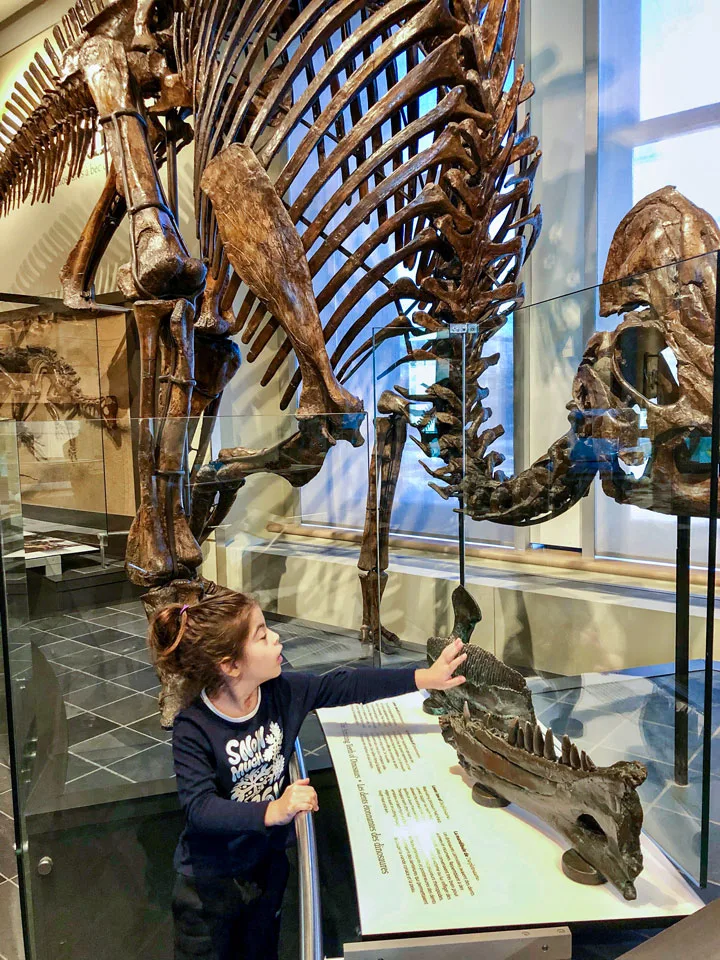
Throughout the United States and Canada, parks and museums offer insights into these prehistoric rock stars.
By Josephine Matyas, F468364
July/August 2024
I have a confession to make: I am a dinosaur junkie. When we’re traveling with our young granddaughter, that passion whips into overdrive. But even on adults-only RV trips, we will happily detour along “the road less traveled” into remote areas to get a fix of the primordial giants that at one time ruled this continent’s land and water.
Millions of years ago, inland seas covered large parts of what is now western North America. When they receded, they left a thick layer of marine deposits with the entrapped remains of fish, reptiles, and dinosaurs. Such factors as time, the forces of wind and water, modern technology, and some sophisticated digging techniques brought some of these remains to the surface.
Today, it’s easy to find dig sites that preserve tracks and remains across Canada and the United States. (Of course, it’s illegal to remove fossils or bones from any of these protected sites.) And in cities, world-class museums and research institutes protect this incredible prehistoric history.
Here’s a short primer: Dinosaurs ruled the land during the “Age of Reptiles” — more formally known as the Mesozoic Era — a time span of 252 million to 66 million years ago that is further divided into three periods: Triassic, Jurassic, and Cretaceous.
What I appreciate about digging into dinosaurs is that you can get as scholarly as you’d like. In the company of our granddaughter, it’s mainly a “Wow!” factor, with some science tossed in for good learning; on our own, we may pepper a staff member with more advanced questions. There’s no right or wrong, even if you can’t tell a Tyrannosaurus from a pterodactyl.
Of course, with many of these sites located hither and yon, there is no better way to explore than by RV. So, unfold your maps — or fire up your GPS — and let’s go digging.
UNITED STATES
Dinosaur National Monument | Utah/Colorado
nps.gov/dino
Dinosaur National Monument
This expansive, remote site straddling the border of Utah and Colorado was established in 1915 to protect dinosaur remains. It’s filled with fossil-rich rocks that create a window into the world of Upper Jurassic-period dinosaurs (a golden age for the biggies). The monument’s excavation bed holds fossils from 400 different dinosaurs — the prehistoric reptiles that roamed this area for over 100 million years. At one time, an ancient river flowed across a vast plain; a long drought killed many dinosaurs, and their remains collected near the dry river channel. When the rains returned, the bones tumbled together into a “dinosaur log jam,” creating a bounty of fossilized remains. Once they were discovered in the early 1900s, a building was constructed around the dig site.
The park’s Quarry Exhibit Hall is considered one of the best places in the world to see dinosaur bones in place — more than 1,500 embedded bones are exposed on the rock face, including those from Allosaurus, Apatosaurus, Camarasaurus, Diplodocus, and Stegosaurus.
|
Museum of the Rockies (MOR) | Bozeman, Montana
museumoftherockies.org
Museum of the Rockies (MOR)
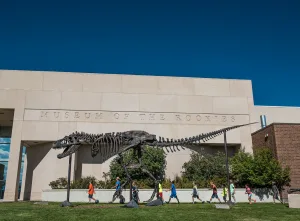
You could say this museum is endorsed by Dr. Alan Grant, the fictional paleontologist in the movie Jurassic Park. The museum’s curator of paleontology, Dr. Jack Horner, was the inspiration for the film’s main character, and he also advised director Steven Spielberg.
The Dinosaurs Under The Big Sky exhibit holds one of the largest collections of North American dinosaurs in the world, showcasing the enormous carnivorous Tyrannosaurus rex, the three-horned Triceratops, an Allosaurus that lived during the Jurassic Period, and the burrowing Oryctodromeus. The Hall of Growth and Behavior is a window into dinosaur eggs, nests, and babies. Watch “preparators” at work in the Bowman Dinosaur Viewing Lab as they carefully remove the rock that has encased fossils for millions of years.
Field Museum | Chicago, Illinois
fieldmuseum.org
Field Museum
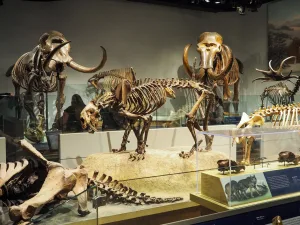
Chicago is known for its wealth of museums, including the Field, one of the world’s largest natural history museums. The museum is home to “Máximo” the Titanosaur, the largest dinosaur ever discovered, a long-necked plant-eater from Argentina that stretched 122 feet in length. The Griffin Halls of Evolving Planet is known for the museum’s iconic “SUE the T. rex” — at 40 feet long, one of the largest and most complete Tyrannosaurus rex dinosaurs ever discovered. SUE: The T. rex Experience includes touchable models, mechanical and digital interactives, large media elements, videos, and a light show.
Big Bend National Park | Texas
nps.gov/bibe
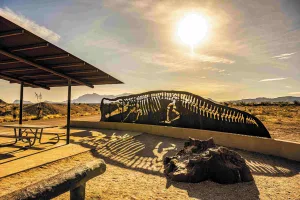
Big Bend National Park
Hugging the Rio Grande in west Texas, isolated Big Bend National Park boasts a rugged landscape with an abundant trove of fossils, including some found nowhere else in the world. The park focuses on a 130-million-year slice of geologic time, including the dinosaur extinction event. The pterosaur Quetzalcoatlus, the world’s largest known flying creature — with a 36-foot wingspan — was first discovered at Big Bend, as was the massive skull of the giant horned dinosaur Bravoceratops (exclusive to Big Bend). Several other species were discovered in or are found only at Big Bend, including various types of horned dinosaurs, duck-billed dinosaurs, and a giant alligator that most likely preyed on the land dinosaurs. The park’s 1,200-and-counting fossil record is one of the most diverse in the National Park System.
Utah Field House of Natural History State Park Museum | Vernal, Utah
stateparks.utah.gov/parks/utah-field-house
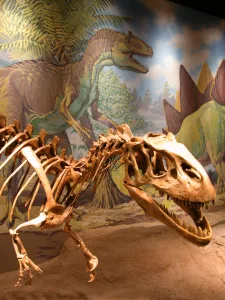
Utah Field House of Natural History State Park Museum
A giant Diplodocus skeleton — 90 feet from tip to tail — greets visitors at the museum’s Uinta Fossil Journey exhibit. A short film enables viewers to experience a virtual day in the field at two local fossil digs. Outside the theater, a rock wall incorporates a small ravine where visitors can try to identify fossils that are mixed among the washed-out pebbles and other debris. The Jurassic Gallery provides a 145-million-year look back at dinosaur skeletons: Stegosaurus, Haplocanthosaurus, and Allosaurus. A simulated dig site shows the science and sequence of fieldwork, including how fossils are removed from rock. The Fossil Lab is a busy place of worktables, lights, glasses, and tools, all used to prepare fossil specimens. A children’s lab entertains youngsters with books, puzzles, and dinosaur models.
At nearby Red Fleet State Park, hiking trails wind past 200-million-year-old dinosaur tracks. The museum is also on the loop of the 500-mile-long Dinosaur Diamond Prehistoric Byway, which encircles a dinosaur-rich region of eastern Utah and western Colorado.
Badlands Dinosaur Museum | Dickinson, North Dakota
dickinsongov.com/museum-center
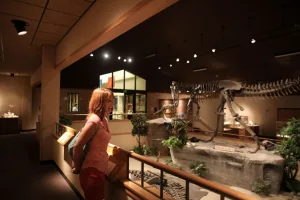
Badlands Dinosaur Museum
Meet “Bill” and “Larry,” highlights of the museum’s Triceratops display (one a skull and the other a near-complete skeleton). They join other specimens in this display of dinosaurs — the largest collection in North Dakota — which includes full skeletons of Stegosaurus, Triceratops, Allosaurus, Edmontosaurus, Albertosaurus, and Thescelosaurus. One exhibit explores “ontogeny” — a study of the origination and development of an organism — by detailing the evolution and function of eggs, illustrating how dinosaurs grew and the effects that change through growth had on their ecology and evolution.
CANADA
Parc National de Miguasha | Quebec
sepaq.com/pq/mig/index.dot?language_id=1
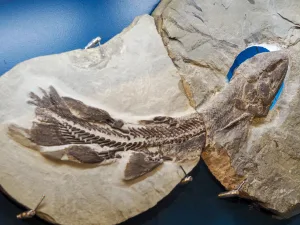
Parc National de Miguasha
A Quebec provincial park and UNESCO World Heritage Site, Miguasha illustrates life during the Devonian Period (approximately 400 million years ago), when the continental plates making up Europe and America collided to form a single continent. Much later, the landmass would separate, creating the wide Atlantic Ocean and, regionally, a warm, soupy equatorial estuary — the perfect conditions for what has become one of the world’s most famous fossil beds. Also known as the Age of Fishes, it was a crucial evolutionary time when the very first limbed creatures are said to have crawled out of the sea and onto dry land. This milestone occurred before dinosaurs, before reptiles, even before mosquitoes. The park is open this year through October 14, 2024.
Royal Tyrrell Museum | Midland Provincial Park, Alberta
tyrrellmuseum.com
Royal Tyrrell Museum
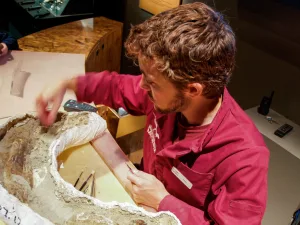
The Royal Tyrrell Museum of Palaeontology is Canada’s only museum dedicated exclusively to the study of ancient life. The Bearpaw Sea — the last of the warm, inland seas once covering North America — receded 72 million years ago, leaving the entrapped remains of fish and reptiles rich with clues to the Age of Dinosaurs. The museum’s paleontologists scooped up the remains, studied them, and preserved them as part of their research into the history of the planet. The spacious galleries represent a 3.9-billion-year journey through time and are home to the “footprints” of these ancient creatures — from tiny, bizarre critters to one of the largest collections of giant dinosaur skeletons in the world.
Canadian Museum of Nature | Ottawa, Ontario
nature.ca/en
Canadian Museum of Nature
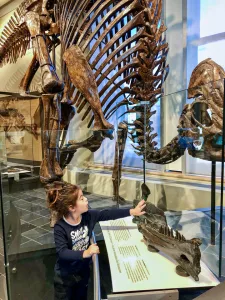
In downtown Ottawa, the Canadian Museum of Nature houses a collection of complete skeletons, models, and touchable parts representing a span of time from 2 billion to 3,000 years ago, with a focus on specimens that came from sites across Canada. The museum is home to one of the world’s best collections of horned dinosaurs, including the newest discovery, Spiclypeus shipporum, with its uniquely ornamented head frill, in which some of the adorning spikes curl forward and others project outward.
Royal Ontario Museum (ROM) | Toronto, Ontario
rom.on.ca/en
Royal Ontario Museum (ROM)
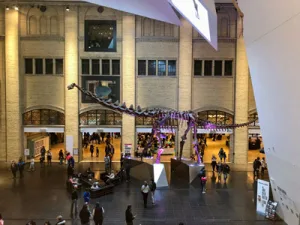
The ROM’s Age of Dinosaurs Gallery is filled with dinosaur experiences showcasing a worldclass collection largely gleaned from Alberta’s rich fossil fields. Enthusiasts can tick off all the biggies — Tyrannosaurus Rex, Stegosaurus, Triceratops — as well as view the impressive collection of dinosaur skulls; the skeleton of a giant sea turtle; and a world-recognized collection of plant-eating, duck-billed dinosaurs. Don’t miss “Gordo,” the 89-foot-long Barosaurus: a giant, long-tailed, long-necked plant eater that roamed Earth 145 million years ago. It’s the largest real fossil dinosaur skeleton mounted in Canada and is one of only three complete Barosaurus skeletons on display in the world.
Dinosaur Provincial Park | Alberta
dinosaurpark.cadinosaurpark.ca
Dinosaur Provincial Park
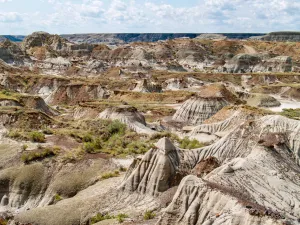
The rocks of the Alberta Badlands along the northern limit of the Great Plains contain the largest concentration of late Cretaceous dinosaur fossils on the planet. The provincial park is a protected UNESCO World Heritage Site, with a mission to help visitors see actual fossils in the ground. The wide variety of daily programs include guided hikes at all skill levels; family-friendly bus tours through the rugged, semiarid badlands; and a hands-on guided dig, where you work on a real excavation at a fossil-rich site that is a 75-million-year-old time capsule.
HELP WITH THE HUNT
- Fossils and dinosaur exhibits are found at dozens of U.S. National Park Service sites. The NPS provides a list of “fossil parks” and presents a deep dive into fossils and paleontology: nps.gov/subjects/fossils/.
- Parks Canada provides comprehensive information for visitors planning trips throughout the country: parks.canada.ca. Most parks in Canada have campgrounds that can accommodate RVs. Visit individual park websites to learn more.
- The CityPASS program includes admission to two key museums: Field Museum in Chicago and the Royal Ontario Museum in Toronto (reservations required for the latter): citypass.com.