
Tips for adding a fire suppression system to your RV.
By Steve Froese, F276276
November/December 2024
I often mention the importance of regular RV maintenance in my articles, including annual inspections of the propane system, periodic checks of the roof and sealants, etc. The value of this can’t be overstated.
This month’s column is not about maintenance, but rather something far more important — your safety and that of your family. As you consider vehicle maintenance requirements, it is important to also think about safety upgrades. In this article I will discuss how to protect your RV from fire. I’m not referring strictly to the need for fire extinguishers, although those are important. Rather, I want to talk about a proactive, innovative, and relatively inexpensive way to safeguard your RV and your family from the devastating effects of fire.
If you have attended FMCA rallies, read the magazine, or visited the website, you may have noticed presentations or advertisements for fire suppression systems. Many different types exist, but the technology that seems most geared toward RV use is a tube-type system, consisting of plastic tubes filled with a fire suppression agent strategically placed in the vehicle.
Several areas in your RV may be susceptible to fire, and some are more prone than others. Areas that are at higher risk of fire include, but are not limited to, the engine bay (in a motorhome), refrigerator compartment, battery bay, and electrical compartment. Some of these areas can be hard to reach with a conventional fire extinguisher. Plus, you may not become aware of a fire until it’s too late.
For those vulnerable areas, I recommend that RV owners consider one of the tube-style fire suppression systems. As noted, these tubes are filled with a chemical agent, and when exposed to excessive heat, the tube releases the highly effective chemical. The intent of these systems is to extinguish a fire before it does damage.
The tubing usually is constructed of polyamide, a material similar to the PEX water lines in your RV. The fire-suppressant chemical varies by manufacturer. Whatever chemical is used, for the most part they share common characteristics: They leave no residue and are environmentally friendly, noncorrosive, and safe for electronics. Tube systems are effective on Class A, B, and C fires. “A” represents standard combustibles such as wood; “B,” flammable liquids and gases; and “C,” electrical. When sourcing fire extinguishers for your RV, ensure that they are rated for A, B, and C fires. As you can imagine, there is potential for all these types of fire in an RV.
Several companies provide tube-style fire suppression systems, in many different sizes and styles. So, if you are considering purchasing one, please reach out to a distributor for advice on the system that best suits your needs. For example, the specific configuration you require in the engine bay likely will differ from one for a fridge compartment.
Some suppliers attend FMCA rallies and are available to configure and install these systems for you. Knowing the systems have been properly sized and professionally installed provides peace of mind.
You also can install these systems yourself, and it isn’t difficult, as long as you purchase the correct system for the application. I rate the difficulty of this installation a two out of five, and the only tool required for my installation was a screw gun. For installation in refrigerator and electrical compartments, which are easier to access, the process is likely to be even more straightforward.
I will summarize how I went about installing a fire suppression system in my engine bay. Note that these systems do not negate the need to have fire extinguishers accessible at various locations in your RV. While suppression systems can protect you and your RV from fire, it may be necessary to assist in the fire fight using a hand-held extinguisher, so do not consider these suppression systems as replacements for fire extinguishers.
The areas most susceptible to fire in an RV, by far, are the engine bay and the refrigerator compartment. Because I have previously replaced my fridge cooling unit with an Amish-built one, and I have an ARP Fridge Defend temperature monitoring device installed, the chances of a refrigerator fire in my RV are significantly reduced. I opted to initially protect only my engine bay with a suppression system; I will likely install additional ones later. You should make the best determination for your circumstances.
Once I was able to source a supplier for my system, I contacted the company and provided the exact year, make, and model of my RV, as well as where I wanted to install the unit, in this case the engine bay. They were able to provide the specific model I needed based on this information.
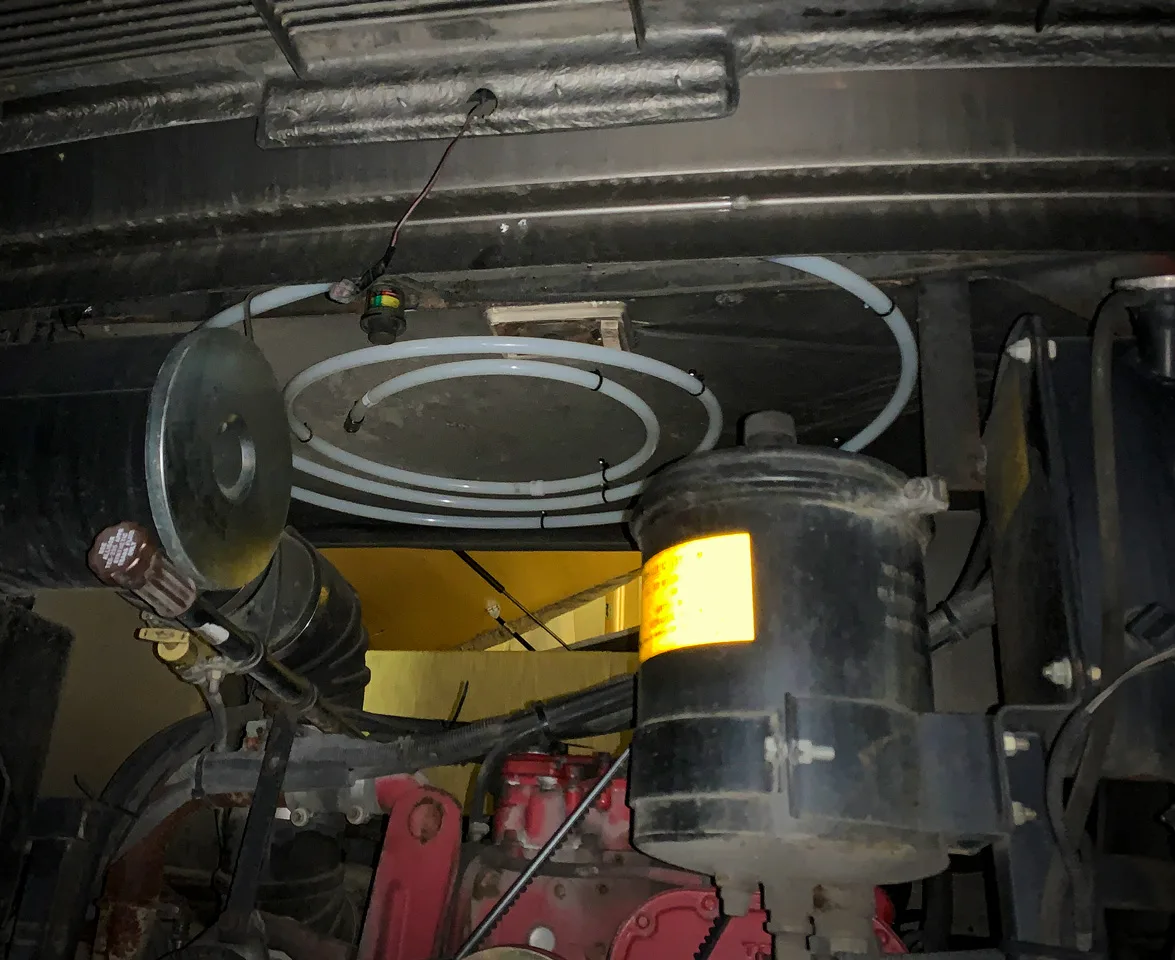
Upon receiving the package, I noted that the tubing was naturally coiled and had stainless-steel end caps. One end has a pressure gauge, while the other has pigtail wires that can be used for an external indicator, such as a light, although this is rarely used. The system also came with heat-resistant cable ties for installation.
For engine bay installation, the first task is to gain as much access as possible to the engine area. In my case, I was installing this on a diesel-pusher motorhome with a rear bedroom slideout. If you have a rear-engine motorhome with no slideout, it may be as easy as open-ing the rear bunk and installing the tubing on the underside of the bed. However, in my case this was not possible. My access points were the rear outside engine hatch and the access cover between the rear bed and the closet. I was able to gain sufficient access this way, but if you find you must directly contact the engine (or lie upside down on top of it like I did), be sure to cover the engine with a blanket and protect any components that may become damaged in the process.
Survey the area above the engine and plan where you will coil the suppression tube. In my case, there is sheet metal above the engine with nothing mounted to it, so I simply had to coil the suppression tubing against the sheet metal and use the supplied tie wraps to secure it.
Make note of the minimum bend radius for the tubing; creating too tight a bend will put stress on the tubing, potentially breaking it. Therefore, when installing the tubing, simply create a spiral pattern. Make the first curve radius as large as possible while still covering the area to be protected, without going too far outside of it, and then work inward. The natural curvature of the tubing may help your layout.
My only real challenge with this install was lying on my back on top of the engine and screwing the tie wraps into the sheet metal. I was able to install some of the tie wraps from the engine hatch outside the RV. This job took me only about half an hour, and when I was finished, I had significant peace of mind knowing the RV has much better protection against an engine fire.
I highly recommend fire suppression for your RV, and the tube type is one of the least complex and is easy to install. Your install may well differ from mine, but all in all it’s not difficult, even if you have limited DIY skills. Keep those fire extinguishers handy, but note that suppression systems will go a long way toward maintaining the safety of you and your family.
As always, please feel free to reach out to me at techtalk@fmca.com if you have any questions about this or any other RV topic.
THIA By Proteng
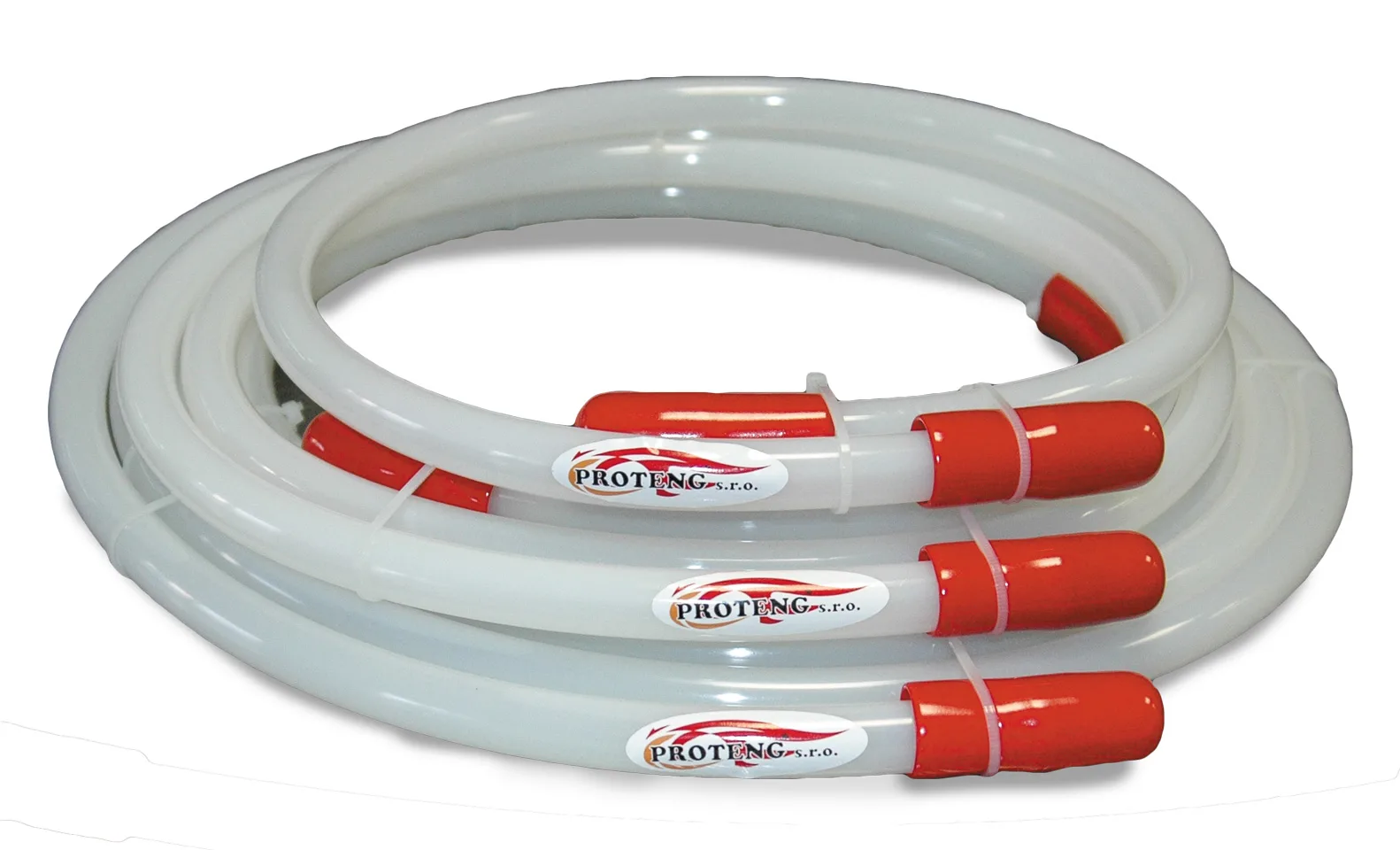
THIA by Proteng fire suppression system
One manufacturer of an automatic fire suppression system is Proteng, and FMCA members are eligible for package pricing and discounts up to 10 percent on Proteng products and services. THIA by Proteng is available in two versions: standard and heavy-duty. The polyamide (synthetic polymer) tubes are filled with FM-200 and rupture when exposed to potentially threatening temperatures (exceeding 158 degrees Fahrenheit for the standard system and 194 degrees Fahrenheit for the heavy-duty system). When the tube ruptures, it disperses the gas and extinguishes the flame at its hottest point.
For more information, visit FMCA.com/proteng.
Send your troubleshooting questions to Steve Froese at techtalk@fmca.com. The volume of correspondence may preclude personal replies. Not all responses will apply in every instance. Some situations may require a visual inspection and hands-on testing. If you choose to follow any procedures outlined in this column, first satisfy yourself that neither personal nor product safety will be jeopardized. If you feel uncomfortable about a procedure, stop and make an appointment with an RV service facility.
You may also want to consult the FMCA Forums (https://community.fmca.com) to see whether your question has already been addressed or, if not, to post it.
Recalls
Looking for the latest RV-related recall information? Visit FamilyRVingmag.com for a list of the most recent recalls issued by RV and component manufacturers. Or, to search for recalls, investigations, and complaints by vehicle year, make, model, and VIN, visit nhtsa.gov/recalls. NHTSA’s Vehicle Safety Hotline is (888) 327-4236.