
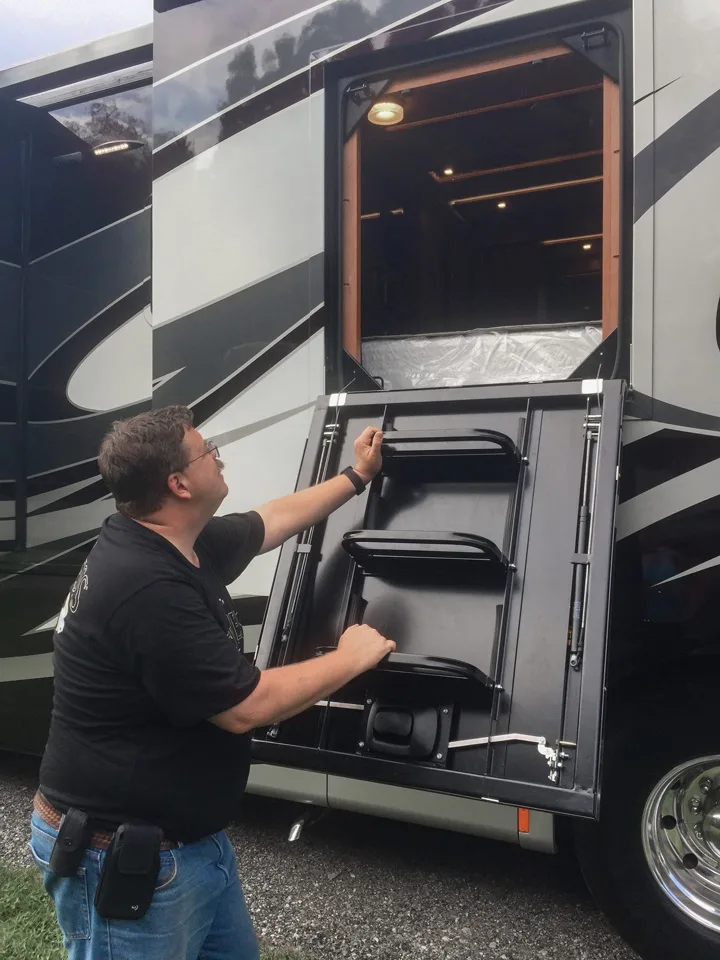
Essential tips for keeping these safety features in top shape — and improving ventilation as well.
By Chris Dougherty, F263059
January/February 2025
Most RV owners don’t think about window and emergency exit maintenance, aside from cleaning the glass. But keeping these devices in good operating order not only will make the windows work better for ventilation but, more importantly, for use as an exit if an emergency mandates that.
Let’s examine what makes up an emergency exit, how many an RV needs, and why.
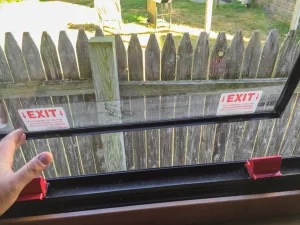
Emergency exit windows have red latches and must be marked with stickers.
Per the National Fire Protection Association “Standard on Recreational Vehicles” (NFPA 1192), which establishes fire and life safety criteria for RVs, an RV must maintain a minimum means of escape, that being at least one primary and one secondary exit — so, the door to the RV plus another exit point. Emergency exits in RVs can take various forms, including doors, windows of different designs, and roof hatches. A sleeping area must have two different exit paths. If the RV has more than one sleeping area and the sleeping area has a door as a primary means of escape, only the door is required.
Some RVs, such as pop-up camping trailers, may have a secondary means of escape only if they are fully set up, and in that case, a label will denote the appropriate place.
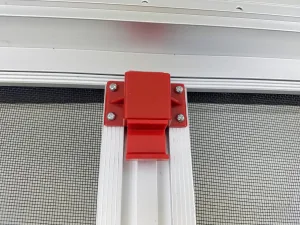
RVs with a roof hatch have a latch to open it in an emergency.
The exit must be operable by hand; must not require a key or tool to function; and must not require more than 20 pounds of force to open.
It must be labeled with an “EXIT” sticker, and the operating handles must be red. Minimum required sizes are also specified in the NFPA 1192 standards. In addition, access to these exit points must not be obstructed.
Windows usable as emergency exits can be as simple as large sliding glass panels that permit passage of a 300-pound adult, or they can be purpose-built escape windows that open using a latch. Smaller sliding windows will have one or more red quarter-turn latches on the bottom, allowing the entire window to be swung upward to permit escape. Jalousie windows will likely have a handle to hold the window open for ventilation but can be swung open farther to allow escape. Special red tabs make it possible to pull the screens off the window frame. Spring clips hold the screens in place, and the screen can be pushed back onto the window after being pulled off for use as an exit or for cleaning.
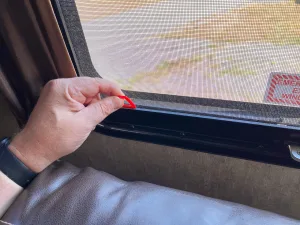
Jalousie-style exit windows have a screen that must be pulled off first.
Hatches are common in truck campers with the main sleeping area in the cab-over section of the unit. For this type of RV, escape will involve climbing onto the roof and then down the exterior ladder if possible.
Some high-end motorhomes, such as those manufactured by Tiffin and Newmar, incorporate special escape hatches. These may take the form of a small door in an aft bathroom or a hatch hidden behind a panel (or panels) that serves as the bed’s headboard. Motorhome owners with these special exits should become familiar with their operation and test them regularly (unless specifically marked as a one-time use exit). If the escape hatch is equipped with stairs or a ladder, practice using them so you’ll know how they function prior to any emergency.
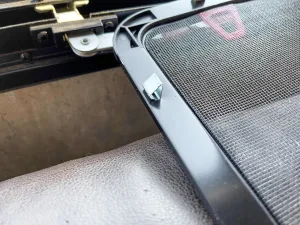
Metal spring clips hold the window screen in place.
Of course, regular entry doors are the best means of egress and should be used in an emergency whenever possible. If your RV is equipped with a premium lock such as the Global Link Ultra E series electronic lock, note the emergency release on the inside of the lock. The Ultra E series uses an internal “deadbolt” instead of a separate throw bolt. In the unusual event that the deadbolt is activated from outside the RV, this slide button overrides all lock mechanisms and allows the lock to be opened. Of course, the red lock knob will work if the lock is activated by someone inside the RV.
As with any mechanical device, RV windows and exits must be maintained and tested for proper operation. Over time, moving parts might become stiff, seals may stick, and corrosion could cause issues. Dirt and other residue may collect in the window tracks, making operation difficult.
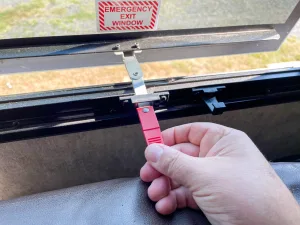
Unlatch the arm and move it outward to open the window.
Most RV windows have drains to the outside to allow rainwater and condensation to escape. Without these drains, water could collect in the tracks and then overflow and seep into the wall, causing damage. Make sure the tracks stay clean and the drains remain open.
3-In-One, a WD-40 company, makes several products that work well for RV emergency exit and window maintenance and can be used elsewhere around the RV as well.
For instance, the company’s RVcare Window & Track Dry Lube helps sliding RV windows to move smoothly in clean, dry tracks.
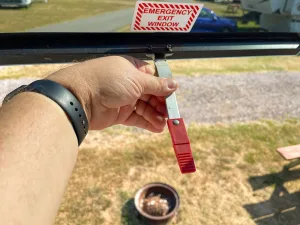
After it is unlatched, push the window all the way open to exit.
Emergency exit windows utilize rubber, foam, or plastic seals to keep out wind and water. Over time, these seals can become sticky, making the window difficult or impossible to open. 3-In-One’s RVcare Rubber Seal Conditioner will help to keep these seals pliable so they don’t stick to the frame. If the window is stuck already, unlock it and carefully press around the outside of the window to try to release it. Using a prying tool (Harbor Freight sells a plastic version) between the aluminum glass frame and the window frame sometimes works well to release the seal. Once released, clean the surfaces carefully before applying the conditioner. If you notice a gap in the seal, it may be a drain, so don’t close it off.
Jalousie windows, roof hatches, and entry doors all have hinges, locks, and mechanisms that need lubrication. RVcare Slide-Out Silicone Lube will work well for this. Of course, other silicone sprays will do the job, but with these three products from 3-In-One, the majority of maintenance and lubrication tasks in and around the RV can be accomplished.
In most framed windows, the fixed glass is held in the frame by a rubber gasket. Over time, these gaskets can fail and start to pull away, so keeping them sealed is essential. Lexel adhesive sealant works well for this application as a DIY fix that stops short of replacing the gasket. It’s a good product to keep in the RV for these kinds of repairs.
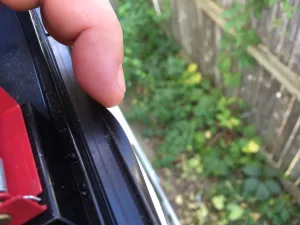
Without treatment, seals may stick to the window frame, making the window difficult to open.
If you have “frameless” windows, surprise! They’re not frameless. The glass is epoxied to the outside of the frame, which uses a “clamshell” design to affix to the wall, just like all other RV windows. The key here is to keep the emergency exit and jalousie window seals in good shape and the hinges and mechanisms working well. If one of these windows develops a leak, fixing it often requires removing the window from the RV and then taking out the glass and regluing it, similar to how a windshield is glued in place. Any automotive glass shop should be able to do this work for you, especially if you can bring the window to them. If you suspect the seal to the wall is leaking, you’ll need to remove the window from the RV to replace the sealant properly.
These days, windows are sealed to the RV wall via a foam gasket. This is especially true for smooth-sided aluminum or fiberglass RVs. The foam gasket is considered the primary seal. Sometimes, products like ProFlex RV flexible sealant or silicone are used as a secondary seal around the door, window, or side hatch. But often, no secondary seal is provided.
Roof escape hatches are sealed the same way as other roof vents, with butyl sealant as the primary seal and self-leveling sealant compatible with the RV’s roofing as the secondary seal.
With proper care, your RV windows and exits will remain readily operable, and you can rest easy knowing you’ll be able to leave the vehicle quickly in the event of an emergency.
SAFETY NOTE 1
All RV occupants should be shown how to operate the emergency exits. In addition, it’s important to establish a meeting place outside the RV in the event of an emergency and make everyone aware of this location.
SAFETY NOTE 2
Using emergency escape windows is a last resort and will likely result in injury, especially when it comes to tall fifth-wheels and motorhomes. Window escape ladders are commercially available; however, if you need to use the emergency window, you may not have time to get the ladder out and deploy it before exiting.
SAFETY NOTE 3
If the escape window doesn’t stay open of its own accord, keep an appropriate-size dowel rod or bar nearby to prop it open. If in a bedroom, grab some bedding to throw over the window frame to protect yourself from the potentially sharp edges as you exit. And, to help with the landing, position yourself “feet first.”