
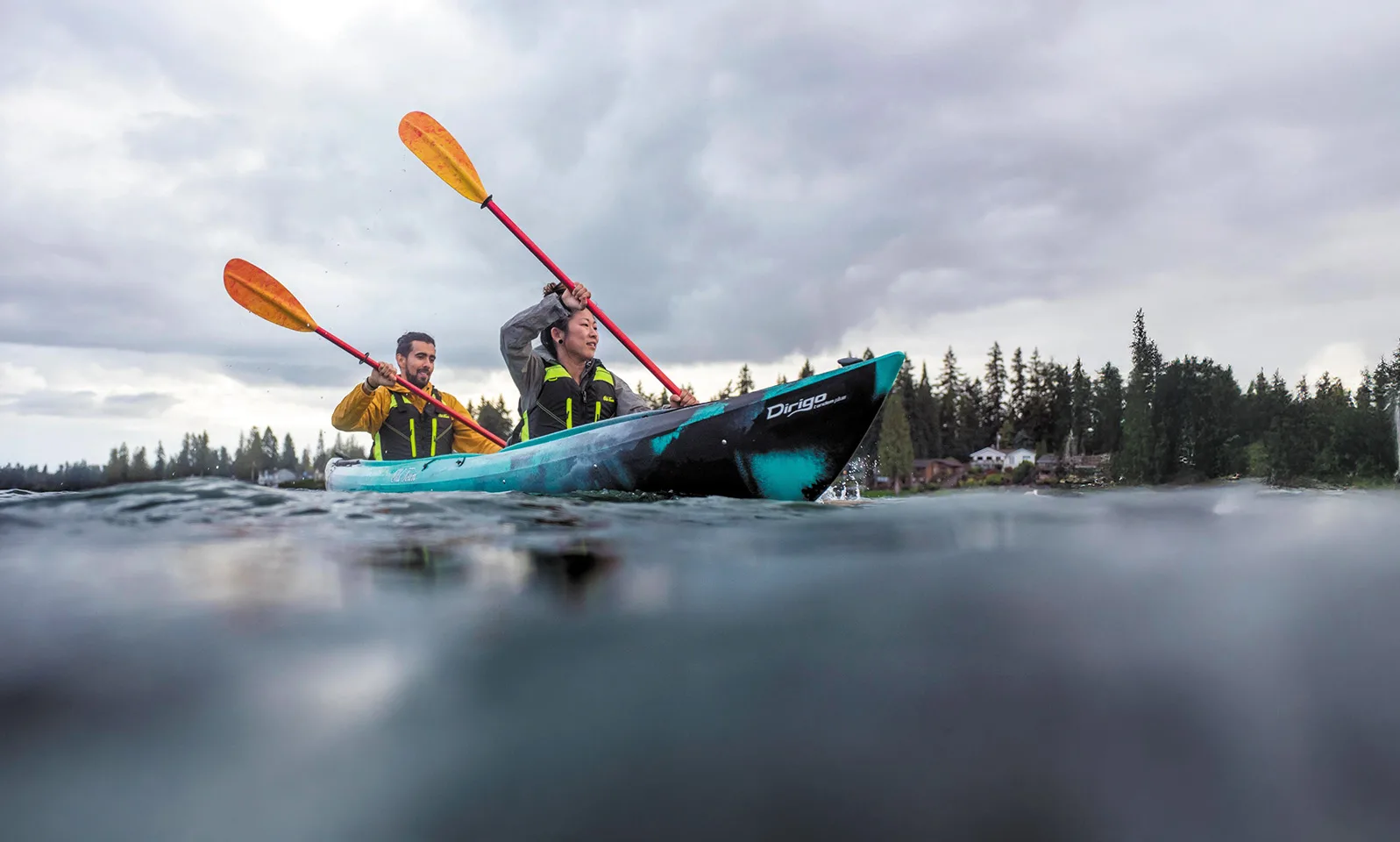
Available in a wide variety of types, lengths, and weights, kayaks enable paddlers to explore nature’s bounty along waterways throughout North America.
By George Moore, F460576
March/April 2025
For years, my view of kayaking involved visions of daring young athletes fighting through dangerous rapids and churning white water while navigating rushing mountain streams and rivers. This narrow perspective resulted from the many movies and videos I had watched that glamorized this sport. What I hadn’t seen were folks quietly paddling and enjoying a peaceful afternoon away from the hustle and bustle of everyday life. Surely all the vehicles I’d encounter on the highway carrying kayaks weren’t transporting people looking for challenging white water.
My fellow nature photographer and close friend Marc had been bugging me for several years to go kayaking with him. My answer was always, “No way. I’m not a strong swimmer, and kayaks tip over way too easily to carry expensive camera gear.”
During my first winter in Yuma, Arizona (2021-22), I visited several lakes to photograph water birds and waders. During these outings, I experienced the same challenges as on previous excursions — access to and clear views of wading birds and birds in the water.
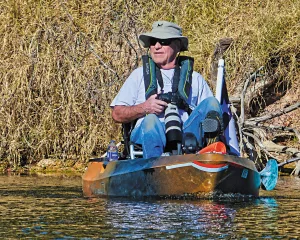
The author selected a pedal-driving fishing kayak, which is equipped with a raised seat and provides a stable base.
After returning home, I started researching kayaks and kayaking. I also went out with Marc (to his surprise) a couple of times (without cameras). These two outings introduced me to a whole new world of relaxing recreation, away from the maddening world, enjoying nature. No noisy outboard motors. Just quietly gliding across the smooth water, listening to the sounds of nature.
What I discovered while doing my research was that kayaking is increasingly popular. According to the Outdoor Foundation, in 2021 it was the fastest-growing water sport. In the previous five years, kayaking experienced a 32 percent increase in participation. And recreational kayaking is the most popular type. In 2022, 13.6 million people participated in recreational kayaking, making up 71.9 percent of all kayakers (Outdoor Industry Association).
Aquabound.com, a producer of paddles, listed five reasons for the rapid growth and popularity of kayaking.
- Rental kayaks are available almost anywhere recreational water exists.
- Entry-level kayaks are relatively inexpensive. Recreational kayaks to fit most budgets can be found.
- Kayaking is easy to learn.
- Folks who are less flexible or have bad knees or hips that make entry/exit from a sit-in kayak difficult may find a sit-on kayak (typically a fishing kayak) much easier to manage.
- Kayaks designed for various bodies of water are available. Being low profile, they don’t catch the wind like a canoe does.
In addition, recreational kayaking promotes enjoyment and relaxation. It provides low-impact exercise that one can approach as leisurely or as aggressively as desired.
Kayak fishing, I learned, is a major sport in many parts of the United States. Not only is it popular on lakes and rivers but also offshore. Yes, some kayaks have the stability to handle offshore fishing. Like their counterparts in powerboats, kayak fishermen (and women) can outfit their boats with a wide variety of accessories, even trolling motors. Kayaks are relatively easy to transport, much less expensive than a fishing boat, and don’t require a boat ramp.
With a vast number of kayak makes and models competing in the broad categories of recreational and fishing kayaks, it should be possible to find one to satisfy just about any personal requirement and budget. As I conducted my research, I learned that the majority of recreational kayaks are sit-inside (traditional) models, which are easier to paddle and glide through the water. They also come in various lengths and are fairly light (roughly 30 to 50 pounds).
Fishing kayaks, on the other hand, are generally wider, heavier (approximately 60 to 100+ pounds), and have a seat on top. Because of their design, fishing kayaks are harder to paddle and don’t glide as well as recreational kayaks. As a result, several manufacturers developed pedal drives to propel the fishing kayak. With this configuration, the kayaker pedals similar to a recumbent bike and steers with a rudder. The pedals turn a propeller. Fishing kayaks are also more stable; in fact, some are designed to stand on when fishing.
Continuing my research, my next question was how to transport the kayak. I found three basic means of transport: roof, pickup truck bed, and trailer. Several brands and models of roof racks are on the market; some even have assists to aid in lifting the kayak. Pickup truck beds are also a common means to transport kayaks. Several manufacturers offer different varieties of pickup bed extenders that mount to the trailer hitch to carry long kayaks in short beds. As for trailers, the third option, several makes and models are designed to carry from one to a few kayaks.
Now that I had all of this information, I needed to narrow it down to what would fit my needs. My number-one priority was stability. Remember, I’m not a strong swimmer and I carry expensive camera equipment. I also would be twisting and turning as I located and photographed wildlife. A fishing kayak with pedal drive (hands-free for my camera) was the way to go. At 5 feet 7 inches and 160 pounds, and 78 years old, I wasn’t about to lift a heavy fishing kayak onto the roof of my Ford Ranger 4×4 pickup, so it would have to fit in the pickup bed with a little overhang.
After narrowing down to one brand and multiple phone calls with a company rep, I settled for a 10-foot-6-inch Old Town pedal-drive fishing kayak. Lazy pedaling propels me through the water, and the kayak is super stable, enabling me to twist and shoot with no tipping or instability. The pedal drive also allows me to maintain or easily adjust my position when shooting. I do use a paddle for maneuvering when I am in a tight area or have to raise the propeller in shallow water.
Kayaking provides a quiet perspective for pursuing nature photography.
Yes, the kayak has provided me a totally new perspective for photographing water and shore birds. But more than that, it has opened up a whole new world of recreation. I am able to get out for a couple of hours or an entire day and enjoy the quiet of a lake or nature preserve as I leisurely work my way along the shore, observing the wildlife and pristine natural areas. I am in another world, temporarily isolated from day-to-day life. As I have learned, kayaking can be a relaxing and mind-clearing form of recreation. It also can be as physically demanding as I choose.
Once you have a kayak, where can you use it? Should you take it on RV trips? The answer is a strong YES. Every U.S. state and Canadian province has recreational water (lakes, ponds, rivers, and coastal water), and many have designated paddling trails. Visiting a state’s parks and recreation website or searching online for “paddling” or “kayaking” in a specific state or province should lead to many opportunities. Following are just a few examples:
- Arkansas has approximately 90,000 miles of rivers and streams ranging from gentle waterways to challenging white water, as well as more than 2,000 lakes and reservoirs. The Arkansas Watertrails Partnership (arkansaswatertrails.com) focuses on the slow-moving bayous, backwaters, and sloughs of southern and eastern Arkansas. These water trails provide incomparable opportunities to see wildlife, unique landscapes, and ancient trees.
- Minnesota is well known for its 10,000 lakes, plus 69,000 miles of rivers and streams, according to the Minnesota Department of Natural Resources. When combined, these provide unlimited kayaking opportunities. In addition, the state’s Boundary Waters is one of America’s most beautiful and remote areas. Located along the U.S.-Canada border in northeast Minnesota, the Boundary Waters boasts more than 1,500 miles of paddling trails over 1,000 lakes, rivers, and streams.
- Texas, a state known for cattle and oil, also promotes water sports and paddling (tpwd.texas.gov/paddling trails). With more than 3,700 named streams, 15 major rivers, and 3,300 miles of Gulf of Mexico tidal shoreline, plus lakes, bayous, and bays, Texas boasts a variety of kayaking opportunities. Among these are 81 designated paddling trails located in urban, rural, and coastal environments. The trails are well mapped, easily accessible, and of varying lengths.
- Even the desert Southwest offers kayaking opportunities. Yuma, Arizona, is one of the major snowbird destinations because of its sunshine, mild winter temperatures, and dry desert air. The Yuma area also has the Colorado River and seven lakes that provide opportunities to kayak. Some of these are in or border wildlife areas or preserves.
If you enjoy getting outdoors in nature and peaceful surroundings, try something new. Be bold and see what the world of kayaking has to offer. No noisy outboard motor. Just you, sitting on top of the water with a gentle breeze, the warm sun, and the soothing sounds of nature.