
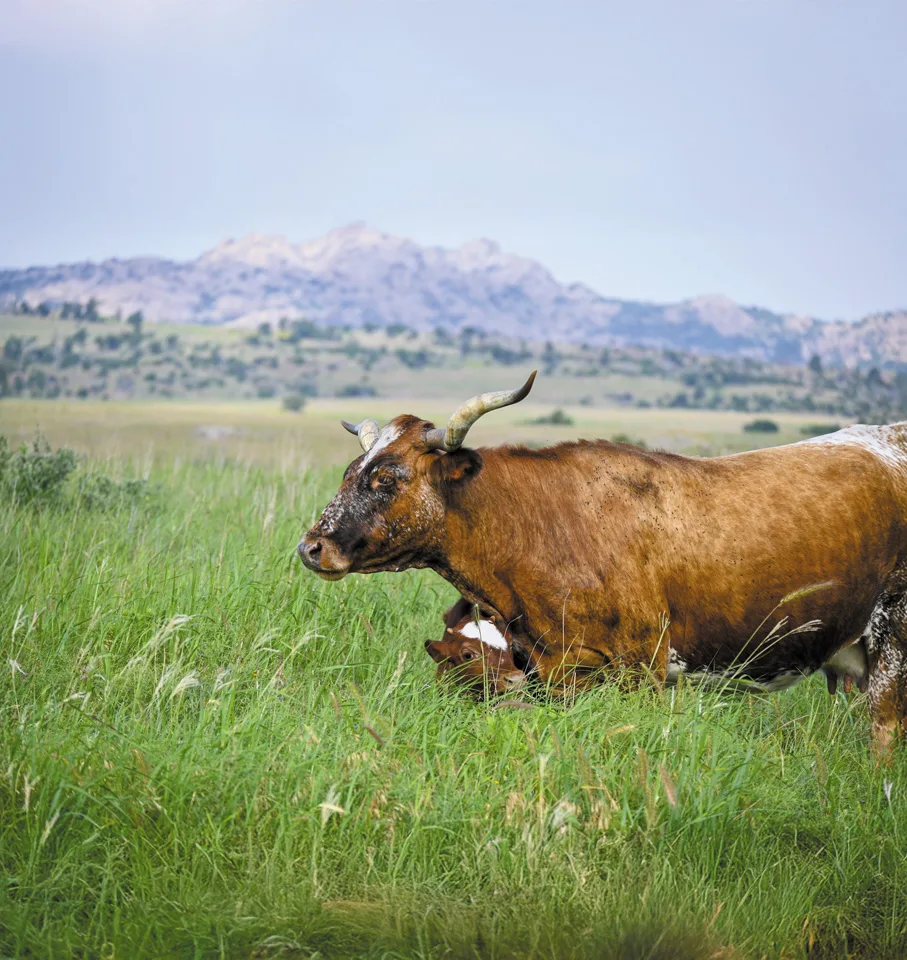
In southwestern Oklahoma, this sprawling land of mountains, prairies, lakes, and streams supports a broad array of mammals — bison, elk, deer, and even Texas longhorns — plus hundreds of bird and aquatic species.
By George Moore, F460576
A few miles west of Lawton, Oklahoma, the Wichita Mountains rise 400 to 1,000 feet above the prairie. Mount Scott, the tallest, reaches an elevation of 2,464 feet above sea level. Along with the approximately 500-million-year-old granite mountains, the refuge includes mixed-grass prairie, freshwater lakes and ponds, and an abundance of wildlife. Established on July 4, 1901, Wichita Mountains Wildlife Refuge is the oldest managed wildlife facility in the U.S. Fish and Wildlife Service system.
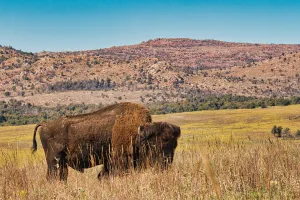
A revitalized bison population inhabits the refuge.
In the 1800s, the American bison was the king of the prairies. However, the arrival of settlers and buffalo hunters quickly reduced the once-plentiful buffalo herds almost to extinction. Through the efforts of the American Bison Society and funding provided by the U.S. Congress, 15 of the finest buffalo were relocated from the New York Zoological Park (now the Bronx Zoo) to the Wichita Mountains on October 11, 1907. From those original 15 bison, the refuge now manages a herd of 600 of their descendants. Since the bison roam free, visitors may find them crossing refuge roads, grazing in a meadow, or wandering through a campground. Young calves can often be seen in the spring.
Bison aren’t the only large animals that reside at the refuge. Almost 300 Texas longhorn cattle and an estimated 1,400 elk roam free. In September and October, visitors will hear the bugling of bull elk during the rut. The refuge is also home to white-tailed deer.
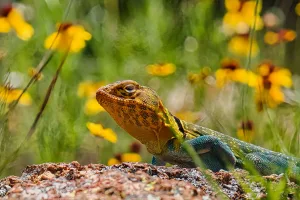
An eastern collared lizard, or “mountain boomer,” suns itself.
In addition to these large animals, tiny black-tailed prairie dogs attract attention. Visitors enjoy watching them scurry about, stand alert in their classic pose, and chatter warnings of an approaching predator. Look closely at a prairie dog colony, and you may spot a burrowing owl that commandeered a prairie dog hole.
Another popular small creature that inhabits the area is the eastern collared lizard (called the “mountain boomer” in Oklahoma). This harmless, brightly colored reptile can often be seen lazily catching rays on a rock.
With over 250 bird species nesting, feeding, or migrating through the area, Wichita Mountains Wildlife Refuge is a popular destination for birders. Two of the more popular birds are the black-capped vireo and the painted bunting. In summer, the vireo’s range in the U.S. is limited to a swath through Texas and a small section of Oklahoma. Once threatened, it was recently removed from the endangered species list, and today the greatest U.S. concentration of this bird is in the refuge.
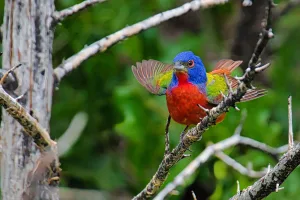
The male painted bunting sports a kaleidoscope of color.
Arguably the most colorful bird in the U.S., the painted bunting is a crowd pleaser. The males of the species sport a bright plumage of blue, green, yellow, and red. It has a limited range in the U.S. but maintains a strong summer presence in Wichita Mountains Wildlife Refuge.
Other popular summer avians include the male summer tanager — a completely red songbird — and the aptly named red-headed woodpecker. Winter visitors also look for white pelicans on the lakes and ponds and bald eagles soaring overhead.
In addition to its bountiful wildlife, Wichita Mountains Wildlife Refuge is known for vibrant colors in the spring and fall. In May and June, the land comes alive with blooming wildflowers; the timing may vary based on rainfall and temperature. Not only are the flowers glorious to look at, but I find it a special blessing to watch bison, longhorns, birds, and butterflies in the wildflower fields.
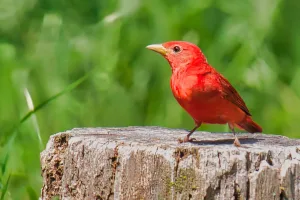
The male summer tanager is known for its vibrant red plumage.
During the fall, pockets of maple, oak, and elm trees display their hues as the leaves change from summer green to fall brilliance. These small groves of color are striking against the barren granite mountains and the grass prairie. Like the spring wildflower bloom, the weather can affect the timing of the leaf colors in fall.
Twelve small lakes and ponds in Wichita Mountains Wildlife Refuge provide year-round fishing for largemouth bass, sunfish, crappie, and channel catfish (an Oklahoma fishing license is required). Kayaking and canoeing are popular and permitted on five of the lakes. Swimming is prohibited. Visitors should check the refuge website for specific boating restrictions.
With 15 miles of trails, hiking and backcountry camping are also popular activities. Trails of varying difficulty pass through and over scrub oaks, grass prairies, and rocky granite mountains. Three-day-maximum permits are required for backcountry camping/backpacking.
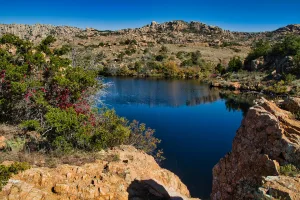
The Wichita Mountains provide a backdrop for freshwater lakes and streams.
Backcountry camping permits, along with reservations for RV sites at Doris Campground within the refuge, can be obtained at recreation.gov. The centrally located campground offers 23 electric sites and 47 non-electric sites for RVs. A dump station, water hydrants, and shower and restroom facilities are available.
A modern visitor center is open 9:00 a.m. to 5:00 p.m. daily. In addition to clean restrooms and a gift shop, it contains an excellent display of the history, geology, flora, and fauna of the refuge. I found the volunteers staffing the center to be friendly, knowledgeable, and helpful.
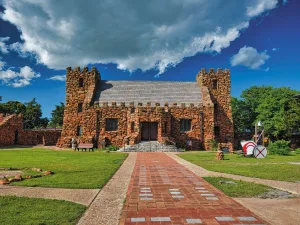
Within the refuge, the Holy City of the Wichitas is known for a century-old tradition of Easter passion plays.
The Holy City of the Wichitas, a 66-acre area within the refuge, is listed on the National Register of Historic Places. Designed to resemble ancient Israel, this site is home to North America’s longest-running passion play — the 100th annual outdoor production of “The Prince of Peace Easter Pageant” was presented in April 2025. The site contains 29 buildings integral to the story and 16 additional buildings and structures. The chapel is constructed of natural stone with 4-foot-thick walls. Its cathedral-style ceiling has 13 beautiful life-size angels, and the walls are adorned with oil portraits of the apostles. A gift shop and museum are also on the premises.
Military history buffs can enjoy a side trip to the U.S. Army Field Artillery Museum at Fort Sill in nearby Lawton. The museum traces the history of artillery from 1775 to the present. Displays include more than 70 guns and artillery pieces, along with artifacts, ammunition, and uniforms. The museum is open Tuesday through Saturday from 9:00 a.m. to 5:00 p.m. Visitors should use the Bentley Gate at 6796 Sheridan Road in Lawton (Sheridan Road North off U.S. 62).
If you enjoy getting out in nature, Wichita Mountains Wildlife Refuge is worth a visit.
MORE INFO
Wichita Mountains Wildlife Refuge
fws.gov/refuge/wichita-mountains
(580) 429-3222
The Holy City of the Wichitas
theholycityofthewichitas.org
(580) 429-3361
U.S. Army Field Artillery Museum
238 Randolph Road
Fort Sill, OK 73503
sill-www.army.mil/famuseum
(303) 854-7598