
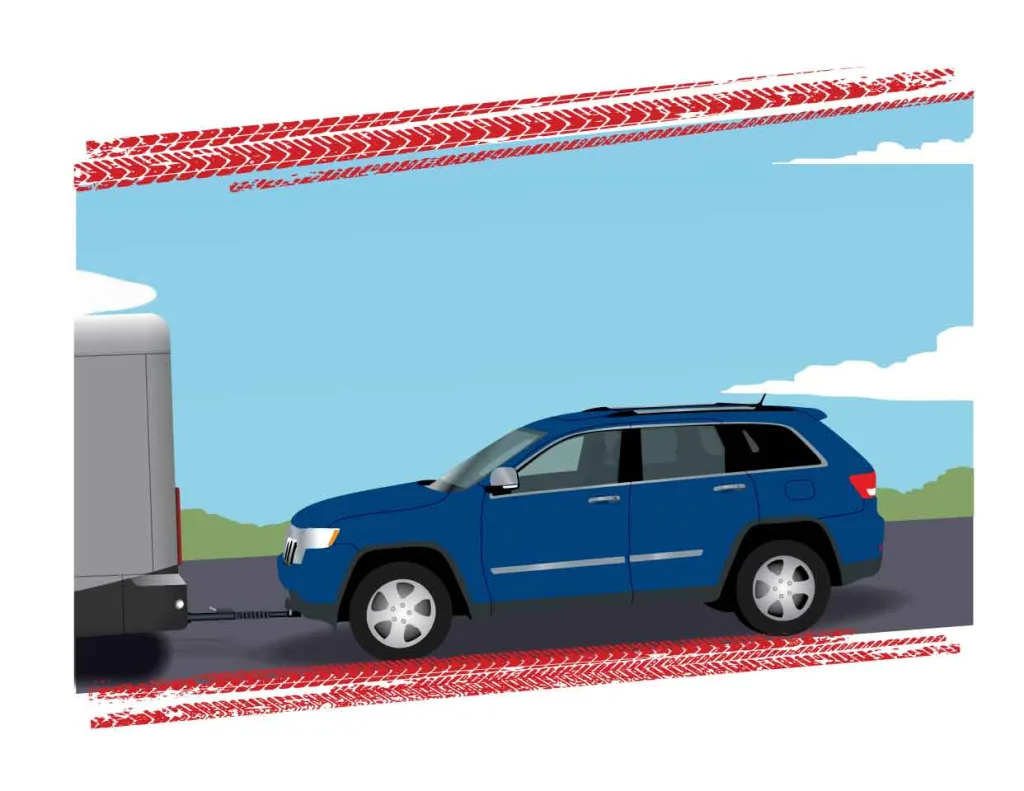
What to consider when selecting a vehicle and the equipment needed to tow it four wheels down behind a motorhome.
By Chris Hemer
May-June 2026
The RV industry never seems to run out of new ideas.
More than ever before, today’s consumers can find a home on wheels that suits their specific needs — from driver-friendly travel vans and Class A diesel pushers to luxury fifth wheels and overland off-road trailers, just for starters. What hasn’t changed is how you travel with these recreational vehicles. In most cases, you tow a trailer and use your truck or SUV to get around once you make camp, or you pull a vehicle behind your motorhome to make travel from the campsite/RV park more convenient.
While either choice involves towing, the equipment required and the setup involved are completely opposite. While a trailer was intended from the outset to be towed by something, the family vehicle was not — unless you consider a trip to the local garage behind a wrecker “towing.” Indeed, while many vehicles can be towed with all four wheels on the ground behind a motorhome, and are approved by the manufacturer for such use, they are still a long way from being ready to tow.
Consider that a trailer has a hitch that easily connects it to the towing vehicle, as well as its own brake system and lighting that work in tandem with the tow vehicle; all you do is plug a wiring harness into a receptacle next to the hitch, do a quick light check, and you’re ready to go. By contrast, a motor vehicle has no such accommodations. So, in order to tow it safely and legally behind a motorhome, you essentially have to fit your “dinghy” vehicle with all the attributes of a trailer — and that’s not as easy as it may sound.
Understanding what equipment is required ahead of time will make prepping your dinghy vehicle easier and prevent any unwanted surprises or unplanned expenses. Dinghy towing products involve numerous variables, but the essentials come down to a baseplate, a tow bar, an auxiliary braking system, electrical modifications, and protection of some kind to prevent your towed vehicle from being damaged while in transit.
BASEPLATE
A travel trailer is equipped with an A-frame (the part that houses the batteries and propane cylinders) and a coupler that accommodates the hitch ball. The car, truck, or SUV you plan to tow behind your motorhome is not so equipped, so the first step is to outfit your vehicle with what is commonly known as a baseplate.
In actuality, a baseplate is not a “plate” at all; it’s an application-specific steel structure that attaches to the vehicle’s frame and/or bumper brackets, enabling a tow bar to be connected. Contrary to what you might think, base plates for small cars are usually bigger, heavier, and more complex to install than those designed for a full-size truck or SUV. Because smaller car frames weigh less, the bar must be able to distribute the towing loads correctly to prevent damage to the vehicle’s chassis. Conversely, a truck or SUV is designed to carry and haul heavier loads, so its frame is already robust and doesn’t require a baseplate with as many structural enhancements (multiple tubes, gussets, etc.).
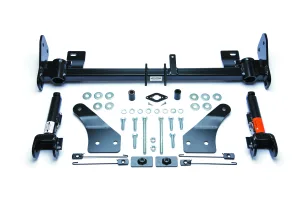
Vehicle base plates like this one from Roadmaster incorporate a strong steel structure, brackets, and hardware for mounting to the vehicle. This kit also incorporates remove arms, making the baseplate nearly once mounted to the vehicle.
Thus, not all baseplates require the same amount of effort to install. Some bolt in with minimal fuss, while others may require modifications to the vehicle’s front fascia (or even its complete removal) and/or trimming of the front grille or other areas. That’s why it’s a good idea to research baseplates for your vehicle first. Blue Ox, Demco, and Roadmaster have “fit lists” on their websites that will tell you if a baseplate is available; simply enter the year, make, and model of the vehicle you plan to tow. Installation instructions can also be downloaded, which is useful for determining how much work will be involved .
As you might imagine, the more work required to install a baseplate, the higher the labor costs. And because not all companies offer the same baseplate designs, be sure to shop each company’s site to find what works best for you. If you don’t know of an RV dealership or repair center that installs baseplates, the product manufacturer in question should be able to suggest a qualified dealer.
TOW BAR
What started as a simple steel A-frame designed in a 1970s vintage fabrication shop has evolved into a well-engineered, full-featured piece of towing equipment that seems easier to use with each passing year. It’s important to do some research to ensure you get the best possible tow bar for your particular needs and budget.
Let’s start with the mechanical aspects. All tow bars have a maximum weight rating, similar to that of a trailer hitch receiver. All tow bars on the market today are rated for at least 5,000 pounds, which covers just about every passenger car out there. So, from a capability standpoint, even the least expensive bar will do the job in most cases. However, if you plan to tow a full-size SUV or truck, load it with camping gear, and strap two kayaks to the roof, the towing weight can easily exceed 7,000 pounds. That’s why it’s important to first determine how much your vehicle weighs when it is full of fuel, passengers, and cargo.
An easy way to do this is with a quick trip to the scales; most truck stops have CAT scales that can provide you with your vehicle’s certified weight for about $16 (as of this writing). Penske also offers a public scale locator (publicscaleslocator.com) that makes it easy to find a scale near you.
Once you know your travel weight, look for a tow bar that has capacity to spare. After all, it is the component responsible for keeping your vehicle securely attached to the motorhome.
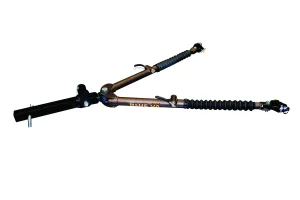
Blue Ox Avail tow bar
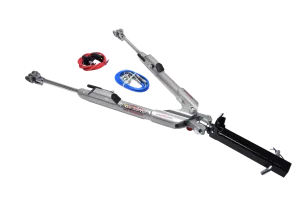
Roadmaster Sterling

D39495 Demco Dominator
While shopping for a tow bar, also consider any unique features or benefits a tow bar manufacturer may offer. For example, Demco’s Dominator bar comes standard with a 1.5-inch drop/rise male receiver and features a pivoting head that allows an additional three inches of adjustment. Roadmaster’s newest Nighthawk bar incorporates LED lighting embedded in each arm that illuminates with the RV’s lights for better visibility. It also features solid stainless-steel inner arms and an aluminum outer body with built-in channel guides for the safety cables and the power cord. Such safety and convenience features can make your travels much more convenient and enjoyable.
The physical weight of the tow bar can also make a big difference. Depending on the construction materials, design, and weight rating, tow bars can weigh 50 pounds or more, which can be a lot to handle. While it is true that the bar will spend most of its time mounted to either the towed vehicle or the motorhome, at times you’ll have to remove it (for storage, theft prevention, etc.). That’s when you may wish you bought a lighter bar. Some good lightweight (or lighter-weight) examples are the Blue Ox Ascent (31 pounds, 7,500-pound rating); Curt Rambler (all-steel construction, under 40 pounds, 7,500-pound rating); Demco Dominator (30 pounds, 7,500-pound rating); and Roadmaster Sterling All-Terrain (35 pounds, 8,000-pound rating).
Next, determine how the tow bar is stowed: on the vehicle or on the motorhome. Older, budget-style steel tow bars often stow on the vehicle, which some users prefer, but it can be unsightly, especially on today’s sleeker automobiles. A better choice, in our view, is a tow bar that stores in the motorhome’s hitch receiver and folds up neatly against the back of the motorhome. These typically come with a vinyl cover that will keep the tow bar clean and protected from the elements.
Depending on where you plan to stay (an RV park with a concrete pad or an unimproved campground, for example), you should verify if the tow bar you’re considering is a traditional or “non-binding” design. Traditional tow bars may be less expensive, but they are more difficult to connect to the vehicle and can be impossible to disconnect if you find yourself on uneven ground. So-called non-binding bars offer legs that move independently of one another, so the dinghy vehicle doesn’t have to be perfectly aligned with the motorhome when connecting. They also incorporate latches that can be released to make it easy to connect/disconnect in less-than-ideal circumstances.
Keep in mind that each equipment manufacturer engineers its products to work with other products in the same family and aren’t necessarily designed to work with another manufacturer’s products, so mixing and matching may not be a good idea. That said, most manufacturers provide details on mounting considerations and available solutions. For example, Blue Ox, Demco, and Roadmaster do offer adapters that make it possible to connect their tow bar to a competitor’s baseplate. You can usually find these products in the tow bar section of each company’s website, but if you aren’t sure, always call and ask what is included with your tow bar, and what else may be required. Blue Ox and Roadmaster offer complete kits with everything you need to tow (called Accessory Kits and Combo Kits, respectively), while Demco offers a variety of kits and individual options. Without knowing exactly what you’re looking at, it can get confusing. So again, find out what you will (and won’t) need ahead of time.
BRAKING SYSTEMS
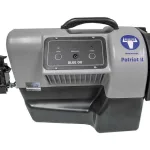
Blue Ox Patriot II auxiliary braking system.
Although a towed vehicle has its own braking system, no one will be inside it to activate the brakes while towing, so they won’t function while you’re underway. This is where auxiliary braking systems come in.
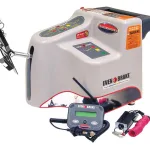
Roadmaster Even Brake auxiliary braking system.
Before continuing, we should mention that some RVers don’t use an auxiliary braking system because they believe the motorhome’s brakes are sufficient to slow both the coach and the towed vehicle. While that may be true in general, the question is, how much will that increase the braking distance? Obviously, it depends on the motorhome and the weight of the dinghy vehicle in question, but there’s no doubt you will appreciate all the braking power you can get when you’re heading downhill and traffic suddenly slows in front of you.
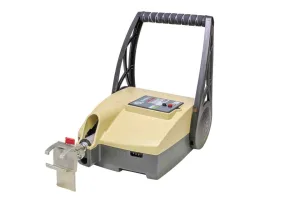
Brake Buddy Classic II auxiliary braking system
Reducing your braking distance by just 5 feet could be the difference between a white-knuckle stop and a nasty rear-end collision. A supplemental braking system will also take some of the burden off your motorhome’s brakes, helping to prevent dreaded brake fade and improving brake life.
If these aren’t good enough reasons for you to purchase a dinghy brake system, consider this: They’re required by law in most U.S. states and Canadian provinces. While the requirements differ by jurisdiction, they’re all based on trailer weight or stopping distance, and in the eyes of the law, a towed vehicle is considered a trailer. To wit: the National Highway Traffic Safety Administration (NHTSA) defines “trailer” as “a motor vehicle with or without motive power, designed for carrying persons or property and for being drawn by another motor vehicle.”
Though a number of dinghy brake systems are available, they fall in two main categories: portable and permanent.
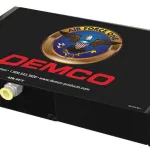
Demco Air Force One portable system.
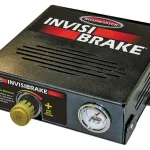
Roadmaster InvisiBrake portable system
Portable Systems
By far, portable systems are the most popular, simply because they install/set up easily and can be transferred from one vehicle to another — a boon if you plan to tow more than one vehicle. Portable systems are placed between the driver’s seat and the brake pedal, and they incorporate an arm and pedal clamp that depresses the vehicle’s brake pedal when the motorhome’s brakes are applied. They have variations that you should compare, but perhaps the most important thing to look for is a system that incorporates proportional braking — when the brakes in the motorhome are applied, the dinghy brakes apply in the same manner, both in timing and force. Systems without proportional braking can cause a perceptible jerking sensation when the brakes are applied. They work, though not as smoothly as a proportional system.
Permanent Systems
Permanent systems are a great choice if you tow only one vehicle and plan to keep it for a long time. While these systems take longer to install initially, very little preparation is required before towing –– just plug in a power cord and/or quick disconnect, and the system is ready. Another key benefit: These units tie into the air or hydraulic brake system in the motorhome and/or its electrical system (brake signal) to activate the brakes in the towed vehicle, so they are all proportional. In addition, permanent systems are practically invisible, typically consisting of a small control unit that mounts underneath the hood or out of view in the passenger compartment.
LIGHTING
When towing a vehicle behind your motorhome, it must have running lights, turn signals, and brake lights that operate in concert with the motorhome, as well as a breakaway system that will apply the dinghy’s brakes should it become disconnected while towing. That means the lighting system in the dinghy vehicle must be modified and fitted with a wiring harness that can plug into the motorhome’s four- or seven-way power receptacle (next to the hitch receiver) when it’s time to tow. This same harness may also be used to operate a supplemental braking system and/or to keep the dinghy vehicle’s battery charged with the addition of a charge line.
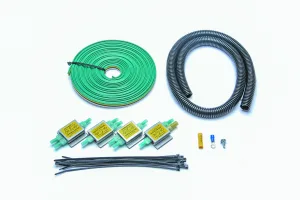
Roadmaster’s #152 Economy Four Wire Kit is a universal wiring kit.
Back in the early days of dinghy towing, such installation work required a skilled automotive technician and hours of labor. Today, however, ready-made kits provide
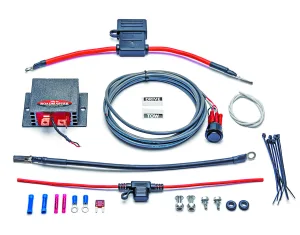
One of the many Roadmaster FuseMaster kits.
an electrical connection to the motorhome without in-depth knowledge needed. Generally speaking, these kits can be divided into three basic types: pre-fabricated, application-specific harnesses that plug and/or splice into the dinghy’s electrical system; “universal” towed car wiring kits; and so-called “bulb-and-socket” systems.
Obviously, a wiring harness designed for plug and play installation would be the easiest solution, but these are only available for certain models, most of which are 10 or more years old. As automotive electrical systems grow more complex with every passing year, it has become increasingly difficult for manufacturers to keep up, but companies like Blue Ox , Demco, and Hopkins Towing Solutions offer fit lists that make it easy to determine if a ready-made kit is available for your car, truck, or SUV.
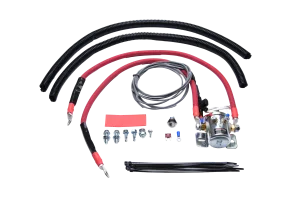
Roadmaster’s line of battery disconnect kits.
If not, a universal wiring kit can be made to fit almost any vehicle by splicing into the existing electrical system.
Finally, a bulb-and-socket system bypasses the vehicle’s electrical system entirely with separate wiring and individual bulb/socket assemblies that mount inside the existing taillamp housings.
The vehicle year, make, and model, as well as who will be performing the installation (you or an RV repair center/dealer technician) will likely dictate which wiring solution will work best for you.
In any case, each wiring setup includes a wiring harness that is routed to a socket located at the front of the vehicle, where it can be plugged into the motorhome when you’re ready to tow. In some cases, wiring kits that incorporate the vehicle’s electrical system may also include one-way diodes that prevent electrical “backflow” from the motorhome’s electrical system to the dinghy (and vice versa), which can damage both vehicle systems. Blue Ox, Demco, Hopkins Towing Solutions, Roadmaster, and other companies offer viable choices.
If you don’t like the idea of someone cutting into your vehicle’s electrical system, another option is a temporary
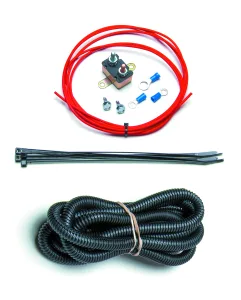
Roadmaster and others offer charge line kits that use the motorhome’s electrical system to keep a constant trickle charge on the dinghy’s battery.
lighting system that attaches to the vehicle with suction cups or magnets, similar to what tow trucks may use to transport a vehicle. These kits include a power cord that is routed across the dinghy vehicle and plugged into the motorhome when it’s time to tow. Although they’re not as tidy as an integrated wiring system and require more setup time before towing, they may be a good choice if you tow more than one vehicle and/or would like to preserve the original electrical system in your vehicle.
Clearly, not all vehicle electrical systems are the same, so it’s important to check your vehicle’s owners manual for the required towing routine. Newer vehicles, in particular, require an increasing number of steps to prepare them for towing; most involve extra time and can result in some real hassles.
For example, many new vehicle owners manuals specify that the negative battery cable be disconnected every time you tow, which means that all your data (time/date, radio presets, etc.) will need to be re-set once you arrive at your destination. In addition, a disconnected battery can’t power up a portable braking system for very long, which creates its own issues. Roadmaster and others offer battery disconnect kits that allow you to turn battery power on or off with a remote switch. Roadmaster’s #766 kit can also provide a positive current source for breakaway systems, portable dinghy brakes, or other accessories that must be connected to the battery.
In other cases, the manufacturer may specify that certain fuses be removed before towing — and you can just imagine the fun of breaking or losing them when you’re miles away from civilization on a holiday weekend. One solution is Roadmaster’s FuseMaster kits, which hold the fuses remotely and allow them to be disconnected by flipping a switch. Installation details vary depending on the vehicle, but it is a fairly simple job and will save you hours of time and frustration.
A dead or dying towed vehicle battery vexes many motorhome owners. It seems unavoidable, because the owners manual specifies that the key remain in the “ACC” (accessory) position while towing to prevent the steering wheel from locking. Unfortunately, this results in a constant drain on the electrical system. A charge line kit like the one available from Roadmaster (part #156-25) uses power from the motorhome’s charging system to help maintain the dinghy vehicle’s battery while in tow, providing up to 15 amps of current. The Roadmaster kit includes 14-gauge wire and a thermal circuit breaker, and is relatively straightforward to install, even for those with limited electrical experience.
As vehicle electrical systems become more complex, unexpected problems can arise when preparing a vehicle for towing. While we can’t go into specific issues for each vehicle make and model, it’s a good idea to contact the component manufacturers mentioned in this article to ask about any known issues with the vehicle you’re considering or already own. In all likelihood, they’re aware of the problem and can provide a recommendation.
PROTECTION
A towed vehicle receives its fair share of abuse on the road. Since it follows directly behind the motorhome, it is susceptible to damage caused by rocks, gravel, wet paint, road tar, and other debris thrown up by the RV’s rear tires. That’s why protecting your dinghy vehicle is so important.
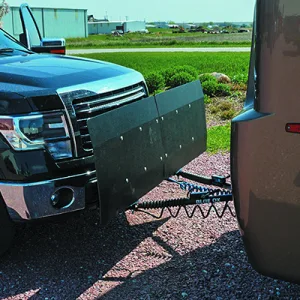
Blue Ox Karguard
The easiest place to start is with the motorhome, which can be fitted with any number of rock guards. Designs vary depending on the manufacturer, but these generally attach to the rear bumper of the motorhome and employ a rubber shield or rubber/nylon strips that hang down a few inches from the road surface. Some motorhomes include one already, but if not, a rock guard will serve as the first line of defense against damage.
Next, consider a rock shield, which protects the front of your vehicle from (you guessed it) rocks and gravel, as well as other debris thrown its way. BlueOx, Demco, and Roadmaster offer shields, but it’s important to check with the manufacturer of your choice to make sure the shield will work with the equipment you already have. Rock shields typically mount to the base plate or tow bar and may not be interchangeable with all equipment brands.
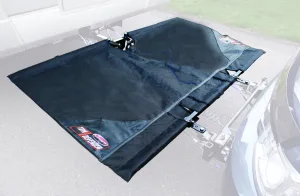
Roadmaster Tow Defender
It’s important to note here that some vehicles approved for dinghy towing by their manufacturers include a special note in the owners manual that cautions against using a rock shield, because it can block airflow to the front of the vehicle. This is because some vehicles employ a transmission cooler that may not work effectively if it isn’t
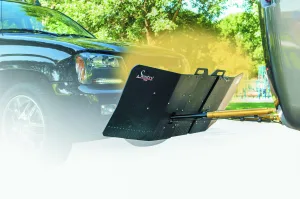
Demco Sentry Deflector
exposed to a steady flow of air. Even though the transmission isn’t driving the wheels while being towed, it is spinning at highway speed and could overheat and suffer damage if the cooler can’t do its job. Always be sure to check the owners manual carefully for any cautionary notes about rock shields or other devices that may prevent adequate airflow.
If a rock shield can’t be used on your vehicle, you might consider Roadmaster’s Tow Defender, an all-weather heavy-duty screen that deflects rocks, gravel and other debris while allowing airflow to the front of the vehicle.
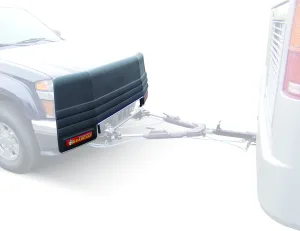
Roadmaster Guardian
Finally, you may also consider paint protection film, such as the product offered by 3M and others. It must be professionally applied and is fairly expensive (several hundred to several thousand dollars depending on the amount of coverage) but it lasts for years. Simply enter “paint protection film” into your favorite search engine, and you’ll find a plethora of information.
TIRE PRESSURE MONITORS
Tire pressure monitoring systems (TPMS) are now standard equipment on newer vehicles, but since you won’t be in the vehicle while it is being towed, you won’t know if any tires are running critically low and could be damaged.
A number of TPMS systems are sold today; one good example is the TireMinder i10 from Minder Research. It can monitor up to 20 tires at once and simultaneously displays information about 10 tires, automatically switching between the front (towing) and rear (towed) vehicles, according to the company. The system checks tire pressure every six seconds, monitoring leaks, blowouts, high temperature, and low/high pressure with a reported +/-1 PSI accuracy. The 3.15-inch color display located in the towing vehicle receives signals from the valve-stem-mounted transmitters.
WHAT TO TOW?
Dinghy-towable vehicles run the gamut from economy cars all the way up to full-size pickup trucks and SUVs. But what is the right choice for you?
The first, and most important, consideration is how much your motorhome can tow. The coach manufacturer supplies a tow rating, or you can perform a basic calculation by weighing the motorhome at a public scale full of fuel, water, and all the supplies you normally bring. Deduct this figure from the motorhome’s gross combination weight rating (GCWR), and what’s left over is your towing capacity. Remember, it’s always better to err on the lighter side. So, if you can tow 10,000 pounds, set 8,000 pounds (or less) as your maximum. This will ensure that your coach won’t be overloaded and will perform adequately on long grades and during hard braking.
Next, ask yourself how you will be using the vehicle. Do you want to travel off the beaten path and explore new places? Then an SUV or pickup might be the best choice. If city travel is for you, a small, light economy car might be your preference. If you’re buying new, make sure to review the vehicle’s owners manual to see what steps are required before towing. Most vehicle manufacturers have an “owners site” where you can enter the year, make, and model of the vehicle you’re considering, then download a handy PDF. Check the index for “dinghy towing,” “recreational towing,” “towing behind motorhome,” “flat towing”, etc. There, you’ll be able to confirm that the vehicle is towable and what steps are involved.
Once you’ve verified that the vehicle is dinghy-towable, check the equipment manufacturers’ websites to make sure a baseplate is available, and what steps are required to install it.
New versus used? Older vehicles have their advantages. They generally require fewer steps to prepare for towing, have a baseplate readily available, and will minimize grief (and repair costs) if they become damaged while in tow. Depending on how old the vehicle in question is, you may still be able to download an owners manual or an earlier dinghy towing guide to make sure it’s towable. Although you may need to be more selective when choosing a newer vehicle, you may appreciate its comfort and overall drivability when it’s not being towed.
In any case, ALWAYS make sure that the vehicle is approved by the manufacturer for dinghy towing — especially if it’s brand-new or under warranty. Otherwise, your warranty claim can be denied, and you’ll be on the hook for any repairs.
A dinghy vehicle remains the easiest, most convenient way to travel away from the campsite or RV park. When properly equipped, it can provide you with years of trouble-free travels.