
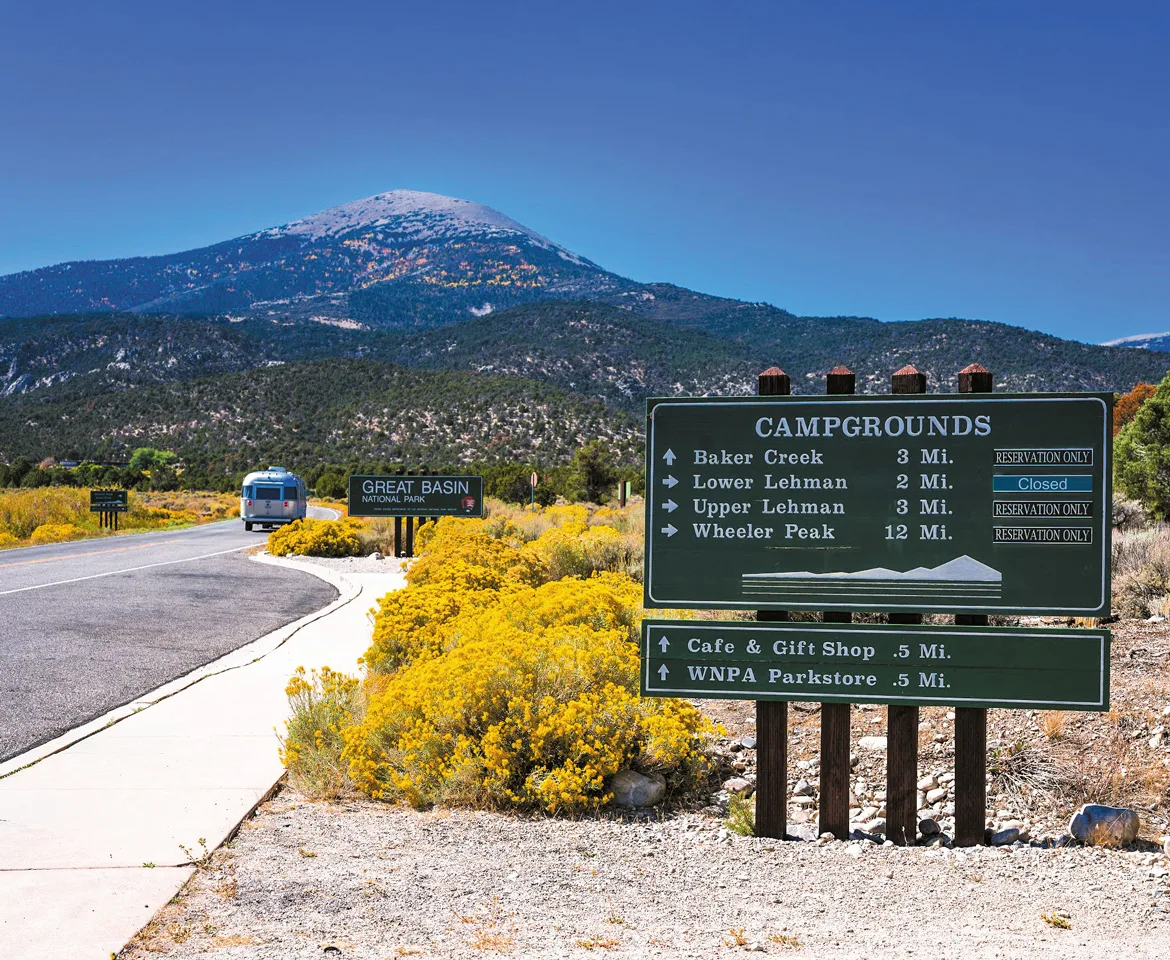
Thanks to dramatic elevation changes within its boundaries, this Nevada jewel displays a variety of natural wonders, some especially colorful in the fall.
By Meagan Butler, F478412
September-October 2026
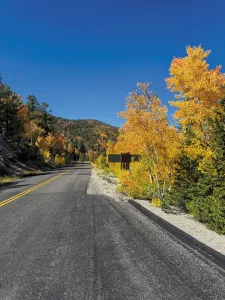
Wheeler Peak Scenic Drive gleams with fall color.
Like many RVers, I’m working my way through America’s national parks one trip at a time. Great Basin National Park became my 31st almost by accident.
A last-minute RV installation sent my husband, Pat, and me in a different direction than originally planned. As we adjusted our route through the Southwest, we realized we could add another national park to the trip. Great Basin wasn’t exactly on the way, but it was close enough to make the detour.
The surprises started before we even entered the park.
We drove west across Nevada on U.S. Route 50 — often called The Loneliest Road in America — and in the distance, Wheeler Peak began to rise from the basin. At first, I assumed it was just another mountain range, but mile after mile, the peak grew larger against the flat, open landscape. Then I saw the distinctive brown sign: “It’s Great Basin National Park!”
I noticed the colors — pockets of gold, red, and orange scattered across the mountainside. It looked like a
watercolor painting.
I looked at Pat with the kind of excitement usually reserved for Christmas morning, a new national park stamp, an Oreo-flavored ice cream, or something equally ridiculous. It had never occurred to me that we might find golden aspens in a Nevada desert.
Whatever I thought Great Basin was going to be, I was already wrong.
WHAT IS THE GREAT BASIN?
Before driving into the park, we stopped at the visitor center in Baker. As I do for every national park visit, I went straight for the passport stamp. While there, I wandered through the exhibits, learning about Wheeler Peak, the ancient bristlecone pines, and something I hadn’t thought much about before: the Great Basin itself.
Great Basin National Park is named after one of North America’s most unusual geographic regions. Unlike most of the United States, where rivers eventually find their way to an ocean, the Great Basin has no outlet to the sea. Rain and snow that fall there collect in lakes, soak into the ground, or evaporate back into the atmosphere.
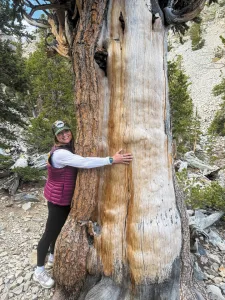
Meagan hugs a bristlecone pine in the Wheeler Peak Bristlecone Grove.
The Great Basin stretches across most of Nevada and into parts of Utah, Idaho, Oregon, California, and Wyoming. Rather than one enormous basin, it’s made up of dozens of mountain ranges separated by broad valleys.
Standing in the visitor center, the maps and exhibits helped me understand the region. Later, as we drove deeper into the park, I began to see it. The broad basin stretched below us while Wheeler Peak rose more than 13,000 feet above sea level. Those dramatic elevation changes shape everything here, from the plants and wildlife to the temperatures and even the seasons.
A DESERT THAT CLIMBS INTO THE CLOUDS
Armed with a little more understanding, we left the visitor center and headed toward Wheeler Peak.
As the road climbed, so did my curiosity. Sagebrush-covered hills gave way to groves of quaking aspens, and the farther we drove, the cooler the air became. I rolled down the window and let the crisp mountain air fill the truck. The scent of fall leaves drifted through the cab while filtered sunlight cast a warm, golden glow across the mountainside. I wasn’t thinking about the next stop anymore. I was simply there, and at peak fall color.
The Great Basin Desert is America’s only cold desert, receiving much of its precipitation as snow rather than rain. Baker sits just over 5,300 feet above sea level, while Wheeler Peak rises to 13,063 feet. Those nearly 8,000 feet of elevation gain create dramatically different climates within a relatively short drive.
Suddenly, everything I’d learned in the visitor center clicked, and the golden aspens finally made sense
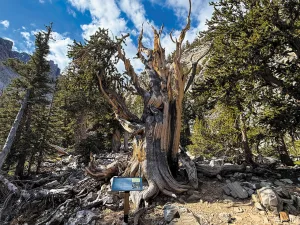
Along the Bristlecone Trail, the gnarled trees tell their stories, thousands of years in the making.
OLDER THAN THE ROMANS
Before visiting Great Basin National Park, I knew the bristlecone pines were ancient. I’d read about them in the visitor center and learned that some of these trees had been growing for thousands of years. One of the park’s most famous bristlecone pines, known as Prometheus, was later estimated to be between 4,700 and 5,200 years old. While Prometheus is no longer standing (cut down in 1964), other ancient bristlecone pines continue to grow on the slopes of Wheeler Peak today.
The best place to experience them is the Wheeler Peak Bristlecone Grove. The trail begins at the end of Wheeler Peak Scenic Drive, and while there are several opportunities to see bristlecone pines throughout the park, this 2.8-mile round-trip hike is one of the most accessible.
As I walked among the twisted, weathered trees, I found myself slowing down. Every trunk seemed to tell its own story, shaped by centuries of wind, snow, drought, and time. Eventually, I reached out and placed my hand against the bark. Then I wrapped my arms around one of the trees, laughing because I couldn’t get close to reaching around the trunk. Pat caught the moment with my camera, and it’s one of my favorite photos from the trip.
Standing there, it occurred to me that this tree had already lived through thousands of years of history. It had been growing long before Nevada became a state, long before the National Park Service existed, and long before I would someday stand beside it trying to comprehend its age.
WRITTEN IN ICE
As we continued exploring Wheeler Peak, I found myself looking beyond the bristlecone pines to the mountains surrounding them.
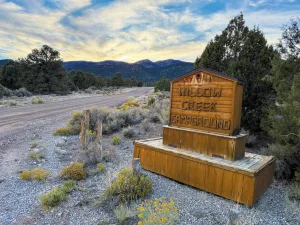
The entrance to Willow Creek Campground in Ward Charcoal Ovens State Historic Park.
Standing among some of the oldest living trees on Earth, it was easy to think of the Great Basin as a place frozen in time. But the mountains told a different story.
During the last Ice Age, glaciers carved the cirques, valleys, and basins surrounding Wheeler Peak. Although the glaciers are gone, visitors can still see the landscape they shaped, including the Lehman Rock Glacier tucked high on the mountainside.
Great Basin may feel timeless, but its landscape has never stopped changing.
WATER, STONE, AND SKY
By now, I should have known better than to make assumptions about Great Basin National Park.
Snowmelt from the park’s higher elevations feeds streams and alpine lakes tucked among the mountains, yet another surprise in this high-desert landscape. Some of the park’s most remarkable features, however, lie beneath the surface.
Lehman Caves, located near the park entrance, is a limestone cave system filled with delicate formations that have been developing for hundreds of thousands of years. Unfortunately, this was one surprise I discovered too late. Thinking we could simply show up and buy tickets, Pat and I walked into the Lehman Caves Visitor Center only to learn that every cave tour had sold out. If visiting Lehman Caves is on your list, learn from my mistake and reserve your tour before your trip.
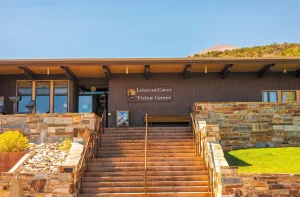
The Lehman Caves Visitor Center provides an introduction to Nevada’s longest cave system, which can be explored on ranger-led tours.
Missing the cave tour wasn’t my only lost opportunity.
I also had no idea that Great Basin National Park is an International Dark Sky Park. According to their website, they’re “champions of the dark sky movement … educating the public through outreach, working for dark sky protections.” If I had done just a little more research, I would have packed my tripod and planned to stay after sunset. Great Basin is home to some of the darkest skies in the United States and offers ranger-led astronomy programs, constellation talks, and an annual astronomy festival. It even has a research-grade observatory: the only one located within a national park.
Now, I have a reason to come back!
BIG SCENERY, SMALL ROADS
Great Basin National Park welcomes RVers, but it isn’t designed for today’s larger motorhomes. As Pat and I explored the campgrounds and parking areas, it quickly became clear that smaller RVs have far more flexibility.
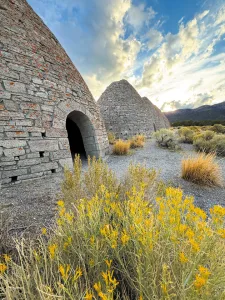
Limestone ovens at Ward Charcoal Ovens State Historic Park were once used to make charcoal.
Vehicles longer than 24 feet aren’t permitted beyond Upper Lehman Creek Campground on Wheeler Peak Scenic Drive. If you’re traveling in a larger motorhome or towing a longer trailer, plan to leave your RV at camp and explore the upper elevations by tow or passenger vehicle.
CONCLUSION
Before heading home, we drove back to the Nevada-Utah state line so I could get the obligatory photo with one foot in each state. Standing there on the Loneliest Road in America, I looked back toward Wheeler Peak one last time.
When we first drove on this highway, I saw a mountain. As we departed, I saw a cold desert, ancient trees, glacial landscapes, caves I still need to explore, and a night sky waiting for me to return.
RV Parking In Great Basin National Park
Oversized parking is available at both the Great Basin Visitor Center in Baker and the Lehman Caves Visitor Center.
There is no designated oversized parking at the Bristlecone Trailhead. The parking lot is small, and maneuvering or turning around can be difficult, especially during busy times.
If you’re traveling in a larger RV or towing a trailer, leave your RV at camp or one of the visitor centers and drive your tow vehicle or passenger vehicle to the trailhead.
WHERE TO CAMP
Inside Great Basin National Park
The park’s campgrounds are all developed or primitive, with no hookups. Campsites include picnic tables, fire rings, and vault toilets, and a seasonal dump station and potable water fill station are available near the park entrance. Cell service is limited throughout much of the park.
- Lower Lehman Creek. The park’s most accessible campground. It’s open year-round and accommodates RVs up to 40 feet.
- Upper Lehman Creek. Some RV sites are available, but vehicles longer than 24 feet cannot continue beyond this campground on Wheeler Peak Scenic Drive.
- Baker Creek. The best option for larger RVs inside the park. Many sites accommodate rigs up to 50 feet, although the upper loop (sites 9–14) is closed to all RVs.
- Wheeler Peak. At nearly 10,000 feet, this campground is best suited for Class B motorhomes and smaller trailers because of tight curves, steep grades, and shorter campsites.
- Snake Creek Campgrounds. Located on the park’s quieter south end, these primitive campgrounds accommodate RVs up to 30 feet and are best suited for campers seeking a more secluded experience.
Outside the Park
- Whispering Elms Motel & RV Park (Baker). Full hookups, showers, laundry, Wi-Fi, and just minutes from the park entrance.
- Ely KOA Journey (Ely). Full hookups and convenient access to groceries, restaurants, and fuel. It’s about 45 minutes from the park.
- Willow Creek Campground. A quiet, year-round campground in Ward Charcoal Ovens State Historic Park with spacious sites and no hookups.
- BLM & Humboldt-Toiyabe National Forest. Dispersed camping for self-contained RVs.
WORTH THE DETOUR: WARD CHARCOAL OVENS STATE HISTORIC PARK
If you’re staying in Ely, set aside an hour to visit Ward Charcoal Ovens State Historic Park, about 20 miles south of town. The park is easy to reach via well-maintained dirt roads.
Built in the late 1870s, the park’s six beehive-shaped limestone ovens were used to turn pinyon pine and juniper into charcoal, which fueled nearby silver smelters. Standing nearly 30 feet tall, they’re remarkably well preserved, and you can still walk inside every one of them.
Willow Creek Campground, located within the park, is open year-round and accommodates RVs up to 45 feet. While there are no hookups, campers will find spacious sites, picnic tables, fire rings, vault toilets, and seasonal drinking water.
Travel tip: The park uses a self-pay fee station, so bring cash or a check and a pen to complete the payment envelope.
BEFORE YOU GO
- Reserve your Lehman Caves tour before your visit. Tours frequently sell out, especially during the busy season.
- Fuel up in Baker or Ely before entering the park. Services inside the park are limited.
- Download maps before you arrive. Cell service is spotty throughout the park.
- Dress in layers. Temperatures can change dramatically between the desert floor and Wheeler Peak.
- If you’re hiking the Bristlecone Trail, arrive early. The trailhead parking lot is small and fills quickly.
- Don’t rush Wheeler Peak Scenic Drive. Overlooks are part of the experience.
- Stay after sunset if you can. Great Basin is an International Dark Sky Park, and the night sky is every bit as memorable as the cenery during the day.
- For more information about Great Basin National Park, visit nps.gov/grba.