
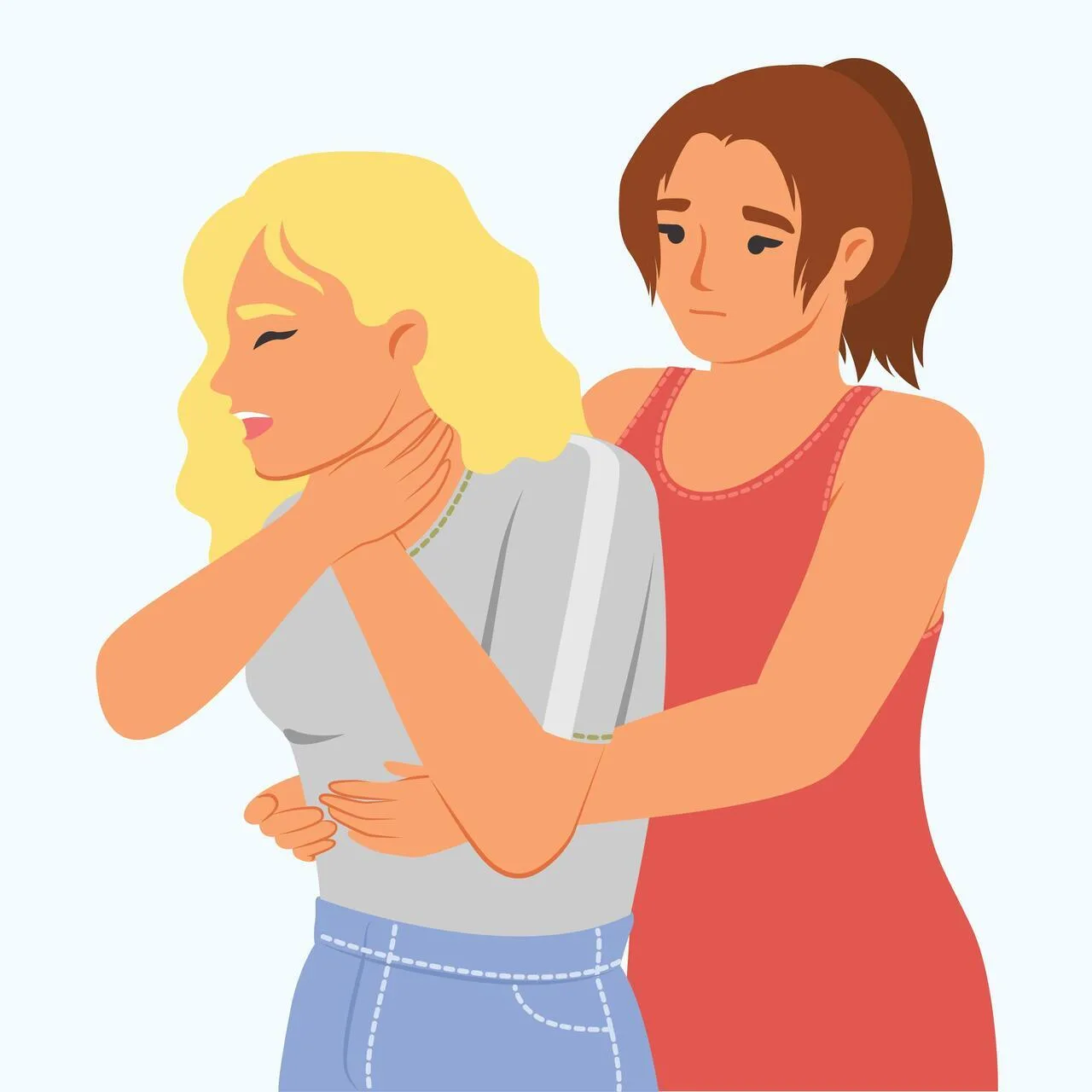
Knowing how to assist a choking victim may help save their life.
By Randy Davis, F471978
September/October 2026
You are sitting around a campfire, roasting and eating hot dogs with your RVing friends. Suddenly, the person next to you grabs their throat, appears to be in distress, and is trying to cough but not making a sound. These are signs of choking. Would you know what to do? If you do not act quickly, your friend could die. You have around four to six minutes to open the victim’s airway. Many times, people camp far away from any Emergency Medical Response, so their life may depend on you.
According to the National Safety Council, 5,923 people died from choking in the United States in 2024.Choking is the fourth-leading cause of unintentional death, the leading cause of death in infants, and the fourth-leading cause of death in preschool children. The elderly can easily become victims of choking, too. Hot dogs are among the leading food causes of choking deaths. Others include hard candy, chewing gum, nuts, seeds, and whole grapes.
So, what happens?
There are two passages in the back of your throat. One is for food (esophagus); the other is for air (trachea). The esophagus can adapt to different sizes of food; your trachea cannot. The tip of your little finger is approximately the size of your trachea.
If an object larger than that is inhaled into the trachea, it is very difficult to cough out. Normally, your gag or cough reflex activates if something approaches the opening of the trachea, and a covering for that opening helps to protect it. But sometimes an object can still become lodged in there.
Look at the tip of a baby’s or child’s little finger and see how tiny it is. That is the size of their trachea; thus, they can easily choke on small objects or food. An older person produces less saliva and may have difficulty with their swallowing muscles, which makes them more susceptible to choking. People with Alzheimer’s or Parkinson’s disease are especially vulnerable.
WHAT TO DO IF SOMEONE IS CHOKING?
Editor’s note: When assisting a person who is choking, newer guidelines recommend beginning with five back blows. Lean the person slightly forward and gently support their chest with your nondominant hand. Use the heel of your dominant hand to strike the area between their shoulder blades. Follow this with five abdominal thrusts (often called the Heimlich maneuver) as described below. Continue alternating back blows and thrusts until the object is expelled or the person becomes unresponsive.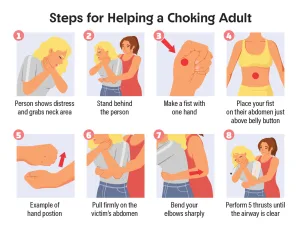
These procedures are recommended for anyone over the age of 1. You may have to kneel down to treat small children or place them on a chair.
If you see an adult in distress, ask them if they are choking and if you can help. If a choking adult or child speaks, observe and support them as they cough. If they cannot speak, contact local emergency services by calling 911.
Abdominal thrusts. Stand behind them with one of your feet between their feet and your other foot back behind you. This helps you to treat and support them and protects you as well.
Tell the victim that you are going to press on their abdomen. Reach around and try to find their belly button with the finger of one hand. Make a fist and place it just above their belly button with your other hand over your fist. Quickly pull your hands in to deeply depress the abdomen and then lift your fists upward to press up on the victim’s diaphragm, all in a swift motion.
If the person becomes unconscious, lower them to the floor, face up, and perform CPR chest compressions until EMS arrives or they resume breathing. If they do resume breathing, place them on their side.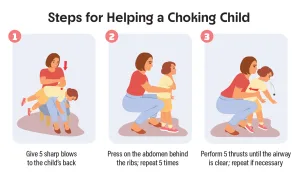
Note: If you feel the victim’s ribs with your forearms, bend down a little until you are clear of the ribs.
Anyone who has experienced choking should be seen by a medical professional to determine if they have sustained damage to the airway.
The person you are assisting may be too large for you to be able to put your arms around their abdomen; they are obviously pregnant; or you are aware they have had a recent abdominal surgery or injury. In such cases, try standing behind them as described above. Reach around their chest and find the little notch at the top of their breastbone to determine the midline of their body. Slide your hands down so that your arms are under the victim’s underarms and your hands are on top of each other over the breastbone in the center of the victim’s chest. Then swiftly pull the victim’s chest back toward you repeatedly until you relieve the obstruction or they become unconscious. If they are unconscious, continue chest compressions by performing CPR as above until EMS arrives. After each 30 sets of compressions, check their mouth to see if the obstruction is there.
For a choking infant, call 911. Sit on the edge of a chair with the infant on your lap. Support their head with one hand and hold them face down while supporting their torso on your arm that is lying on your thigh. Your leg should be outstretched and not at a 90-degree angle to your thigh. Your foot should not be under your knee. This will allow the infant’s head to be in a downward position. Give five back slaps between the shoulder blade with your other hand. Take the arm you gave the back slaps with and place it along the back of the infant with your hand on the back of their head. Holding the infant between both arms, now place them face up on your thigh. Once again, your leg should be outstretched so that their head is in a downward position. Give five chest thrusts with two fingers of one hand. Repeat the cycle until the obstruction is relieved or the infant becomes unconscious. If they do become unconscious, begin CPR immediately.
In all age groups, do not sweep the mouth with a finger. You may push the obstruction deeper. If a seizure should occur due to lack of oxygen in the brain, you would not want your finger in their mouth.
Choking is preventable. For some elderly individuals, you might want to cut food into small pieces or purée it; cut children’s food into small pieces as well. Keep youngsters away from small toys, coins, candy, balloons, and other small items, and always supervise them.
Choking is an all-too-common occurrence. By responding quickly with some first-aid practices, your assistance can lead to a positive outcome.
In my more than 40 years of Emergency Medical Service, I was able to relieve airway obstructions and save a life in all but one case. That case was a toddler who had eaten (what else?) a hot dog, which I removed with Magill forceps. She lived, too.
Consider taking a CPR/first aid class that teaches the methods to relieve an airway obstruction in a victim. You may save a life.
Symptoms
Choking is also known as foreign body airway obstruction. It is often classified into two main types:
- Complete: An object fully blocks the airway; requires immediate first aid
- Partial or Incomplete: a partial airway obstruction; often, the object can be coughed up
Signs of choking include the following:
Adults
- Severe distress
- Clutching the neck
- Unable to make a sound
- Decreased air entry
- Stridor (a high-pitched whistling sound)
- Decreased level of consciousness
Children
- Distress
- Unable to make a sound
- Turning blue
- Stridor (a high-pitched whistling sound)
- Decreased level of consciousness
- Drooling
Heimlich Maneuver (Abdominal Thrusts) Do’s and Don’ts
Do
- React quickly to choking symptoms
- Ask the victim if they are choking
- Call 911
- Perform CPR compressions if victim is unconscious
Don’t
- Hit the victim’s back aggressively
- Sweep the victim’s mouth
- Thrust on the victim’s ribs