
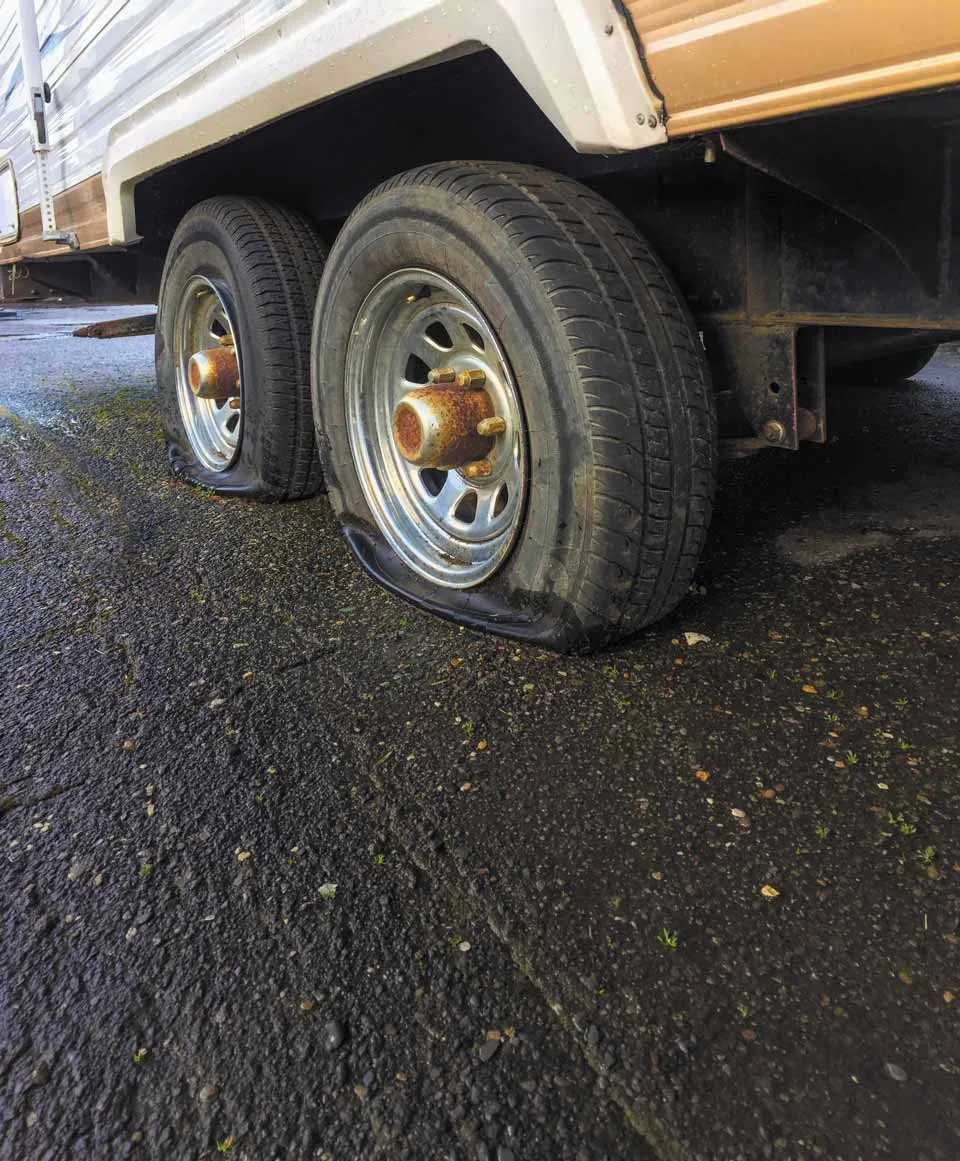
When to replace your RV/tow vehicle tires.
By Bruce W. Smith
September-October 2026
A close friend of mine went into a local tire center to have the air pressures checked in the tires on her low-mileage 2015 Mercedes-Benz camper van after a “low-tire pressure” warning popped up on her dash. Indeed, a tire needed air.
But when she asked if they would rotate the tires after reinflating the one that was low on air, she was told that the store’s liability clause prevented them from rotating the tires because they were 10 years old and “Oregon law mandated the tires had to be replaced.” This was despite the fact that the tread depth was still good.Two hours later, she drove away with four new tires and $800 less in her bank account.
The sad part about her encounter is that she was misled. The store used “the law” to coax my friend into purchasing new tires, when in reality there are no state or federal laws that mandate a tire be replaced due to age.
Is it a good idea to replace tires that are old by tire manufacturer standards? Yes. The National Highway Transportation Safety Administration webpage that addresses tire safety says, “Some vehicle and tire manufacturers recommend replacing tires that are six to 10 years old, regardless of tread wear.” But it’s neither mandatory nor the law.

The Tire Identification Number (TIN) on the sidewall provides a tire’s date of manufacture and other info.
TIRE AGE DOES MATTER
Indeed, automakers like Ford, Nissan, and Mercedes-Benz tell owners to replace tires six years after their production date regardless of tread life. Tire manufacturers such as Continental and Michelin advise customers to replace their tires no later than the 10-year mark regardless of the tread wear.
The reason is because tires lose their structural integrity as the environment takes its toll on the compounds from which they are made. Tires, like humans, are more prone to failure as they get older. Many factors determine “how old is too old” for a trailer or RV tire. More than two dozen components make up a tire and not all age at the same rate.
Heat is the biggest tire killer. According to tire experts, the tires on a trailer used in the hot desert Southwest could have a two- to three-year shorter life expectancy than the same tires on the same trailer used in the cooler climates that you might find in New England or the Pacific Northwest.
So, even though the tires on your tow vehicle, trailer, or motorhome may look good on the outside, they may have lost their structural integrity, which could lead to tread separation or a blowout, neither of which an RVer wants to experience.
HOW TO CHECK A TIRE’S BIRTH DATE
How old are the tires under your RV or tow vehicle? Check the Department of Transportation (DOT) Tire Identification Number (TIN) on the sidewall. The last four digits of the TIN indicate the week and year the tire was made. For example, if the TIN reads 0516, that tire was made in the fifth week of 2016. The DOT TIN is found on the tire’s sidewall — most of the time on the outside, but sometimes on the inside.
Another reason to check the tire’s “birth date” is to make sure the “new” tires you’re purchasing are indeed fresh from the factory. It’s not uncommon for tires to sit on racks for years and still be sold as “new.” So always find out from the tire dealer the manufactured date of the tires before they’re installed to ensure you’re getting what you’re paying for regardless of where the tires are being purchased.
TREAD DEPTH DETERMINES REPLACEMENT TIME
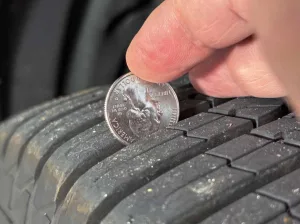
Placing a quarter between the treads is a good way to check whether a tire has enough tread depth.
Tire tread depth is a big safety concern, too. While the age of a tire isn’t covered by law, tread depth is. Federal and state laws say a tire is unsafe and needs to be replaced when the minimum tread depth reaches 2/32-inch, which is the distance between the top of Lincoln’s head and the edge on a penny. Some tires come with tread wear indicators, raised rubber bars molded into the grooves of the tire that will show when the tread has reached the 2/32-inch mark and must be replaced.
For the sake of safety, a tire should be replaced much earlier in its life when the tread is wearing down. The consensus used by most tire manufacturers is 4/32-inch tread depth. To measure this, pull out a quarter and check the tire tread depth in several locations across the face. If the top of Washington’s head is above the rubber, that means the tread depth is less than 4/32-inch and the tire needs to be replaced.
“Tires with less than 4/32 of an inch are very susceptible to hydroplaning and severe reduction in stopping power on wet or dry pavement,” said Woody Rogers, vice president of marketing with Tire Rack, who was the company’s former director of testing and training.
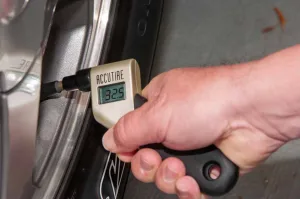
Use a tire gauge to check your RV’s or tow vehicle’s tire pressures at least once a month even though the tires may have a TPMS installed.
IMPORTANCE OF PROPER TIRE INFLATION
Maintaining proper tire inflation is critical to tire integrity. For motorhomes, camper vans, trailers, and tow vehicles, the leading cause of blowouts and tire failures is over- and under-inflated tires according to RV safety experts.
Under-inflated, over-inflated, or over-loaded tires can’t grip driving surfaces properly, leading to poor handling, vehicle instability, and heat build-up in the sidewall and tread areas, causing the tire’s structural components to break down prematurely and lead to tire failure. “Trailer tires should be inflated to the maximum cold-air pressure indicated on the sidewall,” said Discount Tire/Tire Rack expert TJ Campbell. The same applies to pickup trucks that are hauling slide-in campers or towing heavy fifth wheels or travel trailers.
Read your tow vehicle’s and trailer owner’s manuals, as well as the tire information sheet to determine the proper pressures for the tires.
When it comes to motorhomes, proper tire inflation pressure isn’t as cut and dried. It depends on how much weight each tire must support when the coach is fully loaded with passengers and cargo. That requires having the motorhome weighed at each corner.
The corner weights can then be used to find the correct tire pressure for each tire by looking at the tire manufacturer’s inflation chart that relates to those specific tires under your RV. For a full list of tire charts and load indexes, visit rvsafety.com/weight/tire-inflation-tables on the Recreation Vehicle Safety Education Foundation (RVSEF) website, rvsafety.com. RVSEF has provided wheel position weighing service at FRVA international conventions and other RV events for years.
Tire pressures should always be checked with an accurate digital gauge before your RV hits the road — or after the tires have cooled down.
Be proactive. Even if you’re not traveling, check the tire pressures monthly. Don’t wait for the tire pressure monitoring system (TPMS) on your RV or tow vehicle to warn of a tire inflation issue.
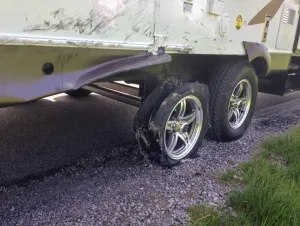
Making sure tires are maintained properly can help prevent RV damage caused by a blowout.
SELECTING THE CORRECT TRAILER TIRE
Tire experts suggest that trailer tires have a load carrying capacity (rating/range) at least 10 percent greater than the trailer’s gross vehicle weight rating (GVWR). If you don’t know how much your trailer weighs when it’s loaded for a trip, pull into a certified CAT scale and get it weighed. You might be surprised at what the scale says.
Make sure to have the same trailer tires — size and age — on each axle. Mixing tires, like putting a couple new tires on instead of a full set just to save some money, puts added pressure on the old tire(s) supporting the load.
Tire and RV manufacturers recommend that if one tire on a tandem or triple-axle trailer fails due to factors other than a simple puncture, it’s best to replace all the tires on that side, because they all were likely subjected to excessive loading during the time before the one tire failed.
With many RVers on fixed incomes, saving money is important. But scrimping on tires by buying a partial set shouldn’t be a place to save.
“From Goodyear’s perspective, replacing all tires at the same time is recommended to maintain consistent handling, driving performance, and even wear,” said Blake Housel, senior manager of product development with Goodyear.
“If replacing all the tires on your RV at the same time isn’t possible, at minimum, replace tires in pairs on the same axle — and match all the tires in size and construction type such as radial or bias-ply,” he added.
MISALIGNMENT CAUSES TIRE ISSUES
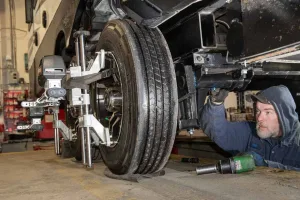
Just like a tow vehicle suspension, as trailer’s suspension should be professionally inspected and adjusted if necessary.
Another factor that leads to tire problems is alignment. This is especially true for newer trailers with independent suspensions — and solid-axle trailers subjected to off-pavement, off-grid camping. A suspension that’s out of alignment will cause excessive tire wear.
“A trailer or fifth wheel suspension just 1/4-inch out of alignment over 5,000 miles is the equivalent of dragging your RV sideways for 125 miles,” says Tommy Henderson, the third-generation owner of Henderson’s Line-up in Grants Pass, Oregon.
“We’ve even seen triple-axle trailers where each of the axles was misaligned, and settings such as toe and camber were out of spec as well. Putting the trailer on the alignment rack to bring everything back into spec solved the tire wear problem.”
Henderson and other RV repair techs indicate that motorhomes are also affected by alignment issues that owners are not aware of, and that’s one of the causes of increased and/or uneven tire wear.
The bottom line with RV tires is that with proper selection, maintenance, and inspection, any RVer should get the maximum service life out of them and avoid costly roadside tire repairs.
TIRE SAVINGS WITH FRVA
One of the most valuable member benefit discounts available to FRVA members is the FRVA Tire Program. In collaboration with participating Michelin (includes BF Goodrich and Uniroyal) and Goodyear dealers, members can save hundreds of dollars on light truck, passenger car, and RV tires.
While the two programs are similar in that they provide great savings on tires, they each work a little differently, which can lead to some confusion as members look to make their purchase. Below are step-by-step instructions to guide you through each of the programs.
Michelin Advantage Program (United States and Canada)
- Get a tire quote — Log into FRVA.com and visit frva.com/rv-tires-discounts to find the Michelin Advantage Program information. Press the GET A QUOTE button and choose the type of tire you need to order.
- Find a Michelin dealer — Press the FIND A DEALER button and enter your address information and choose your application.
- Call the dealer to confirm that the dealership carries the tire you want and that it participates in the Michelin Advantage Program. While speaking with the dealer, find out the age of the tires.
- Schedule your tire installation — Tell the dealer you are purchasing tires through the Michelin Advantage Program and provide the account number. For those in the United States, the number is 1326516. For those in Canada, the number is 0361936. Also provide your FRVA membership number and your email address.
- Call the Michelin Advantage Program before tire installation to register your credit card. For those in the United States, call 855-623-3997 (Option 1). For those in Canada, call 888-532-6425 (Option 1). If calling after hours, call 800-847-9855. Your credit card registration is valid for 30 days.
- At the dealer provide the Michelin Advantage Program Ship To Number. For those in the United States, it is 1326516; for those in Canada, it is 0361936. You will also be asked to provide the name on your credit card; the first digit on the card; the last four digits on the card; and the expiration date.
- Complete your purchase and have the tires installed. Michelin charges directly to your registered credit card. The dealer typically bills separately for mounting, balancing, tire disposal, and state and local taxes.
Goodyear Tire Program
- Log into FRVA.com and visit frva.com/rv-tires-discounts to find the Goodyear Tire Program information.
- Select the GET A QUOTE button. This will allow you to select BUY TRUCK TIRES OR BUY CONSUMER TIRES.
- Once selected, click Search for Tires by Vocation here. Make your selection from the dropdown box: Motorcoach, Construction, Light Truck, etc. Select the position, then the tire size. The Load Range options will populate from which to choose. Enter the zip code where you want to find a dealer. Then press the arrow to continue.
- Your tire selection will appear on a new screen. This is where you can see the tire, choose how many tires you want to purchase, and see the 15 percent discount price. Once you have made your selections, add the order to your cart.
- A sidebar will appear showing the nearest dealers from which to choose. Select the dealer and the Your Cart page will open showing the discount price, installation cost, and taxes. Click CHECKOUT, which will take you to the Checkout page.
- On the Checkout page, enter your email address, first and last names, and phone number.
- Schedule an appointment.
a. If the dealer you selected offers the tire, then they will remain in this selection.
b. If the screen tells you, “We’re sorry an item you selected is no longer available at this location,” you will need to start the process over. Return to Cart will appear and you should click that button. It will take you to CHECKOUT. You will need to change the store and find a dealer will populate again.
c. If it works, then the days of the week to choose from will populate: you can change the store here, too.
d. The location address will be shown, which includes the date and time.
e. On this checkout page, see your information, appointment time, and billing information that will
be submitted.
f. Once the invoice is paid, you will receive a receipt and information about the dealer that your tires will be shipped to and installed.
Disclaimer: Must purchase on Goodyear.com with applicable promotional code during promotional period to get this offer. Discount does not apply to installation, taxes, or fees where applicable. May be used in combination with Goodyear tire rebate offer. May not be combined with other promotional codes. Limit one redemption per transaction. Cannot be applied to previous purchases. Limited quantities; no rainchecks. All other standard terms and conditions apply. Offer may be modified or cancelled at any time without prior notice.