
Boiled Batteries
Dear RV Doctor:
I just bought a used motorhome equipped with dual auxiliary batteries. I used my voltmeter to test them and got a reading of only 8.5 volts. When I checked the cells I found they all were almost dry. I refilled them with distilled water and plugged in my outside power cord to allow a trickle charge. I checked the battery readings every day for three days, and the readings were still routinely 8.5 volts.
Later, I pressed the AUX button on my panel and all five indicator lights came on to the “Full Charge” indicator. I tested the batteries again, and they all registered 8.5 volts. I flipped the auxiliary battery switch to “on” with the outside power still connected and immediately heard a humming sound coming from the battery compartment. When I leaned down over the battery storage compartment, I also heard what sounded like boiling water, and there was a strong, nauseating odor. I tested the batteries again while this was occurring and they tested at 13 volts. I turned the auxiliary battery switch to “off” and again tested the batteries. The reading was back to 8.5 volts. I turned the switch to “on” and it hummed. Once again I heard the boiling water sound and smelled the same odor, and the batteries tested at 13 volts. Yet, when I turned it off, they again tested at 8.5 volts. The two utility batteries are Group 24 marine/RV batteries.
Is this normal, or do I have a problem? Are there specific procedures for checking and recharging utility batteries?
Ken Vieu, Tyrone, New Mexico
First of all, in order for the onboard converter/charger to actually charge the battery bank, the auxiliary battery switch must always remain “on” or “connected.” Apparently this is a type of battery disconnect switch, which typically is employed during periods of non-use. When in the “off” position, it basically takes the battery out of the system altogether “” stopping the batteries from discharging as well as not allowing them to recharge.
But it is quite possible you have more than one problem, such as a battery charger issue, a miswired battery bank; or, since we don’t know their true condition, faulty batteries. A process of elimination will determine the culprit, but it’s obvious the batteries probably suffered some damage just by being boiled dry.
The first step professional RV service technicians take in a situation like this is to eliminate the battery bank as the cause of the problem. It may be time to have the batteries fully tested by using a carbon-pile battery tester. Not usually found in the do-it-yourselfer’s tool kit, a carbon-pile battery tester will reveal internal battery problems that simple voltage measurements ordinarily would not detect.
Here are my thoughts on what was probably happening. The batteries are dead and may be sulfated and damaged beyond rescue. But since the battery bank is removed from the circuitry by virtue of the battery disconnect switch being off, you are actually measuring the converter/charger voltage at the monitor panel while the motorhome is plugged into shore power, not the actual battery voltage. When you turn on the disconnect switch (bringing the batteries back into the system), the converter/charger is suddenly tasked with trying to charge two completely dead batteries. Since you added water to the electrolyte, the sulfuric acid content is very low in each cell and the charger is trying to pump as much current at the highest voltage possible into those dead batteries. The off-gassing (bubbling and odor) is the result.
The first step would be to fully charge the batteries prior to having a carbon-pile test performed. If possible, disconnect the batteries from the RV charging system and charge them independently using a shop battery charger. Of course, if during the off-line battery charging process it’s discovered that both batteries simply will not take a charge, then you probably can assume they are internally sulfated beyond resuscitation, and it may simply be time for a new battery bank. But if they indeed begin to accept a charge (meaning the open circuit voltage and the specific gravity gradually increase) under a slow charge rate, they may still be salvageable. Completely dead Group 24 batteries, though not huge in terms of battery capacity, may take a few days under a slow/low charge rate to fully charge.
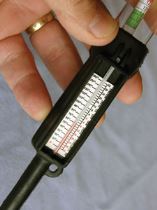
Here’s how to determine when any given battery is fully charged. While charging, monitor the specific gravity in each cell using a temperature-compensated hydrometer. As the battery continues to accept a charge, the specific gravity will rise. At some point the specific gravity will stop increasing. When the specific gravity stops rising in all cells after a three-hour period, that battery is fully charged. It simply will not store any more current. By the way, if there is a difference of 0.05 points between any two cells on the same battery when using the hydrometer, that battery is faulty and should be replaced. Test over!
Once the batteries are each fully charged, have them put through a carbon-pile load test. Some RV shops may not be equipped with a carbon-pile tester (though they should), but you also can have this service performed by any independent battery retailer. Should the batteries fully charge and pass the carbon-pile test, the next step is to be sure they are reinstalled and wired correctly. Two 12-volt batteries are wired in parallel to double the storage capacity yet still remain at 12 volts output. Be sure the “hot” wire from the RV charging system is indeed wired to the positive post of one of the batteries and that the negative ground wire is connected to the negative post of the other battery and to a good, clean, and dry connection on the coach frame.
I wouldn’t put too much faith in the onboard battery meter on the monitor panel. Rely on a good volt-ohmmeter (VOM), or digital multimeter, for more accurate measurements. I recommend every RVer carry a decent digital VOM anyway.
This leads me to the third possibility: the condition of the onboard battery charger. Depending on the brand and model, some less expensive converter/chargers have a propensity to overcharge batteries, hence the condition you found the battery bank in originally. There are very good chargers available that may be a better choice, and you always have the option to upgrade. With shore power connected, the battery switch activated, and the charger operating, you should measure an increase in the voltage at the batteries above what the batteries measure in an open circuit situation.
All this said, I’d wager the charger is probably okay and that the batteries will fail one of the tests mentioned above. If I’m right, new batteries and an investment in a sophisticated, chip-controlled RV battery charger will probably eliminate any future issues. If you opt to keep the current charger, be sure to monitor the electrolyte level in the batteries often while the coach is connected to shore power.
{loadpositionEndBlurbHouseCalls}