
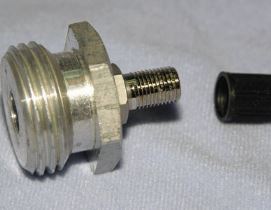
Blowout Plug
Dear RV Doctor:
I’ve heard about the dry method of winterizing a motorhome using a “Schrader valve” to blow the water out of the plumbing lines with an air compressor set to 20 psi, and then adding antifreeze in the kitchen, bath, and shower drains. Is this a good idea? If so, where would I find a Schrader valve and how is it installed?
Bobbie Vee, Florissant, Missouri
The Schrader valve device you mention is called a blowout plug. It has the air inlet valve (Schrader valve) on one end and a male hose fitting on the other end. The blowout plug attaches directly to your motorhome’s city water inlet hose connection, but only temporarily; it isn’t a permanent installation. Clean compressed air is then forced into the system to expel the water through the faucets and low-point drain locations. It’s the quickest way to rid the fresh water system of liquid. Professional RV shops use blowout plugs all the time while performing winterizing procedures or whenever a motorhome is going to be stored for any length of time.
As you drain the fresh water tank and water heater, attach the blowout plug to the city water inlet. Starting with the faucet nearest your water inlet, open each faucet, as well as the hot and cold low-level drain valves, until all are open. Don’t forget the toilet valve and the washing machine line (if so equipped). Next, inject clean air into the system. This purges all moisture from the pipes.
You mention using 20 psi of air pressure, but you can go higher, since the entire piping system is pressure-tested at 80 psi at the factory. And since all the faucets and valves will be open, it will be safe and quicker to use 80 psi. Just be sure it is clean air! As I remind my seminar attendees, this is your fresh water system! Avoid using gas/filling station air or any air from a compressor equipped with a tank. The chance of contamination is greater if the compressor has a storage tank. It also is advisable to have a water trap on the air pressure source when adding air to any system or device. One also should make sure to have an accurate air pressure gauge attached to the system.
When you’re finished purging water from the system using air, pour 1/4-cup of RV antifreeze down each drain to fill the P-traps, and you should be set for winter or any period of nonuse. You can find blowout plugs at any RV dealer or service center’s parts department and through Web sites that sell RV accessories.
Note: Aqua-Hot does not recommend this winterizing method for owners of motorhomes equipped with their system. It leaves too much water in the multiloop exchanger, and water that remains in the bottom of the loop could freeze and rupture the tube.
Generator Stoppage
Dear RV Doctor:
I recently purchased a preowned Leisure-Craft Type C motorhome to pursue a few interests on my “bucket list.” This is my first motorhome, and everything worked fine when I got it home. Within four days of purchase, I made a trip to Mount Rushmore and Devils Tower. I took a total of 14 trips last year “” during some I stayed in campgrounds, but more than half were spent dry camping.
However, now I’m having a problem with my 4.5-kilowatt Kohler generator, which until recently worked wonderfully. While dry camping, I had the generator running when it suddenly stopped. It will crank but won’t start. I did a visual check, and everything looked okay; there are no loose wires or other apparent problems. The oil level is good. I have fuel to the generator, and the plugs have been removed and replaced. I tested for spark by leaving one plug out, and I was able to see a spark jump the gap as I cranked the generator. Since the motorhome did not come with any manuals, one of the first books I purchased was a copy of your RV Owner’s Handbook. The troubleshooting chart would seem to indicate a possible blown ignition control fuse. How do I locate the ignition control fuse? What else should I check? I’m pretty handy, but I’d like to know a bit more before taking the unit to a generator repair shop.
Don Christensen, Salt Lake City, Utah
Without taking a look at the generator and seeing the actual installation, it may be difficult to diagnose from afar, but I’ll give it a try. The fuse protection for the starting circuit is inside the control box on the front of the generator. I can’t recall off the top of my head, but it may be an inline fuse inside that box.
But, first, be sure the fuel pump is actually sending fuel up to the carburetor. It’s possible that the pump may be sucking air through a cracked fuel line between the fuel tank and the generator. If the hoses haven’t been replaced recently, it may be time to do so now. Inspect the full length of the fuel hose and determine whether there are any cracks in the rubber. Or you could be experiencing a choke, carburetion, or governor problem.
If you’d rather not take the generator to a repair facility, I’d suggest continuing the process of elimination to uncover the problem. Start by verifying that fuel is indeed entering the carburetor. You should also verify that the second spark plug (assuming this is a two-cylinder engine) is producing a spark. If both are producing sparks, remove them and do a compression test on both cylinders. Compression should be plus or minus 80 to 110 pounds on each cylinder. Let me know how it checks out and we’ll dig further if necessary.
Tire Squeal
Dear RV Doctor:
We have a 35-foot Itasca Sunova with a Blue Ox tow bar system. Our towed vehicle is a 2006 four-wheel-drive Jeep Liberty Sport with an automatic transmission, and it’s equipped with a Brake Buddy supplemental braking system. The system is easy to use, and the Jeep tows great when we are on the highway. In normal turns and maneuvering, it is also great. However, on some bends in the road, such as traffic circles, highway on/off ramps, etc., we hear what sounds like a loud tire squeal, as you might hear when the brakes are locked. The supplemental braking system is not engaging, and the steering remains free on the towed vehicle. It has occurred when braking and not braking the motorhome. There are no visible signs of rubbing or tire wear, and there is no smell of burning rubber; just the loud noise. I’ve talked with Blue Ox support, done Internet searches, and spoken with other people who tow vehicles, and no one has ever heard of this problem. I went over the installation with Blue Ox, and it is totally within their specifications. My rear camera does not show anything out of the ordinary when this occurs, and it is very intermittent, so I can’t say exactly what conditions might cause it. Do you have any suggestions on how to isolate this problem or what might be causing it?
Bob D’amore, Toms River, New Jersey
I have to say, I’ve not heard of this exact problem, either. Do you feel any type of subtle tug, as though the Jeep brakes suddenly, but just for an instant? One suggestion is to be sure the Jeep’s front end is in alignment and all tires “” on both vehicles “” are at the recommended pressures according to the weight they are carrying. Be sure to include any cargo you stow in the Jeep while towing when considering the weight. This is indeed a puzzler! Let me know what you find out.
Follow-up: Actually, Gary, you were correct; it turned out to be the front-end alignment on the Jeep. I spoke with a knowledgeable service manager for the local Itasca dealer. He immediately said alignment when I described the symptoms; sent me to the tire shop he deals with; and they found the right front toe was out. Not enough to show a problem when driving or during normal cornering, but enough to make the Jeep track wide in turns when towed. This was even news to the folks at Blue Ox. Now, I still hear a little tire squeal if I have to do a tight S-turn, such as bending around to the left in a traffic circle, then having to counter-steer to move right to exit the circle. But I now know to take such turns a little slower. The folks at Blue Ox said that I should try to attach two bungee cords to hold the steering wheel centered. On small cars, the wheels have a tendency to run all over the place while towing straight, so the bungees are needed for that. But for the Jeep, they said it might help return the steering wheel to center more quickly so it can make the counter-turn in the opposite direction.
There you go, Bob! Glad it all worked out.
{loadpositionEndBlurbHouseCalls}