
Dear RV Doctor:
We have a digital clock plugged into an outlet in our motorhome bedroom. While on shore power or generator power, the clock keeps perfect time, but when we are traveling, it runs about twice as fast and has to be reset to the correct time when we arrive at our destination. I replaced the clock with another inexpensive one, and it behaves the same way. Any thoughts?
Alvin Mitchell, F429297
Tuscola, Texas
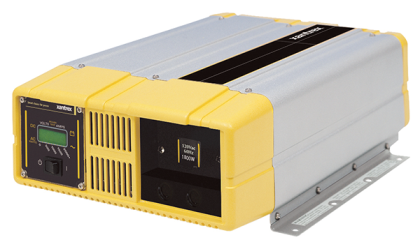
It appears the onboard inverter is powering that receptacle as you drive down the road. Some modified sine wave inverters cause analog clocks to run faster or slower, and in some cases, such inverters also can affect a digital clock. My buddy Don Wilson (the Tech Doctor) explains:
“Some (digital) clocks tell time by using a charged crystal that has a consistent pulse, which a microprocessor uses to calculate time with a simple algorithm. These clocks are not affected by modified sine wave power. Other digital clocks use the incoming AC current to calculate time. The processor ‘counts’ how many times the voltage reaches zero, or ‘zero crosses.’ True sine wave waveforms cross zero cleanly, while modified sine waveforms ‘rest’ on zero for a few milliseconds. The processor could interpret this rest as multiple ‘zero crosses,’ resulting in the time being calculated incorrectly. Many electronic devices utilize digital time calculations as a function of their operation.” Electric blankets, coffee makers, and laser printers are examples of devices that may not operate correctly when powered by modified sine wave inverters.
Short of installing a true sine wave inverter, another suggestion is to buy a battery-powered atomic clock, which keeps accurate time via radio frequencies broadcast from the National Institute of Standards and Technology (NIST). Such clocks are typically available for under $50. Of course, if other sensitive equipment in the coach also is being affected, it might be time to spring for a true sine wave inverter.
Dear RV Doctor:
Which Fluke multimeter and clamp-on tester would you recommend? I started to research this and found it is very confusing! What would be best for the average RV guy who wants to do basic repairs?
Dennis Hamilton
Via email
I’ve been a fan of Fluke instruments for years, but they’ve become quite pricey, especially for the DIY type of RV owner. I have purchased an Extech EX623, and I’ve grown quite fond of it. It has an infrared (IR) thermometer and dual thermocouple features. With IR, you can easily measure the temperature of the tires (or any other surface). And with two individual thermocouple functions, it’s very easy to measure the Delta T temperature difference when checking air conditioner performance. It also measures true RMS voltage, which is a necessity if you have a pure sine wave inverter/charger. The instrument safely measures AC and DC current without having to disconnect any of the conductors. It also features a non-contact voltage indicator for checking for a hot-skin condition. Plus, it measures the AC frequency, which is essential for monitoring generator output. It’s still not inexpensive — when I bought mine, the price was about $224 online — but it will perform any measurement an RV owner needs.
Dear RV Doctor:
I am buying a Type B motorhome that comes with two 100-amp-hour lithium batteries. The options for factory-installed solar panels are to add one, two, or three 95-watt panels. Is there an equation to determine which option would be right for those two batteries? Or should the goal simply be to get the most I can afford, taking into consideration the space I have on top of the RV?
Scott Fairbanks
Via email
Remember that the most important component in a solar array is the solar charge module. With multiple panels in the array, you’ll garner a faster charging sequence, so long as the charge controller can manage the input. To be sure of the number of panels to install, I’d have to know the specifications of the charge controller as well as the panel’s exact capabilities.
A few rules of thumb may be helpful in determining how many panels you should consider. First, visualize how much DC current you might use. Consider just a single 95-watt panel if all you require is simple battery maintenance. If you use a conservative amount of battery current during a typical outing, say just for the weekend, it would be best to go with two panels. If you tend to power computers and other DC devices for longer than a weekend trip and you rely heavily on inverter power, it might be best to spring for three 95-watt panels. Or better yet, add up the potential demand and literally do the math.
Also, be sure the panels are “matched” to the charge controller, and that the charge controller is compatible with lithium batteries. These batteries require a special charger. Also, keep in mind that you can easily add to a solar system. Since they are simply wired in parallel, adding panels at any time is quite doable and recommended. The system can grow as your requirements increase.
Solid Roof Choice
Dear RV Doctor:
I need a new roof on my 2001 Newmar Dutch Star motorhome. My two options are a PVC roof at a cost of more than $5,000 or an RV Armor roof at almost twice as much. Either way, all the wood must be replaced before the new roof is installed. RV Armor representatives said their system would be sent directly to the wood and would be much stronger than the PVC. We plan to keep the RV (which has 40,000 miles on it) at least 10 more years; the inside already has been totally renovated. Is the RV Armor roof that much stronger than the PVC? Is it worth the extra money? Would it add enough value when selling the RV to make the price worth it? Their guarantee to be leak-free and maintenance-free for life is a strong selling point.
Tom Mauldin, F417213
Monticello, Georgia
I’m a huge fan of RV Armor. The lifetime warranty, plus the fact they come to you, convinced me to endorse the product. I believe it’s the best roof on the market, period. It’s a shame you had some wood damage along the way, but the best way to install the RV Armor roof is to the bare substrate anyway, so you’ll end up with the perfect roof.
I consider RV Armor far superior to the PVC roofing material on production RVs. You can add up the annual maintenance costs (not even counting roof replacement or damage repair costs) that will be negated by installing the RV Armor roof. That will help you swallow that $10,000 pill a little easier. Over a projected 10 more years with that motorhome, to me, it’s a no-brainer. As far as resale value, the RV Armor warranty stays with the RV. The next owner will have a fully guaranteed roof for the life of the coach. The warranty is logged and tracked to the VIN number of the motorhome, not the owner.