
By Gary Bunzer, Technical Editor
September 2018
Engine Battery Dies
I have a 2005 Georgie Boy Cruise Master motorhome on a Workhorse W-22 chassis with an 8.1-liter Vortec engine. When the motorhome is plugged into shore power, the engine-starting battery dies over a very short period of time, with all appliances off. While driving, all is normal and all the batteries remain charged. I have checked most of the connections, and all are clean and tight. The batteries are about two years old and maintain a charge after sitting for an extended period. I have installed a battery disconnect that is used while plugged into shore power. Any ideas?
Ray Strickland, F163796 · Warren Center, Pennsylvania
Gary Says…
Your situation is common among many brands of coaches. At issue are the hidden, parasitic battery drains associated with the chassis’ DC components and the engine-starting battery.
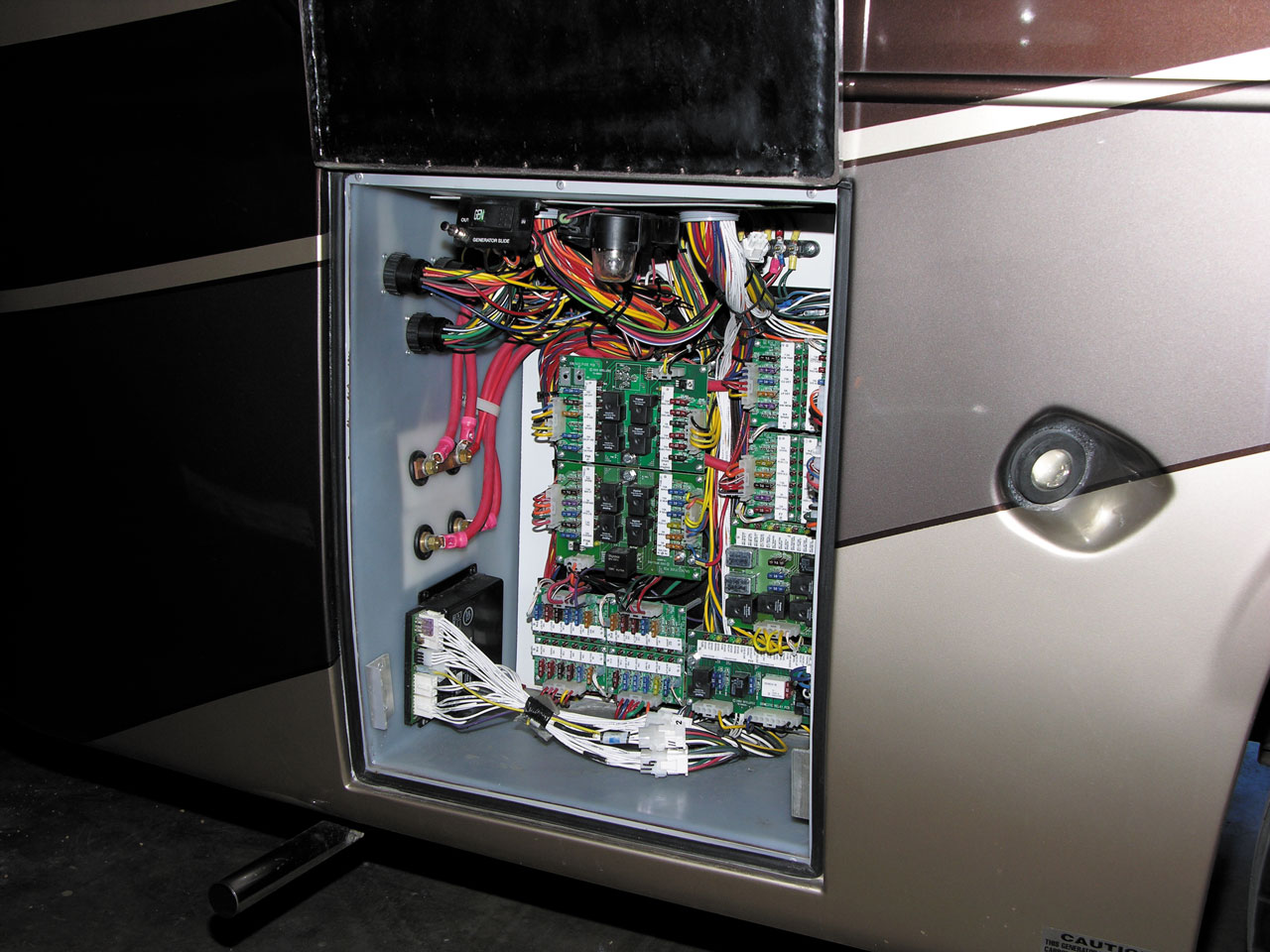
For instance, all the dash functions, lamps, switches, fans, etc., usually are powered by the chassis battery. In addition, items such as the radio’s memory or the electric entry step, may be configured into that battery’s system. It’s also possible someone connected other loads to that battery.
When the coach is being driven, the engine’s alternator usually charges both battery banks sufficiently, but when connected to shore power, the converter or inverter/charger charges only the house bank. In most instances, the only means of charging the chassis battery while driving down the road is the alternator. Apparently, some parasitic loads are draining the engine battery; or perhaps you’re not driving far enough for the alternator to have time to fully charge that battery.
A few measurements by a competent RV service technician should be able to locate the battery drain(s). First, the technician should eliminate the battery itself as the cause of the drainage. It’s important to understand that nuisance parasitic drains are cumulative; they all add up. You shouldn’t have much more than a few milliamps of drainage in most situations. Anything well over a full amp can be problematic. But with a few electrical measurements and by pulling each fuse, one at a time, the circuit containing the drain can be located and further diagnosed.
Aftermarket battery chargers are available that can connect to both banks so that each will charge while the coach is plugged into shore power. But the battery disconnect cannot be activated at the same time. When it’s activated, amperage from and to that battery bank will be stopped. Both battery banks must remain active.
Also…
When checking the cleanliness and tightness of electrical connections within the battery circuits, don’t forget the negative, or ground side, of the system. Oxidation and corrosion on the negative connections are just as important as on the positive side.
A Coach Divided
In the April 2018 “Tech Talk” column (page 18), motorhome owners John & Kathy Spudick asked what options are available for replacing a Coleman basement air-conditioning system. It is no longer being manufactured. One suggestion was to check online forums, but I have not seen any information. Since this is a major problem for many motorhome owners, I’d like to know whether anyone has successfully retrofitted a new model or knows of a shop that will do the job.
Edward Woodson, F420223 · New Tazewell, Tennessee
Gary Says…
I haven’t heard or seen anything regarding a Coleman replacement system. I believe the logical option is to install two independent rooftop units to replace that older split system. However, I have read of an optional unit others have installed. According to some blog articles, this unit appears to be working out, although I have no firsthand knowledge. It is quite pricey, in my opinion.
The Coleman unit basically was a 2-ton refrigeration system, which equates to approximately 24,000 Btus, similar to two standard roof units. My question: How well will those new mini-split systems work in a motorhome over the long haul? Considering the cost, I would opt for two RV roof-mounted units. At the very least, you’d know they were approved for an RV, and most RV repair centers can handle the installations with relative ease. Plus, you’ll gain a few more cubic inches of storage space.
Too Much Generator
We attended your seminar in Perry, Georgia, earlier this year. During the seminar, you stated the AC voltage should be between what and what? I cannot remember. I worry because my Generac generator puts out 130-plus volts. Any suggestions?
Joe Sullivan · Via email
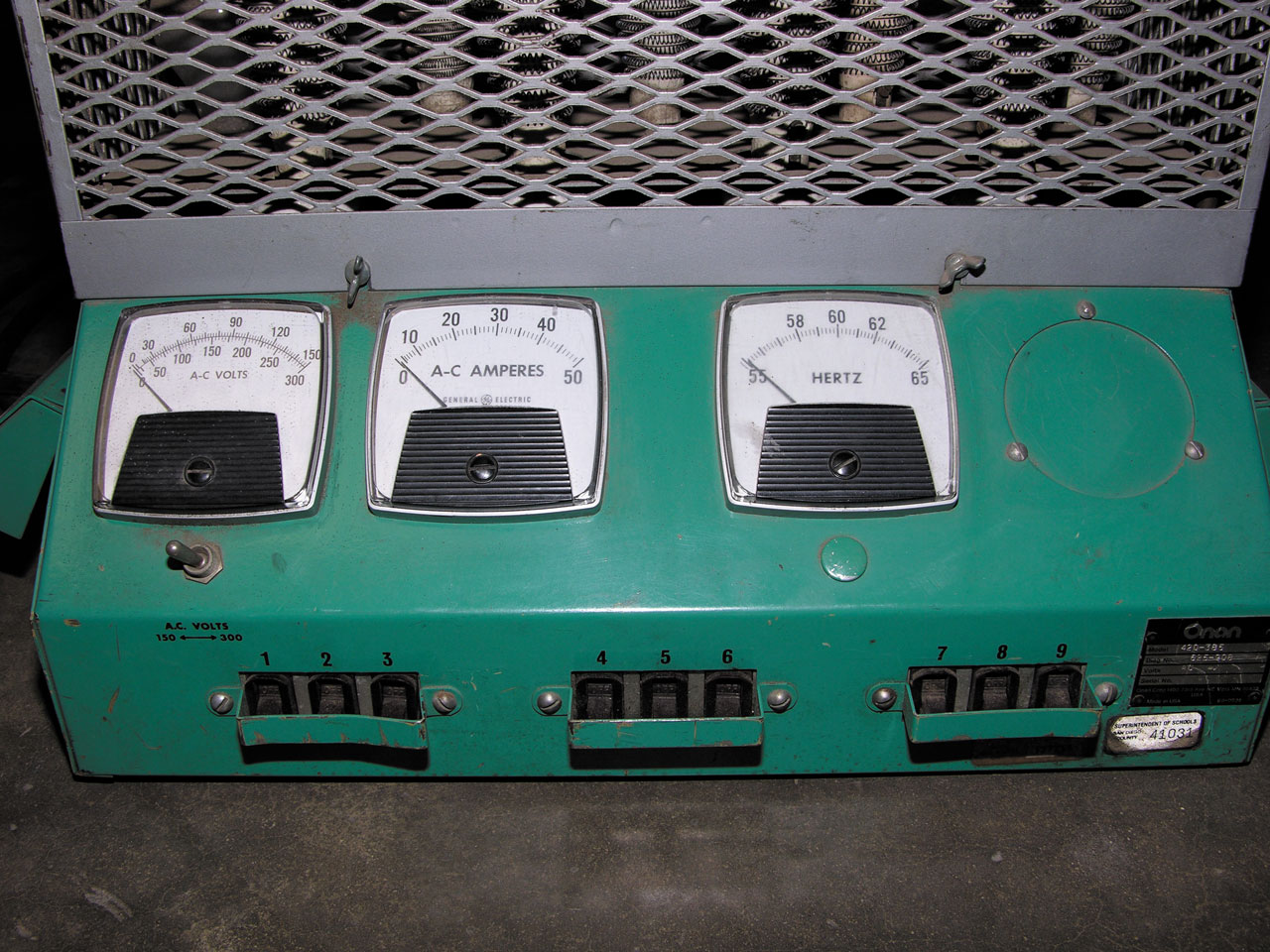
A load bank is required to properly adjust the carburetor and governor on an RV generator.
Gary Says…
The safe operating range of the incoming voltage (shore power or generator) is 120 volts AC, plus or minus 5 percent. Your generator’s output shouldn’t be a problem. As you apply loads, the voltage should come down. Plus, the idle voltage is always set a little high on Generac units. The output voltage is controlled by what is called “voltage over frequency” regulation. As a load is applied, the voltage comes down a bit while the frequency reduces to between 59 and 61 cycles per second.
To be sure, though, a quick voltage and frequency measurement might be in order. If you can find a service shop that has a load bank in its arsenal of diagnostic tools, a good technician can easily dial in your carburetor and governor to the perfect voltage and frequency setting, all while applying a measured load. These days, the hard part is going to be finding a shop that actually knows what a load bank is.
No-Flush Please
Does it cause a problem to flush disposable cleansing wipes and run them through the macerator in my RV?
Ann McHazlett, F479068 · Grand Junction, Colorado
Gary Says…
In my opinion, it’s a “no-no” to flush so-called natural or biodegradable wipes through any macerator. Just about anything can clog an RV macerator, it seems. Though I have no scientific proof, I’ve read that many septic experts contend that flushable wipes are a problem even in standardized, household septic systems. Some campgrounds may prohibit holding tank evacuations if a holding tank contains such products. Unless dumping uphill, macerators are really not necessary in an RV as long as proper waste-management procedures are followed.