
First Month . . . First RV Trip
The start of a new year prompts a trip down memory lane and thoughts regarding new beginnings.
National President
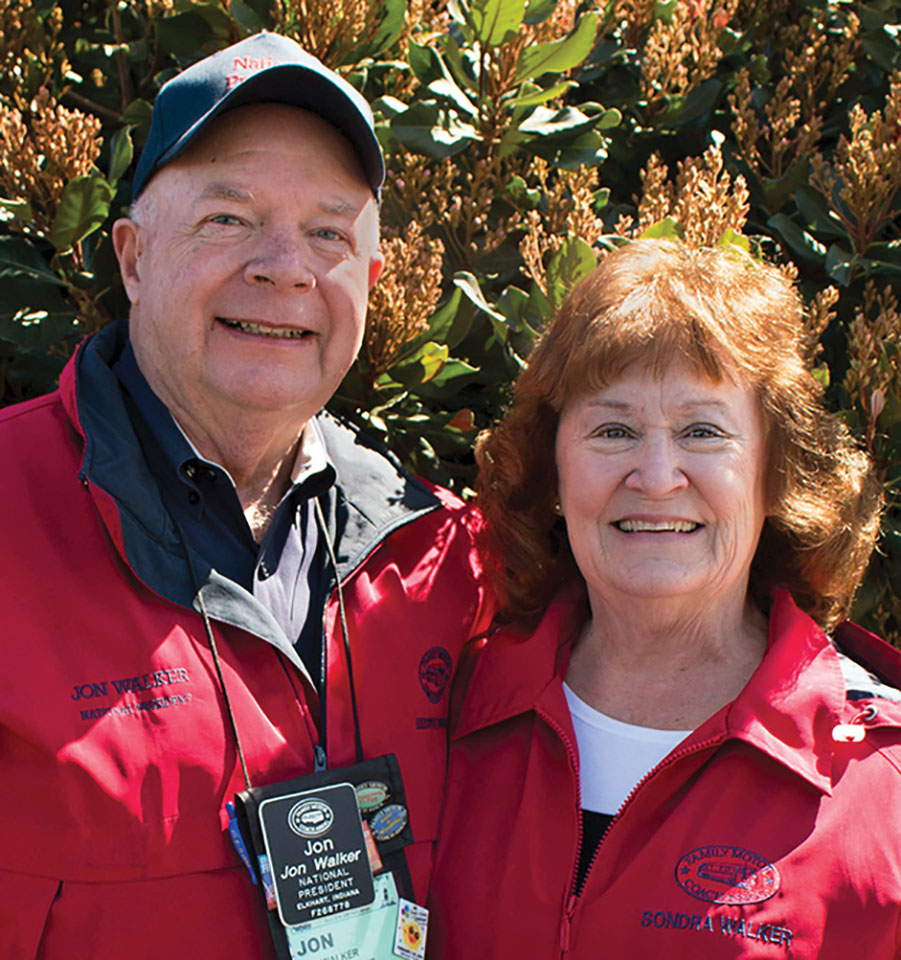
Jon Walker, F268778
jwalker@fmca.com
It is hard to believe we already are starting a new year. Time really flies in the RV world. I am sitting here thinking about the first month of the new year, and my mind keeps going back to another first — our first trip in our “new to us RV.” In reflecting on our inaugural RV trip, I know now WHY we joined FMCA.
Sondra and I certainly did not become RVers in the traditional way. Our introduction to the RV world was through University of Notre Dame football. We started our company, Mail Management, on April Fool’s Day in 1988. As our business slowly grew, we discovered that many of our prospective customers loved Notre Dame football. We also learned early on in our business life that many prospects became customers based upon social connections. What better way to get to know people than to entertain them at a big-time football game.
We started renting motorhomes to go to Notre Dame home football games, where we would tailgate with prospects and customers. After renting motorhomes for several years, my brother and I discovered that we probably could own a used motorhome for less money than we were paying for rentals. If you have ever rented a motorhome, you will know what I am talking about.
Our first motorhome was a preowned Holiday Rambler. We decided on a Holiday Rambler because they were one of our first big customers. So, it only made sense for us to have a unit built by one of our good clients. We used that motorhome for several years, driving it the few miles to campus for the games. We never stayed overnight in it, though.
After we had owned the Holiday Rambler for a few years, the rules changed at Notre Dame. Motorhomes were directed to the north side of campus, and only “buses” were allowed near the stadium. So, we bought a used bus to continue our tailgating. That lasted a couple of years until Notre Dame changed the rules again and only allowed commercial transit buses to park near the stadium. We tried parking the bus on the north side of campus, but it simply was not the same; so, we stopped tailgating. The next question was, what to do with the motorhome/bus? Again, we had never stayed all night in it.
That all changed on June 4, 1999. Sondra and I made plans to meet two couples we grew up with in southern Illinois for a week’s vacation in Myrtle Beach, South Carolina. One of the couples, Judy and Randy Lynn, had a timeshare, so they asked the other couple, Linda and Dale Goldsmith, to meet us there. Sondra and I decided to take the bus, which we had named “Express Mail,” on our first overnight adventure.
When we left our home in Elkhart, Indiana, we decided to stay the first night near Chillicothe, a small town in Ohio where one of our good friends, Sanford Vaughn, had grown up. I wanted to see the airport where Sanford spent most of his years with his father, the airport manager.
We started the trip with no big problems. The water tank was full; the waste tank was empty; and all was good in the world. We took back roads in order to enjoy the scenery of the rural Midwest. When we arrived at the campground in Ohio, the first hurdle involved backing into a small, narrow site. I had never really backed the 45-foot bus before this, but we made it. We got plugged in, and all was well. I pulled out the gas grill, fired it up, and we had steaks to celebrate the first leg of our vacation.
We rose with the sun the next morning, because we wanted to reach Myrtle Beach before dark in order to have dinner with our friends, who were waiting for us at their oceanfront condo. I turned the key, waited for the yellow glow plug to go off, and turned the key the rest of the way to start the engine. Nothing. No starter, no battery, no nothing.
Now what? I did not know whom to call. We were in a rural area and had no clue where to turn for help. I went into the campground office and shared our plight. They told me to call my roadside assistance company. I did not have roadside assistance. They called someone for me, and we sat there for about an hour and waited. Finally, a small truck arrived. A young kid hopped out and grabbed his jumper cables to help get us started. He found to his dismay that we had a 24-volt system, not a 12-volt system. He then called someone who came out and installed some new batteries so we could get on our way.
As soon as the battery installation was finished, we set out toward Myrtle Beach. I remember that we decided to skip the back-road scenery and instead head to the interstate that took us to Columbia, South Carolina. As we turned east for the last leg to the beach, a large thunderstorm surrounded us and followed us the rest of the way. The wind was tremendous; we had a hard time seeing; and day became a very, very dark night.
We had a reservation at an RV resort in Myrtle Beach. I don’t remember the name — it included the word “Pirate,” or at least that was part of the theme — but they assured me when I made the reservation that our friends’ condo was just up the beach. We arrived at the campground very late, but someone was at the gate. The resort escort van took us to one of their premium sites near the beach. It was raining so hard we could not see, but we followed the pirate van, and the man helped me hook up the electric. I ended up soaked, because I did not have a raincoat with me. I did have lots of Notre Dame T-shirts and Notre Dame beer bottle holders, though.
We called our friends and told them that we had arrived later than expected and would come over to their condo in the morning. After all, it was just up the street. We were so tired from the day’s problems and the huge rainstorm that we immediately went to bed.
When I awoke in the morning, I knew something was terribly wrong. Our bed was leaning at what seemed like a 45-degree angle. Sondra was up against me, and I was falling off the bed. I thought to myself, “We are in quicksand on the beach from the storm, and we will never be able to get out.”
I got out of bed and went outside to see how far our bus had sunk in the sand. What I found was that sand was not the issue. One side of the bus’s air bags had gone flat. Now what do I do? I had no roadside assistance plan. I unhitched the Jeep, drove up to the resort office, and asked for advice. The office manager called someone. About two hours later, a man showed up, looked at the air bags, scratched his head, and told me he did not work on buses. He suggested I call one of the charter service companies in town and see whether they could help. As I remember now (it has been many, many years), I was told to let the air out of the air bag system. That would make the bus level again. The person giving me the advice thought that when I started the bus up, all would air up and it would be level as long as the engine was running. I did that. I do remember when we got home, we had to replace most of the air bags.
We wasted most of the day trying to figure out how to fix the air bags. We finally started up the street for the ride to our friend’s condo, and with all of the traffic on the strip in Myrtle Beach, it took almost an hour to go several miles. That would not do. When we arrived at our friends’ condo, we noticed a very nice RV resort called Ocean Springs right next door. I went in their office and immediately made a reservation for the rest of the week. It was silly to have to drive two hours a day in order to spend time with our friends.
When we returned to the Pirate place, I went into the office to check out and to cancel our week’s reservation. They promptly told me that my reservation was paid for the week and that they did not give refunds. When I noted that they never told me it was going to take an hour to get to our friends, the reply was that I should have checked things out better. No refunds. So, now we had a week’s rent paid in advance for two places. Well, I guess you live and learn. I told the Pirate place I would not be returning. I don’t think that made any impression on them at all.
As we drove out of the deluxe spot on the beach, I thought to myself that there had to be a better way. When we reached Ocean Springs, I asked the office manager whether he knew anything about roadside assistance for motorhomes, and whether he had any suggestions for learning more about my RV. He told me I should look into FMCA. He said FMCA certainly was a huge help to him; that it was a not-for-profit membership organization; and that their monthly magazine was full of educational articles for newbies and first-timers like me and Sondra.
We did get back to Elkhart; we did get the air bags fixed; and we did decide to do something to help us learn. We joined FMCA on October 18, 1999. I started reading the FMCA magazine from cover to cover.
The next summer, 2000, I signed up to go to what FMCA referred to as an international convention. This one took place in Brunswick, Maine. My dad went with me, because Sondra was busy teaching school. We got there, and my eyes widened at the sight of more than 7,000 motorhomes, many of them parked on the runways at the naval air station. I had never seen that many RVs in one place in my life. I was hooked, and have been ever since.
Thus began our FMCA experience, something that has given us so much pleasure during the past couple of decades.
Sondra and I wish our FMCA family a very Happy New Year and many wonderful miles of travel in 2019. Remember, it still is all about having fun!
Feeling Peachy?
Make plans now to join us for FMCA’s “Peachy in Perry” convention. Set to take place March 13 through 16, 2019, at the Georgia National Fairgrounds & Agricenter, FMCA’s 99th International Convention and RV Expo is sure to be bushels of fun! The registration form appears on pages 57 and 58 of this issue and online at FMCA.com. Register by the January 11 early-bird deadline and save $20 versus the regular registration fee.
Information about the seminar slate for the convention appears starting on page 60 of this issue.
On top of that, we have a couple of special educational opportunities lined up prior to the convention itself. One is RV Basics, a relaxed, classroom-style experience wherein several RV experts share their know-how with those who are either new to RVing or simply want to brush up on their knowledge. And a pair of hands-on programs will be offered for those who want to become safer and more confident drivers. FMCA has partnered with the RV Driving School to provide the RV Driving Class and the RV Backing Class, two separate sessions. All of these classes take place right at the convention site and prior to the start of the event itself. So, attendees can get their learnin’ on and then shift their focus to having fun at the convention. For more information, see the ads that appear on pages 55 and 70, or visit FMCA.com.
As they say in the South, “Y’all come!”
Membership FAQs
Answers to a few of the questions that members often ask staff at the FMCA national office.
Chris Smith
Executive Director
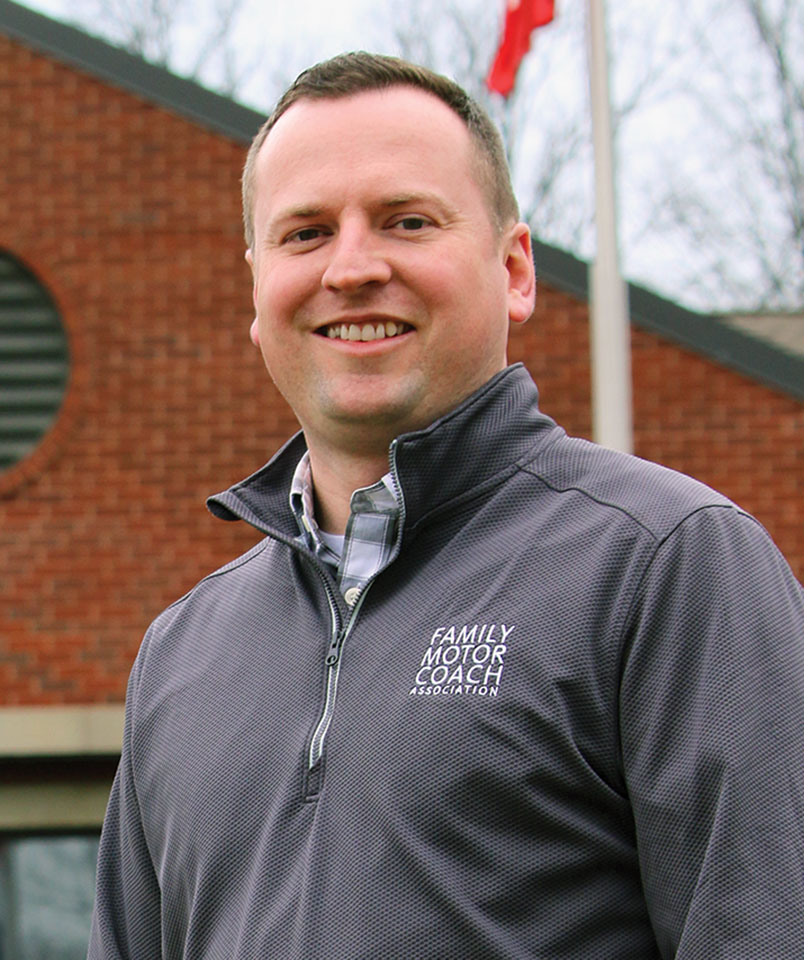
Chris Smith
csmith@fmca.com
Wow! Is it really 2019 already? Seriously? Seems just the other week I was making my 2018 New Year’s resolutions; no, I will not divulge whether I kept them!
Despite the bitter cold here in Cincinnati, January is one of my favorite times of the year. The holiday buzz lingers, college basketball season is in full swing, and it’s the perfect time to step back from our fast-paced lives and truly reflect on the previous year, while setting the tone for the year ahead.
With that in mind, let’s take a look back at some of the most frequently asked member benefit questions of the past year as we forge ahead into 2019.
How does the FMCA Tire Savings Program work?
While the Michelin Advantage and Continental Choice programs are similar, they do have some subtle differences. Following are general steps involved in buying tires via the program from either provider; for detailed, step-by-step instructions regarding each program, please visit FMCA.com/fmca-tire-program.
First, determine the size or the MSPN of the tire you need and use the Tire Savings Calculator found at FMCA.com/fmca-tire-program to receive your tire quote. Once you have your price, visit https://www.michelintruck.com/tools/dealer-locator/#/ to find a participating tire dealer that is convenient for you. Next, call the tire dealer to confirm availability of the tires you need and to schedule the installation.
Finally, for Michelin you will need to register your credit card in advance by calling the Michelin Advantage number — 888-532-6435 during business hours, or 800-847-9855 after hours. If using the Continental Choice program, you will not need to register your credit card — you are all set once you’ve scheduled the installation with a dealer. To find a dealer, visit https://www.continental-truck.com/truck.
Be sure to have your FMCA membership card ready to show, and please note that the FMCA Tire Savings prices do not include additional fees such as mounting, balancing, and state and local taxes.
I’m excited to announce the addition of Hankook Tires to our FMCA Tire Savings program. Much like the Michelin Advantage Program, Hankook now offers FMCA members discounted prices for RV, light truck, and passenger car tires. You will also need to register your credit card prior to having any Hankook tires installed on your vehicles. Additional information appears at FMCA.com/fmca-tire-program.
The FMCA Roadside Rescue® benefit is included with my membership dues, right?
Unfortunately, it is not. Occasionally confused with the FMCAssist Medical Emergency and Travel Assistance benefit, FMCA’s Roadside Rescue® benefit, powered by SafeRide RV Motor Club, is a roadside assistance plan that provides coverage for your RV (and other household vehicles) in the event of a mechanical or roadside problem. For the can’t-beat-it price of only $69 per year, you are covered in the event you need a tow, jump-start, tire service, or mobile mechanic, to name a few of the services. You can even extend your coverage to include additional family members living in your household. To learn more, visit FMCA.com/RoadsideRescue.
On the other hand, the FMCAssist Medical Emergency and Travel Assistance Program benefit is included with your FMCA membership. At no additional cost to you, FMCAssist provides peace of mind knowing your family, pets, RV, and car will be returned home safely if something unexpected happens to you. FMCAssist also will provide coverage should you require transportation to a medical facility better suited to treat your specific medical condition. It’s important to note, though, that FMCAssist is not medical coverage and will not pay your medical bills. To learn more, visit FMCA.com/FMCAssist.
Which mobile hotspot option is better for me: FMCA Connect-on-the-Go (Verizon) or FMCA’s Tech Connect + (Sprint)?
The answer largely depends on two factors: First is the primary geographic location where the device will be used, and second is the way in which you intend to utilize the service.
Regarding geographic location, Verizon generally has better coverage, particularly on the West Coast. Sprint does well on the East Coast and offers a free Magic Box to help boost your signal if you’re in an isolated area. In addition, as the merger between Sprint and T-Mobile takes shape, Sprint’s coverage will only get better and better.
In terms of utilization, both plans come with unlimited data. However, the Verizon plan will throttle your speeds significantly once you reach 25GB of data within a given billing cycle. Sprint reserves the right to slow your speeds if in a congested area, for example, but there is no “hard stop” based on data usage. For light internet users who periodically check email or peruse the internet, 25GB (Verizon plan) generally is enough, but if you require internet for work or want to stream videos, the Tech Connect + (Sprint plan) may be the better option.
Finally, the Verizon plan involves a 2-year contract, while the Sprint plan is month-to-month.
If you still have questions or would like more info, I invite you to visit the following link, which will help you further compare the two plans: FMCA.com/fmca-tech-discounts.
Why doesn’t FMCA have more benefits for Canadian members?
This is a tricky one to answer . . . but I am very proud of the variety of benefits we are able to offer our Canadian FMCA members.
Included with your membership dues are benefits such as the aforementioned FMCAssist ($105 value!); our monthly publication, Family RVing; FMCA’s mobile app; countless RV-education opportunities; and the advocacy work FMCA does within the RV industry.
In addition, Canadian members are able to take advantage of discounts on goods and services such as the $69 offer for FMCA Roadside Rescue®; two free nights per month at the FMCA RV campground in Cincinnati; pet insurance and pet monitoring; special rates on caravans with Fantasy RV Tours; and discounts from FMCA commercial members throughout North America.
We have worked hard to negotiate special rates with partners such as KOA (for new FMCA members); UPS; FMCA mail forwarding powered by Your Best Address; Staples; Passport America; and car rentals through Avis, Hertz, Enterprise, and National.
With that said, it can be challenging to find benefits that apply equally to U.S. and Canadian members. Because Canada is a different country, we have to work around laws and regulations, as well as fluctuating currency rates. One of my big-ticket assignments is to find even MORE benefits for our Canadian members, and I assure you we are working hard toward that goal every day. I’ve found the best way to find more is to reach out and ask, so if you have any suggestions, I’m all ears!
I hope I have clarified for you some of the most common questions we hear at the FMCA headquarters here in (chilly) Cincinnati, Ohio. I imagine some of you had these questions but weren’t sure how to ask. Please don’t hesitate to contact us whenever you want additional information. We can be reached by calling (513) 474-3622 or (800) 543-3622, Monday through Friday, 8:00 a.m. to 5:00 p.m. Eastern Time; or email us anytime at membership@fmca.com.
Enjoy the journey!