
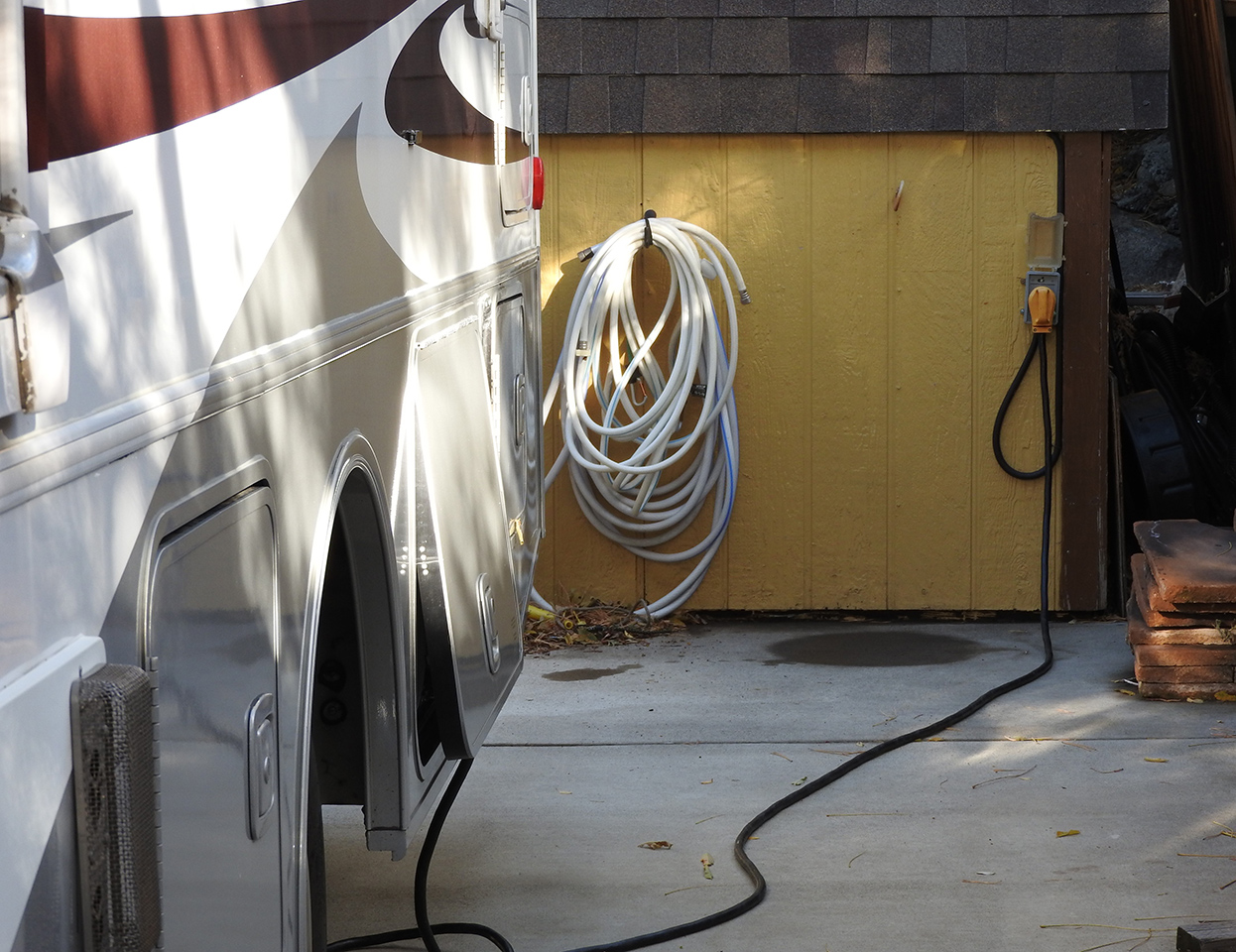
A dedicated RV receptacle offers convenience and ample electricity.
By Bill Trimmer, F439193
August 2018
Maybe you park your RV at home just to load or unload, or perhaps you are fortunate enough to be able to store it there. Either way, it’s nice to have electricity available to cool the fridge, to charge house batteries, or to run the air-conditioning in summer.
The easiest way to do this: Run an extension cord into your garage or to an exterior 15-amp or 20-amp receptacle and use an adapter for your shore cord. If you have a small RV with a 15-amp cord, you may only need a garage receptacle, depending on how many things you will run off that circuit.
However, adapting down from either a 30-amp or 50-amp RV always results in limited use of the RV’s electrical circuits, and in some cases it nullifies overprotection devices. Never compromise safety. Therefore, only use a reducing adapter temporarily for connecting the RV to a garage receptacle. If you desire long-term use, have a dedicated RV receptacle installed. A dedicated RV receptacle also makes sense because owners of 30-amp and 50-amp RVs will want more amps than the garage outlet can supply. First, though, let’s look at the garage/outdoor outlet option.
Garage/Outdoor Outlet
A ground fault circuit interrupter (GFCI) protects most 15/20-amp receptacles in a garage or outdoors. If plugging in the RV causes the GFCI to trip — either immediately or later when certain items are turned on — there is an electrical leakage problem in the RV. A competent RV technician should locate and repair such a problem, because it could result in a shock or possibly electrocution.
A defective electrical water heater element often is the cause of electrical leakage in RVs, although it is not the only possibility. Since the 30-amp and 50-amp receptacles normally used at an RV park are not GFCI-protected (nor are they required to be, per the electrical code), you may not discover that an electrical leakage problem exists until the RV is connected at home. You can still get this GFCI check benefit by temporarily connecting to a 15-amp or 20-amp GFCI receptacle in a park pedestal or to one at home. Use appropriate adapters as required; also use a three-wire extension cord if needed. Just don’t turn on too many appliances at once or you will trip the house or park breaker.
Also, don’t confuse a circuit breaker trip with a GFCI trip. A circuit breaker trip indicates an attempt to operate too many things at once in the RV. A short circuit could also cause a breaker trip. Note that if the 15/20-amp circuit in a pedestal uses a combination circuit breaker (overload protection) and GFCI protection, you may not know which caused the trip. Try it anyhow. If you have no trip, you are clean. If you do get a trip on a combination breaker/GFCI, try again at a different GFCI receptacle or at the next park that has a GFCI-protected 15/20-amp receptacle.
Why worry about a GFCI electrical leakage trip? A leakage can exist for a long time, undetected, with little harm. But someday, you will encounter a park pedestal that has an open ground. I was “lucky enough” to happen upon six such pedestals in a two-year period. The combination can lead to a hot chassis, also known as a hot-skin condition, and a potential shock or electrocution hazard. Therefore, it’s better to discover an electrical leakage problem early, before this happens. By the way, contrary to popular opinion, a reverse polarity (hot and neutral) will not, by itself, cause a hot chassis.
Using a standard home receptacle may require the use of a long extension cord. A long cord can cause excess voltage loss. When voltage at the RV is too low, equipment does not operate safely, so keep cords to the minimum essential length. Also be careful that the cord does not run in harm’s way, such as on a sidewalk, a driveway, or in the path of vehicles or machinery. I routed a cord aerially to avoid lawn mowers, snow blowers, and trip hazards.
Use heavy-duty cords that are at least 14-gauge for a 15-amp circuit and at least 12-gauge for a 20-amp circuit. (These amperages are for the house breaker, not the RV’s shore cord rating.) If the extension cord distance is greater than about 150 feet, increase the wire to the next heavier (lower gauge number) size.
House/garage receptacles typically provide only 15 amps (possibly 20 amps), minus any household equipment also operating on the same circuit. That should suffice to run a refrigerator, to charge house batteries, and to run a few lights, but it may not be enough to run an air conditioner or other appliances in the RV. As noted earlier, the answer could be to install a 30-amp or 50-amp receptacle dedicated for RV usage.
Using an existing 30-amp or 50-amp household appliance circuit is never recommended, as there is a higher probability of fire, appliance damage, or electrocution. Simply put, residential alternating current (AC) wiring is configured differently from RV wiring. Therefore, when tapping into household power, it’s recommended you use a dedicated and protected RV receptacle installed by a qualified electrician who fully understands RV wiring. This is not a do-it-yourself project. At press time, RVPowerOutlet.com was selling a residential RV electrical box with 50-amp, 30-amp, and 20-amp receptacles for $155.
Dedicated RV Receptacle
I have a dedicated RV receptacle, and I appreciate the convenience of having it near my RV’s parking space. Before hiring a qualified electrician to install a 30-amp, 120-volt circuit or a 50-amp, 120/240-volt circuit, consider the following:
- Do ordinances or covenants, conditions, and restrictions prohibit keeping an RV on your property, or impose limitations such as parking behind a fence? (Consider that many houses don’t have driveway access to a side or rear yard.) Are there time limits, such as 24 hours for loading and unloading? If you face time limits, you may decide that an extension cord to the garage is sufficient.
- Do you own the property? If not, can you get written permission from the owner and determine who will pay for the work? Will this impact your rent? Who will pay if removal/restoration will be required when you vacate? Will this require an upfront deposit?
- Do you plan to remain at this location long enough to make the investment worthwhile?
- Is there space in the house’s breaker box for the required new breaker(s)? If not, a subpanel may be a possibility but will add to the cost.
- What length of wire will be needed and is there a practical route to run it? Will conduit or cable have to be run along the outside of the house, or underground? Will wires be run overhead or through a crawl space or an attic? If several possibilities exist, which is the most economical? A 30-amp circuit will require 10 gauge, 3-conductor wire. A 50-amp circuit will require 6-gauge, 4-conductor wire; 8-gauge wire can be used if its insulation is rated for 75 degrees Celsius (167 degrees Fahrenheit). If the run will be more than 150 feet, consider the next larger size wire to reduce voltage loss.
- Will the proposed outlet location be convenient to the RV and out of harm’s way?
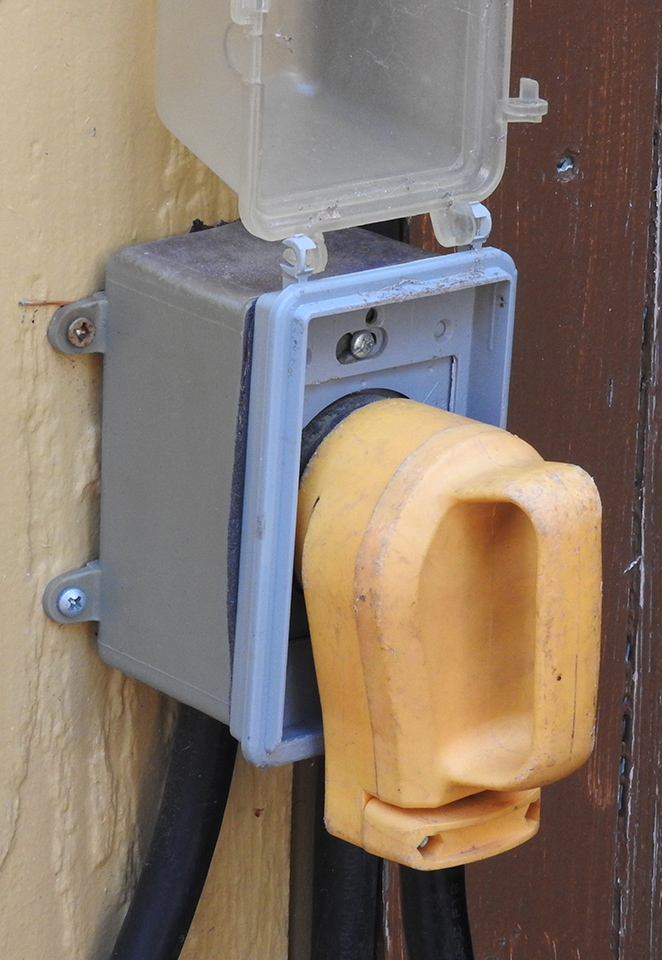
- You’ll want to include a rainproof enclosure for the dedicated RV receptacle. (Preferably one that includes a suitable circuit breaker or disconnect switch that can be turned off before plugging/unplugging.) This is particularly beneficial for 50-amp RVs. If the receptacle will be located in a common or public-access area, it would be wise to include a lockable cover to prevent others from using the dedicated receptacle and running up your power bill.
- Will the routing of the shore cord to the receptacle be a trip hazard? Is it likely the cord will be damaged by lawnmowers, snowblowers, other machinery, or vehicles?
- If things look doable up to this point, get estimates from several licensed electrical contractors. They should be able to help with answers to items 4 and 5 above.
- Is the quoted price for such an installation acceptable? In light of the costs, you may decide you can get by with an extension cord from a standard 15-amp circuit.
- The services of a licensed electrician/electrical contractor are highly recommended, as all permanently installed wiring must comply with the National Electrical Code (NEC) and local codes. A building permit and electrical inspections may be required.
- If your RV is a 30-amp unit, consider installing a 50-amp 120/240-volt dedicated circuit. This will be more expensive initially, because heavier wire and four conductors (instead of three) will be required. But the cost will be much less expensive than retrofitting later if you someday buy a 50-amp RV. In the meantime, use an adapter (50-amp male to 30-amp female). On the other hand, you may be satisfied with the lower cost of installing a 30-amp receptacle even if you have a 50-amp RV. Consider how you get along at rallies and older parks where only 30-amp service is available. Having the contractor quote the cost of both 30-amp and 50-amp installations may help you decide.
- Be aware that the wiring may be quite different from that at a house if the dedicated RV receptacle will be installed at a business. Consult your electrician about the differences.
- NEMA is the National Electrical Manufacturer’s Association. The NEMA classifications 14-50R and TT-30 are the designations for standard RV 50-amp and 30-amp receptacles, respectively. An electrician should understand these. If not, look for a different electrician.
When installing either 30-amp or 50-amp receptacles, the electrician should mount it with the ground (round) hole up, just like at RV pedestals. This allows the shore cord to go downward when connected. Not all contractors are familiar with RV wiring requirements.
Summary
The convenience of having a dedicated RV receptacle at home should not be underestimated. It’s up to you to decide whether the cost of installation will be worth the investment.
Remember, every installation will be different. Installing a heavy-duty receptacle and wiring is a serious undertaking and should be performed by a professional. Bungling the job could result in shock, electrocution, fire, and damage to RV equipment. Better to be safe!