
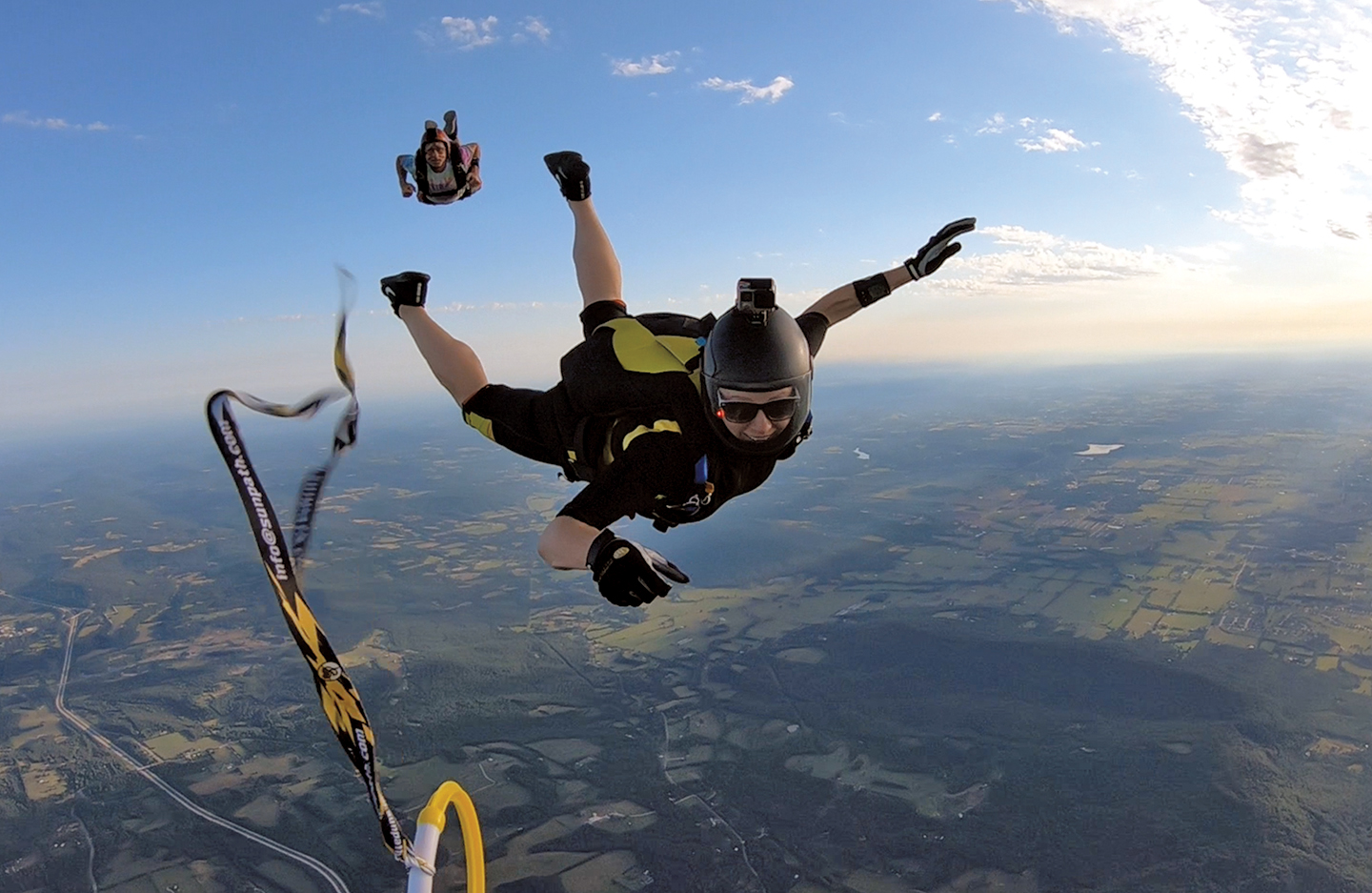
FMCA member Annette O’Neil made it her mission to skydive in every state.
By John Johnston, Associate Editor
November 2018
We won’t call Annette O’Neil, F485930, a daredevil, because that might imply she’s recklessly daring. She’s daring, all right. But insists she’s not reckless.
“I’m an incredibly conservative jumper in all the things that I do. Like, jumping out of planes, off bridges, off cliffs, off buildings. My goal in life is to be the most boring skydiver and BASE jumper on the planet,” Annette said.
You won’t often see the word “boring” in the same sentence with “skydiver” and “BASE jumper.” Then again, you won’t often meet someone like Annette, 37, who also enjoys paragliding (launching herself off a precipice while in a harness that’s attached to a fabric wing), sport bikes (motorcycles optimized for speed), and indoor skydiving (more about that later). She also writes about air sports for a variety of publications.
When Family RVing caught up with her in July 2018 at the FMCA Campground in Cincinnati, she was nearing the midway point of “Down for 50,” a six-month endeavor to skydive in all 50 states. The purpose of the feat, which she said has never been done in one fell swoop: raise money and awareness for Operation Enduring Warrior (OEW), a nonprofit organization that assists in the physical, mental, and emotional rehabilitation of wounded military veterans.
OEW’s programs encourage veterans to challenge themselves in any number of ways, including mountain climbing, multiday biking tours, scuba diving — and skydiving. “They’ve taught (veterans) who are missing multiple limbs how to skydive,” Annette said.
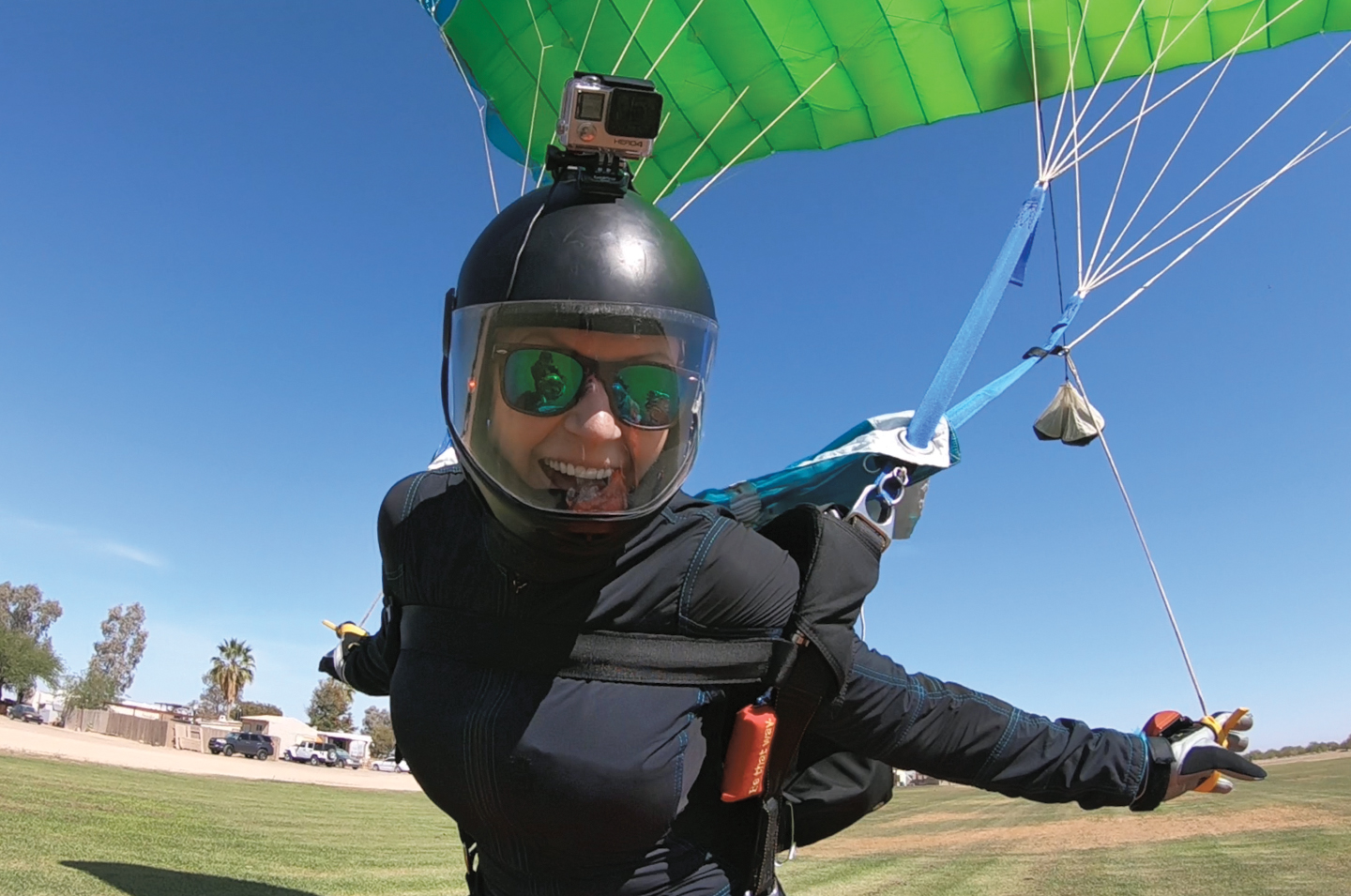
FMCA member Annette O’Neil flashes a smile after landing at Skydive Arizona in May 2018.
She knew little about parachuting in 2009 when she met Brett Kistler while backpacking in South Africa. “I thought skydiving was something you did once (in your life) for a birthday. He explained to me that skydiving is a sport.”
They traveled together to a small drop zone in Pietermaritzburg, South Africa, where Annette made her first tandem jump, from 13,500 feet. An instructor, attached to her via a harness, guided her the entire way down.
“I was definitely terrified,” Annette said. “You are definitely well within your rights to be, especially if it’s your first time. I remember looking at my feet on the door of that plane, my toes sticking out over the edge and seeing the landscape beneath me, which looks for all the world like a map. You have no perspective. It’s like a drawing underneath you.
“I don’t remember a whole lot about the jump itself. I do remember that feeling when I landed, and looking back up to where I just was, and looking back down on the ground. There’s no way you’re the same person after that.”
Annette returned to the states, got her skydiving license, and reconnected with Brett at the Bridge Day festival in West Virginia. It’s the one day a year when BASE jumpers can legally leap off the New River Gorge Bridge, an 876-foot-high span.
BASE is an acronym for the places from which jumpers usually leap: buildings, antennae, spans, and earth. It’s more dangerous than jumping from an airplane, because there’s far less distance to the ground. Depending on the height of the object, a BASE jumper may have only a second or so to correctly deploy his or her parachute.
“The first BASE jump I watched, the guy broke his back,” Annette said. “I remember thinking, ‘I’m not sure if I’ll ever do this.’”
She did, of course. She’s made about 350 BASE jumps and 900 skydives. One close call occurred during a BASE jump in Kuala Lumpur, Malaysia, when her canopy became twisted. She fixed it as best she could, and landed unharmed.
“A lot of us don’t get into these sports for adrenaline, but for the focus that they require,” Annette said. “When you jump out of a plane, nothing else exists. Your inner monologue, no matter what it might be, shuts off completely. It’s a place of complete peace. And it lasts quite a while after the jump itself.”
That’s why Annette believes strongly that skydiving, and air sports in general, are good for veterans, particularly those dealing with the effects of combat. Skydiving also helps to restore self-confidence and build trust, she said. Jumpers must trust that others, from the pilot to the instructor, have their back.
The military is in Annette’s blood. Her parents, and both sets of grandparents, are veterans. After a 30-year Air Force career, her father, Terrence J. O’Neil, became an associate chief of staff for a Veterans Administration medical center in Tennessee. He’s now retired, and Annette said Down for 50 is her way of honoring him.
Joel Strickland, a British-born skydiving champion Annette has known since 2012, agreed to jump with her in all 50 states. As their plans took shape, and with fond memories of traveling in her maternal grandparents’ motorhome, Annette concluded an RV would be perfect for a road trip across the 48 contiguous states. That led to the purchase two years ago of a 1996 Type A motorhome. “We thought it was a steal,” Annette said. “Turns out there were a lot of back-end costs involved.”
Before their 12,000-mile trip began, the engine was replaced and the interior was renovated. Then shortly after the journey began, the transmission died. Replacing it put a serious dent in their travel budget, which they are self-funding.
A bigger problem arose in late June in Missouri when Joel was seriously injured while skydiving over a lake. He had intended to cut his chute loose just before landing and plop safely into the water, but it’s difficult for a jumper to judge the distance to the surface. Joel cut loose too soon and fell about 30 feet. He was hospitalized with a ruptured bowel, fractured shoulder, and a broken rib.
While Joel recovered, Annette skydived with Brett Kistler. Joel eventually returned to jumping in full form.
At the time Family RVing went to press, Annette and Joel expected to complete Down for 50 by October 20. Then they will move to Berlin, Germany, where Joel will be sport manager of the Hurricane Factory, an indoor skydiving wind tunnel. Such tunnels create a column of wind that allows participants to simulate the experience of a free fall.
“You can do some incredibly beautiful acrobatic moves,” Annette said, “especially since you don’t have a parachute to hinder your aerodynamics.”
Which means more opportunities to do what she loves: Fly.
To donate to Operation Enduring Warrior through the Down for 50 website, visit www.downfor50.org/contribute. For more information about Operation Enduring Warrior, visit www.enduringwarrior.org.