
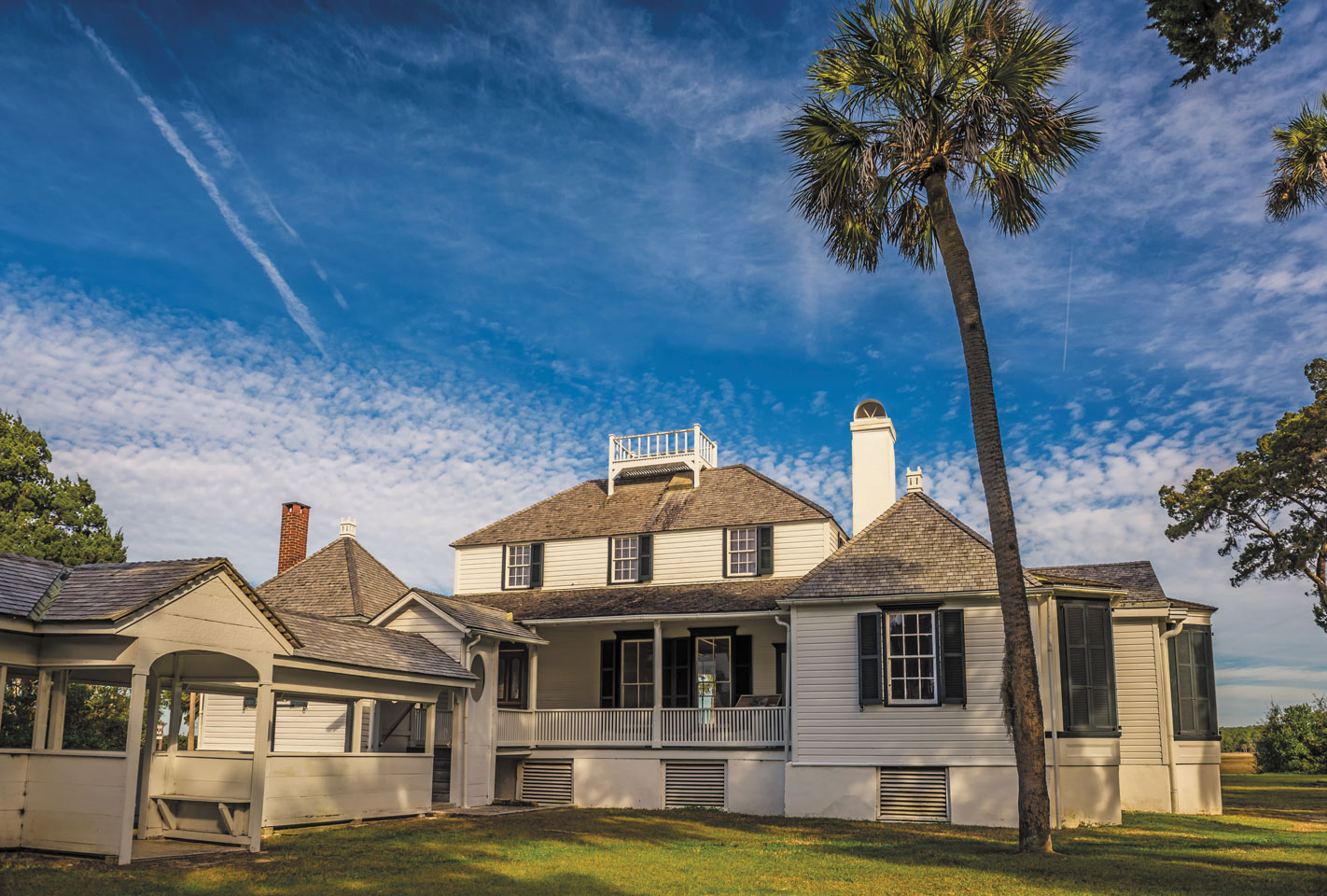
Stories run deep at the oldest surviving plantation home in Florida, now part of a national park in Jacksonville.
By Neala McCarten
November 2019
Now known as Kingsley Plantation, the site on 1,000-acre Fort George Island is part of a national park called Timucuan Ecological and Historic Preserve. The plantation has some of the most complete remnants of slave cabins. Built of an oyster-shell-based concrete called tabby, the remaining walls of these tiny homes have withstood the wind, rain, heat, and humidity of northern Florida. The plantation house itself, probably built between 1797 and 1798, is the oldest surviving plantation house in the state. These things alone make the site unusual, but there are more reasons to visit.
Archaeological research has found a scattering of possessions in the slave cabins, but there is little left on the grounds of either the enslaved people or the plantation owners. Visitors can glean information from exhibits along a self-guided trail, which is thoughtfully created and illuminating. They learn about the horrors of slavery, as well as the attitudes of the Kingsley family and how the plantation was run. The crops grown by the enslaved included a little-known type of cotton called Sea Island, characterized by its long, silky fibers.
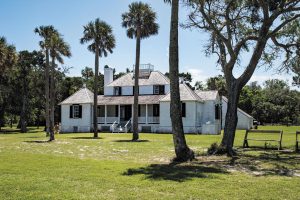
The oldest such home in Florida, the Kingsley Plantation house dates to the late 1700s. This view shows the back side of the house, which faces Fort George Inlet.
Ultimately, we remember a good story much better than a cold fact. At this place, story after story reveal fascinating details. A diverse group of families lived in the house. John “Lightning” McQueen, a Revolutionary War veteran, seemed to be escaping his debts as much as seeking his fortune. He had the house built. Another owner, John McIntosh, was a patriot who led a revolt against the Spanish and had to flee when they regained control. The next owner was Zephaniah Kingsley, whose family story has an unusual twist. He purchased a slave named Anna, married her, and in 1811 obtained for her the status of one of the “free people of color” from the Spanish government. She wound up with her own plot of land and her own slaves.
After the United States bought Florida from the Spanish in 1821, the Kingsley family’s lifestyle was threatened. U.S. laws did not recognize Anna’s status, nor that of the Kingsley children. After protesting the injustice for several years, Zephaniah packed up and moved his family as well as several former slaves to Haiti, where he started a colony in 1837.
The stories of these three families make the free weekend tour of the house a must-do. If you can’t visit on a weekend, the self-guided tour of the grounds, available daily, takes visitors through the slave quarters and a restored cabin; the barn (now filled with exhibits rather than farm animals); the garden; and the kitchen. In addition, a room called Anna’s Parlor tells the story of the girl who was sold to the man who became her husband, was given freedom, and owned slaves herself.
An audio tour is offered at no charge from the visitors center. A printed map of the major stops along the way also is available at the center.
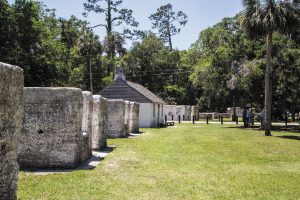
The ruins of slave cabins line a part of the property. One of them has been restored to serve as an example of what they once may have looked like.
Plantation entry, parking, and tours are all free and open daily from 9:00 a.m. to 5:00 p.m. Tours of the house are available only on Saturdays and Sundays at 11:00 a.m. and 3:00 p.m. Call (904) 251-3537 to reserve a spot; the tour is highly recommended. It’s the best way to learn the story of the land’s multiple owners and the evolution of the house’s architecture.
Ribault Club: While you’re visiting the park, you may want to learn about more recent history at the Ribault Club, a 1930s playground for the very rich. A visitors center has exhibits about Fort George Island. It’s open Wednesday through Sunday from 9:00 a.m. to 5:00 p.m. Because the club now doubles as a special-event venue, it provides good parking facilities.
The road to the plantation is unpaved but in good condition, and the large parking lot can accommodate RVs. Kingsley Plantation and the Ribault Club are a short drive apart on Fort George Island.
Elsewhere On The Preserve
Timucuan Ecological and Historic Preserve also includes Fort Caroline National Memorial and the Timucuan Preserve Visitors Center. They are located on the other side of the St. Johns River. Getting there from the Kingsley Plantation area requires about a 40-minute drive; or, a ride on the St. Johns River ferry. Depending on when you visit, the ferry may have a long wait. And it’s not inexpensive if you are in your RV: $20 one way. For a car, van, or truck, the ferry is $6. See www.stjohnsriverferry.com for details.
Timucuan Preserve Visitors Center: Timucuan Preserve was named after the American Indians who were living in the area when Europeans arrived. Little is left of the people and their artifacts, but excellent exhibits at the Timucuan Preserve Visitors Center describe their daily lives and the push and pull of the Spanish and French over this part of Florida.
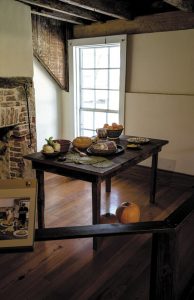
A glimpse of the kitchen in the plantation house. Visitors can take a guided tour of the interior on weekends.
A short walk from the visitors center leads to the Fort Caroline National Memorial. Signs tell the tragic story of the settlers. The French came to the area in 1564 both for commercial gain and to establish a safe haven for the persecuted French Protestants (Huguenots). But the Spanish attacked the fort in 1565, killing nearly all inhabitants. The French got their revenge by returning in 1567 and recapturing the fort. The site is open daily from 9:00 a.m. to 5:00 p.m. There is no admission fee. Limited parking is available at the visitors center.
Editor’s note: According to the park website, hurricane-related repairs to Fort Caroline were scheduled to take place through December 2019. While repairs are under way, visitor access to parts of the interior and exterior will be limited.
Details
Timucuan Ecological and Historic Preserve
Kingsley Plantation
11676 Palmetto Ave.
Jacksonville, FL 32226
(904) 251-3537
www.nps.gov/timu/learn/historyculture/kp.htm
Timucuan Preserve Visitors Center and Fort Caroline
12713 Fort Caroline Road
Jacksonville, FL 32225
(904) 641-7155
www.nps.gov/timu/learn/historyculture/foca.htm