
Often ubiquitous, roadside signs entertain, inform, and help pass the miles.
By Dorothy Rieke
August 2021
Ben met Anna
Made a hit
Neglected Beard
Ben-Anna Split
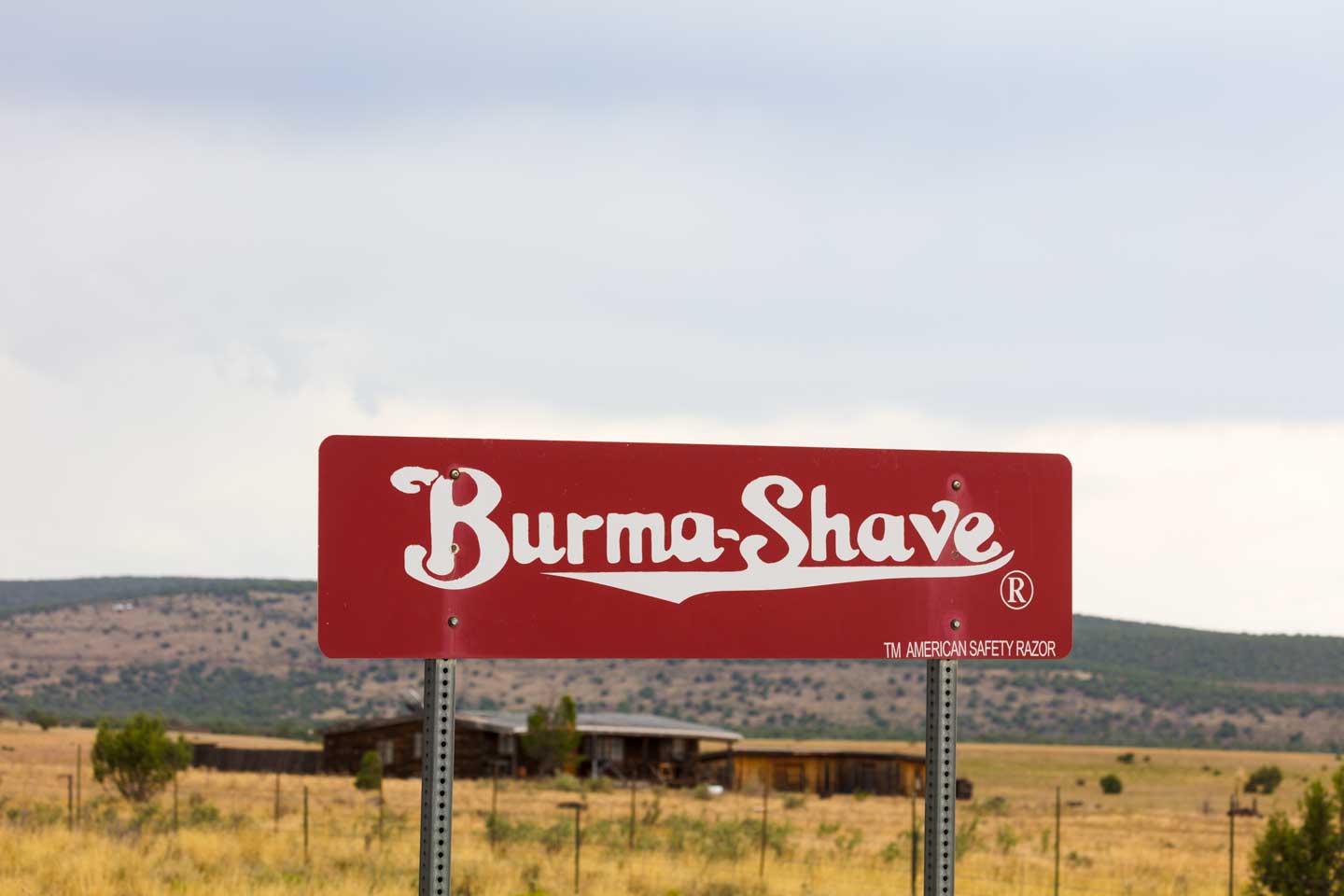
Burma-Shave
Burma-Shave signs helped launch today’s billboard business.
How delighted I was as a youngster to read and laugh at the Burma-Shave signs as our family drove along U.S. 75 south of Nebraska City, Nebraska. Rather than advertising on one large billboard, the company that created Burma-Shave, a brand of brushless shaving cream, erected a series of five or six simple signs along roadsides throughout America. Each was strategically separated and printed with part of a clever little jingle that kept readers hooked until the punchline.
Every shaver
Now can snore
Six more minutes
Than before
By using Burma-Shave
Even though I saw the same set of signs over and over, I continued to read them whenever we drove past, chuckling again and again. I was not the only one who found the signs amusing, of course. The signs were so popular across the country that they became woven into the very fabric of Americana and are, arguably, the most recognized billboards to ever dot the landscape. Some are now on display in the National Museum of American History at the Smithsonian Institution.
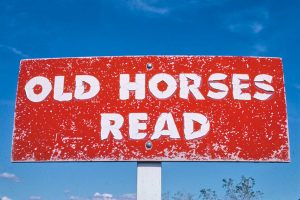
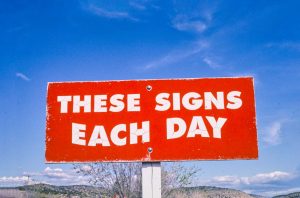 The Burma-Shave signs first appeared in 1925, and the company continued with the advertising concept through the post-World War II era, when automobile travel skyrocketed, before stopping in the early 1960s after the company was sold. Their success not only pushed Burma-Shave to become the second-highest-selling brushless shaving cream in America at the time but had a secondary impact as well: They helped increase the popularity of billboards.
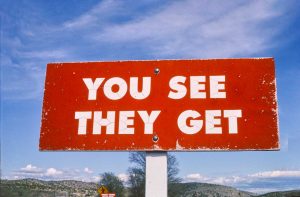
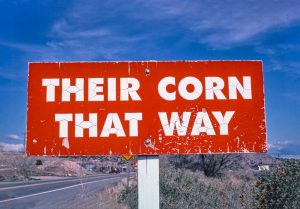 Since the creation of the Model T, America has been a country on the move, and that has never been truer than today. Citizens — including RV travelers — spend more time on the road than ever before, and as the number of motorists has increased, so has outdoor advertising. Billboards have grown so much, in fact, that they now could be considered part of the American landscape. They are informative, entertaining, and — especially for RVers — a great way to pass the time as the miles roll by.
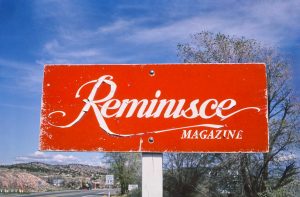
In 1995, Reminisce magazine held a contest and created Burma-Shave sign reproductions that were placed in 45 cities.
History
The Romans were known for their superb road building, so it makes sense that billboards — mostly signs on stone pillars giving directions to Rome — dotted the Roman roads. The oldest known billboard was posted in the Egyptian city of Thebes more than 3,000 years ago, offering a reward for a runaway slave. Many European cities also used billposting to relay information.
Some of the first billboards in America were signboards listing names of taverns, coffeehouses, auctions, and stagecoach timetables. As early as 1835, traveling shows, including circuses, used mobile signs mounted on horse-drawn wagons. Between 1872 and 1912, laws began to be enacted to standardize the size of billboards to “24 poster panels,” or 19.5 feet by 8.7 feet. Today they range from 5 feet by 11 feet to 14 feet by 48 feet.
A nationwide paint service firm, Bradbury and Houghteling, became the largest outdoor advertising company in the United States in the 1870s by contracting to create visuals on barns, sheds, or fences along railroad tracks or highways around the country with such messages as “Use Hood’s Sarsaparilla.” Mail Pouch Chewing Tobacco Company also utilized this method, agreeing to paint the other sides of the barn any color if the owner agreed to reserve one side for the large “Chew Mail Pouch” ad. A few of those ads are still visible in rural parts of the country.
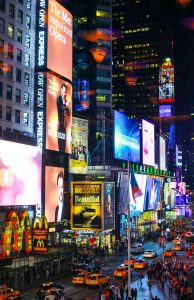
Today Times Square boasts digital billboards.
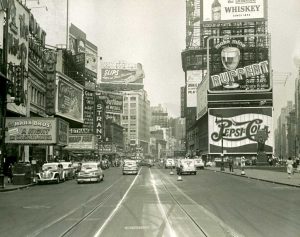
New York City’s Times Square grew to become the epicenter of outdoor advertising, including painted signs.
Today, rather than barns, billboards are placed in a wide variety of locations. New York City’s Times Square is, of course, the epicenter of billboards, with signage on top of buildings, on the sides of buildings, and next to buildings. Mostly, though, billboards are freestanding, located along highways, targeting travelers with messages of nearby restaurants, hotels, shops, and services.
Although the where and how of advertising with billboards has changed, their purpose remains the same: Inform and/or entertain.
Billboard Best
Through the years, Burma-Shave informed and entertained travelers with roughly 600 sets of signs. Some were pure advertising:
No Matter
How you slice it
It’s still your face
Be humane
Use Burma-Shave
Dewhiskered Kisses
Defrost
the misses
Burma-Shave
However, in the mid-1930s, it started mixing in safety messages:
Brother speeder
Let’s rehearse
All together
’Good Morning Nurse!’
Burma-Shave
Past
Schoolhouses
Take it slow
Let the little
Shavers grow
Burma-Shave
The famous Marlboro Man ads began appearing in 1954, although in 1971 when tobacco companies were banned from advertising on radio and television, billboards became their mainstay. That lasted until 1998 when cigarette advertising was banned from billboards as well.
While billboards strive to capture the passerby’s attention, some present a huge distraction. In 1994, a Wonderbra “Hello Boys” ad featuring Eva Herzigova so distracted drivers that it is rumored cars hit medians, poles, and even each other. True or not, its impact was so great that Glamour magazine cited it as the most iconic billboard ever.
It is true that some drivers allow themselves to be distracted by billboards. Billboards often change a driver’s patterns of visual attention, increasing the time needed to respond to road signs and, thus, driving errors. As a result, authorities monitor the use of certain designs and locations of roadside advertising, especially along interstates.

Advertisers often seek to attract viewers by enhancing traditional billboards, such as Chick-fil-A placing three-dimensional cows on its signs.
Like those Burma-Shave signs, billboards often emphasize safe driving. One billboard, sponsored by the Colorado State Patrol, displayed a picture of a car ramming into the back of a semi. The sign read, “Tailgating Isn’t Worth It.”
Advertisers have also used billboards to create unique or unusual messages in an effort to attract viewers. A recent Chick-fil-A billboard included a three-dimensional cow figure attached to the billboard pretending to paint a misspelled slogan, “Frendz don’t let frendz eat beef.” Vancouver’s ReThink, an advertising agency, glued 9,000 dazzling glass “diamonds” to a billboard to promote a Science World exhibit, noting that, compared to other gems, diamonds aren’t that rare.
A billboard in Sioux Falls, South Dakota, displayed a woman sitting on a gurney in front of two wrecked cars. Smoke literally billowed out from one of the cars on the billboard, thanks to a hidden smoke machine. The Bloom grocery chain had a billboard in Charlotte, North Carolina, depicting a giant cube of beef being pierced by a fork. The interesting thing about this sign was that it was scented. Twice a day it emitted aromas of black pepper and charcoal in an effort to stimulate the senses and make people hungry.
At times, because spelling and grammar mistakes are made, travelers laugh. One sign from Creative Kids Software read, “So fun, they won’t even know their (they’re) learning.” A Louisiana auto dealership sign — and also the name of the business — stated, “We BYE used cars.” About 10 years ago, a sign for Trophyland in Atlanta read, “Plagues, awards, specialty engraving and trophies.” Perhaps they meant “Plaques.”
As with everything else, technology has worked its way into the billboard world, with digital billboards now taking over. They rotate to allow multiple messages from different companies, thus creating a maximum impact on a wide audience. Technology also allowed Beck’s Beer to create a playable musical billboard. When conductive ink was linked to sensors and speakers, and the billboard was touched, sound began.
Location, Location, Location
Like real estate, the placement of billboards is a crucial factor in their effectiveness. That’s one reason why mobile billboards — much like the signs on horse-drawn wagons in the 1800s — are still in use. The one advantage of this type of billboard is that it can be moved to reach the targeted audience, such as near heavy foot traffic during a specific event.
Typically, though, billboards are placed along highways and busy streets — wherever people travel regularly, so they will be seen and remembered. Being remembered is up to the messaging, and in the billboard world, less is best. Viewers have only a few seconds to see the billboard, read the message, and retain it. In today’s saturated communications environment — as any RVer will tell you — there’s another billboard up ahead.