
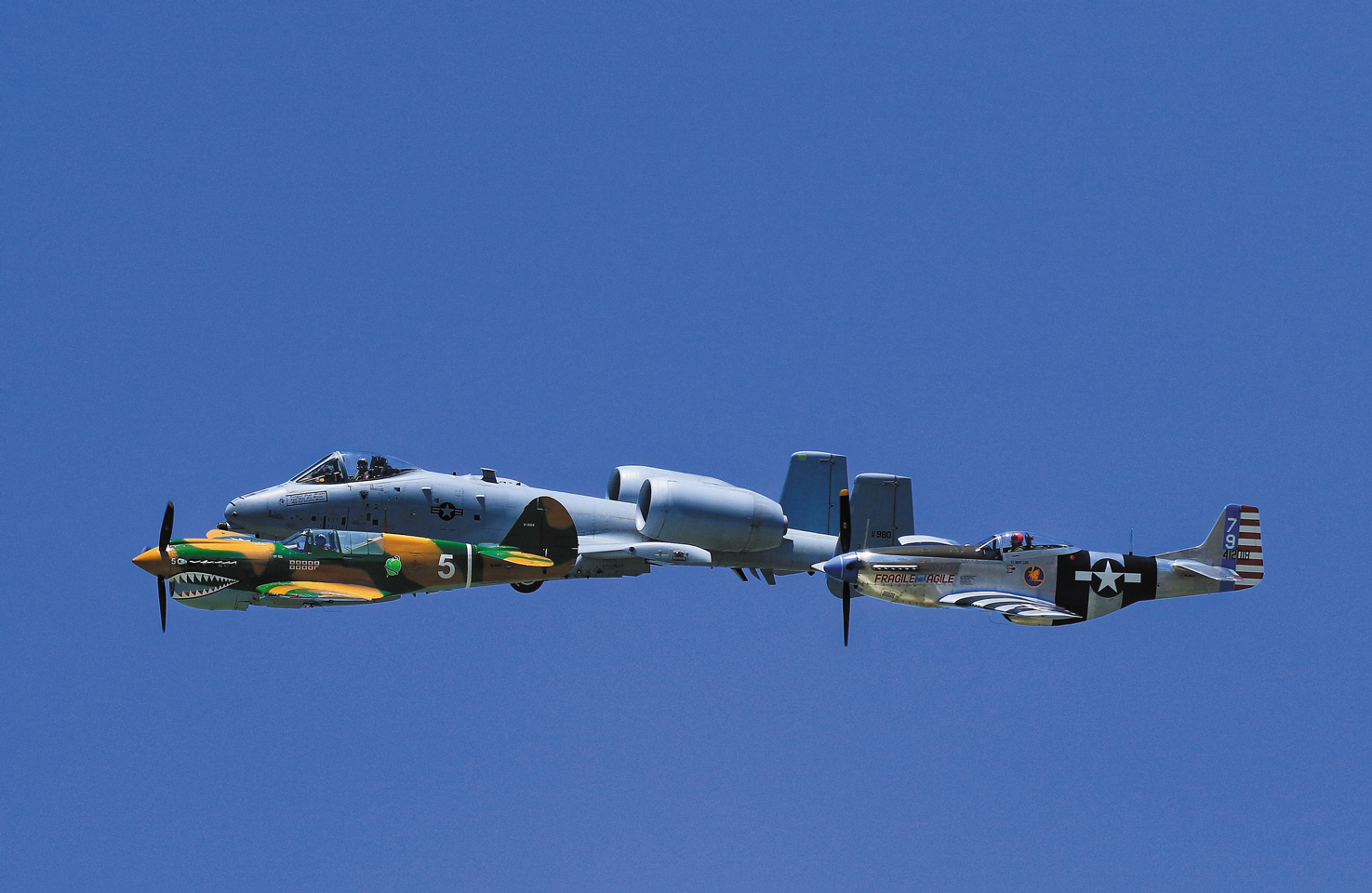
RVers can experience the thrill of aerial displays at air shows throughout the United States and Canada.
By George Moore, F460576
August 2021
As a young child in the early 1950s, I lived in White Plains, New York. On Armed Forces Day, I remember sitting in the backyard watching formation after formation of military aircraft fly over. The aircraft represented all branches of the U.S. armed forces and ranged from World War II planes to new jets. Even then, I felt a sense of patriotic pride as I watched this annual spectacle.
U.S. Air Force Thunderbirds
In 1956 my father was transferred to Rome, New York. Here, during the late 1950s and early 1960s, I had the opportunity to attend the annual open house and air show at Griffiss Air Force Base (which closed in 1995). I watched in awe as the pilots performed aerobatics and high-speed maneuvers in their jet aircraft. It was equally exciting to look at the modern military and historic aircraft on static display.
Upon graduating from college, I realized my childhood dream of becoming a U.S. Air Force pilot. During my 25-year career, my wife, Sherrian, and I attended many air shows.
After I retired from the Air Force, we eventually settled in the Texas Panhandle, and air shows became a thing of the past for us — until we took a motorhome trip to Port Aransas, Texas, in April 2019. Watching the local news one evening, we learned that the annual Wings Over South Texas Air Show was coming up soon at Naval Air Station Corpus Christi. Many years had passed since we attended an air show, and we were excited about the opportunity. We were especially eager to see the U.S. Navy flight demonstration team, the Blue Angels, perform.
U.S. Air Force Thunderbirds
Wow! What an experience, and with a chamber-of-commerce weather day. In addition to inspecting the aircraft on static display, we watched nationally and internationally ranked aerobatic pilots perform seemingly impossible maneuvers in their specially built aircraft. Aerial demonstrations were conducted by the U.S. Coast Guard, as well as pilots in WWII early military jet aircraft (R.A.F. Vampire) and Vietnam-era aircraft (MiG-17 and T-28). The highlight of the show was the Blue Angels squadron. Flying the F/A-18 Hornet, these pilots wowed the crowd with their close-formation flying and single-aircraft high-performance demonstrations. The Blue Angels have since upgraded their aircraft and now fly the Super Hornet, promising an even more heart-stopping performance.
After attending that air show, I wondered how many in our FMCA family have never experienced the thrill of watching modern-day pilots perform seemingly impossible aerobatic maneuvers. (One even lands his aircraft on the roof of a moving pickup truck.) How many have never witnessed the Blue Angels or the U.S. Air Force Thunderbirds?
You don’t have to be a pilot or aviation buff to enjoy an air show. They come in all types and sizes. For example, small, old-time country barnstorming-type shows are presented at the Flying Circus Airshow in Bealeton, Virginia. You might even see wing walkers at that one, recalling the 1920s popularity of barnstormers.
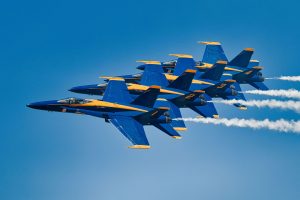
U.S. Navy Blue Angels
Antique aircraft are spotlighted at the Old Rhinebeck Aerodrome in Red Hook, New York. The museum features aircraft from the pioneer era, World War I, and the golden age of aviation between the wars. Air shows are scheduled on weekends.
World War II aircraft are the focus of the Commemorative Air Force AIRSHO in Midland, Texas. The CAF has wings and museums in many locations across the United States and participates in or sponsors several air shows annually.
Several military bases, civilian airports, and cities host air shows, and all are open to the public. In addition to the U.S.A.F. Thunderbirds and the Navy Blue Angels, the Royal Canadian Air Force Snowbirds perform at several air shows in the United States and Canada each year. You might also catch a performance by the U.S. Army Golden Knights Parachute Team.
I would be remiss if I didn’t mention the “big daddy” of all U.S. air shows, the annual EAA AirVenture in Oshkosh, Wisconsin. This weeklong event attracts 600,000-plus visitors from more than 80 countries. Visitors can view over 2,500 aircraft displayed in specific “neighborhoods,” such as Boeing, warbirds, home-builts, vintage, etc. It is not unusual to spot one-of-a-kind aircraft. Air shows are performed daily. AirVenture 2021 will take place July 26 through August 1; AirVenture 2022, July 25 through July 31.
Air Show Tips
Check the website for the air show you plan to attend. You can review the schedule, parking layout and traffic routes, and security restrictions for backpacks and other items. Information about COVID-19 restrictions will be provided as well. Some of the larger air shows also have reserved seating and VIP-style hospitality tents for which you can purchase tickets.
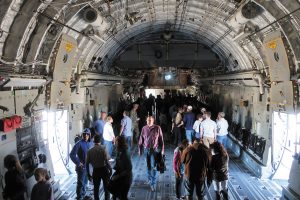
Spectators can tour static ground displays, such as this C-17 cargo plane at Sheppard Air Force Base, Texas.
Bring ear protection (high-performance jet aircraft are loud), along with sunscreen, water, a hat, a camera, and an easy-to-carry collapsible lawn chair. Food and drink concessions are available.
The air show season runs from spring through fall, offering plenty of options throughout the United States and in Canada.
See you at the show.
Resources
In addition to these sites, search online for specific air shows.
U.S. Air Force Thunderbirds
www.afthunderbirds.com
U.S. Army Golden Knights
www.goarmy.com/events/golden-knights.html
U.S. Navy Blue Angels
www.blueangels.navy.mil
Royal Canadian Air Force
www.rcaf-arc.forces.gc.ca
EAA AirVenture
www.eaa.org/airventure
MILAVIA
www.milavia.net
The Air Show Network
www.airshownetwork.com