
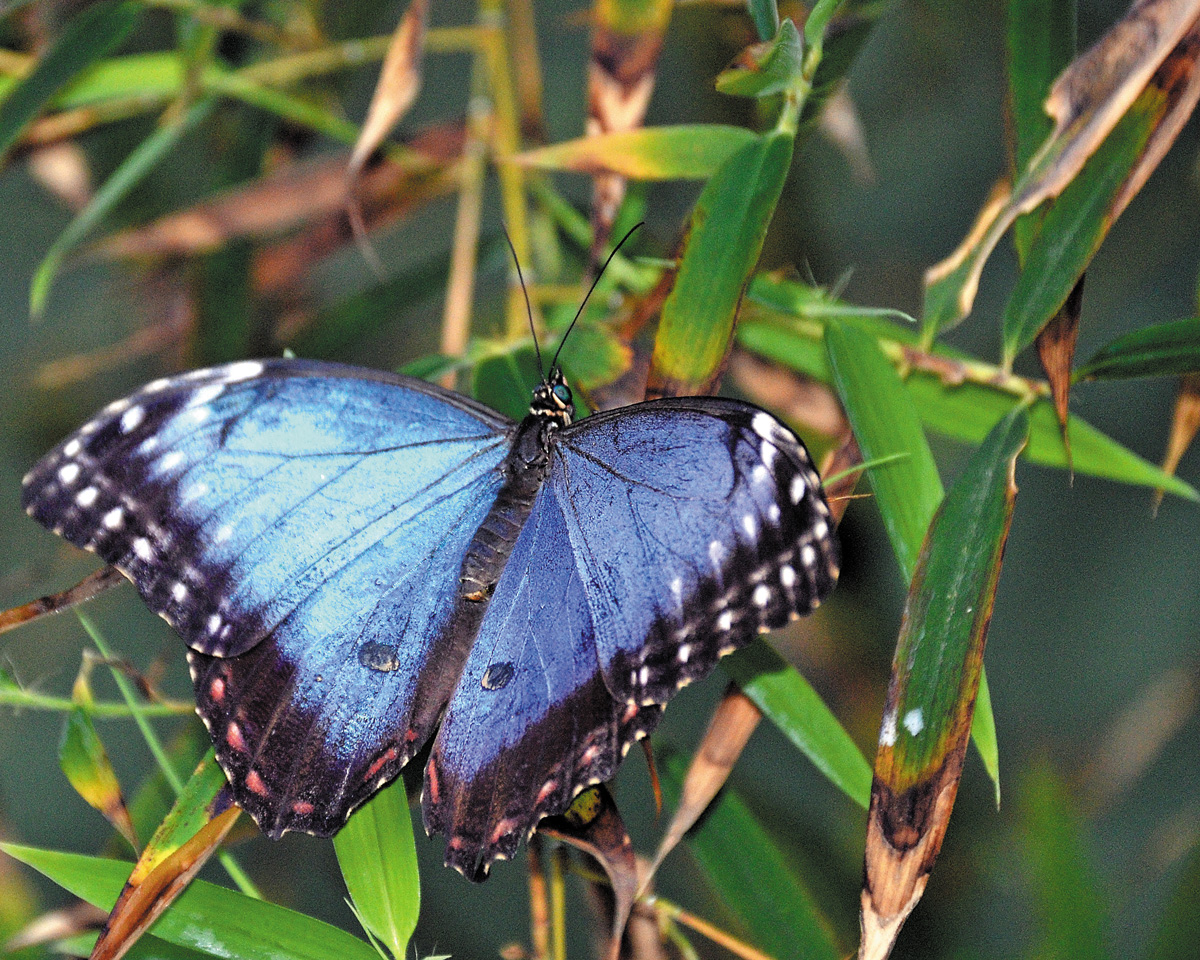
This Scottsdale, Arizona, attraction invites visitors to step into a lush tropical paradise that teems with thousands of captivating winged creatures from around the world, and so much more.
By Richard Bauman
January 2022
Butterflies are magical and mysterious. They flutter around plants and flowers, landing only briefly, and then scurry away to the next plant that attracts them. Their frenzied flight seems to have no rhyme or reason. Typically, they don’t sit still long enough for us to get a good look at them, let alone admire the colors and patterns of their delicate wings.
But a visit to Butterfly Wonderland in Scottsdale, Arizona, will change all that. Here, butterflies take center stage. They are the stars, the main attraction. Unlike the butterflies we see commonly around our homes or other places, numerous species are here for visitors to see and admire, up close, in all their radiant glory.
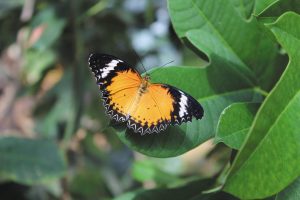
Butterflies from around the world, including the Asian malay lacewing, inhabit Butterfly Wonderland in Scottsdale, Arizona.
The main gallery at Butterfly Wonderland encompasses 10,000 square feet of tropical rainforest mist, butterfly-satisfying plants, and flowers selected to meet the needs of the thousands of butterflies flittering about. It ranks as one of the largest butterfly conservatories in North America. The flowers provide nectar for nourishment, and trees and plants offer places for them to rest. Feeding stations with sliced oranges and other delectables further satisfy the demanding palates of various butterflies. The room is kept at a constant temperature of 80 degrees and at 80 percent humidity to ensure the best living conditions for its residents. Small waterfalls and even a large koi pond add to the atmosphere.
Butterfly Introduction
Before entering the gallery of flutter, you’re invited to watch a 15-minute IMAX movie about the migration of monarch butterflies. Each fall, North American monarchs journey from their summer breeding grounds to overwintering locations. East of the Rocky Mountains, monarchs travel as much as 3,000 miles to central Mexico. Monarchs living to the west of the Rockies have a much shorter migration to the California coast. In either migration pattern, along the way they find refuge in stopover locations with abundant nectar sources and shelter from bad weather.
The film was shot in 3-D, and special glasses provided at the theater door give you the full effect of standing in a rain forest with thousands of butterflies fluttering around you. Instead of just allowing you to view the butterflies, the 3-D technology thrusts you into the midst of thousands of orange-and-black monarchs.
After the movie, the next stop most visitors make is the Butterfly Emergence Gallery. It’s a small room with three glass windows in one wall. Behind each window are hundreds of butterfly chrysalises attached to a low ceiling. Different species of butterflies at various stages of development can be viewed. It might look like nothing much is happening, or the exhibit is artificial, but that’s not so. The butterflies emerge slowly, struggling almost imperceptibly, but emerge they do, and then they become ready to join the other butterflies in the butterfly garden.
A guide generally can be found in the chrysalis room to answer questions and explain the process going on behind the windows. Did you know there are about 28,000 species of butterflies in the world? The chrysalises you see in the Emergence Gallery are from butterfly farms in Costa Rica, Malaysia, Ecuador, Thailand, and the Philippines.
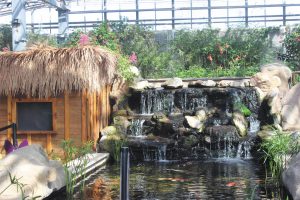
Ponds and small waterfalls create a tropical environment suited to butterflies.
Butterfly Lore
Humans have been fascinated by butterflies since ancient times, in part because they are wonderful examples of change, transformation, and growth. And in many cultures, they have become the stuff of myth and legend.
For example, Irish folklore says that these little flyers can pass easily between this world and the next, and if a white butterfly lands on your shoulder, it’s a sign that the soul of a recently departed loved one has arrived in heaven.
Ancient Greeks also held butterflies in metaphysical regard. Aristotle named the butterfly Psyche, which is Greek for “soul.”
American Indian tribes had a number of legends concerning butterflies. Some tribes of the American Southwest believed butterflies were conveyors of prayers and wishes to God, whom they called the Great Spirit. The Sioux called butterflies “fluttering wings.” Other tribes, such as the Zuni, looked to butterflies to show them what the weather in coming seasons would be. If they saw predominantly white butterflies, they took it to mean summer was near. On the other hand, dark butterflies were a prediction of a stormy summer. And yellow butterflies foretold, they believed, a warm, sunny summer.
Main Gallery
As mentioned above, the main gallery, or butterfly garden, is kept at a constant temperature and humidity. It doesn’t matter whether it’s bone-chilling cold or sun-hot outside; the weather inside never changes. The air is heavy with moisture and mist. If you wear eyeglasses, you can expect them to fog over as soon as you step into the garden. Likewise, camera lenses can become coated with mist. Thus, it’s a good idea to carry a lens-cleaning cloth or lens tissue with you to remove the moisture.
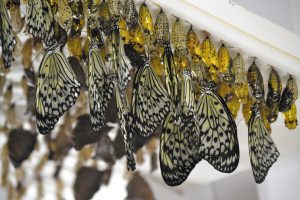
Paper kite butterflies emerge from their chrysalises in the Butterfly Emergence Gallery.
Though none of the 3,000 butterflies in the main gallery will harm you, you can harm them. It’s a good idea to watch where you step or sit, because butterflies sometimes land on the floor or on benches.
The number, colors, and sizes of butterflies here is mind-boggling. Some are as small as a nickel, and others are bigger than an adult’s hand. It takes at least a few minutes to absorb it all — plants, flowers, and butterflies. Visitors spot butterflies on plants, some clinging to the underside of leaves, while others flutter about. Their colors range from drab to brilliant, and there’s always motion in the garden.
A favorite of photographers is the iridescent blue morpho butterfly from the rain forests of South America. Monarch butterflies with their orange-and-black wings and shiny black bodies are easy to spot in the atrium.
There’s no need to rush through the atrium. No time limit is imposed; nor is there anyone urging you to move through it. You proceed at your own pace, and the slower you go, the more you’ll see. Keep handy the brochure you received when you purchased your admission ticket so you can identify the various species of butterflies you’ll encounter. While the brochure shows 30 species, not all of them typically are present in the atrium, but many will be among the 3,000 or so butterflies fluttering about.
Unlike many museums and other attractions, there isn’t a computer screen or interactive technology device in sight here. There’s no digital hype at Butterfly Wonderland. It’s an attraction meant to be enjoyed in a natural setting.
Though butterflies don’t make noise, that doesn’t mean it can’t become noisy in the atrium if it’s crowded, especially if you happen to be there when a school field trip is taking place. To avoid both crowds and students, try visiting early in the day. Also, the butterflies are more active in the morning. Later in the day, they are generally a bit lethargic, which can be a great time to photograph them.
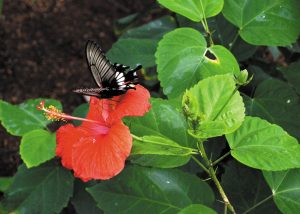
Hibiscus plants provide a source of food for some of the butterflies at Butterfly Wonderland.
Additional Exhibits
While the butterflies are colorful and plentiful in the main atrium, several other interesting and educational exhibits are available to see and enjoy. For starters, you might want to visit the Honey Bee Extravaganza, where you can look into an active beehive and watch the busy bees working. Bees are constantly zooming from the hive via a tube to the outside world, where they collect nectar and pollen from local gardens in Scottsdale and then return to the hive with their bounty.
Two of the newest exhibits at Butterfly Wonderland are the Spineless Giants and the Reptile Rainforest.
The main attention-getters in the Spineless Giants display are tarantulas. A few of the facts you’ll learn at this exhibit include:
*There are more than 700 species of this spider.
*They are venomous, but the venom is weak and not lethal to humans.
*They’ve been around for millions of years.
You’ll likely also catch sight of other colorful spiders, large millipedes, and scorpions at this exhibit.
The Rainforest Reptiles exhibit, the largest expansion to the facility since it opened in 2013, has a plethora of critters, including tiny but poisonous dart frogs, Asian water dragons, and dwarf caiman crocodiles.
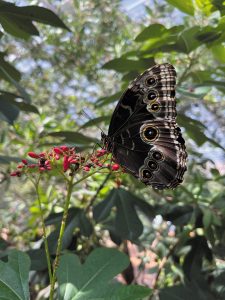
The blue morpho is primarily brown, with spots on the outside of its wings that act as camouflage against tree bark and mimic the face of an owl.
If you get hungry during your visit, the Butterfly Wonderland Café is available for snacks and drinks. Perhaps you’d like to try some exotic fare. A vending station sells tasty treats such as chips made with cricket protein, chocolate-covered ants, coconut brittle mealworms, and scorpion lollipops.
Butterfly Wonderland is a colorful adventure into the world of butterflies. It’s a great place to photograph butterflies or simply enjoy these colorful creatures as they flutter from plant to plant. It’s an out-of-the-ordinary exhibit that you might want to include on your itinerary during your next trip to Arizona.
If You Go
Butterfly Wonderland
9500 E. Via de Ventura
Scottsdale, AZ 85256
www.butterflywonderland.com
(480) 800-3000
Hours: 9:00 a.m. to 5:00 p.m. daily
Admission: $24.95 for adults; $17.95 for children 2-12. Visitors may exit and re-enter throughout the day to enjoy other attractions within the Arizona Boardwalk.
Notes: Facility is handicap accessible and has excellent parking.