
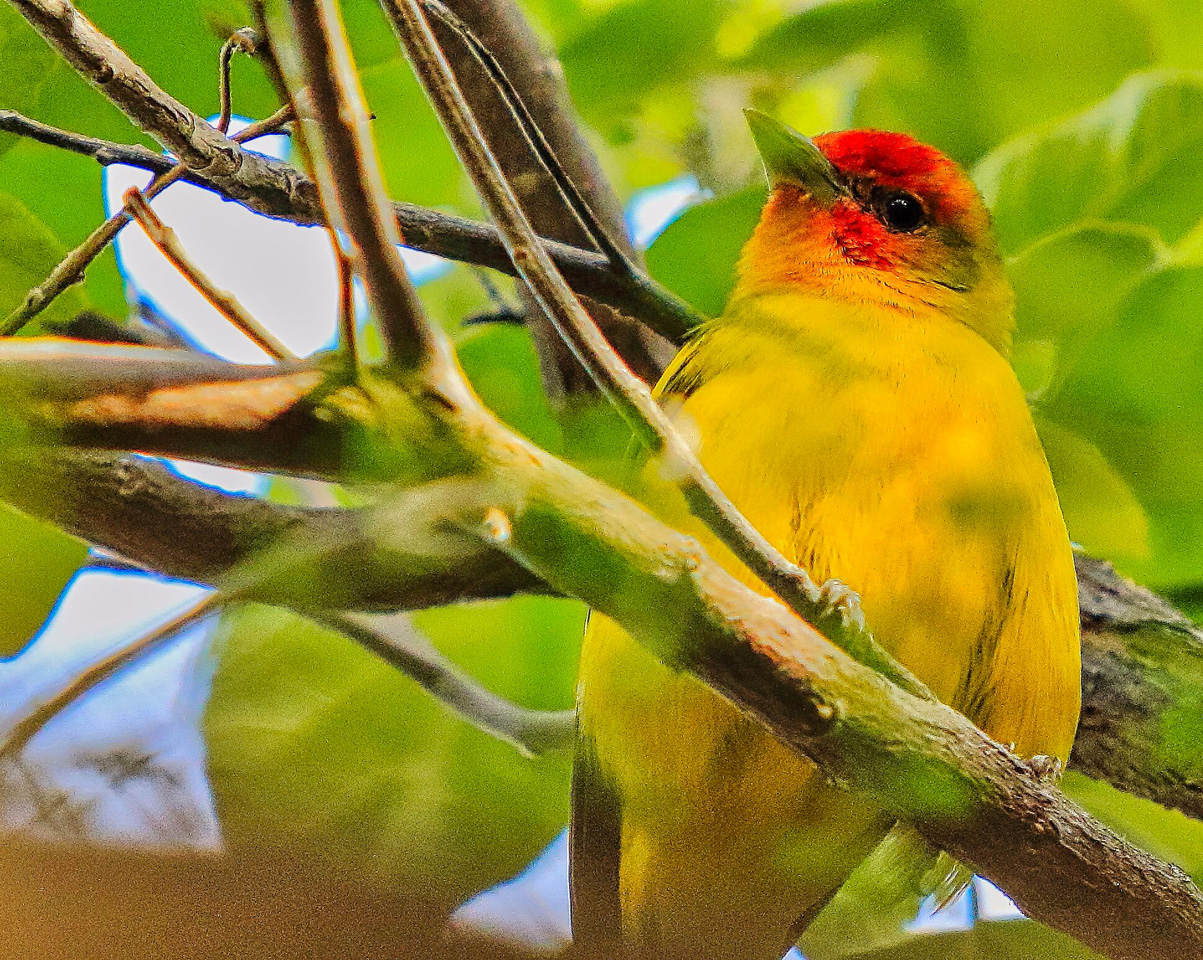
The host city for FMCA’s 104th International Convention and RV Expo isn’t just a haven for RV owners. It also is known as a bird-watcher’s and nature-lover’s paradise.
By George Moore, F460576
January 2022
Tucson, Arizona, is for the birds, or maybe better said, Tucson is for birders. With the area’s desert, mountains, forests, mild winters, and proximity to tropical Mexico, sightings of more than 500 species of birds have been recorded.
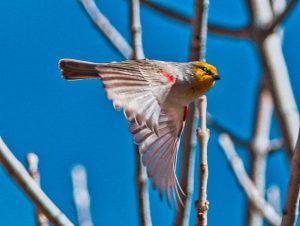
Verdin
I am an amateur nature photographer who enjoys capturing photos of everything from insects to large mammals, and that includes birds, but I am not a serious bird-watcher. As a person who likes being out in nature, and one who appreciates observing and photographing wildlife, I would like to share four of my favorite nature spotting and birding locations in and near Tucson.
Sabino Canyon Recreation Area is located in northeast Tucson at 5700 N. Sabino Canyon Road. This picturesque canyon in the Santa Catalina Mountains, part of Coronado National Forest, is one of the premier natural areas in southern Arizona. Although no private vehicles are permitted in the canyon, tram service is available. Visitors can take an enjoyable and educational 45-minute, 3.8-mile narrated tram ride through the canyon. For the more adventurous, trams stop at several trailheads, providing access to 30 miles of trails throughout the canyon.
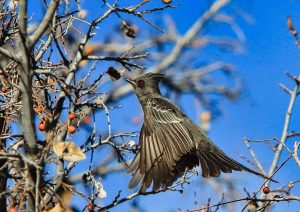
Phainopepla
In addition to the wide variety of mammals in the canyon, birders might spot vermilion flycatchers, pyrrhuloxias, gray hawks, western tanagers, phainopeplas, and peregrine falcons.
Many folks picture the saguaro cactus (the largest cactus in the United States) when they think of Tucson. One great place to see a vast collection of these majestic plants is another of my favorite spots, Saguaro National Park, which actually is two parks in one. One district lies east of Tucson (Rincon Mountain District) and the other is to the west (Tucson Mountain District); approximately 30 miles separate them. Both have well-maintained roads and numerous hiking trails. Note that vehicles more than 8 feet wide and trailers longer than 35 feet are not permitted on the Cactus Forest Drive (east park) or Bajada Loop Drive (west).
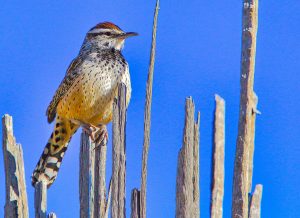
Cactus wren
Each of the districts has distinctive characteristics. The west park has the greatest number of saguaro cacti, as well as an ancient petroglyph site. Visitors may spot birds and other wildlife in both parks. Keep your eyes open for the distinctive Gambel’s quail, Gila woodpecker, American kestrel, northern goshawk, and cactus wren, among many other species.
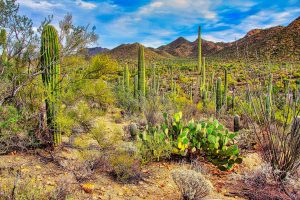
Prickly pear and cholla cacti seen alongside the giant saguaros in Arizona’s Saguaro National Park.
On my “must visit list” is the Arizona-Sonora Desert Museum at 2021 N. Kinney Road in Tucson (adjacent to Saguaro National Park West and Tucson Mountain Park). The gardens at the museum have walking paths through a vibrant Sonoran Desert ecosystem that is home to native plants, butterflies, and birds. The museum also has natural enclosures (not traditional zoo enclosures) with mountain lions, bobcats, Mexican gray wolves, gray foxes, and other mammals native to the area, plus a free-flight bird aviary and a hummingbird aviary.
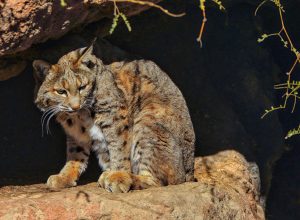
Bobcats can be seen at the Arizona-Sonora Desert Museum.
The highlight of this museum for my wife and me was the raptor free-flight demonstration, which provides an up-close look at hawks, falcons, and owls native to this part of Arizona. It was such an amazing display and photo opportunity that I returned a second day to take more photos. My 70-200mm lens was quite suitable (the raptors are so close that a shorter lens should be fine). The raptor free-flight demo is held at 10:00 a.m. daily (except Wednesdays) through April 10, 2022. At the time of this writing, masks were required, since social distancing isn’t possible.
The fourth location I will recommend is probably the most widely known among birders — Madera Canyon in the Coronado National Forest and the Santa Rita Lodge. Madera Canyon lies south of Tucson in the Santa Rita Mountains. Santa Rita Lodge (located at 1218 S. Madera Canyon Road in Madera Canyon) offers overnight accommodations, as the name would suggest, but it also has a bird feeding area that is open to the public. Free parking is available for those visiting the viewing area, which has limited seating and is wheelchair accessible.
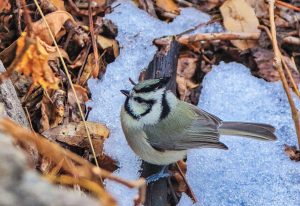
Bridled titmouse spotted in Madera Canyon
Here, you can view and photograph a wide variety of birds in a natural setting. A telephoto lens in the 400mm to 500mm range will work very well. Among the wide variety of birds attracted to the feeders are the yellow-eyed junco, flame-colored tanager, painted redstart, Mexican jay, crescent-chested warbler, and 15 species of hummingbirds. You might also get a glimpse of an elegant trogon, a prized sighting for birders in southern Arizona. The lodge has a well-stocked gift shop with books, jewelry, pottery, and more.
Coronado National Forest offers several trails in the area, with limited parking at the trailheads.
Tucson boasts a wide array of natural and man-made attractions, with something to interest every-one, including those who enjoy getting outdoors in nature. It is a renowned birding destination for visitors from far and near. It also is popular among snowbirds and other RVers, and RV campgrounds and resorts abound in the area.
If You Go
Tucson Bird-Watching Tips
www.visittucson.org/birding
Sabino Canyon Recreation Area
5700 N. Sabino Canyon Road
Tucson, AZ 85750
www.fs.usda.gov/recarea/coronado/recarea/?recid=75425
(520) 749-8700
Saguaro National Park
(Rincon Mountain District)
3693 S. Old Spanish Trail
Tucson, AZ 85730
www.nps.gov/sagu/
(520) 733-5153
Arizona-Sonora Desert Museum
2021 N. Kinney Road
Tucson, AZ 85743
www.desertmuseum.org
(520) 883-2702
Santa Rita Lodge
1218 S. Madera Canyon Road
Madera Canyon, AZ 85614
www.santaritalodge.com
(520) 625-8746