

Immerse yourself in wildlife, history, and small-town charm by visiting Kingsland and the surrounding coastal communities.
By Kathleen Walls
January-February 2026
The city of Kingsland, Georgia, is the perfect hub for anyone interested in visiting the southeast corner of the Peach State. The town is located just north of the Florida border and near many popular attractions, including Cumberland Island and the town of St. Marys.
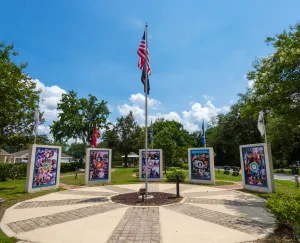
Veterans Memorial Park in downtown Kingsland salutes those who have served in the military.
In Kingsland, begin your exploration on historic Lee Street. Stop at Veterans Memorial Park, where, in a serene garden setting, memorial walls and statues pay tribute to the brave men and women who served in the various branches of the U.S. military. Then make your way to Kingsland Station to visit the Florida-Georgia Railway Heritage Museum, see a live show, and take a train ride.
While you’re downtown, also visit the Thiokol Memorial Museum to learn about the Thiokol Chemical Plant explosion that rocked Georgia in 1971. You’ll find out how a small fire at the facility, which manufactured trip flares and munitions for the Vietnam War, led to one of the worst industrial tragedies in U.S. history. Twenty-nine people were killed, and another 50 were injured. Most of the casualties had no idea about the volatility of the materials they were handling.
Music fans will love the Woodbine Opry, located 10 miles north via U.S. 17 in the historic Old Woodbine School. On Friday and Saturday nights, talented local musicians play old-time bluegrass, gospel, and country music. And you can’t beat the admission price: It’s free! The night I visited, I heard many of my favorite old-time songs: “Seminole Wind,” “I Still Miss Someone,” “Lucille,” and the old Ralph Stanley classic, “One Drop of Water.”
There’s no shortage of great dining in Kingsland and the surrounding area. Steffens Restaurant, which opened in 1948 as a small roadside stand serving hot dogs, burgers, and doughnuts to travelers on their way to and from Florida, remains a local staple. The diner is known for its down-home Southern cooking and small-town ambience. If you have a hankering for fresh seafood, try Ship 2 Shore Seafood and Steaks, also in Kingsland. Captain Stan’s Smokehouse in nearby Woodbine serves fantastic barbecue meat and all the fixings on an outdoor patio shaded by large oaks, with live music on the weekends.
Several campgrounds in the Camden County area would serve well as your home base. Crooked River State Park (gastateparks.org/crookedriver) has 63 tent, trailer, and RV campsites surrounded by palmettos and Spanish moss-draped oaks. Features include a boat ramp, four hiking trails, a nature center, fishing and birding opportunities, and much more. Plan to visit this park even if you’re camping somewhere else, as I did.
I stayed at the Walkabout Camp & RV Park (walkaboutcamp.com), just off I-95 in Woodbine, which offers camping with an Aussie twist. Its multitude of amenities include a clubhouse, a heated pool, an indoor gym, a bar, a playground, walking trails, and a dog park. I really enjoyed the farm animals in its mini zoo.
Other RV parks located in the area include the Country Oaks RV Park & Campground (countryoaksrv.com), A Big Wheel RV Park (abigwheelrvpark.com), and Huck’s RV Park (hucksrv.com).
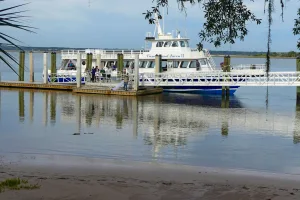
The Cumberland Queen II shuttles passengers from St. Marys to Cumberland Island National Seashore
About a 15-minute drive southeast from Kingsland is the town of St. Marys, where you can browse historic homes; visit the St. Marys Submarine Museum and the Cumberland Island National Seashore Museum; and dine at Locals Dockside seafood restaurant or the Southern River Walk Bar & Grill. The Café at Cottle & Gunn combines one-of-a-kind vintage items and tasty lunch options.
If you want to get out on the water for an afternoon of paddling fun, book a guided kayak tour around St. Marys Harbor with Adventures Up The Creek (jacksonvillekayakcompany.com).
Be sure to save a day or two to visit Cumberland Island National Seashore on the southernmost of Georgia’s Golden Isles. Here you can relive the era of the Carnegie family, known for amassing wealth in American industry; see feral horses roaming the island; and visit historic ruins of a civilization abandoned years ago.
The island is not accessible by bridge, but the National Park Service provides ferry service from the dock in St. Marys. No more than 300 visitors are permitted to visit the island each day, so be sure to make a reservation. There is also no transportation on the island. You can get to many places on the southern part of the island on foot, but a limited number of bicycles can be transported on the ferry for a small fee. Note that cell phone reception is sketchy.
Because concessions are not available either, you’ll want to bring the essentials with you: a water bottle (there are water refill stations), food, bug spray, sunscreen, an extra layer of clothing, hand sanitizer, and face covering. The rule on the island is that if you bring it in, you pack it out, so include a trash bag in your backpack as well.
The island grass is kept trimmed by the feral horses and deer you will see roaming about the island. The equines are descended from domesticated horses that were abandoned on the island in the 1700s. These animals receive no human care and wander freely. Do not approach them, and give them the right of way if you come across them while hiking.
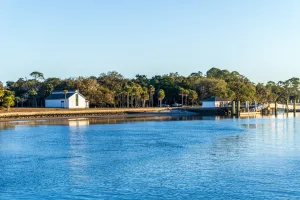
The Ice House Museum near the Dungeness Dock.
A free Footsteps Tour begins at Dungeness Dock and takes visitors through the Dungeness Historic District. The tour, which begins at 10:00 a.m., lasts about 30 to 45 minutes and covers approximately ½-mile.
History abounds here. The Ice House Museum is a good place to begin your exploration. Originally built to store large blocks of ice shipped to the island for the Carnegie estate, the building now houses a small museum that recounts the history of the island from 1733 when General James Oglethorpe arrived and claimed it for the English. The island was named after William Augustus, the Duke of Cumberland and son of King George II.
Shortly after the Revolutionary War, General Nathaniel Greene planned his home on the site of an old hunting camp belonging to General Oglethorpe. Greene died before it was completed, but his wife, Catherine, and her second husband, Phineas Miller, continued with his plans and constructed an elegant four-story mansion called Dungeness. They operated a vast Sea Island cotton plantation on the island prior to the Civil War.
That mansion is long gone, but what remains nearby is the oldest standing building on the island, the Tabby House. It is thought to have been the Millers’ temporary residence while constructing the mansion and later was remodeled to serve as the business office for the Carnegie estate.
Steel magnate Thomas Carnegie acquired most of the island in 1882 and built a replica of a Scottish castle on the site of the original Dungeness home, also naming it Dungeness. When Thomas died in 1886, his wife, Lucy, continued to use Dungeness as a seasonal home for many years. Gradually, the magnificent showplace fell into disrepair. A fire ravaged the building in 1959, leaving only a skeleton that is still one of the most imposing structures on the island.
The Carnegies later deeded most of their land to the National Park Service, so today about 90 percent of the island is designated a national seashore. The Carnegies specified that the land was never to be developed, so it remains preserved as a national treasure with miles of hiking trails, dirt roads, and sandy beaches.
Lucy gave several other mansions on the island as presents to her children. Margaret Ricketson, her daughter, received Greyfield. The property was later converted to an all-inclusive inn that’s owned and operated by Carnegie descendants today. The property was the secret reception site of John F. Kennedy Jr. and Caroline Bessette’s wedding.
The Cumberland Island ferry makes a second stop at Sea Camp Dock for those who wish to stay overnight at the island’s primitive campground. It’s also the departure point for the Lands and Legacies Tour, the only motorized excursion on the island. This five- to six-hour tour in a 10-seat van covers about 30 miles of unpaved roads. Participants are shuttled to the north end of the island with stops at many cultural and natural landmarks along the way. Passengers may only bring a small backpack or bag. No hard coolers or camera tripods are permitted.
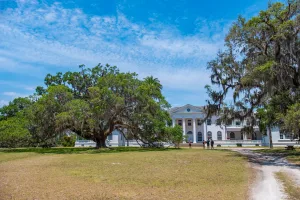
Lucy Carnegie built the Plum Orchard mansion for her son, George, in the late 1800s.
Tour highlights include Plum Orchard mansion, which was a wedding gift from the Carnegies to their oldest son, George, and his bride, Margaret. Those on the tour are taken inside this magnificent 30-room Classical Revival-style home.
After George died in 1921, his widow sold the furniture and abandoned the house. The youngest Carnegie sister, Nancy, moved in. The home had running water and electricity before it was available in most other places. There’s a swimming pool and squash court inside the home. Many of the artifacts seen today were left by Nancy and her second husband, Dr. Marius Johnston.
The next stop is the Stafford Plantation, which predates Carnegie history. Robert Stafford, the largest plantation owner on Cumberland Island, disapproved of slavery even though he owned slaves. Stafford insisted they learn reading, writing, and arithmetic, and provided a church and hospital. He encouraged them to earn money after their duties and to save it. Though he never married, he had two mixed-race families that he provided with large trust funds. One of his daughters, Nancy, became one of the first African American doctors.
Lucy Carnegie purchased the plantation from Stafford’s heirs and gifted it to her eldest son, William, when he married. After a fire destroyed the original Stafford mansion on January 5, 1900, William built another house on the site. The tour visits the cemetery where Stafford, his mother, and sister are buried.
After the Civil War ended, Stafford’s freed slaves migrated farther north on the island and lived in what they called The Settlement. Union soldiers returned home and talked about the balmy southern winters, creating a market for hotels on the island. Developers saw the African Americans living there as an excellent source of hired help. Residents purchased lots for $11 where they built houses and worked close by. When the Great Depression shut down the hotels, the workers left for jobs on the mainland.
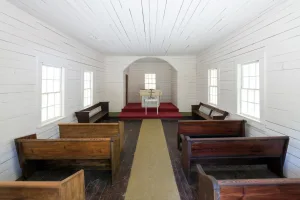
Forty guests squeezed into the First African Baptist Church for the wedding of John Kennedy Jr. and Carolyn Bessette in 1996.
Today, only a few buildings remain at The Settlement. They include the First African Baptist Church, where the Kennedy-Bessette marriage took place. The other open building is the Beulah Alberty home. Beulah, a college-educated schoolteacher, was the daughter of one of the original homeowners. She returned to The Settlement and started a school for the children, helped the community with legal matters, and became known as Mayor of The Settlement. Her house is unfurnished but contains photos and restrooms.
It’s impossible to overrate the charm and mystic aura of this island where there are few vehicles, just hikers and bikers. Feral horses, wildlife, and history claim Cumberland as their own.
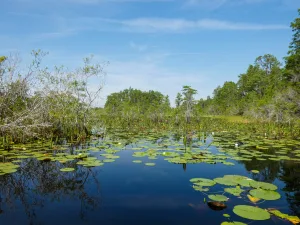
Gators, turtles, birds, and other wildlife call Okeefenokee Swamp Park home.
Back on the mainland, branch out a few miles northwest of Kingsland to see the wildlife and plants that make Okefenokee Swamp Park in Waycross so intriguing (okeswamp.org). Take a boat tour at Okefenokee Adventures; you won’t believe its variety of wildlife. I spotted more alligators than I could count, plus lots of water birds, turtles, and amazing plants seldom seen anywhere else.
If you’re hungry after the boat tour, stop at the Snack Shack for a bite to eat or something to drink during your swamp visit. Then take Swamp Island Drive to the historic Chesser Homestead in the Okefenokee National Wildlife Refuge. A ¾-mile trail leads to the home and through a forest of oaks, palmettos, and Spanish moss. Several boardwalks and trails access the east edge of the swamp.
These are just a few of the interesting places to visit in the southeast corner of Georgia. So, if you’re heading north from your winter stay in the Sunshine State or tooling around the South looking for something new and different to explore, stop in the Kingsland area for an array of wildlife viewing opportunities, history lessons, and outdoor fun to experience.
MORE INFO
Kingsland Convention & Visitors Bureau
visitkingsland.com
St. Marys Convention & Visitors Bureau
visitstmarys.com