
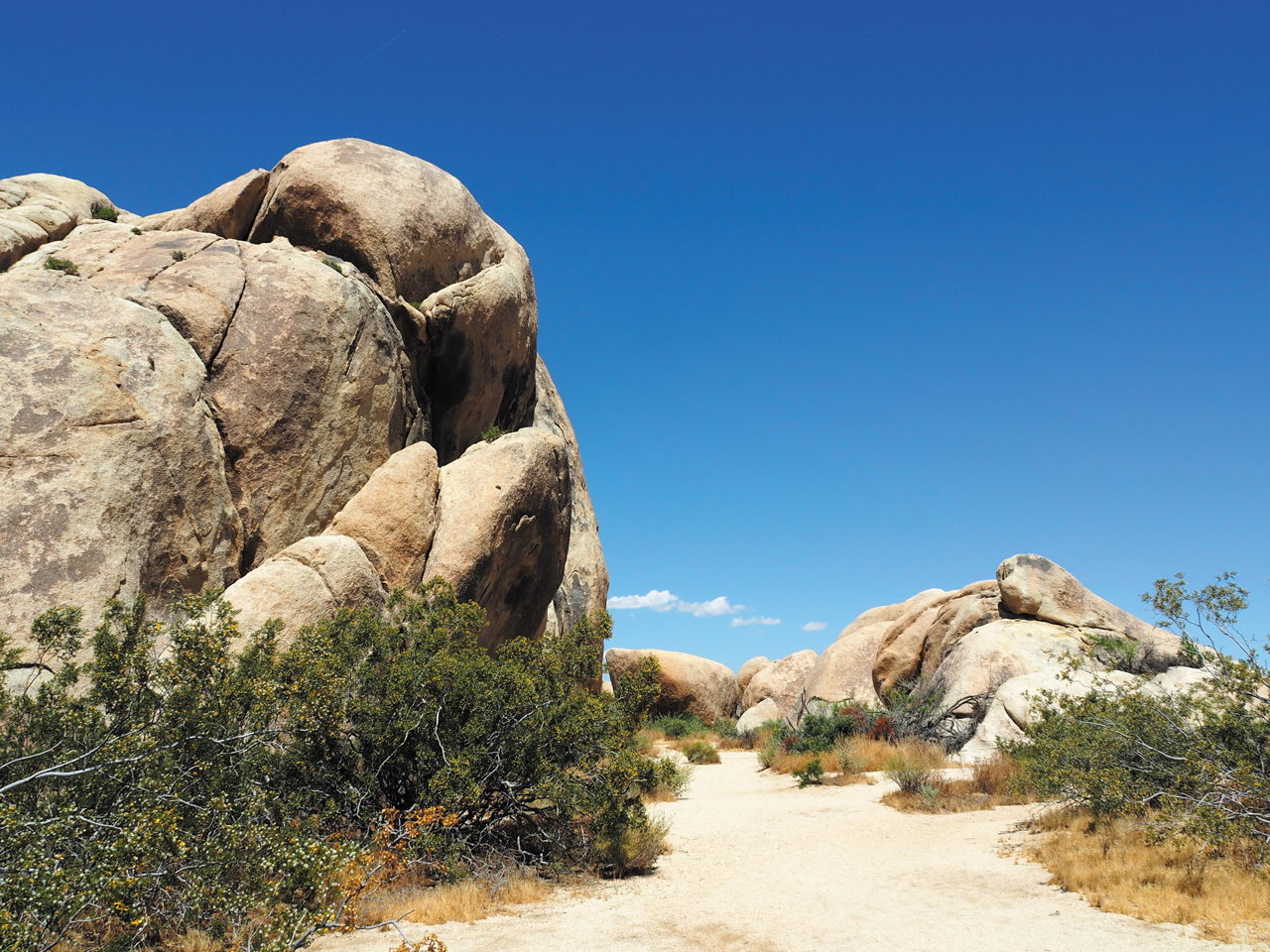
Two desert ecosystems combine for an otherworldly experience in California’s Joshua Tree National Park.
By Josephine Matyas, F468364
March 2022
Several small motorhomes jockey for parking spots along the cul-de-sac at the Keys View overlook in Joshua Tree National Park. It’s 10 minutes to sunset and the vista over the Coachella Valley — with the lights of Palm Springs winking in the distance — takes my breath away. Where else (with two feet planted on solid ground) can you get a bird’s-eye view of the daunting San Andreas Fault? That crack sketched into the surface of the Earth is a sobering reminder of the fragility of the landscape. The menacing fault line marks one of the world’s most active tectonic boundaries; geological faults crisscross the entire park.
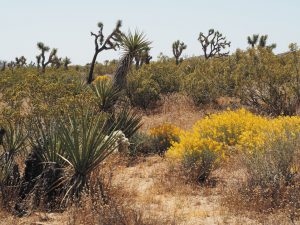
The oddly compelling Joshua tree, the park’s namesake, brings drama to the landscape.
Joshua Tree is, hands-down, one of my favorites in a long list of spectacular national parks in both Canada and the United States. It is arid, untamed, and remote. The super-sized boulders and wild-armed vegetation look like something from the pages of a Dr. Seuss book. The surroundings have had a hit of steroids: The night sky is dark and splashed with stars that touch the horizon; when the wind blows, it really howls; the boulders are the size of vehicles; and the landscape is ablaze with cacti and hardy desert vegetation.
The sprawling national park of almost 800,000 acres is a two-hour drive east of Los Angeles (if the city’s infamous traffic snarls cooperate) and is the spot in southeastern California where the high Mojave and the low Colorado deserts converge. This transition zone of two distinct desert ecosystems is noteworthy, creating a blended area of significant biological diversity. In desert ecosystems, elevation determines everything, as desert plants and critters are extremely sensitive to the slightest change. The park is home to bighorn sheep, cactus wrens, roadrunners, and desert iguanas. The threatened desert tortoise occasionally meanders across roadways. As in many desert settings, snakes often curl up below the rocks for shade.
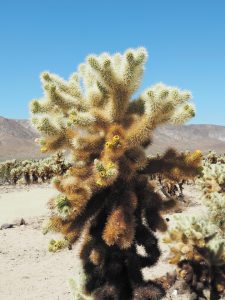
The Cholla Cactus Garden reveals a broad expanse of teddy bear cholla along a flat loop trail.
Driving from the park’s northern entrance at Twentynine Palms to the southern entrance just off Interstate 10, our Type B camper van dipped from the higher elevation of the Mojave Desert section (with some spots topping 5,000 feet) to the lower elevation of the Colorado Desert, an ecosystem overlapping with the Sonoran Desert of southern Arizona and northwestern Mexico. The higher elevations are home to the park’s namesake, the iconic Joshua trees; the lower, more arid lands are covered with the long, thin branches of the spindly ocotillo, prickly “jumping” cholla cacti, and green-barked palo verde shrubs. In springtime, it’s a blast of colorful wildflowers. Year-round, it’s a landscape with a lot of thorny vegetation encircled by rugged mountain ranges.
If you come properly prepared (water, hat, sturdy footwear, paper map), the trails and rocks of Joshua Tree are a dream for hiking and world-class bouldering. Pets are not allowed on the trails or in the backcountry, so plan accordingly for their comfort and safety. We explored the main roadways and stopped to hike at spots such as the nature trails through the boulders and the luxuriant Cholla Cactus Garden. Staff at the visitors centers can help you pick a suitable trail from among the almost 30 in the park, which range from easy to challenging.
The park lends itself to exploring by short road trips (most of the roadways are paved and well maintained) or via a walk from one of the trailheads. We started with an easy trail at Hidden Valley, a popular one-mile loop twisting through a rock-enclosed valley that at one time created secluded hideouts for cattle and horse rustlers. Since we weren’t rock climbing, it was a nice way to get up close to the imposing stones. Farther down the park’s main road to the south, the Cholla Cactus Garden is a quarter-mile, flat pathway meandering through dense “gardens” of the “jumping” teddy bear cholla, a very prickly cacti known for attaching itself to unwary passersby.
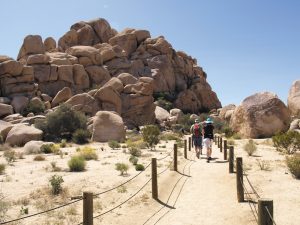
Giant boulders encountered along the Hidden Valley Trail.
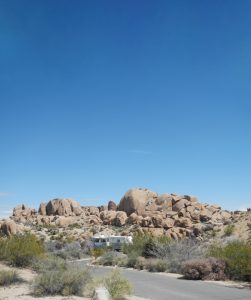
The Mojave Desert part of the park is marked by jumbles of massive boulders interspersed with pinyon pines, junipers, prickly pear cacti, and yuccas. Thousands of established routes make the park a favorite destination for rock climbers. We camped among these truck-size boulders at Jumbo Rocks, one of the park’s eight campgrounds. Only two campgrounds (Black Rock and Cottonwood) have water, flush toilets, and dump stations. Cottonwood is especially popular with RVers. At the Hidden Valley and White Tank campgrounds, RVs are limited to a maximum combined length of 25 feet (RV and a towed or towing vehicle); in the other campgrounds, the limit is 35 feet, space permitting.
The rustic campgrounds offer a true desert experience, and if you’re lucky, you may spot wildlife such as rattlers, coyote, bighorn sheep, and the elusive and endangered desert tortoise. Most sites are at higher elevations, so nighttime can be chilly. Joshua Tree is remote wilderness, and cell phone coverage is unreliable at best. Many campsites fill during the peak season of October to May — most can be reserved at www.recreation.gov.
Our site in Jumbo Rocks was classic Joshua Tree — tucked between the boulders that define the park’s northern landscape. The huge, ball-shaped masses of rock are granite that formed when molten fluid within the Earth’s crust was pushed to the surface about 250 million years ago. Over millennia of erosion, these granite boulders were left on the surface, many looking like piles of enormous marbles, stacked and abandoned.
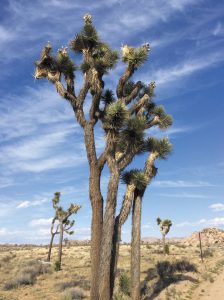
The park’s Joshua trees may loom more than 45 feet tall.
Many people come to contemplate and photograph the otherworldly Joshua trees that pepper the rolling desert of the park’s Mojave section. Growing at an unhurried rate of ½-inch to 3 inches per year, it is not a tree at all, but a species of agave that can grow more than 40 feet tall. The clusters of waxy, spiny leaves provide homes for owls, woodpeckers, hawks, and many other birds. The “trees” are incredibly photogenic and one of the main reasons that people visit Joshua Tree National Park.
Despite the park’s remote setting and its dryer-than-dry ecosystem, I find that Joshua Tree draws me back again and again. It’s one of those indulgent destinations — one of the few spots to find the spiny trees, to feel tiny next to enormous round rocks, and to look upward into some of the darkest night skies in Southern California. It’s a camper’s dream.
Info
Joshua Tree National Park
74485 National Park Drive
Twentynine Palms, CA 92277-3597
www.nps.gov/jotr
(760) 367-5500
Camping Outside The Park
If the park campgrounds are full or you are looking for more amenities, try one of the nearby private campgrounds, which furnish hookups and dump stations. Information about two of the possibilities follows. For additional options, check the National Park’s website or your favorite campground directory.
Joshua Tree Lake RV & Campground
2601 Sunfair Road
Joshua Tree, CA 92252
www.joshuatreelake.com
(760) 366-1213
Twentynine Palms RV Resort
4949 Desert Knoll Ave.
Twentynine Palms, CA 92277
www.twentyninepalmsresort.com
(760) 367-3320
 Best Camping Practices In Joshua Tree National Park
Temperatures and weather can vary, depending largely on elevation. In the winter months, prepare for chilly camping. When hiking, always carry water and warm clothing to layer. In remote areas, keep your fuel tank topped off. Be prepared for hot weather, too, as Joshua Tree is in the desert and can be sunny with very limited shade available.
Be aware that rocks, plants, animals, and historic objects are protected in all national parks. Best practice is to enjoy but to leave them in their place.
Joshua Tree is operated by the National Park Service. If you have plans to visit several parks over the year, investigate the America the Beautiful Pass, which is valid for one full year from the month of purchase ($80). The pass covers entry to parks and many other government-operated sites, but not camping or tour fees.