
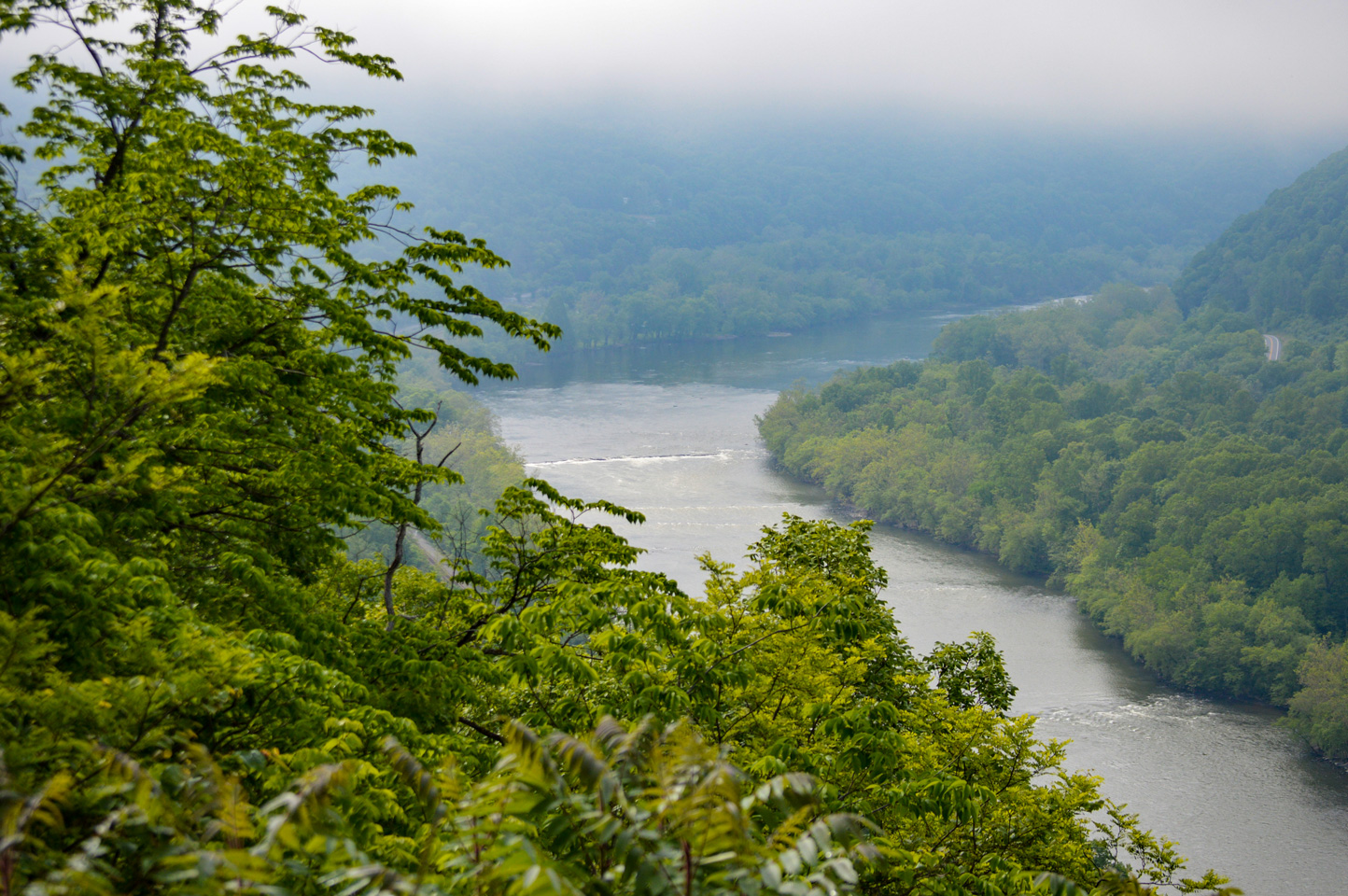
Now designated a U.S. national park and preserve, West Virginia’s New River Gorge hosts nature lovers and history buffs, who also travel outside its boundaries to explore many other intriguing attractions.
By Ann Bush, F516383
March 2022
Located in the Appalachian Mountain Range, West Virginia is a land of peaks and forests. Its highest point is 4,863-foot Spruce Mountain, with others nearby towering 4,000 feet and more.
An untouched environment attracts migrating animals and outdoor enthusiasts by the thousands. With mountains come spring-fed rivers, flowing down slopes so fast and furiously that they carved deep, wide gorges, creating one of the most scenic and sought-after recreational sites in the United States: New River Gorge.
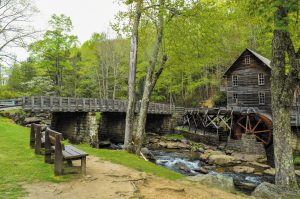
The photogenic Glade Creek Grist Mill is the most famous feature in Babcock State Park.
The New River formed a spectacular small canyon and left behind gigantic limestone cliffs estimated to be up to 320 million years old. Surrounded by a forest that changes persona with every season, the New River actually flows north and is one of the oldest rivers in the world. Recognizing it as a treasure to be protected, the National Park Service designated the New River Gorge area a National River almost 50 years ago.
In December 2020, the National Park Service went a step further by upgrading its status to New River Gorge National Park and Preserve, the nation’s 63rd national park. This protected area includes a 53-mile section of the New River and adjacent land.
Creating a state or federal entity after people have established homes, businesses, and farms within the desired area can be tricky. Generations of families have lived on this land since the nation’s infancy, resulting in attempts by the federal and state governments to purchase land often not for sale or priced too high. As a result, the boundary of New River Gorge National Park is less defined than other national parks, and it meanders around and sometimes through private property.
However, there’s good news for visitors: Since there are no defined boundaries, there is no formal entrance area or entrance fee. The national park designation will serve to limit commercial access and development in order to preserve and protect this beautiful habitat and its historic sites.
Top Five Park Destinations
Canyon Rim Visitor Center
One’s first stop should be the Canyon Rim Visitor Center, which serves as the park’s information station. Smartly designed interpretive exhibits are fun for all ages and give a good overview of the park’s scenic highlights and activities. Near the main entrance, a short trail guides visitors to a boardwalk that leads down the gorge toward the riverbed; it ends at a patio that offers amazing views of the famous New River Gorge Bridge.
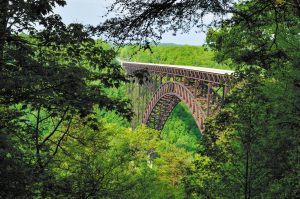
The New River Gorge Bridge as observed from the Canyon Rim Visitor Center.
Hiking Trails
For the past 50 years, most visitors who sought the New River Gorge area aimed directly for the river, which is known for the white-water rafting opportunities it provides. Today, visitors of all ages come to shop for folk arts and crafts, to rock climb, to drive the many scenic highways, or to dine on delicious food in quaint historic towns scattered along rivers. Many, like me, come to hike the beautiful trails. The Trails of New River guide I picked up at the Canyon Rim Visitor Center has plenty of detailed information on hiking and biking trails.
Over 100 miles of maintained trails are scattered through an unbroken mesophytic forest within the New River Gorge area. These trails take the visitor near the river’s edge, on forested slopes, along ridge tops for amazing views, or to an open field of wildflowers. One foot trail runs underneath the New River Bridge’s road, sending hikers across the river at a dizzying height with vehicles buzzing along a few yards above their heads.
A favorite of many visitors is the 2½-mile Endless Wall trail, which winds through an emerald-green forest scattered with wild pink rhododendrons and snow-white mountain laurels. When I was on the trail in May, the dogwood trees were in full bloom. The trail ends at the canyon rim top, offering views of an endless wall of rugged limestone cascading down to the pristine river.
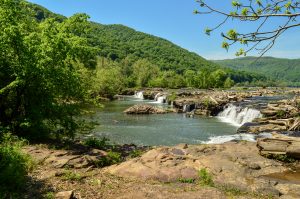
Sandstone Falls spans a 1,500-foot section of the New River.
Sandstone Falls
The largest waterfall on the New River drops almost 25 feet around a series of islands. A short trail on an accessible boardwalk takes the visitor to various beach accesses for fishing or just hanging out to enjoy the scenery. On the way to the falls, stop at the Sandstone Visitor Center on Interstate 64 to learn about a daring man who built his own river raft out of simple logs from the forest. The exhibits are especially geared toward helping youngsters learn more about rivers. The beautifully tiled floor, designed as a map of the river and park, is mesmerizing.
Thurmond
A thriving town during the early 1900s, Thurmond was one of the busiest railroad communities located on the Chesapeake and Ohio Railway line. Abandoned soon after diesel engines replaced coal-powered trains, the town has been left surprisingly untouched by modern development. It is considered an important historic landmark and was included in the New River Gorge National Park territory. The Thurmond Depot has been restored and serves as a visitors center; the town itself provides a wonderful example of railroading history.
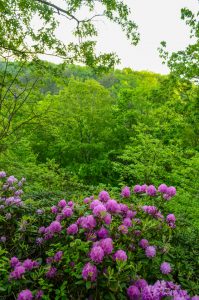
Rhododendrons herald spring’s arrival throughout the New River Gorge area.
Grandview
A peaceful place to unwind, and recognized for its pleasing hiking trails, the Grandview area of the park includes the Turkey Spur Overlook. Perched 1,400 feet above the river, it offers panoramic views of an active railway and of the quaint town of Quinnimont. Many people I met said the trails at Grandview were well-known for winding through beautiful wild rhododendrons. Rose-purple catawba rhododendrons generally bloom in mid to late May, while the white great rhododendrons put on a show in late June and early July. An outdoor theater operates during the summer.
Roads that lead to these sites were in good condition during my visit and easily managed by large vehicles. However, a word of caution for owners of larger RVs: Many of the routes that lead down to the river are old country roads — very narrow and with serious switchbacks. Check a map or talk with a local representative before taking an off-the-main-highway adventure; or navigate these roads in a towed or towing vehicle. Also note that many parking lots along trailheads are small and may lack the space in which to turn around a large RV.
Where To Sleep
New River Gorge National Park and Preserve does not offer lodging or campgrounds with water and electric hookups. Only primitive camping limited to tents is available; they have served rafters and kayakers for many years. Instead, the park embraces current West Virginia state facilities and private businesses in the area as partners.
Babcock State Park, Clifftop
Located near the middle of the New River Gorge National Park, Babcock State Park is best known for the photogenic Glade Creek Grist Mill, a fully functioning replica of Cooper’s Mill, which once stood on the grounds. Babcock State Park has 4,127 acres of serene yet rugged forest environment with an unspoiled stream flowing through the park. The 52-unit campground has 28 sites with electric hookups (four of which are accessible) and a central bathhouse.
Bluestone State Park, Hinton
Near the restored historic town of Hinton, Bluestone State Park contains four campgrounds with a combined total of 120 sites. Meador Campground has 32 sites, seven with electric and water hookups and 15 with electricity only. Old Mill Campground offers 44 rustic sites. A tent-only campground has five sites, and sites in East Shore Campground are accessible only by boat. Still a thriving railroad town, Hinton is at the center of where the New River splits and creates the Bluestone National Scenic River. The state park borders its namesake river, making this one of the most scenic sites in the area.
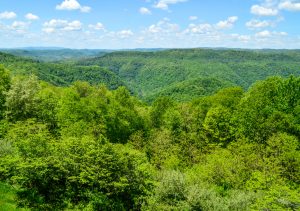
Pipestem Resort State Park (left) offers camping and numerous other amenities.
Pipestem Resort State Park, Pipestem
I have been to many state parks during my 30 years of traveling across the United States, but I have never been to a state park resort! This 4,000-plus-acre park on the southern tip of the New River Gorge area is complete with a luxury lodge, restaurants, two golf courses, mini golf, horse stables, a splash park, a lake, a zip line, cabins, a nature center, hiking and biking trails, and wooded campgrounds. New RV campgrounds were in the design stages, but during my visit, 82 campsites were available year-round, of which 31 are equipped with full hookups and 19 with only electricity. Did I forget to mention the tram that takes visitors to a restaurant on the valley floor?
Private Facilities
Numerous privately owned campgrounds and RV parks also dot the area. Since New River Gorge received its national park designation, some facilities are creating additional RV sites. One is the New River Gorge Adventure Resort near Fayetteville (www.adventuresonthegorge.com; 855-379-8738).
More To Do Nearby
Besides the many highlights awaiting within the national and state parks, the New River Gorge area is filled with scores of other interesting and fun things to do. Six scenic drives take the visitor on winding switchback roads through the mountains to overlooks with perfect sunsets and historic places unique to West Virginia. (Check locally before setting out to see whether a particular route is best driven with a towed or towing vehicle, not an RV.)
John Henry Historical Park, Talcott
Known as a steel driver for the railroad who matched up against a steam drill, the legendary John Henry was a living, breathing hero to many. His story has been sung in ballads, documented in history books, splashed on the screen in movies, and retold thousands of times by parents encouraging their children that they can do anything if they try. John Henry Historical Park tells his story with style and also hosts John Henry Days every July to celebrate him.
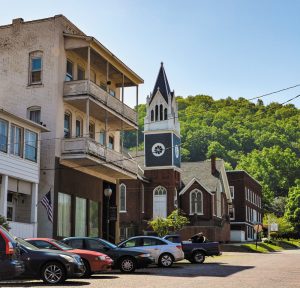
Hinton’s historic district makes for an interesting walking tour.
Historic Hinton
A remarkable, bustling town famous for a large railroad roundhouse and bridge over the New River, Hinton is considered a gateway to the New River Gorge area. The scenery is stunning, with many homes and lodges near or on the rivers. A guided walking tour of the Hinton Historic District leads to many restored buildings in the downtown area.
Tamarack Marketplace, Beckley
If handmade Appalachian crafts spark your interest, Tamarack is the perfect place to spend an afternoon. The unique circular building houses a collection of thousands of high-quality items for sale, created by more than 2,800 West Virginia artists and crafters. In addition, hands-on classes are offered in glass blowing and other arts. The large parking lot has plenty of room for RVs.
Exhibition Coal Mine, Beckley
A restored coal mine town that once employed hundreds of miners is now a living museum complete with the original church, a miner’s shanty, bunkhouses, and a school. Take the walking tour, but don’t miss one of the finest galleries of coal mine artifacts on display in the restored Coal Company House. The guided underground tour of the coal mine takes the visitor around mined areas in a coal rail car to more exhibits that detail the daily life of a coal miner. Tour guides are all former mine employees. A campground is available on-site.

Tamarack Marketplace in Beckley showcases the handiwork of West Virginia artisans.
The Greenbrier, White Sulphur Springs
Greenbrier Valley, on the eastern side of the New River Gorge area, is best known for rich colors in the fall. But perhaps its most amazing site is The Greenbrier, or “Old White,” a historic hotel and mineral spring spa resort originally built for rich diplomats living and working in Washington, D.C., a two-hour train ride away. This preserved and still-busy luxury lodge held a secret for 30 years. A 1992 Washington Post article revealed the existence of an underground bunker designed to be a Cold War relocation center for members of the U.S. Congress. Hidden from the world, lodge tenants, and most staff, the bunker is equipped with House and Senate chambers, dorms, a kitchen and dining room, a clinic, and a food storage area large enough for months of hiding behind a 25-ton blast-proof door. Guided tours of the declassified bunker are available, but save extra time for dining or strolling through the lodge, which has not changed much since it was built when John Quincy Adams was president.
If You Go
New River Gorge National Park and Preserve
www.nps.gov/neri
(304) 465-0508
West Virginia State Parks
ww.wvstateparks.com
(833) 987-2757
Visit Southern West Virginia
www.visitwv.com
(800) 847-4898