
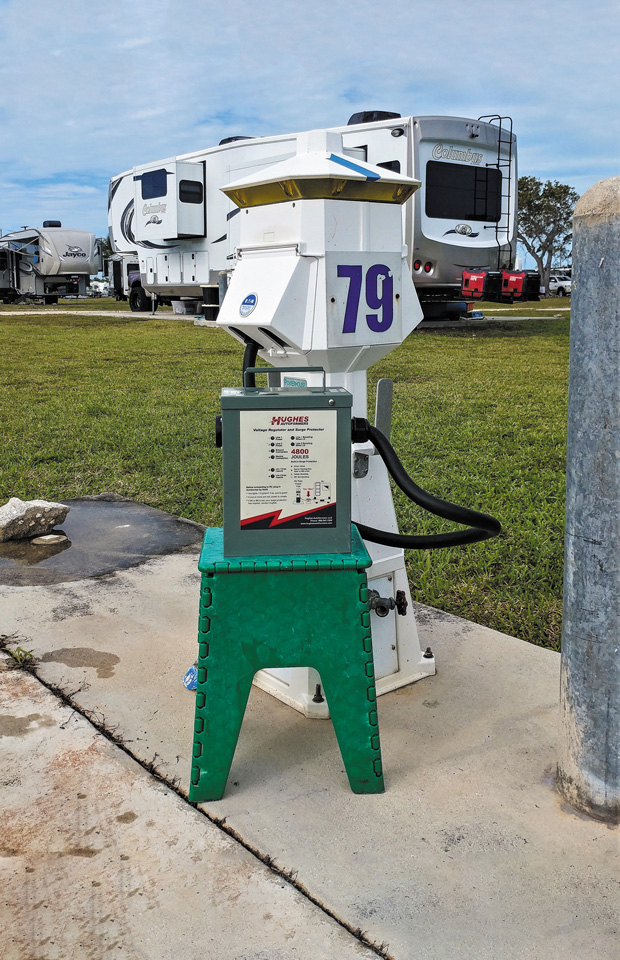
Voltage spikes receive considerable attention, but low voltage also can cause damage. The Hughes Autoformer is designed to combat that issue.
By Scott Fox, F470415
What is the ideal campground voltage? And if the campground voltage is low, can you boost your voltage? Why would you want to boost your voltage? What is a Hughes Autoformer? Do you need one, and how does it work?
We have installed a Hughes Autoformer voltage booster on our RV, and after researching and using the product, I’d like to answer the above questions and explain why you might consider adding one to your RV as well.
A Hughes Autoformer plugs into the electrical pedestal at the campground, and then the RV power cord plugs into the Autoformer. Because I wanted to keep the Autoformer inside the RV, I mounted it in one of our storage compartments between the power cord and RV – rather than between the electrical pedestal and the cord. To do this, I cut the power cord inside the RV and hardwired the Autoformer into the cord before the automatic transfer switch.
In the unlikely event that you never plan to plug into a campground electrical system, you do not need an automatic transfer switch or a Hughes Autoformer voltage booster. But if you use campground electricity, this device can be a valuable addition to your RV.
What Is The Ideal Campground Voltage?
The voltage delivered to your house (or RV) is ideally 120 volts AC in the United States; this is the voltage level that allows appliances to operate at maximum efficiency. For 50-amp service, we use a split system of two 120-volt wires to create the possibility of 240 volts. Regardless of whether you have a 30A or 50A RV, you still want 120V AC for your appliances. Acceptable voltage is between 110 volts and 120 volts. Some appliances can function at voltages as low as 108. Conversely, voltages up to 132 typically will not cause damage. Most appliances require a minimum of 110 volts and ideally will have 120 volts available for operation.
A low-voltage situation exists below 110 volts and is considered a “brownout.” All lower voltages cause higher amperage draws for motors. The amount of effort (load) required by the motor does not change.
Think of an inductive load (a device you want to operate electrically: fans, pumps, jacks, slideouts, compressors, AC motors, and refrigerators) as a weight on the end of a lever. If the lever is long (higher correct voltage), then the weight will be easier to lift with a given force (current). If the lever is short (low voltage), then the load will require more force to lift the load (higher current).
Loads do not change when the voltage changes. Assuming the voltage remains low, the current required to operate the load increases. The problem is that increasing current also increases heat.
Voltage, Amperage, And Watts
The relationship between voltage, current, and watts is simple. The one thing to remember when discussing electricity use is that loads (watts required) do not change. A 1,500-watt load requires 1,500 watts (of energy) to run. The two variables are voltage (potential energy) and amperage (current). If one goes up, the other can go down and still operate the same load. Running a 1,500-watt load at 120 volts requires 12.5 amps of current. Running a 1,500-watt load at 110 volts requires 13.6 amps of current. As noted, using extra current creates extra heat. That leads to accelerated wear.
Current And Resistance
As current increases, resistance to the flow of the current increases. Consider a river; as the current (water) flows rapidly, the resistance creates erosion along the banks. In terms of electricity, resistance creates heat both in the wires and in the devices that the current is powering. In motors, increased heat leads to decreased efficiency and a reduced lifespan. Increased voltage decreases current and heat because of the decreased resistance.
More Than A Transformer
The primary component of a Hughes Autoformer voltage booster is a transformer. Transformers can be used either to step up voltages or to step down voltages. A power company uses transformers to change the voltage before it enters your house. Without transformers, we would not have an effective electrical system anywhere in the world.
The Hughes Autoformer voltage booster is a special type of smart step-up transformer. This voltage booster takes a lower voltage and increases it, sacrificing a little bit of the available current that powers the device. This potential current loss is not significant, however. The greater efficiency associated with operating at the correct voltage makes up for most of the current loss.
Not An Autotransformer
The Autoformer is not an autotransformer. It has multiple windings, whereas an autotransformer has a single winding with multiple taps that allow for different voltages. Without multiple windings, any electrical failure in an autotransformer can cause a significant safety issue.
A transformer will provide electrical isolation between its windings. An autotransformer, with its single winding, does not provide for isolation between source and output. Thus, a failure in an autotransformer can result in full input voltage being delivered to the output when not needed, resulting in undesired high voltages.
As a multiple-winding, computer-controlled, smart transformer, the Hughes Autoformer is designed to provide additional levels of protection.
The output on the Hughes Autoformer adjusts by load demand and input voltage. When no extra voltage is needed, the voltage is boosted by 2 percent. When a larger boost in voltage is required, the extra windings on the output side of the transformer will engage and step the voltage up to or close to the desired 120-volt output (10 percent).
Why Do I Need It?
As the number of RVs in a campground increases, the additional occupancy increases the amount of electricity required from the campground electrical system. Each additional RV in the campground adds to the load. And since most campgrounds were not designed for the new, more power-hungry RVs, their electrical systems may not be sufficient to accommodate the increased number of users. When this happens, voltages drop and can endanger every RV in the campground.
When the electrical grid at a campground is ideal, you do not need a Hughes Autoformer voltage booster. However, when an RV park’s electrical grid is undersized (for the number of RVs at the park), problems can result. On a busy day, such as a Saturday afternoon in the summer, many RVs will be drawing power from the RV park electrical system, running air conditioners and other electrical appliances.
When this happens, the voltage at the park decreases, and because the voltage coming into each RV is now lower, the amperage used by each RV increases. As amperage increases, so does heat. As the voltage decreases, each RV in the park is increasingly at risk for damage. Each RV then uses more current to accomplish the same task, and that compounds the problem. Every inductive load (e.g., air conditioners) will get hotter from the increase in current caused by the insufficient voltage.
Each RV that experiences low voltage will suffer electrical damage caused by the extra heat. This is not a club you want to join. Hence, it makes sense to boost your voltage and avoid the issue.
How Does It Correct For Low Voltage?
The Hughes Autoformer voltage booster corrects for the lower-than-desired voltage at the campground pedestal and increases the voltage inside the RV to protect it from low-voltage operation. The device corrects the RV park’s low voltage back to an ideal grid voltage inside the RV.
Any time the Hughes Autoformer voltage booster is plugged in, the voltage is increased by a minimum of 2 percent. This will take an ideal input voltage of 120 volts to 122.4 volts, making it slightly better. If the voltage drops to 109 volts, an extra 10 percent boost will correct this to a nearly ideal 119.9 volts. If the voltage drops to 96 volts (considered dangerously low), then the Hughes Autoformer voltage booster will correct this by the same 10 percent back to 105.6 volts. As the voltage drops to these critically low levels, every RV in the campground will start to suffer damage. RVs equipped with electrical management systems will trigger their emergency power-off relays and drop from the campground electrical distribution system.
What Is The Risk Of Low Voltage?
During low-voltage operation, appliances such as air conditioners and refrigerators will run slower, get hotter than they normally would, and ultimately fail. This is because correcting for low voltage results in the electrical current increasing, thus increasing the heat. Even if the appliance does not fail right away, the extra heat accelerates wear. This results in less effective operation. The accelerated wear increases the load and causes an even higher amperage draw, thus creating even more heat. All of this can be avoided with the correct voltage. Heat — especially excessive heat — is the enemy of electrical devices such as compressor motors in air conditioners.
Does It “Steal” Electricity From Other Campers?
Some people believe Hughes Autoformer owners use more than their share of electricity in a campground. They noticed that an RV with a Hughes Autoformer did not trip circuit breakers when their RV did. Thus, they concluded that the Autoformer allowed the RV to use extra electricity. Rather than using more electricity, the RV equipped with an Autoformer uses the electricity correctly, as designed. If you have a 30-amp RV on a 30-amp circuit, your limit is still 30 amps. The question is then, “How do you use the 30 amps?”
Do I Need It On A 50-Amp RV?
An RV with 50-amp electrical ser-vice can experience the same issues as a 30-amp RV. If the input voltage is low, it does not matter whether you have a 30-amp RV or a 50-amp RV. The company produces both 30-amp and 50-amp versions of the Autoformer.
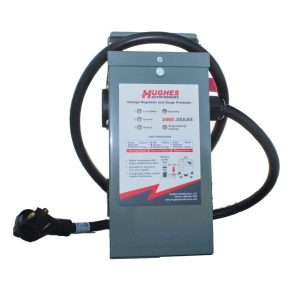
The 30-amp Hughes Autorormer
Why Is It More Critical For A 30-Amp RV?
That said, 30-amp RVs have more potential for electrical issues. This is because of the size of the wire in a 30-amp RV power cord. A 30-amp power cord typically has 10-gauge wires. My 50-amp power cord has 6-gauge wires. Each 6-gauge wire carries a maximum of 55 amps. Cord length also plays into this variable. Longer cords, thinner wire equals more resistance.
Fault Detection And Reporting
The Hughes Autoformer voltage booster will also detect faults in campground electrical systems. The display lights will reveal an open ground connection, an incorrectly wired neutral connection, and a reverse polarity condition. Any of these faults can damage an RV’s electrical system and appliances. The Autoformer includes both a surge protector and some functions — but not all fault detections — of an electrical management system (EMS).
What Is An EMS?
An EMS is an electrical device that includes a surge protector and a relay that shuts off power to an RV when a damaging condition exists, such as low voltage. Conversely, the Autoformer corrects for low voltage instead of shutting off the power. Its fault detection feature reports the malfunctions. The Hughes Autoformer does not replace an EMS, but rather augments it.
Surge Protection
The Hughes Autoformer’s voltage booster includes a built-in surge protector with indicator lights that identify if the unit has been hit by too many surges and can no longer provide protection. Not all surge protectors have an emergency power-off feature. Typically, this feature is part of an EMS that includes a surge protector.
Why Not Just Use An EMS For Voltage Drops?
This is a fine idea for a temporary voltage drop. But do you really want to live without your air conditioner when what you really need is a boost in voltage to correct for an inadequate RV park electrical system?
Is An EMS Still Necessary?
I still have an EMS installed between the Autoformer and the automatic transfer switch on my RV. When a voltage boost is necessary, the Autoformer will perform this task before the EMS shuts down the power. If the Autoformer is unable to boost the voltage sufficiently, the EMS will protect my RV from issues not corrected by the Autoformer.
Conclusion
In my opinion, the Hughes Autoformer provides the highest level of correction and protection for my RV electrical system. I am glad I installed it.
More Info
Hughes Autoformers
www.hughesautoformers.com
(888) 540-1504
About the author. Scott Fox is a retired Navy pilot and flight instructor who has been traveling full-time in his RV for almost four years and camping for more than 50 years. Scott’s blog, FoxRVTravel.com, shares stories and explains some of the more technical aspects of RVing.