
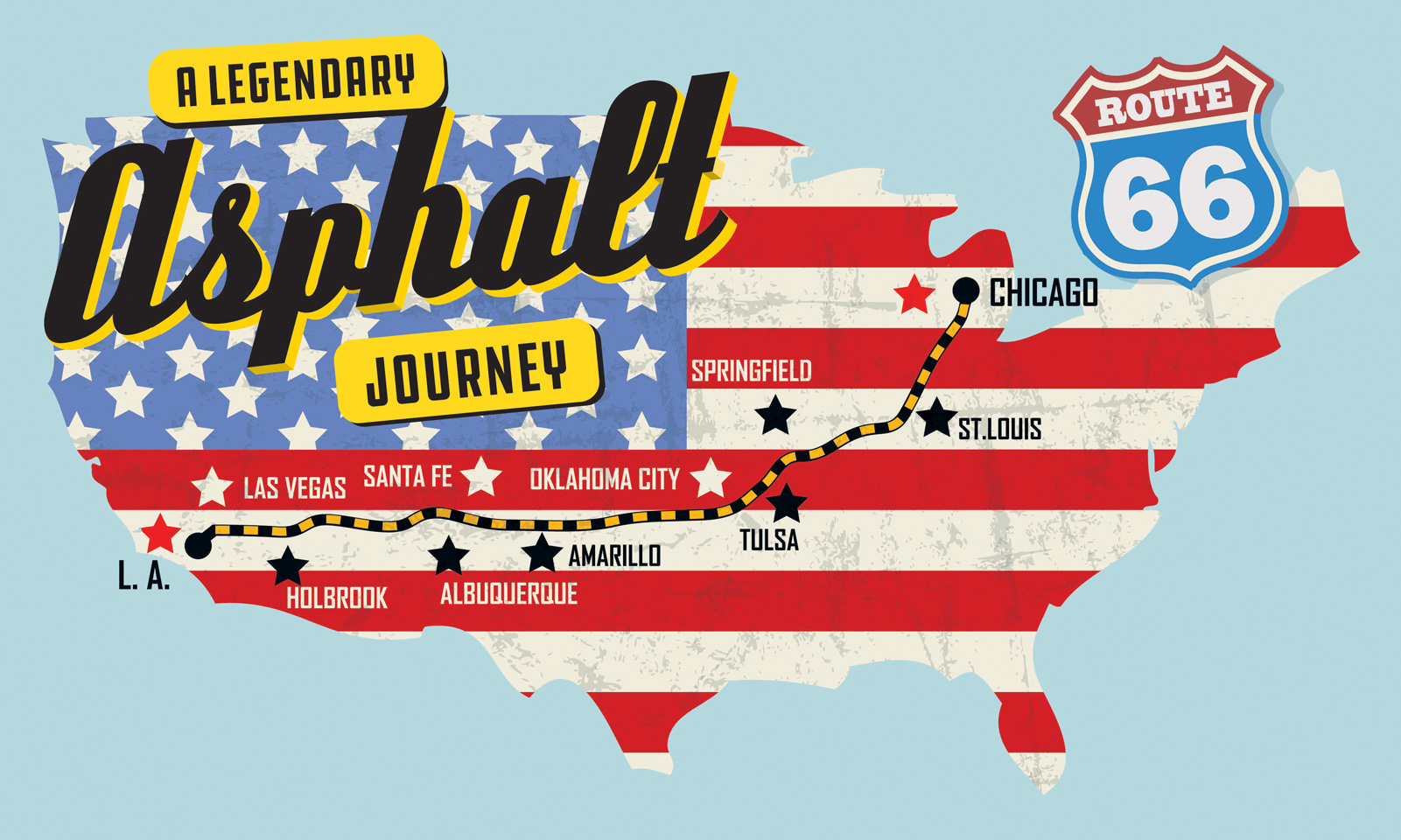
Get your “kicks” and enjoy a hearty dose of Americana by exploring some or all of iconic Route 66.
By Ann Bush, F516383
June 2022
Like so many success stories, Route 66 began with a dream. In the early 1920s, Oklahoma highway commissioner Cyrus Avery sought funding to build better roads in his state. More specifically, he believed the roads were needed to accommodate the newfangled automobiles passing through. The automotive industry was reeling; from 180,000 vehicles sold in 1910, the number had skyrocketed into the millions during the next decade.
Avery’s idea of linking Chicago to Los Angeles with a major road, following the success of the railroad system, took years to become a reality. With the hard work of eight states, Route 66 was officially commissioned for 2,448 miles in 1926. The National Highway System connected current roads with new construction and dubbed the route “Main Street of America.” Cafés, bars, and hotels for the tired and hungry construction crews sprouted up along the route faster than dandelions.
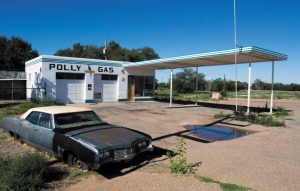
Originally a Texaco service station, this re-creation in Tucumcari, New Mexico, calls to mind the Polly Gasoline stations of old.
Illinois, Kansas, and Missouri completed their route sections by 1931. To celebrate, road crews threw coins into the wet cement. In 1935 California extended the route beyond Los Angeles to coastal Santa Monica. Advertisements cropped up along the roadside to entice drivers to patronize some of the new stores, gas stations, and even theme parks. By 1938, workers finished paving the last stretch in Oldham County, Texas.
One year later, John Steinbeck published The Grapes of Wrath and described Route 66 as “the mother road, the road of flight.” This was because migrants used the route to escape west in search of a better life during the Dust Bowl and the Great Depression. The book was adapted into a film the following year, and Route 66 became cemented into pop culture, being forever associated with the Dust Bowl. During the Great Depression, Route 66 traffic included waves of people migrating from the Midwest to California, many caught in the fallout of failed agricultural practices. It was a journey of sadness, escape, and hope.
With the start of World War II, resources became scant and automobile production ceased. Materials for tires became scarce, and gasoline rationing began. Tourist traffic turned into military traffic, with vehicles full of soldiers and supplies.
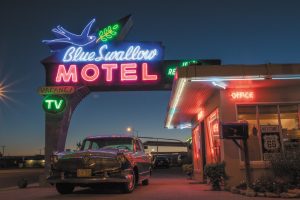
The Blue Swallow Motel, also in Tucumcari, has been serving travelers along the Mother Road since 1939.
When the war ended, a growing economy produced the American Dream of success. Emphasizing the concept of family vacations, in the 1950s the automotive industry began to design larger and faster cars for long road trips. Eager to show off new national parks in the Western states, the U.S. government built four-lane interstate highways. Federal funds were available for new construction but rarely earmarked to repair existing roads. And Route 66 had been severely damaged by heavy military vehicles, as the roads could not accommodate them.
The movement to save Route 66 began with another dream, this time at a grassroots level that grew to national proportion. Missouri petitioned the American Association of State Highway and Transportation Officials to renumber the new interstates near the route as I-66 from Chicago to Los Angeles. They refused the proposal. By 1970, nearly every part of Route 66 had been bypassed by modern four-lane highways. By 1985, the route was officially decommissioned, and signs were either removed by order of state officials, destroyed by the elements, or stolen. Crumbled sections of the route now led to ghost towns.
However, the people did not give up. In 1987 the Historic Route 66 Association of Arizona was formed to protect the road’s historic significance; through its efforts, interest in preserving this legendary icon began to grow. In 1999 Congress passed the Route 66 Corridor Preservation Program, to be administered by the National Park Service.
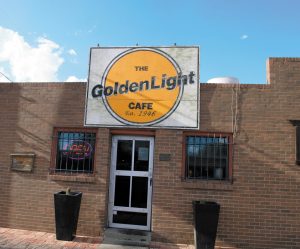
The GoldenLight Café in Amarillo, Texas, has been known for its hamburgers since it opened in 1946.
My own passage on Route 66 covered a short distance compared to the entire route, running only through Texas, New Mexico, and a tad bit of Arizona. I have driven this section many times throughout the years on my way from Texas to visit family in South Dakota. When I retired, my dream was to see all the U.S. national parks, which included Route 66 as part of the journey. I will never grow tired of this route. I always spot something new and see a lot of interesting old things every time.
When planning a trip, especially one along Route 66, my travel strategy is to find the best places for gas, food, and lodging. Here are some suggestions on where to “get your kicks on Route 66.”
Fill ’Er Up
From the very beginning, my favorite spot to get gas has been in Tucumcari, New Mexico — no matter what direction I’m heading. In 1925, the average price for gas was 22 cents per gallon, which equates to $3.61 as of February 2022 when adjusted for inflation. Until the last couple of decades, service came with a smile along with a fill-up.
I remember, as a child, the highlight of a vacation in the 1960s was stopping at a Sinclair station for green dinosaur soap — a simple way to portray that our car sped along on ancient fossils. Don’t miss the distinctive Polly gas station in Tucumcari, which now offers only stories of the past. Polly Gasoline was a brand operated by Los Angeles-based Wilshire Oil and purchased by Gulf Oil in 1960. Polly Gas memorabilia are very desirable and collectible today.
Snack Attacks
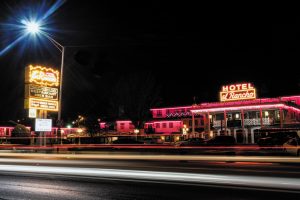
In its heyday, El Rancho Hotel in Gallup, New Mexico, was frequented by Hollywood movie stars.
For many folks, the best part of traveling is eating, especially at local cafés. In my view, there is none better than the GoldenLight Café in Amarillo, Texas, for one of its famous hamburgers. The oldest restaurant in town, it is located along Amarillo’s Route 66 Historic District, which features more than a mile of art galleries, knickknack and antiques stores, and eateries with live bands housed in restored versions of the original buildings. One of the first business districts established in the city, this area attracted Route 66 kick-seekers, which contributed to the success of Amarillo as a whole. (By the way, the GoldenLight hamburger I devoured lived up to its reputation.)
If dining with famous people or soaking in the Southwest style of living is your kick, then save room for a big meal at the El Rancho Hotel in Gallup, New Mexico. The menu has a Mexican flair but also includes American sandwiches and steaks. Many dishes have been named after the famous people who have eaten there. For example, the Ronald Reagan burger comes with a side of jellybeans. Don’t leave the camera in the RV, because the hotel lobby of this national historic site is filled with Southwest pottery; Navajo, Hopi, and Zuni art; and handcrafted furniture. Guests are still greeted at the door of this one-of-a-kind lodge, which was considered a luxury hotel in the early days of Route 66.
Step On The Brakes
Since RVers carry their “houses” with them, and they vary in shapes and sizes, it is difficult to give advice on lodging. However, www.theroute-66.com is an excellent resource that lists hundreds of RV campgrounds along the route by state, plus other information.
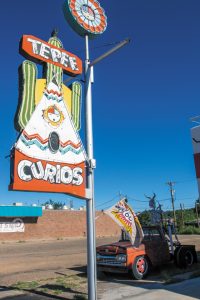
A curio shop in Tucumcari.
It’s also important to find somewhere to take an eyestrain break, stretch your legs, and perhaps purchase a sweet treat. One good option is the Conoco Tower Station and U-Drop Inn café in Shamrock, Texas, for its updated maps and green fudge. This is an interesting architectural art piece: The roof has an unusual four-sided obelisk topped with a metal “tulip.”
Other great places await in Tucumcari, New Mexico, a nicely restored village close to Interstate 40. You will find many little cafés, ice cream shops, curio shops, and even chic restored hotels with vintage cars in the parking lot. Along the route, look for the mural of a handsome James Dean standing next to a fancy convertible in the middle of nowhere — a perfect place for a selfie.
Arizona’s section of the original route through the Painted Desert no longer exists, but travelers can still spot traces of the road alongside the telephone poles. Watch for a pull-over with a bench made from an antique car to sit and reflect; just don’t forget to bring a few crackers for the resident ravens.
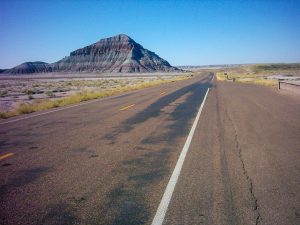
Petrified Forest National Park, along I-40 in northeast Arizona, is the only U.S. national park that contains an original section of Route 66.
Just before I veer off Route 66 in Arizona, I head to Petrified Forest National Park. Drawing people from all over the world, this amazing place of geological magic was, and still is, the only national park containing a protected section of the original Route 66.
Are We There Yet?
This American legend refuses to disappear — even when physically destroyed or mentally forgotten, like so many other features of our past. Route 66 lives on, ready to make more dreams come true.