

Staying in a hot locale . . . in your RV . . . on purpose? Here’s one Michigan couple’s experience.
By Grace Grogan, F476047
August 2022
In our minds, we know how things change with the seasons. However, experiencing life in a different location can change your perspective. This is what happened when I found myself living life backward.
Greetings from Yuma, Arizona — one of the hottest cities in America. Yuma normally experiences about 175 days of 90-degree-plus temperatures every year. This city is the sunniest place on Earth, having sunshine for approximately 308 days per year. Yuma also is among the driest places in the United States and averages three inches of annual precipitation. Located in the Sonoran Desert along the banks of the Colorado River, the city boasts a winter climate that makes it attractive to snowbirds.
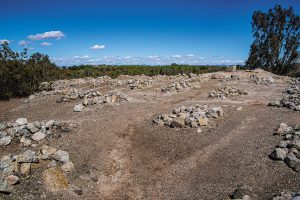
At Yuma Territorial Prison, 104 of the 111 inmates who died while incarcerated there are buried in its cemetery.
Some people refer to Yuma as “Canada’s southernmost city,” because of the high number of Canadian residents who arrive there by RV each winter. The city greets approximately 90,000 snowbirds, filling more than 60 RV resorts every year with the annual “Winter Visitor Welcome Back Bash.”
My husband, Paul, and I came to Yuma in January 2020, intending to stay through April. But because of COVID-19, we decided not to travel and remained there for the summer of 2021 — the hottest summer on record! Many days were over 115 degrees, with the hottest being 120 degrees. If you think those temperatures are rough in a house, try them in a motorhome!
Our family and friends back home in Michigan wondered how we handled such extreme summer temperatures in Yuma. It’s simple; you just live life backward.
In Michigan, as with much of the United States, people primarily stay inside during winter. They go from heated homes to heated cars and to heated buildings. Outdoor activities are kept to a minimum unless you are a winter sports person. When spring arrives, flowers bloom and farmers plant their fields. Throughout the warm summer and fall months, everyone enjoys outdoor activities. During the fall, things cool down, crops are harvested, and people prepare for the cold winter ahead.
In Yuma, Arizona, things are the opposite. The “coolest” month of the year is December, with an average high of 69 degrees and a low of 49. On December 10, 2020, there was just enough rain to get the ground wet. It didn’t last long, but it was the first serious rain the area received in about nine months, and we found it exciting. To top it off, on December 12, we had fog with enough moisture in the air to leave condensation on the Jeep windshield.
By February, average temperatures are up to about 75 degrees during the day and 50 at night. During these winter months, everyone is outside enjoying the weather, walking, biking, swimming, and taking in the open-air markets. Tourism activities are open and active, and the weather is perfect for hitting the off-road trails in the area.

Visitors can explore Yuma’s history at the Sanguinetti House Museum, a former 19th-century home that is set up like a game of “Clue.”
Even though COVID-19 caused many historic and tourist sites to shut down, we still were able to spend time enjoying off-road trails, some historic places, and desert plant life. We just had to keep an eye out for rattlesnakes while walking!
We visited the Arizona Historical Society Sanguinetti House Museum & Gardens, which is a history museum set up like a game of “Clue.” We rode the ridge of the Laguna Mountains in our Jeep — the terrain made us feel as though we were driving on the surface of the moon. We also traveled into California to drive the Mortero Wash/the Impossible Railroad and the Arroyo Tapiado Mud Caves trails located in Anza-Borrego Desert State Park. One of my favorite trails is the Kofa Queen Canyon Road, in Kofa National Wildlife Refuge near Yuma.
Spring brings out the desert cactus flowers, but they quickly dry up. The farmers harvest their crops, and the fields are left barren. The outdoor markets close for the season, and the majority of snowbirds roll out of town by mid-April. The temperatures go into the 90s during May and reach triple digits by June.
When you step outside at 7:00 a.m., it feels like you are walking into a hot, dry furnace. We survived the heat by going from the air-conditioned RV to the air-conditioned Jeep, then into an air-conditioned building. We always went out early and got back as fast as possible, preferably before 9:00 a.m.
When you hit triple digits during the day and the mid-80s at night, keeping the RV cool is impossible. We kept the blinds closed to block the afternoon sun, but it still was difficult for the air conditioner to keep up. Three to four hours every afternoon, the motorhome was HOT, even with the A/C on. We purchased a 12-inch oscillating fan to help circulate the air.
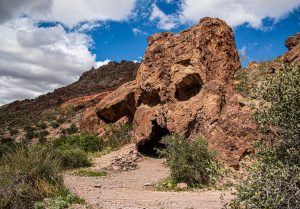
A natural formation known as Skull Rock is located near the end of the off-road trail in Kofa Queen Canyon.
Don’t count on water staying cold unless you keep it in the refrigerator. When you turn on the faucet, the water is hot and only “cools” down to warm. This is because Arizona code requires water pipes to be buried only 12 inches below the surface of the ground. By comparison, the frost line in Michigan is 42 inches, and the minimum depth for water lines is four feet below the surface. Not only does that prevent freezing in winter, but it also keeps the water cool in the summer heat.
After Yuma’s hot summer, we had one cool day where it rained for about three minutes. It was just enough to leave some polkadot clean spots on the Jeep, but not enough to wash the dust off.
Then came fall. It is strange walking into a grocery store in October and seeing a bin full of pumpkins when it is still in the 90s outside. Nighttime temps drop down to the 60s, and you can open the door and windows until about 10:30 a.m. — that’s when it becomes too warm, and you have to close up and turn on the A/C. You know it has been a hot summer when you catch yourself saying, “It’s only going up to 90 today!”
Once again, people are outside walking, biking, or just sitting on their patio enjoying the weather. The farmers begin planting their fields, since the growing season is November through March. Seasonal places like outdoor markets begin to reopen.
Arizona is one of only two states that do not observe daylight saving time. In addition to having to do a mental adjustment when calling back home (in our case, Michigan) or crossing into California, it seemed to us that the world revolves around Eastern Time. Boy, was this a wake-up call on New Year’s Eve.
Around 10:00 p.m., we were watching the New Year’s Eve celebration on a local Arizona TV channel. But the local stations turned off the New York celebration before the ball dropped. They switched to local programming, because it wasn’t midnight where we were. A recorded version of the Times Square ball drop was shown two hours later at midnight in Arizona. We felt gipped! We have since discovered that you can watch the real deal live on CNN without any interruptions.
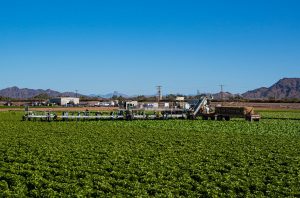
If you drive through Yuma during the fall, winter, or spring, you’ll likely see fields full of lettuce and other leafy greens.
If we’re feeling energetic, we may go watch the Yuma Iceberg Drop. They do it twice, once at 10:00 p.m. when New York drops their ball and again at midnight Yuma-time. Why lettuce? Because Yuma is the “lettuce capital of the world,” producing more than 90 percent of the world’s lettuce. It is home to nine facilities that produce bagged lettuce and salad mixes, and each one processes more than two million pounds of lettuce per day.
Yuma also cultivates 175 different crops year-round. About two-thirds of the wheat grown in Yuma County is exported to Italy for pasta production. Yuma County ranks number one in Arizona for its production of tangelos, tangerines, lemons, watermelons, and cantaloupes. Medjool dates are a hot crop in the area as well, and date shakes are delicious!
Yuma has 23 cooling plants where refrigeration units chill crops down to shipping temperatures before they are loaded and transported to the East Coast within three to four days. Winter in Yuma is great. Thanks to COVID-19, Paul and I spent 16 months there before hitting the road again. We decided 2020 was our first and last summer in Yuma, but we returned in November 2021 for the winter. We are now “seasonal” residents, because we enjoy living life backward in the sunniest place on Earth.