
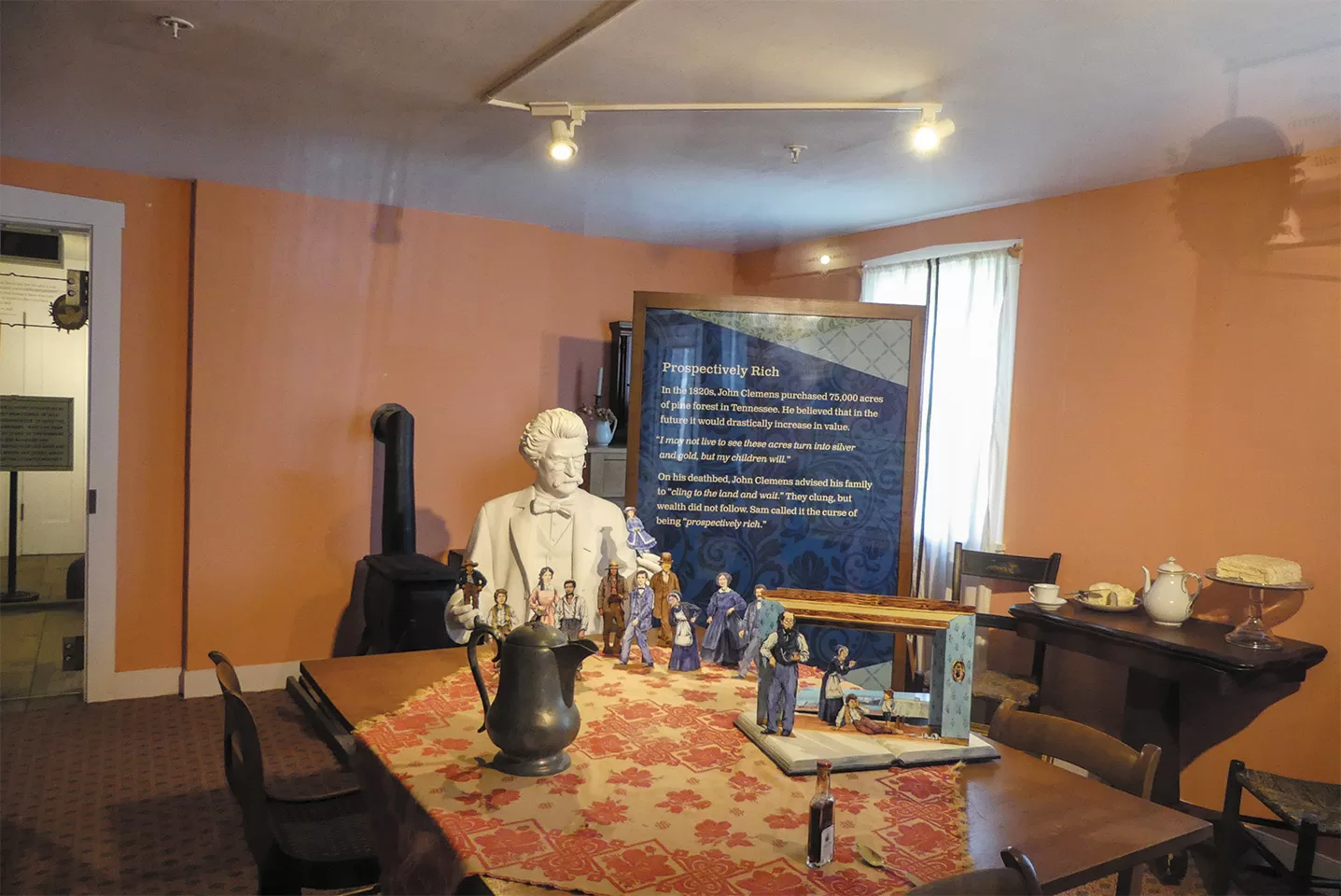
The Missouri town where one of America’s most renowned writers spent his childhood heavily influenced and inspired the setting of his novels.
By Kathleen Walls, F522187
September 2023
If Samuel Langhorne Clemens were alive today and visited Hannibal, Missouri, he would feel right at home. For those who recall reading his books written under the pseudonym “Mark Twain” — including The Adventures Of Tom Sawyer and The Adventures Of Huckleberry Finn — visiting downtown Hannibal is like stepping back to Twain’s time. Hannibal is located 100 miles north of St. Louis, along the mighty Mississippi River.
Museums Of Hannibal
At The Mark Twain Boyhood Home & Museum, Twain would see a reproduction of the town and his home as it appeared when he was a boy living there. A white picket fence like the one Tom Sawyer conned his friends into painting stands near the museum entrance.
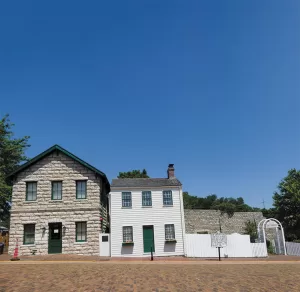
The Mark Twain Boyhood Home & Museum.
The museum is filled with many Clemens family artifacts. A timeline around the museum traces the family history from before they came to Hannibal in 1839. One placard explains that his parents, John and Jane, had five children and one enslaved woman named Jennie. John had not been successful in his career choices. He managed to buy a small row of buildings but ended up selling them, and Jennie, to pay his debts. A relative in St. Louis, Missouri, helped him buy the family home on Hill Street.
Another exhibit in the museum has copies of Twain’s early books and photographs. One photo shows him relaxing in a small chair aboard one of his steamships, wearing his captain’s outfit. Another pictures one of his daughters, Susy. The timeline states that Susy was born in 1872. The timeline also notes that Twain revisited Hannibal in 1882 on one of his riverboat tours. He piloted a riverboat for two years prior to the Civil War; “Mark Twain” was a rivermen’s term to indicate the depth of the water.
At the boyhood home, you can look through glass into the different rooms. Each room is furnished as it would have been when Twain lived there. There’s a statue of Twain as an adult in each room and a placard that explains various happenings in his life. In the dining room, fruit and utensils adorn the simple wood table. The plain, white Twain statue stands next to a placard that notes how his initial views on slavery were formed at an early age when his father beat an enslaved worker and his minister said slavery was “God’s will.”
Mark Twain’s childhood ended when his father died; the youngster was just 11 years old. His writing career began shortly after; he also went to work as a printer’s apprentice at a newspaper in Hannibal.
The home of Elijah Hawkins — whose daughter, Laura, was the model for Becky Thatcher — is now the Becky Thatcher House, one of various properties operated by the Mark Twain Home Foundation. There’s also the Huckleberry Finn House Site, a re-creation of the home of Tom Blankenship, who was the model for Twain’s Huck Finn character.
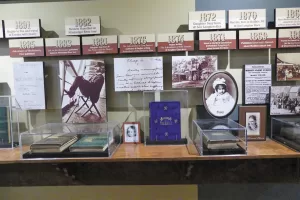
A timeline in the museum marks noteworthy events in Twain’s life.
For a deeper dive into lesser-known history, visit Jim’s Journey: The Huck Finn Freedom Center. This small museum tells the big story about the real-life Jim from The Adventures of Huckleberry Finn. Daniel Quarles, who was born in 1798 into slavery, was the inspiration for the book’s Jim character. Young Mark Twain often spent two or three months at his uncle John’s farm every year. Daniel was one of the enslaved people at that farm. Twain knew him as “Uncle Dan’l,” who played music and told stories to the children. Faye Dant, the museum’s founder, traces Daniel Quarles’ family to present times and showcases much about the African American community in Hannibal.
Another famous person who lived in Hannibal was Molly Brown. She was a survivor of the Titanic sinking in 1912. A movie and play titled The Unsinkable Molly Brown made her famous. The Molly Brown Birthplace & Museum tells the story of her life, including her fight for social causes like women’s rights.
Main Street
Mark Twain could walk down Main Street today and not feel out of place. The J.M. Clemens Justice of the Peace Office is where his father worked. Grant’s Drug Store still looks much as it did when Twain hung out there. These properties are operated by the Mark Twain Boyhood Home & Museum.
Mark Twain Brewing Company, Aunt Polly’s Treasures, and similar shops line the street. At Mark Twain Dinette you can enjoy some of Twain’s favorites, including fried chicken. They make their own root beer.
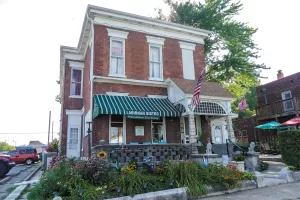
LaBinnah Bistro serves dishes from all over the world.
For more upscale dining, try LaBinnah Bistro, which is located in a historic home. Much of the menu reflects a Turkish influence, but there are many other choices as well. Notice that the name is “Hannibal” spelled backward.
Hannibal visitors also can visit Twain’s steamboat era and take a trip along the Mississippi River aboard the Mark Twain Riverboat. A one-hour sightseeing cruise is offered, as well as a dinner cruise if you so choose.
The Cave And Other Attractions
At the Mark Twain Cave Complex, the Mark Twain Cave would rekindle Clemens’ childhood memories of playing in the then-dark, unexplored cave that’s mentioned in several of his books. You can take an hour-long guided tour of the cave and see his signature on the rock wall. Though it has been there for years, the signature was only recently discovered, in 2019. Jesse James used the cave as a hideout in 1879 and left his signature on the wall as well. You cannot descend to it because of its location, but you can see it from above.
The Mark Twain Cave is well lit, and the pathway is relatively smooth. You can also visit the more primitive Cameron Cave. It’s unlit and more difficult to walk through, but flashlights are provided.

Hannibal’s steamboat tours are a great way to experience the Mississippi.
Another attraction at the complex, the Cave Hollow Theater, presents “The Life and Times of Mark Twain,” a one-man re-enactment by Jim Waddell or Peter Lebron. They get their dialogue directly from Twain’s speeches and writings. The cave complex also includes Cave Hollow West Winery, which offers wine made with Missouri-grown grapes. The wines are named in honor of Mark Twain, including Mark Twain Reserve, a semi-dry red; The Gilded Page, a velvety port; An Innocent Broad, a sweet white wine; and Satire, a dry white wine. There is also live entertainment.
For those who are interested in the darker stories, Haunted Hannibal Ghost Tours talks about the cave’s history and takes you to many other locations around town, including the Baptist cemetery that was established in 1837. It contains graves of many Civil War soldiers, both Union and Confederate, since Missouri was such a divided state. At the cemetery, the guide will give you a pair of divining rods and let you search for any resident spirits. The Haunted Hannibal Tour bus departs from the Hannibal History Museum. This museum tells many stories of Hannibal’s most famous residents. I love its Tom Sawyer dioramas.
If Mark Twain were cruising the highways of Missouri today, he likely would park his RV at the Mark Twain Cave Campground, located at the Mark Twain Cave Complex. It can accommodate even large RVs and makes a great base to explore Hannibal. There are over 100 pull-through or back-in sites with fire rings and water, sewer, and electric (20-, 30-, and 50-amp) hookups. Other amenities include Wi-Fi, laundry facilities, a walking trail, a gift shop, and a playground. It’s close to downtown and pet friendly, too. Full hookups are available from April 1 to October 31, and dry camping is available throughout the winter. Best of all, campers receive a discount at many attractions.
Further Info
Visit Hannibal Missouri
www.visithannibal.com
(573) 221-2477
Mark Twain Cave Campground
300 Cave Hollow Road
Hannibal, MO 63401
marktwaincave.com/campground
(573) 231-1000