
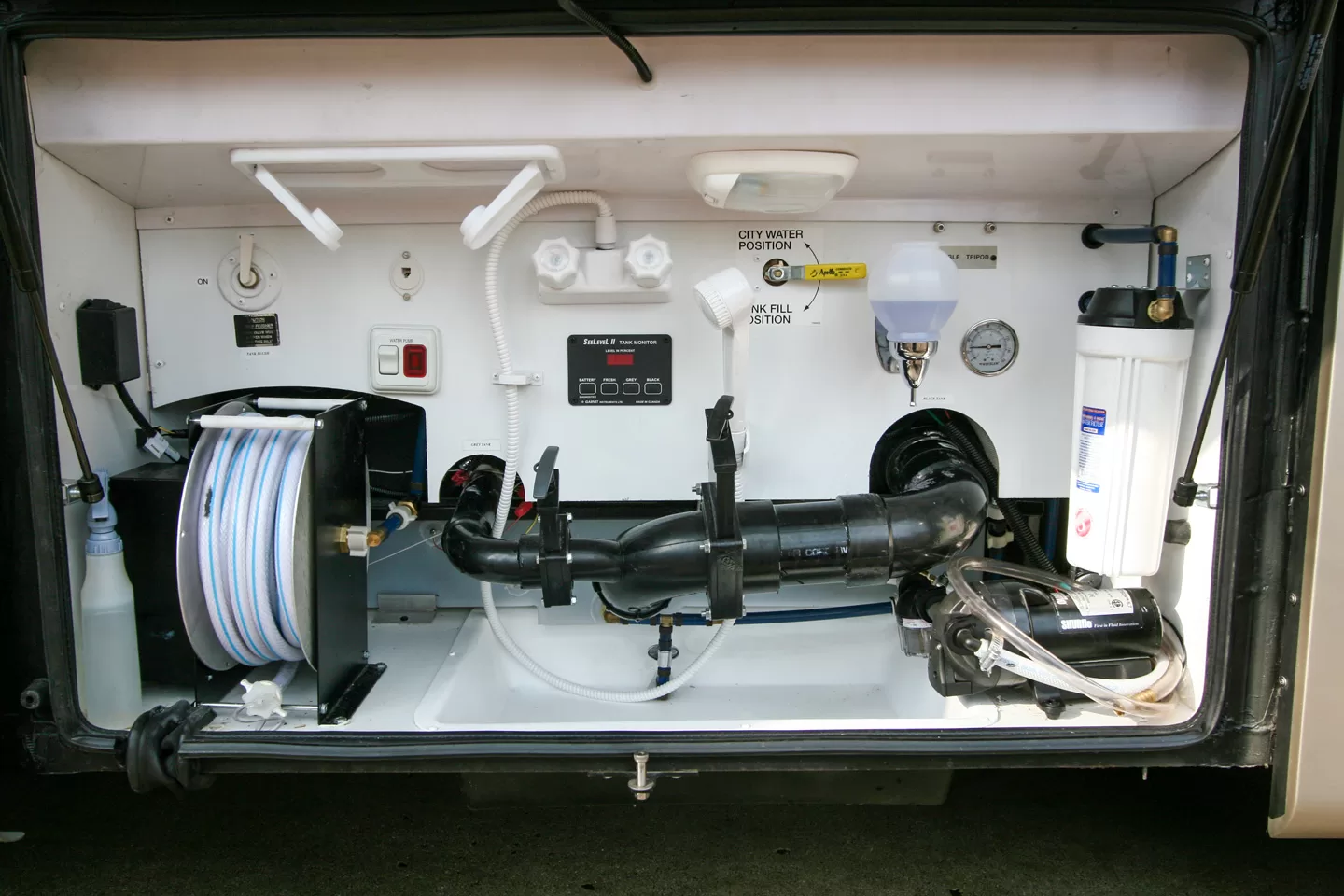
Your RV’s plumbing system needs routine maintenance to keep it in tiptop shape, and knowing how it operates simplifies the process.
By Mark Quasius, F333630
March 2024
Recreational vehicles are designed to be self-contained. One of the main components of this is a wastewater management system — generally consisting of holding tanks and dump valves connected to various plumbing fixtures, vents, and drains. While not the most glamorous aspect of RVing, it is a necessity. And, like all components, it requires a bit of maintenance.
HOLDING TANKS AND DUMP VALVES
Most recreational vehicles have two holding tanks: a gray-water tank and a black-water tank. However, exceptions exist. Some larger towable RVs contain a pair of gray tanks to minimize long plumbing runs, and some RVs with a second toilet have an additional black-water tank as well. Also, larger luxury motorhomes may be equipped with a single holding tank that handles both gray and black water.
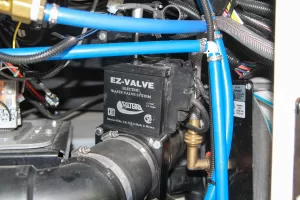
Electric dump valves, such as this EZ-Valve by Valterra, can be mounted in inaccessible locations.
The black-water tank connects to the toilet and holds human waste. The gray-water tank is fed from various sinks and showers in the RV and does not contain human waste. This two-tank design originated in the early days of RV travel where, in many cases, gray water could simply be dumped on the ground. In recent years, this has become illegal in many areas, so having separate holding tanks isn’t as necessary as it once was. The high-end coaches that use a large single holding tank generally are parked at a full-hookup RV resort, so it’s less likely tanks will need to be dumped separately. Plus, having gray water in the mix helps to keep solids from drying out and hardening like they can in a dedicated black-water holding tank.
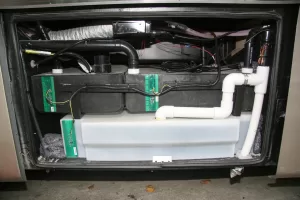
Holding tanks are generally constructed of ABS or polyethylene plastic, with connections that may be spin welded into the tank wall, depending on the material. The drain lines that feed the tank connect at the top of the tank, while the dump valves are located at the bottom of one side of the tank.
The typical RV toilet uses a gravity flush that allows human waste to exit the bottom of the toilet through a blade valve and fall directly into the black-water holding tank; this requires the toilet to be located directly above the tank. This setup may vary, of course. Some fifth-wheels with a deep basement may have a toilet with a 30-degree pipe.
In cases where an RV has a second toilet, or the main toilet cannot be positioned directly over the black tank, a macerator-style toilet may be used. These toilets use an impeller to grind the waste and pump it via a smaller pipe — typically with an inside diameter of 1½ inches — to the black tank. This method works well, but a macerator toilet does require more water to operate, which can be a concern if dry camping.
Dump valves are blade-style valves opened by pulling a tee-shaped handle. Each tank will have a dump valve but, in most cases, they will be joined by a wye connector so that a single hose can handle both tanks. The wye connector will have a bayonet lug fitting that is standard throughout the RV industry.
If the dump valves are in an inaccessible location, the RV manufacturer will either install a cable release to operate them remotely or will incorporate electrically operated dump valves. The black-water holding tank uses a 3-inch valve, while the gray tank may use a 3-inch valve or a 1½-inch valve, depending on what size pipe was used to plumb to the gray tank.
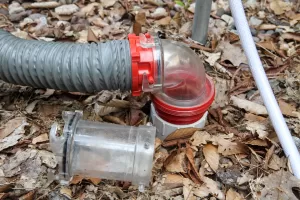
Clear-view fittings are helpful when flushing tanks.
SEWER HOSES
Sewer hoses are generally available in 10-foot or 20-foot lengths; are 3 inches in diameter; and use a standard four-lug bayonet fitting, although some hose systems utilize cam-lock couplers. And sewer hoses are often the bane of RV owners. The hoses don’t last forever and can easily get damaged from being dragged around or stepped on.
Hoses are available in a wide variety of colors and quality levels and are often identified by the thickness of the hose wall, expressed in mils (thousandths of an inch). Inexpensive hoses typically have thin walls, and you’ll find that pinholes develop easily, the hoses may not flex well, and they can tear and fail when it’s cold outside. Plus, exposure to the sun can make them brittle and cause them to crack when you try to move them. You’ll need to replace them often. Upgrading to a higher-quality hose with a thicker mil rating will help.
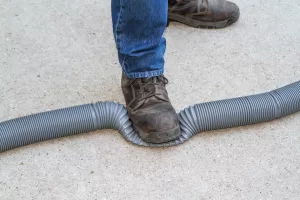
If crushed, the Viper hose will return to its original shape.
Basic vinyl hoses have a wire wound inside them for support. If you upgrade to a higher-quality hose, such as Camco’s popular RhinoFLEX, you’ll have a much better experience. My personal choice is Valterra’s Viper hose. The Viper is rated for use down to minus 30 degrees Fahrenheit while retaining flexibility. It also rebounds; if you step on it, it will spring right back, unlike a stiff vinyl hose. And it also has a smooth interior rather than the corrugated interior common to wire-wound vinyl hoses, so waste material flows more easily and isn’t likely to leave residue inside the hose.
Macerator hoses are smaller in diameter. Unlike a 3-inch “slinky” sewer hose, which uses gravity to dump, this smaller hose is filled by the macerator pump, which can move waste 100-plus feet and uphill if necessary. Earlier macerator hoses were 1 or 1¼ inches in diameter, but the Sani-Con Turbo macerator pump is more powerful, has a higher flow rate, and uses a 1½-inch hose. The macerator hose may be hard-plumbed to the macerator pump with a sewer adapter and dust cap on the output end, or it may be connected with cam-lock couplers to allow for the addition of extension hoses. Some macerator hoses are equipped with a canvas sleeve to help protect them from abrasion.
Campground sewer connections range from a simple 3-inch open pipe to sewer pipes with either 3-inch or 4-inch female pipe threads. A number of 90-degree adapters are available. Depending on the type, they can either be attached directly to a sewer hose and held in place with a hose clamp or fitted with a bayonet coupling to attach to any sewer hose. Look for an adapter that has both thread sizes and a straight shank that will accept a rubber doughnut to allow a tight fit into any open sewer pipe.
SeeLevel sensor strips are applied to the outside of holding tanks to prevent fouling.
MONITOR SYSTEMS
You’ll need to know just how much wastewater is in the holding tanks. If the gray tank fills up unexpectedly, you’ll find yourself standing in a large puddle of water when taking your shower. You’ll also want to know when to dump the black tank. The most basic monitor systems use a series of sensors installed inside the tank at various levels — for instance, at the bottom, 1/3 level, 2/3 level, and the very top. Each sensor connects to a small LED on a monitor panel to indicate how full the tank is. This isn’t a very accurate method. The sensors are subject to fouling from waste, which results in erroneous readings. More recent technology has allowed for digital systems with externally mounted tank sensors that aren’t susceptible to fouling. Plus, products such as the SeeLevel system report tank levels in percentages, resulting in greater accuracy. Later multiplex systems use a similar technology but integrate the displays into a central touch-screen panel that controls various other RV features.
TOILETS
RV toilets are equipped with either a blade-style valve or a waste-ball valve that opens to allow the waste to fall into the black tank. Water is used to help flush the waste out of the bowl via an electric solenoid valve or manually operated foot pedal valve. This greatly minimizes water usage compared to a tank-style toilet, which is an important consideration in an RV.
The blade valve rests against a rubber seal in the base of the bowl. The seal incorporates a channel where the blade rests when the valve is closed. Occasionally, this channel may become fouled with human waste, causing the bowl to no longer hold water. In that case, the blade valve should be held open while the groove in the seal is cleaned out. The seal will eventually need to be replaced, which entails removing the toilet to gain access.
The ball design also has a seal but is less prone to fouling. However, like all seals, it also eventually will require replacement, which necessitates removing the toilet bowl to gain access.
Macerator toilets incorporate a motor that grinds and pushes waste a farther distance to the black tank. They don’t have the same issue with leaky seals as gravity-flush RV toilets, but they do use quite a bit of water with each flush.
OPERATING TIPS
Gray-water tanks are fairly simple to maintain, because they don’t handle human waste. Water from showers, washing machines, and sinks tends to be relatively clean, and soap residue helps to keep things flowing when it’s time to dump the tank.
The gray tank is designed to hold water, not solids. So, scraping your dishes to deposit any heavy accumulations of food into the garbage rather than rinsing it down the sink drain will keep things more clean and avoid gunk building up on the walls of the tank.
Monitor the gray tank level and be sure to drain the tank if it’s almost full before you take a shower or do laundry. If you have a washing machine on board, it’s a good idea to open the gray tank before doing laundry, assuming you have a sewer connection.
Some RV owners like to keep the gray tank dump valve open all the time when at a full-hookup site. This eliminates having to watch your gray tank levels, but there are drawbacks. For one, bugs can enter via your sewer connection and get into your RV. You might find you have some little six-legged friends with you the next time you shower. Another benefit of not leaving it open is that it is useful to keep a good slug of water in the gray tank to help flush the sewer hose after you’ve drained the black tank.
The black tank needs a bit more TLC to keep things working as intended. You should only flush human waste and toilet paper down the toilet. No paper towels, facial tissue, or feminine products should be flushed, so be sure to warn any guests.
You also need to use the correct toilet paper. You can buy RV-specific toilet paper, but there is really no need. Any paper that dissolves quickly will suffice, and a number of brands work well. The best way to determine whether tissue will work is to place a sample of it in a jar, add water, screw the cap on tight, and shake the jar. If the toilet paper falls apart into a bunch of fluff, it will be fine. If it retains its form and just gets soggy, do not use it.
Not using enough water or allowing the tank to dry out can cause issues. The black tank dump valve should never be left open; it should be opened only when draining or flushing the tank. If the valve remains open, waste will fall into the tank and could dry out and harden. This often results in the dreaded pyramid forming directly beneath the toilet’s opening. By keeping the dump valve closed, the water in the tank will help to prevent solid waste from hardening. The best practice is to allow the black tank to get reasonably full before dumping so that the sidewalls become wet and debris doesn’t harden on them.
If you have a long day’s drive planned, before you leave, fill your black-water tank to almost 2/3 full and add holding tank chemicals. The sloshing action as you drive will help to rinse off the tank walls and keep everything suspended. Once you arrive at your campsite, dump the black tank and rinse it out. It should be reasonably clean, and your sensors may function more accurately.
It’s important to flush your black-water holding tank on a regular basis. Flush wands that attach to garden hoses are available at RV dealerships and camping supply stores. Just stick the wand down into the toilet to power wash the inside of the tank. Many RVs are equipped with a black-tank flushing attachment that consists of a spray head mounted inside the tank. It connects to a female garden hose fixture mounted in the RV’s wet bay. Hook a garden hose to it, open the dump valve, and turn on the water until it comes out clear. Short, clear inspection tubes that attach to the sewer drain hose using bayonet connectors are available, allowing you to monitor the water as it flows out. To prevent bacteria from contaminating your fresh-water supply, be sure to use a separate garden hose, not your drinking water hose.
Holding tank chemicals are sometimes misunderstood. Campground septic systems require bacteria to dissolve waste. Some chemicals designed for RVs contain formaldehyde, which will kill beneficial bacteria, so these products should not be used. In fact, most campgrounds specifically prohibit the use of waste tank treatments that contain formaldehyde, and the state of California banned the sale and use of these products starting in 2022.
Fortunately, a number of products on the market incorporate natural bacteria or enzymes instead. They help to speed the process of dissolving waste and to prevent sludge buildup on the tank walls. Keep in mind, though, that enzymes take about four days to activate. The main reason for using enzymes is to eliminate odors, so if you dump frequently, you might be wasting your money.
For the most part, human waste will dissolve in water. Treatments with various enzymes help to break down other materials. Cellulase breaks down toilet paper and vegetable matter, lipase breaks down fat and oil, protease breaks down proteins, and amylase breaks down starches. Note that none of these specifically dissolve human waste, so if you only allow human waste and RV-capable toilet paper in the black tank, you really don’t need additional chemicals to dissolve your waste.
An excellent alternative to tank chemicals is the UViaLite, which uses ultraviolet light to kill bacteria and eliminate odors.
A bit of maintenance and understanding how your wastewater system operates will help to ensure that everything functions as designed.
RESOURCES
360 Products North America
360productsnorthamerica.com
(503) 559-8094
360 Siphon RV roof vent
Camco
camco.net
(800) 334-2004
RV hoses and sanitation products
Garnet Instruments (SeeLevel)
garnetinstruments.com
(800) 617-7384
RV holding tank monitors
Happy Campers
happycampersworld.com
RV holding tank treatment
Thetford
thetford.com
(800) 543-1219
RV toilets and sanitation products
UViaLite
uvialite.com
(540) 362-9636
RV ultraviolet light purifier
Valterra Products
valterra.com
(818) 898-1671
RV hoses and sanitation products