
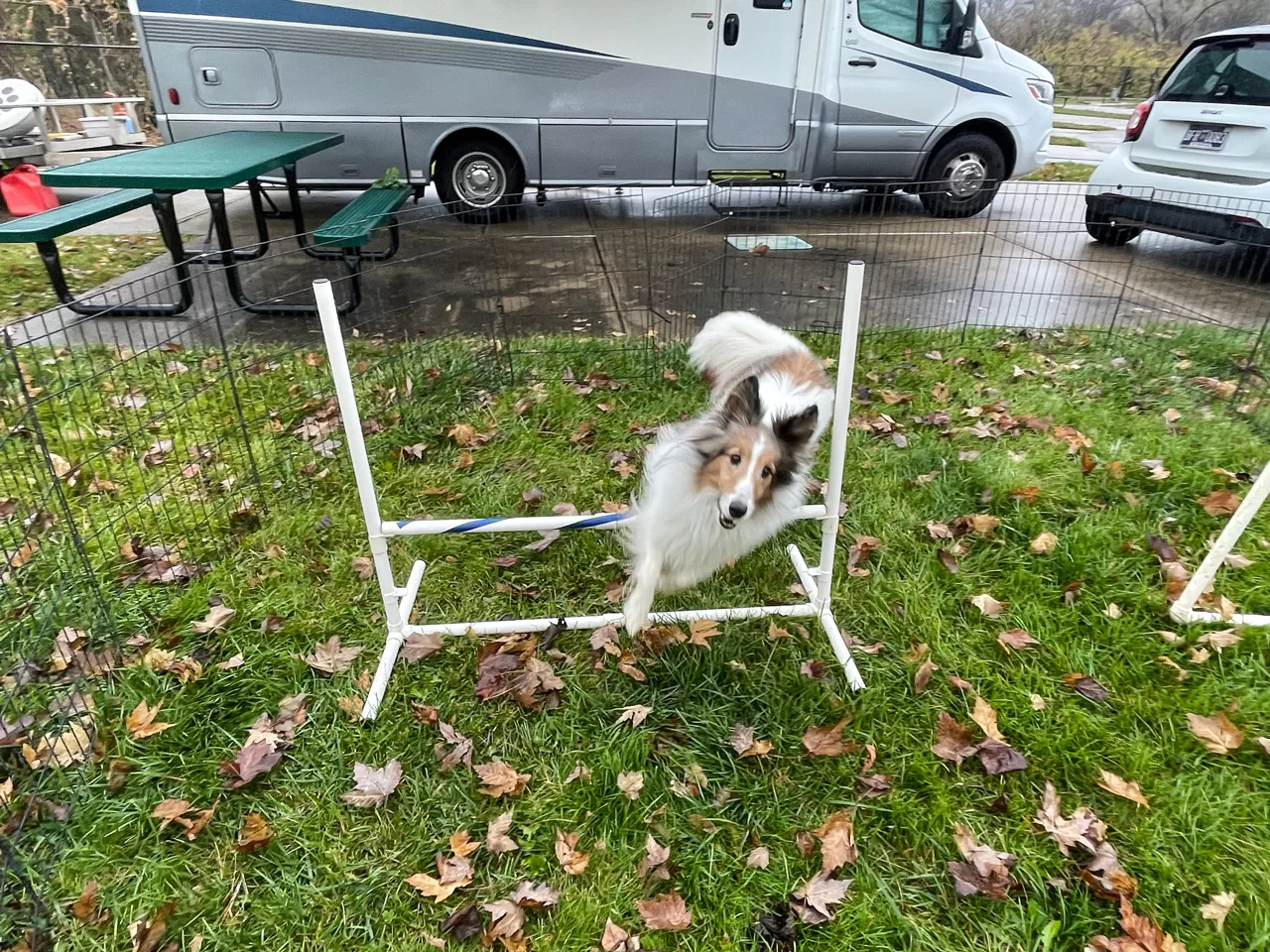
When you travel with furry friends to participate in canine sporting events, RV travel can’t be beat.
By Nick Sparks, F11893S
May 2024
It’s no secret that for many people, one of the main attractions of RVing is how it simplifies traveling with your pets. If you’ve ever traveled with a pet apart from an RV, then you understand the challenges associated with cars, hotels, rest stops, and even just grabbing lunch. An RV of any size reduces those challenges while keeping your four-legged friend as comfortable as possible. It basically offers them their own “home base” while traveling.
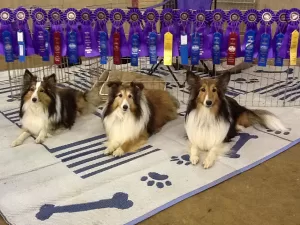
Mr. Shelby, Fiona, and Daphne strike a pose at an NADAC competition.
For some of us, having an RV for traveling with our pets becomes almost a necessity. My wife, Phyllis, and I are weekend warriors who travel to dog competitions. Our focus is to keep our dog-sport partners as comfortable and safe as possible. We rely on them just as much as they rely on us. RVs play an integral part in these weekend events. We call it “crating out of the RV.”
Let me catch you up on who I am and what I do. I’m Nick Sparks, a professional dog trainer, handler, agility judge, and TV host. I’m also an RVer. My history with RVs stretches back to the mid-1970s when my parents purchased their first motorhome, joining FMCA soon after. So, I’ve been a member of FMCA since the ’70s, albeit a very young one at first. That’s why our membership number is F11893S ˛ the “S” stands for “son.” When Phyllis and I jumped into the motorhome world in 2009, for me it seemed I’d never left.
AGILITY TRIALS BY RV
We participated in our first agility competition in December 2007. We made car and hotel travel work until 2009 when we were “forced” into an RV. I say forced because of one event over Christmas where we were in the middle of Oklahoma in freezing temps and strong winds, and we were forced to use an outdoor portable potty. Two months later we purchased a Roadtrek Class B motorhome.
The Roadtrek was a perfect weekend RV for one person and two dogs. Traveling with two people and four dogs made for tight quarters. Plus, having an RV prompted us to travel to distant destinations, meaning additional days in a small box. We are now on our third Class C Sprinter-based motorhome, a Winnebago View, which is still small compared to a 45-foot Class A palace. However, the 25-foot Class C allows us to travel occasionally without a towed car and still navigate small towns with ease.
Dog agility trial locations also dictate the RV size. Horse barns have fantastic parking, but some competitions are held at local soccer facilities. These normally don’t allow for Class A motorhome parking, but in our smaller RV, we often can find a spot. Being in a small, inconspicuous vehicle has afforded us many comfortable weekends at places where larger RVs are not welcome.
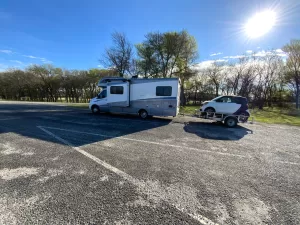
Nick’s traveling setup has everything he and his pups could possibly need.
When using an RV like we do for a specific purpose and staying at unique locations, items we need to take along on any given weekend may differ from what you’d pack for a normal camping trip to a state park. For us, one of these things is a second generator. Many locations where dog shows are held don’t have electricity for RVs, and running the main generator is not always acceptable. So, I found portable generators that have the capacity to power items in the RV without the noise to be beneficial. Our current RV has a propane-powered generator, and we discovered that dry camping would empty the tank in less than a day. The portable gas-powered generator fits our needs better because of ready access to fuel stations.
Another requirement for RVing and attending dog shows is to have extras of everything. You need to meet the pet’s needs not only in the RV but also at the event site. This includes crates, food, water, leashes, and whatever helps your canine partner feel comfortable. We carry chairs for the event and others for sitting outside the RV. Inside the RV are crates secured for travel. I’m aware that some travel with their dogs loose. We did that when I was a kid. But as I mentioned earlier, we do everything to keep our partners safe and comfortable, including having specific crates for travel. For us, traveling to dog competitions is the sole purpose for our RV, and the RV becomes an integral part of the event.
COMPETITIONS
If you’ve watched the televised National Dog Show on Thanksgiving Day, then you’ve seen only one type of dog event — conformation, which is where they judge the dogs solely on presentation and appearance. But there are so many other dog event options. Agility is our chosen sport — that’s where dogs are directed through an obstacle course with jumps, tunnels, and other challenging tests. It’s a race based on speed and accuracy. An agility course is set on a field measuring upward of 100 feet by 100 feet. So, these events are held in horse arenas or soccer facilities, on open fields outside, or anywhere a course will fit.
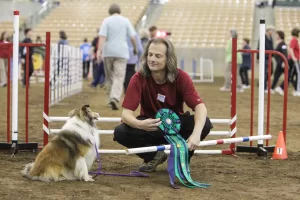
Nick enjoys a moment with Fiona after she earned an AKC national title.
Other dog sport options would be rally, scent work, herding, tracking, or dock diving. There are about a dozen different organizations offering these types of events. The American Kennel Club (AKC) is the one most people know, but some find that other organizations fit them or their dog better.
Note that most of these events can’t be entered on a whim. Anyone who’s registered with one of the major dog organizations can enter, but this needs to be done well before the event date; walking up and registering doesn’t really work. I should also point out that these events are not intended for teaching the sport. That should be investigated at your home base, with local trainers preparing you to attend these events. But once you’re ready, hit the road and make new friends along with great memories and achievements with your pup.
Our journey started with Fiona, our first agility dog. She was a Shetland sheepdog we adopted from our local sheltie rescue. Agility was the furthest thing from my plan, but Phyllis took Fiona to general obedience classes, and in the next room was an agility class. I still blame (and thank) Jeff, the agility trainer, for all of this. He saw something in Fiona and, as they say, “the rest is history.”
Fiona passed away from bladder cancer at age 11, but not before earning four national titles in four different agility venues, podium placements at national events, and being my cohost on a national TV show on the RFD network. She is the reason I’m writing this article.
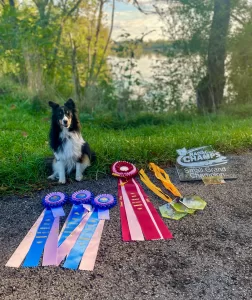
Breanna boasts many prizes, including a small-class grand championship win.
We currently have four shelties. Two are retired, one is a star, and one may never grow up. Breanna, the star, is the only one who wasn’t a “rescue.” She came from a breeder boasting an amazing pedigree. Her lineage includes some remarkable agility stars, and all I had to do was flip a switch, and she was on stage. In October 2023 she won small-class grand champion at the North American Dog Agility Council championships in Springfield, Ohio. She is currently on her way to earning the AKC grand champion award, which is not a small task. She holds multiple national titles and has placed two years in a row at the Westminster Kennel Club show. As you can probably tell from my story, when you get hooked, you get hooked.
TRAINING
I’m often asked how much I train my dogs. Training occurs every day. First thing in the morning, we run what would be considered wind sprints. Each dog hits a pattern of jumps and obstacles. It’s somewhat repetitive, but I try to change directions or move things around every few days. Our current training location isn’t as spacious as the previous one. That said, any training helps keep the connection.
On the road, we can always find space somewhere to do some type of exercise. Most KOA campgrounds have a small dog area, some with agility equipment. I’ve also set up exercise pens (X-pens) and placed two jumps inside to do warm-ups. Parking cones, something most RVers carry, can be used as a simple training aid. Place a few in a spot and have your dog go around them in a pattern. The goal is to train your dog to follow your direction. From there, your practice can grow, but always start simple. Dogs want something to do and to be successful. If they receive treats for going around a cone, they’ll be happy and you’ll have taught them a fun trick.
I want to share one other RV-related tip, and it’s about safety. As you can glean from what you’ve read so far, our dogs are more important to us than almost anything else. Aside from providing them crates and secure harnesses, we also worry about them being left in the RV. Before the RV, I had a second cellphone that I would place near Fiona if I had to leave her somewhere. Yes, my dog had her own phone. I would call it and activate the speakerphone so I could listen in via an earbud to make sure nothing was happening. The only thing I ever heard was her getting into my leftover sandwich sack. Today, our motorhome boasts three Ring cameras connected to our FMCA Tech Connect+ hot spot. That way I can tell what’s happening inside and outside the RV. I also have a commercial-grade temperature and electrical-power sensor that connects to its own internet service. If the power goes out in the summer, I’ll know within two minutes. All this costs money each month, but it’s worth it.
CINCINNATI CONNECTION
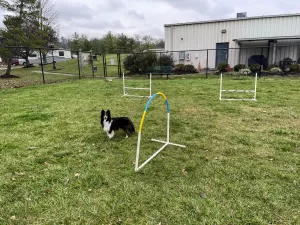
Breanna waits for her next cue at the FMCA Campground dog park.
They say the joy is in the journey. We enjoy each destination for unique restaurants, cool sights, and sometimes just a change in weather. One of our favorite locations for dog trials is the Cincinnati, Ohio, area. And, yes, that’s the home of FMCA and its amazing campground. We’ve enjoyed many visits to the FMCA Campground on Round Bottom Road in Newtown, a Cincinnati suburb. It’s only 15 minutes from the agility club where we are members: Clermont County Dog Training Club (CCDTC). CCDTC started us on the agility journey with Canine Performance Events, one of the dog sport organizations I alluded to earlier. Daphne, one of our sheltie team members, holds seven national titles in CPE along with a placement at nationals.
The Cincinnati/Dayton area is a hot spot for dog sports. I looked up trials taking place in Ohio a year ago in March, and there were over a dozen just in agility. Ohio is a great place to play with your dog. Over the years, the FMCA Campground has gone through some improvements, including the addition of an area for off-leash play, as well as a gate to the trail around the neighboring lake. That has become a perfect “stretch our legs” dog walk. I’ve actually planned agility trials in the Ohio area simply to have a night or two at the FMCA Campground. Each December, outside of Pittsburgh, world team agility tryouts are held. I use the FMCA Campground as a halfway travel point from our home in Tennessee. With Ohio being such a great spot for dog sports, and with the FMCA Campground located at the gateway to most destinations, it becomes a perfect pairing for agility travels.
WANT TO LEARN MORE?
My travels have afforded me an appreciation for the locations I’ve visited. It’s amazing how similar parts of the United States are while at the same time being unique. Dog sports tend to create bonds among people who normally wouldn’t be connected. Most of us have no clue what anyone does as a profession; we just focus on our dogs and the sport. I enjoy introducing others to my fun, unique world full of dogs and people who believe their dog is the best dog around. I know mine are!
NickSparksAgility.com is my website where you can watch livestreamed agility events and get info on how to play this amazing game. AKC covers all the dog sporting bases, and the NADAC or CPE are other organizations to check out for those interested in starting agility sports. My other website, NickSparks.me, has links to nadactv.com and cpetv.dog with info on these organizations.