
An award-winning quilter, fiber artist, and author describes how she manages multiple craft projectswhile traveling in an RV for extended periods.
By Diane L. Murtha, F465708
May/June 2026
I am happy if I can quilt every day, and my husband, Tim, is happy spending time in the RV. So, the RVing lifestyle is perfect for us. I can quilt, see the country, and still sleep in my own bed and cook in my own kitchen.
Although my home quilting studio is much larger than the workspace in our motorhome, the advantage of the RV coziness is that I can look up from sewing at the dinette and chat with my husband any time or absentmindedly listen to a football game he is intently watching.
We have incorporated quilting into our travels, stopping at quilt shops or quilt museums en route to our next destination. We’ve also structured specific trips around quilting events, including quilt shows and my teaching and lecturing events.
We winter in our RV every year, so I focus on preplanning before a trip begins. I prepare my projects, complete with patterns, tools, thread, embellishments, tracing paper, fusible web, and special rulers; then, I pack each into its own project bag. That way, I’m sure I have everything I need for whatever I am working on.
Once we’re on the road and I complete a quilting project, I have to contend with scraps, leftover fabric, and various other items. I’ve tried leaving them in the project bag; however, if I need something later, I have difficulty finding it. Fabric and scraps are everywhere. So, I’ve come up with some tips for fabric and scrap management:
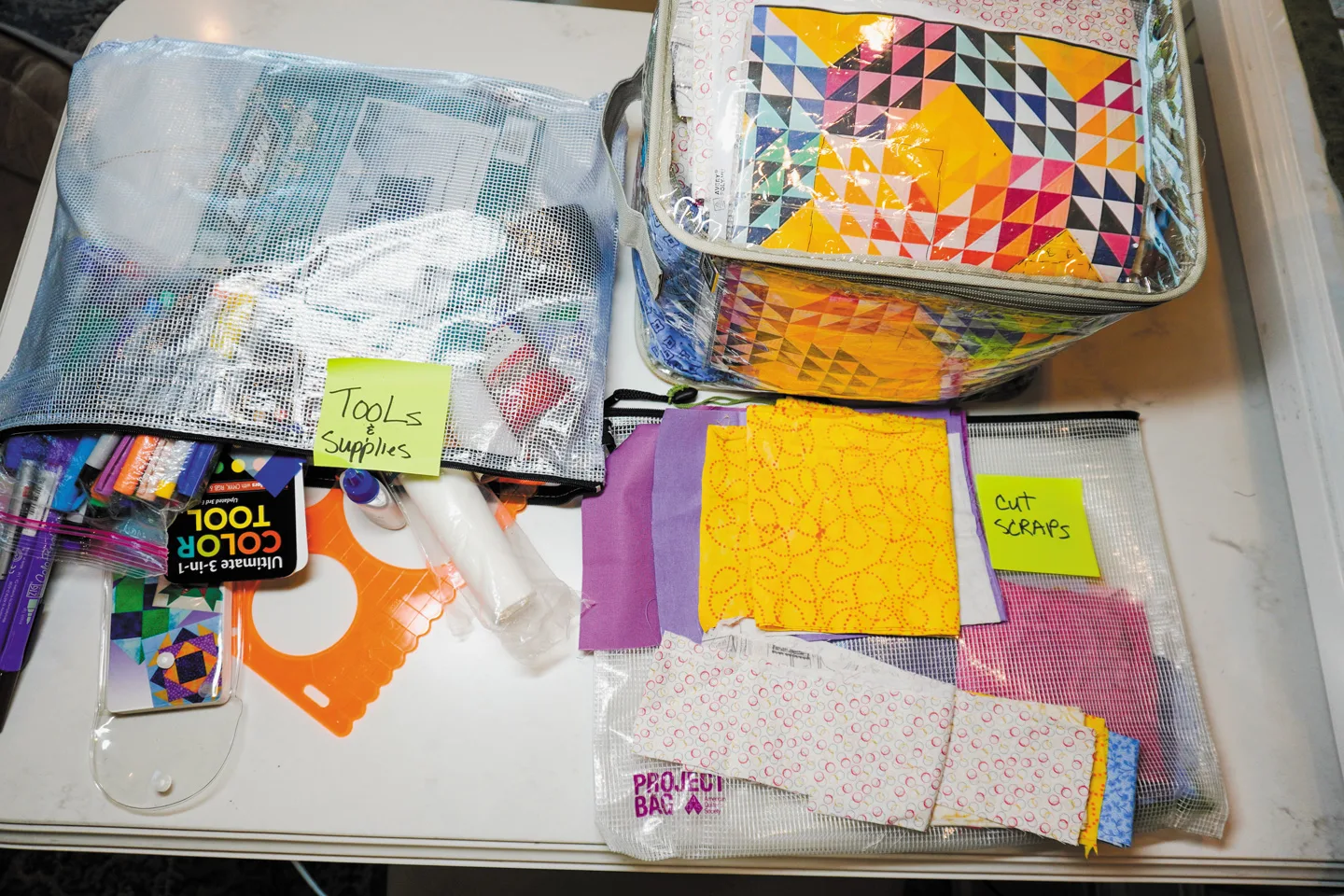
- Pack an extra zippered tote bag or a clear see-through plastic zippered bag. Use this to capture and store all the tools and embellishments once a project is complete. Everything eventually ends up in this one spot.
- Roll batting scraps into a small bag and tuck it inside the larger batting bag.
- Leftover fabric measuring a half yard or larger goes in another zippered tote bag. This becomes my go-to stash when I need more fabric or am looking for a different color.
- Fabric scraps get tricky. Many crafters have their own preference for organizing them. You can search “fabric scrap management” on the internet and find dozens of strategies. But for small-space living, this is what works for me. I cut all the scraps into usable sizes, starting with the largest piece I can salvage — such as 4½, 3½, and 2½ inches wide by whatever length they are. This gives me a wide variety of options for future projects. Why cut everything to 2½-by-2½-inch size, only to realize your next project requires something larger, say, 2½ by 4½ inches? I store these cut scraps in a flat project bag. Should I get too many, then I sort them by color groups, such as lights and darks.
- Label everything. When I leave home in October, there is no guarantee I’ll remember what to look for — for example, I create a label indicating that my “tree” project is in a red bag when I want to work on it in February.
Don’t get frustrated if you still can’t find something, or your dog devours your roll of hemming tape. I speak from personal experience! Just order it online. Stay safe in your travels. Happy quilting.
Follow Diane at dianelmurtha.com.
SHARE YOUR NEWS
Do you own an unusual RV, participate in an interesting hobby, travel with pets, or have an RV adventure to tell about? Has your chapter observed a major anniversary, held a rally with a fun theme, honored a dedicated member, or helped out a charity? We want to hear about it. Share your story in 500 words or less, or contact us to tell us about an RV owner you think others should know about. A high-resolution photo and caption instead of an article are also welcome. Email editor@frva.com; mail Family Matters, c/o Family RVing, 8291 Clough Pike, Cincinnati, OH 45244.