
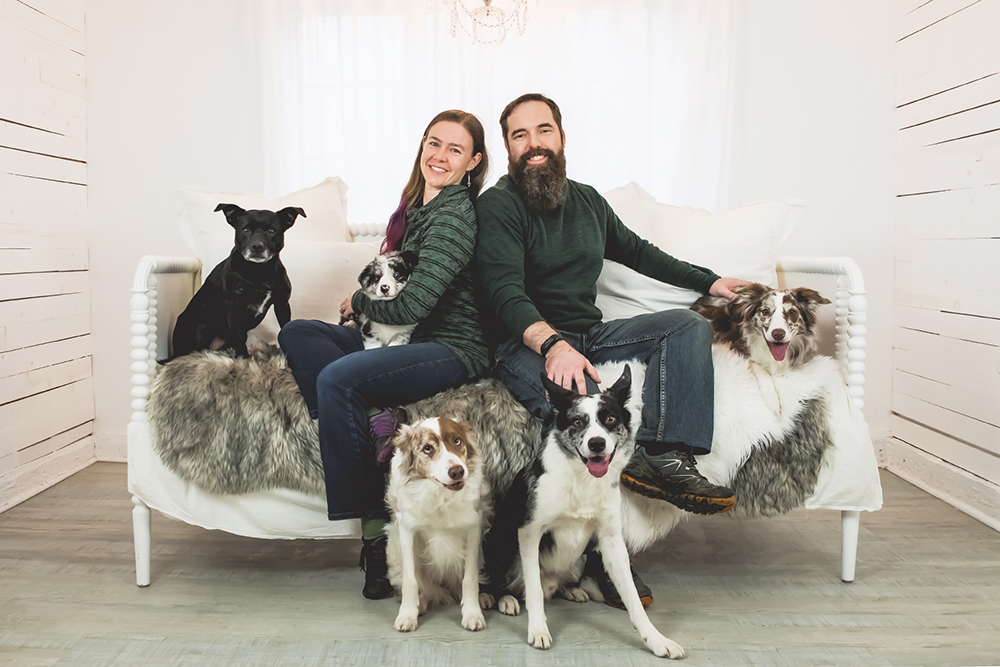
RVers Chris and Joy Adiletta and their dogs enjoy this competitive team sport.
By John Johnston, Associate Editor
May 2020
Many FMCA members travel with pets. Some buy an RV because of their pets. The latter group includes Chris and Joy Adiletta, F484302, of Bothell, Washington.
The backstory begins in 2002, when the couple married. Also that year, with the U.S. economy in a tailspin, Chris lost his job as a sales engineer. Ten months later he remained jobless, so to raise his spirits, Joy suggested they visit their local Humane Society and adopt a dog. It’s worth noting that Chris had grown up with dogs, but Joy, to that point, always had been a cat person.
At the shelter, they found a terrified female border collie, about a year old. They brought her home and named her Jadzia, after a character in the TV series “Star Trek: Deep Space Nine.” (Note to Trekkies: More character names to follow.)
While looking for activities that would build Jadzia’s confidence and allow her to socialize with other dogs, Chris and Joy saw a flyball demonstration at a local fair. That’s when their lives took a turn.
Flyball is a team sport in which dogs, paired according to ability, race side by side on a 51-foot-long course. After jumping four hurdles, a dog on each team presses a spring-loaded box to release a tennis ball. Then, carrying the ball in its mouth, the dog dashes back over the hurdles.
The course is run as a relay, with four dogs on a team. The first team to have all four dogs cross the finish line error-free wins the heat.
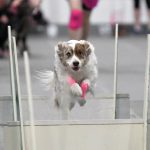
Ezri, who turns 11 this summer, leaps over a hurdle during a competition. She has earned the Hobbes, the top flyball title.
Jadzia trained for a year before she was ready to join a team. Along the way, she took a particular liking to Joy, the cat person. In fact, Jadzia became Joy’s dog.
So, Chris got a puppy, Curzon, who turned out to be faster than Jadzia. And then Joy got Ezri, who was faster than Curzon. And then Chris got Martok.
“We keep competing with each other,” Chris said. And since 2004, they have competed against other flyball aficionados, traveling once a month to weekend tournaments in North American Flyball Association (NAFA) region 7, which includes Oregon, Washington, and British Columbia. The sport offers a nice break from their jobs: Chris works in the IT industry; Joy is a biotech scientist.
Curzon and Jadzia are no longer living, but Ezri and Martok still race, as do two others, Sprite and Sirella. The newest addition, a puppy named Sarek, is too young to compete. All are border collies, or, in the case of Sprite, a Staffordshire terrier/border collie mix.
Training a dog for flyball can take a year or longer. “Once it clicks,” Chris said, “it gets really exciting for them to go to tournaments and go to practice and get to run full-out.”
“Our dogs absolutely love it,” Joy said. “I have worked with other dogs who have kind of been like, eh, I’ll do it because my parents want me to.”
Some dogs, especially those with an aggressive nature, simply don’t take well to flyball, Joy said. “Having seven other off-leash dogs all running at top speed is way too much for those dogs to handle.”
Flyball isn’t for every human, either. The nonstop noise produced by 120 dogs barking in an arena can be intense. “Most of us wear earplugs the entire day,” Chris said.
But in addition to barking, there’s a lot of bonding. Working toward a common goal not only brings pets and their owners closer together, it links people.
“The thing we like most about it is, it’s a community of people,” Chris said. The Adilettas’ team, called Engage Flyball, consists of 10 people and 17 dogs.
Certainly barking can be an issue during hotel stays. That’s assuming a dog-friendly hotel can be found near the tournament site. And then there’s the cost of a dozen weekend hotel stays a year. All of which led Joy to suggest to Chris that they buy an RV, even though neither had RVing experience.
“The only RV picture I had in my mind was (from the movie) National Lampoon’s Christmas Vacation,” Chris said. “I didn’t want to be that guy. But it was easy convincing me (to purchase an RV).”
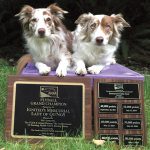
Plaques show the points that Sirella (left) and Ezri have racked up in North American Flyball Association competitions.
Because Joy is a team captain, she must arrive early at tournament sites. “She does all the responsible stuff,” Chris said, half-joking, “and I feed the dogs breakfast, make myself breakfast, and sit around drinking coffee. Having the RV is nice.”
They are on their second travel trailer — a 2018 Jayco Eagle RSTS — which they prefer over a fifth-wheel, because they haul their flyball gear in the bed of their pickup truck. They also like that the 40-foot Jayco has enough open space that they can invite flyball friends over to socialize, and the dogs have a place to play during inclement weather.
When the Adilettas first hit the flyball circuit, they saw few RVs. Now, as many as 30 might be parked at a tournament site. The other members of Engage Flyball also own RVs.
“You pull in, and everybody’s helping you find your spot,” Chris said. “If something goes wrong with a rig, four guys are going to show up with toolboxes and (say), ‘How can I help?’”Because of the coronavirus outbreak, tournaments have been halted temporarily, and the Flyball Open World Cup, which was to be held in Belgium in May, has been canceled. The Adilettas’ team was one of five in the United States and one from Canada that were selected for the tournament.
In flyball, there are no cash prizes. But championships are won and titles are awarded. Individual dogs, as well as teams, earn NAFA points based on their performance. A dog that accumulates 100,000 points fetches the top title in flyball, called the Hobbes, named after the first dog to reach that total.
Joy’s dog Ezri, who will be 11 years old this summer, earned the Hobbes about a year ago. To do so, she traveled 55,500 miles, raced with 107 teammates, and competed in 113 tournaments in nine states and one Canadian province.
She celebrated her title by devouring a bacon cheeseburger.