
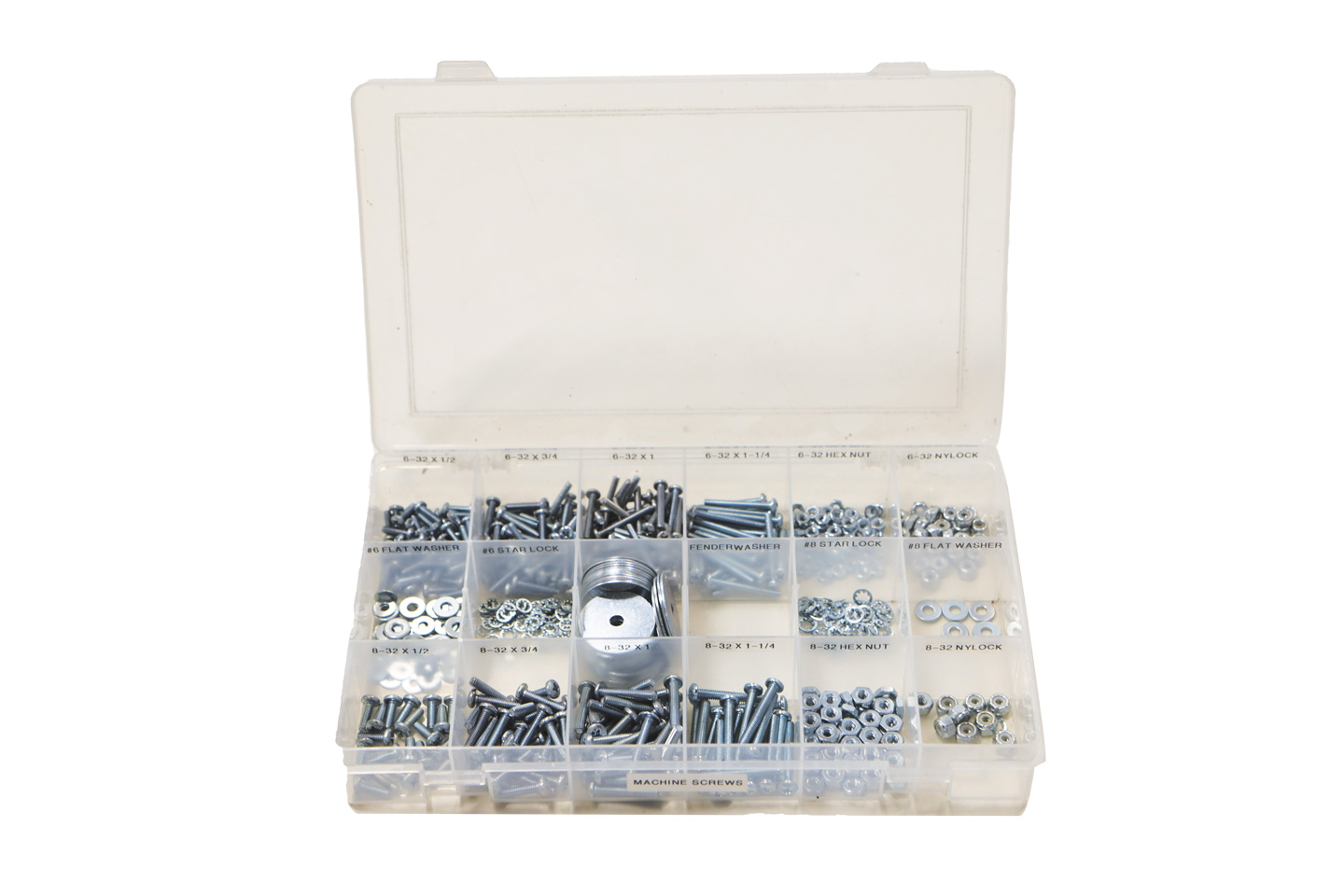
Behind the scenes, RVs are assembled using a wide variety of mechanical fasteners. Knowing the difference between items such as Loctite and lock washers can keep you from getting rattled while repairing all that rattles.
By Mark Quasius, F333630
August 2021
Today’s RVs aren’t so much manufactured as they are assembled. They incorporate a large number of components sourced directly from the RV manufacturer or from third-party suppliers and then welded, glued, nailed, bolted, bonded, stapled, and screwed together into the final product.
For the RV owner, knowing the differences among the mechanical fasteners holding together their home on wheels is important. The fasteners can, after all, loosen or fall out over time. This may be the result of improper installation or even just years of bouncing up and down on bumpy roads. Eventually, something will need to be repaired, reworked, or replaced, and it’s imperative to use the correct fastener for the job.
Welding is best left to the professionals, and adhesives vary in scope and also require repair skills that often go beyond the capabilities of most RV owners, so we won’t go into detail about them in this article. Sealants sometimes come into play when making repairs, but this article does not cover them, either (see “RV Sealants,” January 2017).
Knowing which mechanical fastener to use in a specific situation can be a challenge. Will it be used inside or outside? Will it involve a blind hole, or can you attach a nut to the backside? What kind of exposure will it have to the elements? What style head should you use? Is it capable of supporting the intended load?
This article will offer the basics in mechanical fasteners so you can hold it all together during your RV repairs.
Nuts And Bolts
Nuts and bolts are the fundamentals of fasteners. The advantage of a nut and bolt combination is that it achieves its holding power by clamping the material together. A bolt passes through two items, and then utilizes the nut on the other end to supply the clamping force. The benefit to a bolt and nut combination is that the material being fastened does not affect the strength of the bond. The disadvantage is that you need to be able to access both sides of the material so you can tighten the bolt and nut together. If you want to mount a porch light on the side of your RV, for instance, a nut and bolt are not going to work.
Bolts come in various diameters and lengths. They also come in a variety of head styles, grades (strength), and thread pitches (the distance between each thread). Good old American bolts are called imperial fasteners. Fine-threaded imperial bolts are referred to as SAE or UNF bolts, while coarse-threaded bolts are referred to as USS or UNC bolts. Fine-thread bolts provide more holding power than coarse-thread bolts, but coarse-thread bolts have a deeper thread and work better with softer material, such as aluminum. Fine-thread bolts work better for steel castings. It is important to use the correct nut with each bolt to prevent stripping the threads. The majority of fasteners used in an RV are coarse-thread.
Metric bolts are becoming increasingly popular, especially on motorized chassis. Metric bolts don’t use the SAE/UNF or USS/UNC standards, but they identify the thread pitch in millimeters, from .35 (fine) to 1.5 (coarse). Again, make sure you match the correct bolt and nut for each task. Metric and imperial fasteners are not interchangeable.
Bolts are also graded for strength, and markings on the head of the bolt identify its grade or class. Imperial bolts typically fall into three grades: Grade 2 (no markings), Grade 5 (three radial lines), or Grade 8 (six radial lines). Metric bolts also fall into classes and are identified with numbers such as 8.8, 10.9, or 12.9 on the head of the bolt.
A Grade 8 bolt is harder than a Grade 5 and offers greater clamping power, but it is also more brittle and can shear more easily if allowed to loosen. A Grade 5 is the best choice for most applications, because it has good tensile strength; however, it will give a bit and deform rather than break when excessive shear loads are applied.
In many cases, a lock washer is also utilized with nuts and bolts to prevent the connection from loosening. The most common lock washer is the split ring washer that binds into the head of the nut or bolt, but star lock washers are used in some situations, especially where thinner sheet metal is involved.
Nuts can also be of the self-locking type. These nuts require additional effort to tighten, but they hold much better than a plain hex nut. Lock nuts can be crimp-style or have a nylon lock ring built in. When reusing either of these, be sure the crimp or the nylon is still effective. If you can easily spin the nut on, don’t use it. Replace it with a new self-locking nut.
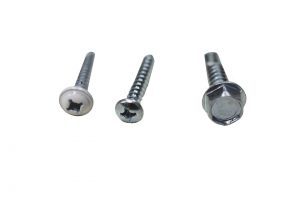
Three screw head types (left to right) ― Phillips/Robertson, Phillips, and hex washer.
A third style is the castle nut, which uses a cotter pin inserted between the towers of the nut and through a hole cross-drilled into the bolt or shaft. This type commonly is found on wheel bearing retaining nuts on trailer axles.
Screws And Direct-Thread Bolts
Despite its name, a cap screw is technically a bolt that is screwed directly into a threaded fitting — as opposed to into a nut. A lock washer or thread locking fluid, such as Loctite, is required to prevent the bolt from loosening and backing out of the threaded fitting. Thread locking fluid comes in blue for a removable bond or red for a more permanent bond.
Contrary to bolts, screws rely on the strength of the material they thread into for their holding power. The threads of the screw are designed to dig into the substrate as they turn. Also, if the substrate is thin, such as sheet metal, it can be very easy to tear the substrate, resulting in a hole that is too large for the fastener. Excessive torque when installing the screw or vibration during use is the most common cause of failure, although screws that are too small for the stress loads also will fail. In some cases, a washer or even a larger-diameter screw can be used in its place, but if the hole is too large you may need to install a rivet nut or screw anchor or take a more drastic action to repair it.
In some cases, a pilot hole needs to be drilled before the screw can cut its threads. However, if the pilot hole is too small, the screw may break. If the hole is too large, the screw can’t effectively cut its threads, will likely strip the substrate, and the desired holding power is lost. Many drill bit charts show the proper drill bit size for each screw. If a drill bit chart isn’t handy, just size the bit so it is the same diameter or slightly smaller than the solid shank of the screw. That will allow the threaded portion of the screw the greatest holding power possible.
Self-drilling screws, which have a drill bit point on them, eliminate predrilling by boring the precise hole size necessary while also allowing the threads to dig into the substrate. Self-drilling screws work great on soft substrates. However, using a self-drilling screw on hard surfaces, such as steel, can be a chore or even an impossible task.
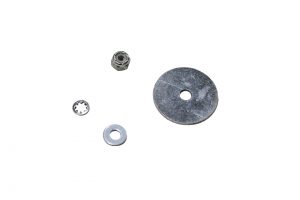
Counterclockwise: top, nylon self-locking nut; internal star lock washer; SAE flat washer; large-diameter fender washer.
Washers
Fasteners installed into softer materials such as plastic or lauan plywood may result in the head of the fastener becoming buried in the material, which can damage the material, or cause it to crack or split. To prevent this, you can use pan-head screws, which have a larger diameter washer-style head. Using a traditional flat washer prevents this as well by spreading the clamping force over a wider area. SAE/UNF flat washers have close tolerances to fasteners, so their inside diameter is close to the outside diameter of the bolt or machine screw. USS/UNC flat washers have a larger inside diameter and fit rather loosely around the fastener, but they also have a large outside diameter, which gives them more surface area to distribute the clamping force. Finally, fender washers have extremely large outside diameters and can help to hold very soft materials.
Lock washers are also a necessary component of many fasteners. Without some sort of tension, the fastener can work loose, and the joint can fail. External components generally require a lock washer unless a self-locking flange head bolt is utilized. The most common lock washer is the split lock. Split lock washers have a sharp end that bites into the head of the bolt or nut and the substrate beneath to prevent the fastener from loosening. Other styles of lock washers are the internal or external star lock washers. These are more commonly used in sheet metal applications where the locking force is distributed among several smaller locking points rather than the single large point on the split lock washer. They also are an excellent choice for connecting a wire terminal to a terminal stud or a ground location.
Fastener Materials And Drive Systems
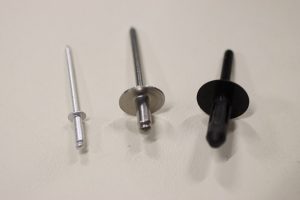
Blind hole rivets (left to right): aluminum, stainless steel with a large-diameter button flange, and black nylon.
Fasteners come in a variety of materials. The most common is steel. Bare steel, referred to as “black,” is fine for the inside of an engine that gets plenty of lubrication, but external moisture, salts, and other contaminants can cause a fastener to rust or corrode quickly. Cadmium plating is the most common method of preventing this. These “bright” fasteners make up the vast majority of fasteners on the market. For conditions that require greater corrosion resistance, brass and stainless-steel fasteners are the best choice. Brass is softer than steel but works well for interior cabinets. Stainless steel is the best choice for any area that needs a combination of strength and a high level of corrosion protection. Stainless steel is also the best choice when attaching aluminum to steel to avoid the effects of galvanic corrosion, which takes place between two dissimilar metals.
One of the most common fasteners in the RV industry is the Robertson- head fastener. This is a square drive head that allows greater torque and helps keep the bit from slipping out of the head. Stepping it up to the next level is the Torx fastener, which has an internal star-shaped head that applies the ultimate in torque with no slippage.
These, of course, are not the only fasteners you may run across in your RV. You may find rivets, staples, clips, and even nails holding something in place. The days when everything was put together with monkey wrenches and slotted screwdrivers are long gone. The key is being able to recognize the issue and choose the correct fastener for each task – and to install it correctly.