
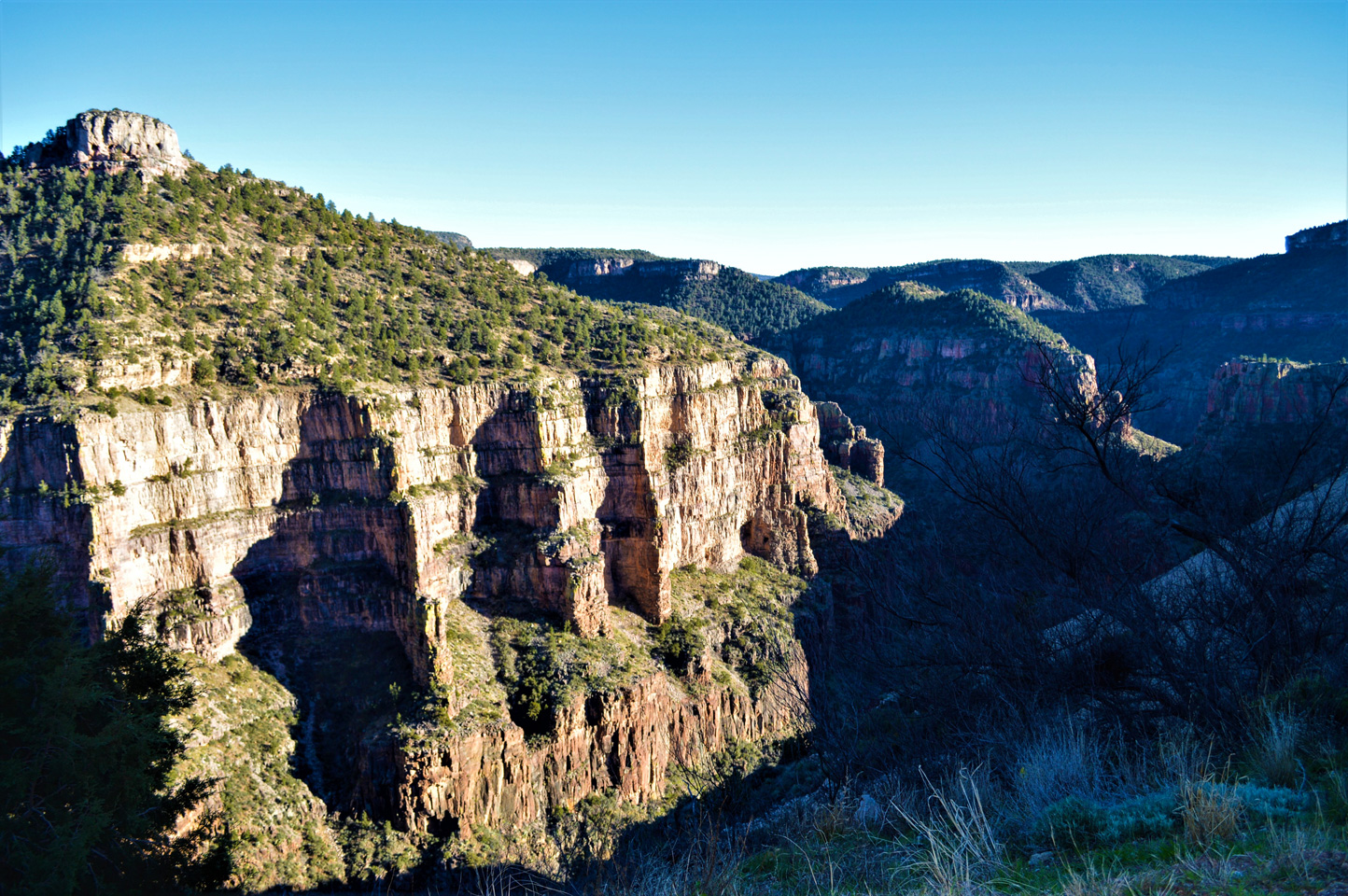
Desert, mountains, lakes, diverse wildlife, and a variety of attractions await exploration within and outside the limits of this bustling Arizona city.
By Ann Bush, F516383
February 2022
When my best friend from high school, Linda, told me to get out of town during our 47th annual class reunion in Phoenix, Arizona, I didn’t take it personally. Getting out of busy, congested cities to soak in the natural beauty of our planet has long been my favorite thing to do, and she knew I wanted to see the natural side of Phoenix during my stay. Interestingly, our high school was in North Dakota, but many of my fellow classmates have headed south, far away from the cold, snowy winters we suffered in our youth.
Phoenix often becomes overshadowed by Tucson or Sedona, and it frequently is viewed by visitors as a mere refueling stop on a journey to the Grand Canyon or the California redwoods. What many travelers don’t realize is that there is much to see and do in and around Phoenix.
Downtown architecture displays a mix of silver skyscrapers, adobe missions, and vintage Spanish Colonial homes. Phoenix boasts numerous galleries and museums, including the Heard Museum, with its extraordinary collection of Southwest American Indian art. Another interesting place to visit is the famous Taliesin West home built by architect Frank Lloyd Wright in nearby Scottsdale.
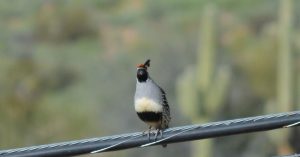
Gambel’s quail
This country girl definitely was eager to get out of town and learn why my North Dakota friends find this place so inviting.
The Adobe Cabin
My homemade camper was half finished at the time of this spring trip, and March was too early to stay in a tent, even in the desert. Linda’s winter home was full of our classmates, so I opted to rent a rustic, restored 1940s adobe cabin on Superstition Mountain, overlooking Phoenix. I turned onto a dirt road and headed almost straight up, and at the end I found the cabin, placed squarely on top of the hill. The view of the valley below was mesmerizing, and the little porch was the first place I went. I watched the sun set and saw the city lights begin to sparkle in the distance.
The cool, fresh air was perfect for leaving the porch door open all night. The next morning, I woke to a flock of Gambel’s quail watching me intently through the screen door. Sitting quietly on the back porch with a cup of coffee and goodies from the welcome basket, I observed a cactus wren perching on a neighboring cactus, and I noticed skinny striped lizards crawling along the rocks. A long-eared rabbit darted between juniper trees, and a lone quail — not easily scared off — posed on the telephone wire. “Welcome to Arizona,” they seemed to say.
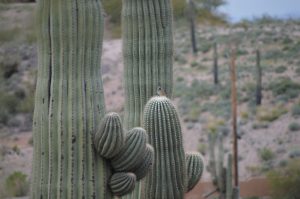
Cactus wren atop a cactus
If this was what an Arizona desert offers, I wondered what area campgrounds were like and soon headed out to explore.
Lost Dutchman State Park
Starting at the small town of Apache Junction near my cabin, I took the Apache Trail Scenic Drive (Arizona State Route 88) to Lost Dutchman State Park (www.azstateparks.com/lost-dutchman), located 40 miles east of Phoenix. In the 1870s, a Prussian immigrant named Jacob Waltz reportedly found gold in the Superstition Mountains. Living lavishly afterward, he kept the whereabouts of the mine secret, only revealing the location to his caregiver on his deathbed in 1891. She and countless others since have tried to find the Lost Dutchman Mine, without success.
I found the real treasure — an Anna’s hummingbird — on a hiking trail winding through the park’s high Sonoran Desert landscape. The males flash a ruby-red throat that sparkles like diamonds as they court females each spring, and this guy was giving the show of a lifetime.
The state park campground has 138 sites; 68 of them come with 50/30/20-amp electric service and water. Picnic tables and fire pits were clean and ready for visitors to join tall-eared jackrabbits zip-ping from campsite to campsite. The campground has no RV size restrictions, and a paved road networks all sites.
Several hiking trails lead visitors from the park deep into the Superstition Mountains wilderness and surrounding Tonto National Forest. Locals sharing my trail told me that in another month, a carpet of wildflowers would take over the park. Lost Dutchman is in the middle of an area with a diverse wildlife habitat, so don’t be surprised to see a desert mule deer, a greater roadrunner, or a Gila monster stroll through your campsite.
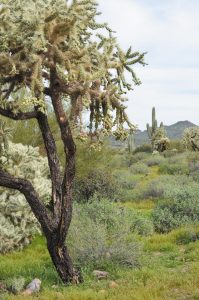
Trails in Lost Dutchman State Park lead to the Superstition Mountains wilderness and Tonto National Forest.
Tonto National Forest
An internet search for Tonto National Forest yielded a five-star-rated description of desert, mountains, rivers, and camping. What more could one ask for?
Leaving Lost Dutchman State Park on Apache Trail Scenic Drive, I headed north straight into Tonto National Forest. This is one of the most scenic drives in Arizona. However, a warning: Drivers encounter narrow shoulders and steep grades along parts of this route, and some of it is unpaved. Large RVs are not recommended on certain sections of the 120-mile loop. In fact, the Cruise America RV rental firm does not allow their vehicles to be driven on some parts of this route.
But if you tow a smaller vehicle or can unhook from a trailer, this scenic route is well worth the endeavor, although nervous drivers or passengers may want to pass. Twisting and turning around buttes of alternating layers of rose-, cream-, and rust-colored sandstone canyons sprinkled with stubby pine bushes suggests a scene right out of an old John Wayne movie.
I made it as far as Canyon Lake that day. Known for its shorelines with easy access for boaters seeking seclusion, Canyon Lake resembles a turquoise gem trapped between rocky cliffs. Many picnic areas, private campgrounds, and RV resorts surround the lake. Most places are set in a typical desert atmosphere with campsites surrounded by conifer, oak, and aspen trees, depending on their location on the lake. The Canyon Lake Marina and Campground offers marina services, a restaurant, and a beach, as well as 28 RV sites with electric and water hookups.
By late afternoon, I turned around and aimed for the cabin via the same Apache Trail, trying to beat the setting sun. Amazing new views from this direction emerged as the sun slid lower. Once, goose bumps crawled along my neck when I checked the rearview mirror: I swear I saw Roy Rogers sitting tall on Trigger against the horizon of a remarkable red butte.
Not that I’m a coward when it comes to ghosts, but on the next reunion break, I explored a different route into Tonto National Forest. The largest national forest in Arizona consists of almost 3 million acres of cactus-studded desert among pine-covered mountains. Because of its proximity to Phoenix, the forest is considered one of the most “urban” forests in the United States, with more than 3 million people visiting every year.
During the winter months, international and national visitors flock to the Sonoran Desert flatlands, surrounded by red stone canyons filled with lakes. In the summer, the mountain areas provide cool shade sprinkled with lake swimming. The critical fire season is short, generally ranging from May until mid-July.
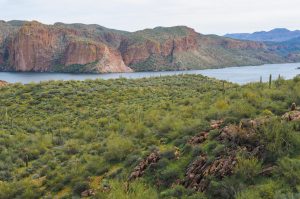
Reservoirs at Tonto National Forest provide abundant recreational opportunities.
Somewhere along the way, I learned that the forest was not named after the famous sidekick of the Lone Ranger but after the Tonto Basin at its core, which was found on historic maps created when the land fell under Spanish rule. Why the Spanish named the basin Tonto is a mystery. A few historians claim the term “tontos,” which is Spanish for fools or crazy people, was often heard in early pioneer days in reference to the Apache Indians. Most speculate the name resulted from the early settlers’ impression of a people who dressed and talked very differently from themselves. Hmm; maybe that ghost was not Roy.
Established around the construction of Roosevelt Dam, the forest was created in 1905 to protect the watersheds of the Salt and Verde rivers. The forest has two scenic rivers known for their fast-moving clear water, fossil rock formations, and guided raft or kayak excursions. Another terrific place is Tonto National Monument, which showcases cliff dwellings occupied by the Salado Indians starting in the 13th century. The museum there hosts a fine collection of their pottery and textiles.
Tonto National Forest is incredibly large, with many camping options. Elevations range from 1,300 to 7,900 feet, and some areas may be difficult to reach with large RVs, so it is important to research the many private and public campgrounds in the area. The main question to ask yourself is what Arizona habitat you wish to embrace for your stay — the desert flats or the forested mountains.
For more information, the best resource is the U.S. Forest Service website at www.fs.usda.gov/tonto.
Rio Salado Trails
One day, in between class reunion events, I drove two miles south of downtown Phoenix to a trash dump. Well, okay, a former trash dump. Now a thriving oasis, the Rio Salado Habitat Restoration Area (www.riosalado.audubon.org) stretches for five miles along the Salt River, which historically ran through Phoenix. The once-dried-up riverbed is now a lush riparian corridor of native plants, wetland ponds, colorful wildflowers, cottonwood trees, and a mesquite forest.
The Arizona Audubon Society manages the site, which has become a bird magnet. The Audubon Interpretive Center is tastefully designed for all ages. The trails highlight an aqua river against the Phoenix skyline, making this the perfect urban nature getaway.
Making the most out of my hike, I chased more birds along the interpretive trail, ending at a pond with a Boy Scout troop knee-deep in murky water. A few water-shy scouts watched from the boardwalk and explained to me that they were removing overgrown reeds so that more oxygen could move through the currents to better support wildlife. They were proudly earning their wildlife badge.
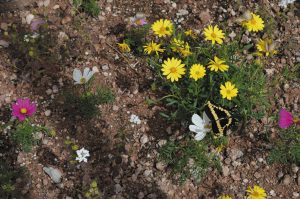
Spring blooms and a butterfly at the Desert Botanical Garden in Phoenix.
Desert Botanical Garden
Once Linda and I fulfilled our reunion activities, we spent a day enjoying nature within the city at the Desert Botanical Garden. Beautifully designed with more than 21,000 cacti and desert flora, it made for a calming stroll along prickly cacti. Desert plants of many colors were showing off spring blooms of red, lavender, and yellow. Many sizes were represented as well, with one cactus as tall as a two-story building. The garden boasts of nurturing 4,400 different species in its Living Collection and 485 plants that are rare and endangered species.
Water features are scattered throughout, inviting visitors to stop and rest their feet. I highly recommend the Desert Wildflower Loop Trail, and the enclosed Butterfly Pavilion is a must see. We followed a tour group guided by a volunteer while butterflies landed on our heads, noses, shoulders, and nectar-producing plants.
Programs for children, families, teachers, and gardeners are held routinely at the Desert Landscape School, with online or in-person activities. To learn more about their programs; events; the Patio Café; and Gertrude’s Restaurant, with its own herb garden, visit the Desert Botanical Garden’s website at www.dbg.org.
As my trip to Phoenix ended, I had to admit that my view of a desert was much different from what it was when I crossed the border into Arizona. Expecting a bare habitat with dry sand, tumbleweeds, and leafless prickly trees, I left with an admiration for an environment that supports unique flora and wildlife in its own way. What’s more, a reunion with old friends became a union with nature, Phoenix style.
A Few Fun Facts
At Tonto National Forest starting in early November, a special permit can be purchased to cut down your own Christmas tree.
The Salado Indians settled along the Salt River, near where the original city of Phoenix was built. Salado in Spanish means “salty.”
The Desert Botanical Garden is a popular venue for weddings and nature photographers. During the winter holiday season, 8,000 flickering luminaria candles light up the garden in the evening at the Las Noches de Las Luminarias throughout December.