
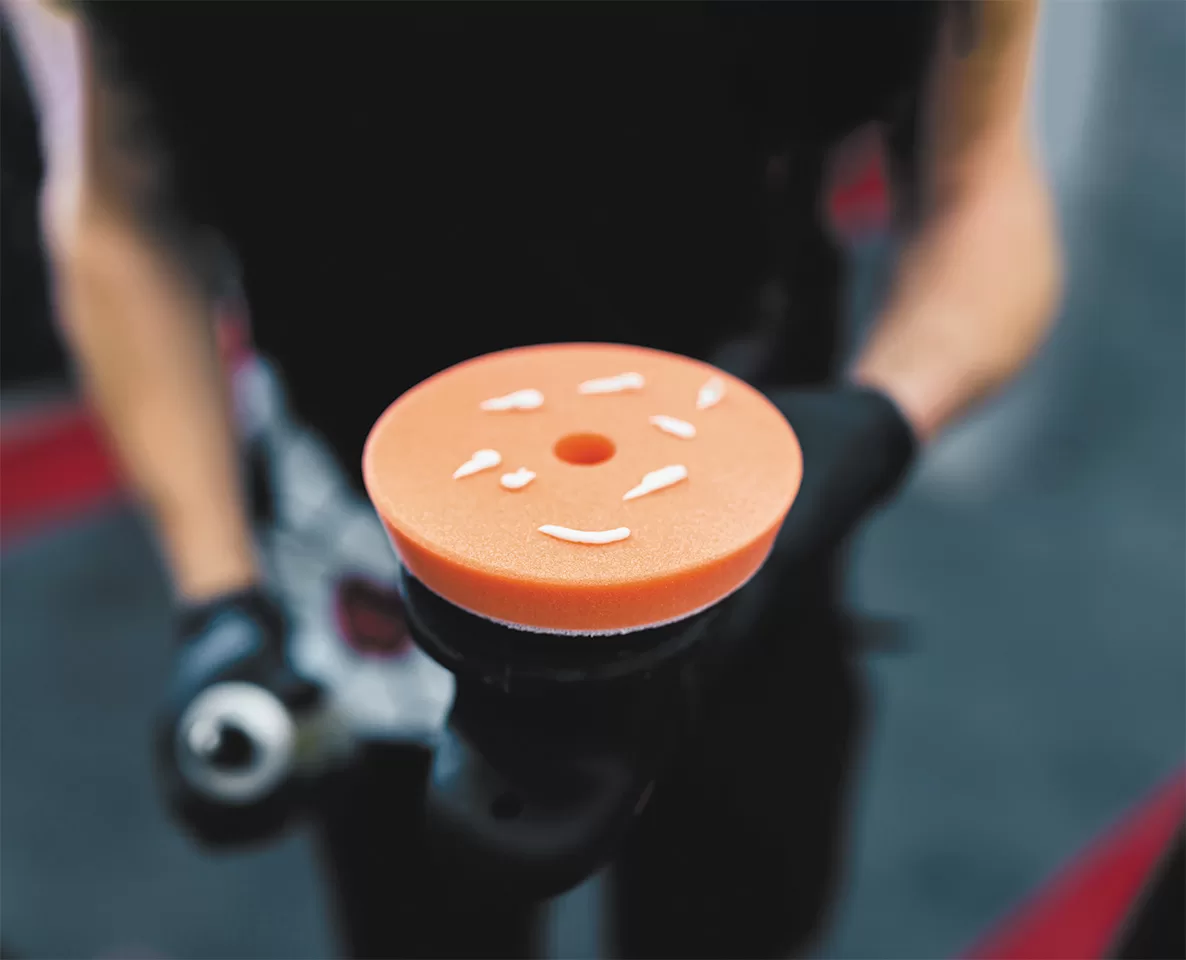
Whether you’re a DIYer or a pro, it’s essential to understand the product and the process.
By Chris Dougherty, F263059
November 2023
Fiberglass and fiberglass-reinforced plastic (FRP) composites are all around us in the modern world. The ancient Egyptians used blown-glass fibers, but how did that become the fiberglass we use today, and why do we use it in RVs? What is an FRP composite? Why do they age so severely? How can we care for and maintain these products?
FIBERGLASS, FILON, AND FRP
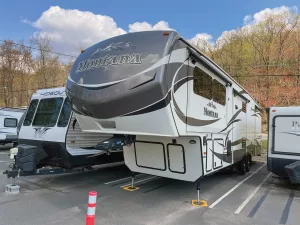
This 2015 Montana spent most of its life in storage.
Fiberglass is a commercially manufactured product dating back to the 1800s and is the result of hitting molten glass with pressurized air. The process was refined in the early 20th century when Corning Glass and Owens-Illinois joined forces to develop the product we now know as Owens Corning Fiberglas insulation.
By the mid-20th century, Owens Corning had developed flexible fiberglass cloth that became the first fiberglass-reinforced plastic panel product when mixed with a new resin.
Since then, FRP has had several iterations, from sprayed and molded panels used for RV caps to boats, car bodies, shower stalls, art, and coilable FRP panels such as the Filon brand. The product can form any shape, incorporate structural support for strength, and be coated with a gelcoat for color and smoothness to create a finished look. It’s waterproof (to a point) and lighter than metal or wood.
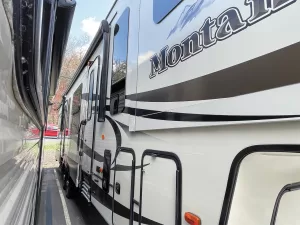
The door side is always in the shade, so it’s in almost perfect condition.
Filon, a product by Crane Composites, is a very thin, flexible, coiled FRP roll that can be adhered to a substrate to produce a laminate (think plywood) that gives the RV a nice, finished appearance with added strength. Various grades of Filon are available depending on the desired application and finish. To be clear, other firms are making FRP, but as Crane Composites is a major supplier to the RV industry, I refer to them specifically without favor to any one supplier.
An FRP roll affords the RV manufacturer exceptional flexibility in changing vehicle designs and floor plans without significant retooling. The laminate panels can be made in a specialized facility and transported to the assembly line for final construction.
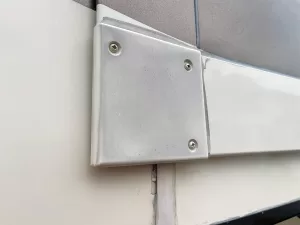
The plastic corner blocks felt like sandpaper and needed replacing.
Molded fiberglass RV bodies, like those from Oliver Technologies, Bigfoot, Cortez, and Coach House, require a detailed mold for each floor plan. This adds considerable expense and manufacturing time for the OEM and can limit them to a few basic vehicle designs, although the finished product is often superior in quality.
Here are four key takeaways about any fiberglass-reinforced plastic:
- Regardless of whether it is molded or rolled, RV fiberglass requires the same care and restoration techniques.
- All fiberglass and gelcoats, irrespective of application (RV, boat, etc.), will suffer from oxidation when stored outdoors.
- Proper and relentless care will reduce the weathering effect, but the surface will oxidize over time, eventually requiring removal.
- The only ways to completely protect an RV exterior from oxidation are to use full-body exterior paint and keep it under cover.
PROTECTING THE RV EXTERIOR
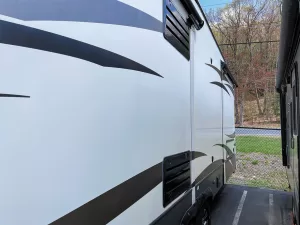
An outline could be seen in the oxidation on one side of the RV.
If you are among the RVers who store their RV outside, and you care about the appearance and longevity of your rig, there are steps you can take to protect the FRP on its exterior. It should also be mentioned that all plastics degrade when exposed to the weather, especially UV exposure. Over time, the vent covers, vinyl graphics, skylights, antennas, slideout corner blocks, and other RV parts will fade to yellow and become brittle. With most of these products, keeping them protected is the best answer. Products with UV blockers, such as Protect-All and 303 Automotive Protectant, may help. Pollutants, heat, and moisture also take their toll. Minimizing the FRP’s prolonged contact with soiling agents will help, but avoid using overly caustic cleaners that can dull the surface over time, and remove waxes and protectant that has been applied.
According to Crane Composites, waxing the surface is the best way to protect the FRP from weather, including sun exposure. The frequency of waxing depends on the amount or frequency of exposure.
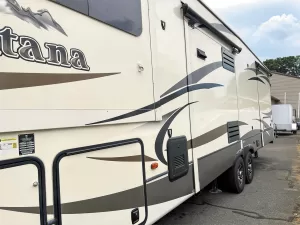
After five days of work, the Montana’s exterior looks as good as new.
Crane Composites recommends that FRP sidewalls be waxed at least once every six months after being washed with mild soap and water. More frequent waxing is required if the FRP is darker in color or constantly exposed to the elements. In that case, the suggested interval is reduced to every three months. Furthermore, the vehicle should be regularly rotated to change the sun-exposed side and keep the exterior weathering evenly. If you own a large RV, this kind of care is a major undertaking, and hiring professionals can involve hundreds of dollars. As they say, that’s the cost of doing business.
In most cases, once the RV surface has suffered oxidation, the gloss can be restored if it hasn’t progressed too far. The key is removing the top layer of the gelcoat that has weathered and restoring a smooth surface. In more severe cases, wet sanding with up to 2,000-grit sandpaper and then polishing and waxing may be needed, but many modern products will also do the trick.
We recently worked with Andrew Norman, owner of CCD Detail Services in Agawam, Massachusetts, to restore one side of a 40-foot 2015 Keystone Montana fifth-wheel that had suffered moderate oxidation while in storage for several years. The interesting thing about this case is that the RV is parked in a storage facility close to other RVs on each side, and the outline of the smaller trailer on the sunny side could be seen in the oxidation. This makes it clear that even moderate shade will prevent or reduce damage.
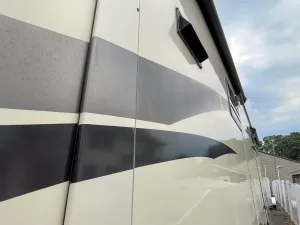
The vinyl graphics were permanently degraded and needed to be replaced.
“We knew that it was going to be a big job with a lot of buffing and a lot of compounding and polishing,” Norman said. “Sun caused this damage and just oxidized it like a chalkboard. We have to first compound the whole camper and get as much of the oxidation off, and then it has to be polished over. Can’t do it in direct sunlight. Can’t do it in humidity. Got to come in early in the morning. It can’t be damp out, because it’ll just gum up. So, just a lot of wheeling on it.”
The process took the better part of a week, as the detailing techs could only work on the RV in the mornings, and plenty of thunderstorms during that week added further delays. Ideally, it would be done in a shop or under cover, but those facilities are not readily available in this part of New England for a 40-foot long, 13-plus-foot-high fiver.
Norman reiterated that oxidation is inevitable, and continuous care is all that keeps it at bay. After a quick wash, they used a Meguiar’s marine/RV restoration kit along with Rupes cutting and polishing discs. Once this step was completed to their satisfaction, they sealed the surface with additional Gliptone carnauba paste wax, which should provide three to six months of protection.
CCD Detail Services works on many high-end vehicles, new and old, and often performs color correction and ceramic sealing. Ceramic sealant is relatively new to vehicle detailing and involves replacing wax with a “hard” coating for longer-lasting protection and shine. Norman has used ceramic sealing on one fifth-wheel and discussed the pros and cons of each method.
“If [the RV is] brand new, or even used and it looks good, the wax is what still works on these. If you’ve got the money to spend the thousands of dollars to have it compounded, polished, and then ceramic coated, is it worth it in the long run? You’re just not going to get that longevity [on an RV] as you would on a vehicle, but you’ll still get a couple of years out of it before [oxidation] starts coming back,” he said.
PRODUCTS
It becomes a judgment call on what product to start with. If you’re trying to correct moderate to severe oxidation, then the more aggressive products from Meguiar’s and 3M may be your best starting point. If it’s a lighter fade, many of the RV fiberglass restorer products on the market may take care of it with far less effort. It all comes down to abrasiveness and using just the right amount for the best effect.
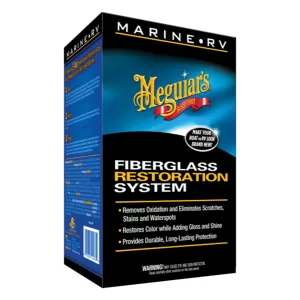
Meguiar’s makes a three-part kit designed to restore fiberglass on boats and RVs.
Many polishing and wax products are on the market and targeted specifically for general vehicles, boats, or RVs. Because FRP is so different, the products designed for boats and RVs are likely your best bet. But, as always, it’s best to research individual products to see whether they will work for you. In our case, the Montana came out looking almost new. Of course, severe fading had occurred to the graphics and slideout plastics. In addition, the paint on the aluminum trim faded differently from the FRP. The exterior still looks a bit off, but the chalk is gone.
One thing we have discovered on the road is that not all mobile detailers are created equal. I have yet to find one who knows about cutting the oxidation off an FRP panel, but I am sure they are out there. If you have one try to do the work, discuss it with them in advance and offer to supply the higher-end products for their use.
UV protection products, like from 303 Products (Gold Eagle), may help with plastics and graphics. Other newer products on the market promise some level of UV shielding.
Lastly, if an older RV has weathered terribly, another option would be to paint or gelcoat the exterior. Of course, this is a very expensive choice, sometimes costing upward of $20,000 (a vendor at the 2023 Hershey RV Show quoted $40,000-$50,000 for the aforementioned Montana, but admitted that they try to avoid those projects). The benefit is that compared to gelcoat, automotive paint and clear coats are quite tough and should better withstand the rigors of nature in the long term. Occasional corrections can be made to these surfaces, and they can be sealed with wax or ceramic coatings to create a more robust surface.
As mentioned, other plastics and vinyl on an RV also suffer from environmental exposure. Some solid plastics will provide a degree of UV resistance, but many do not. Hatches, vents, skylights, slideout trim, and other pieces can all suffer damage. When this happens, many of these parts craze, become brittle, and can even disintegrate. Little can be done other than to replace the affected parts. If caught early enough, the oxidized plastic may be able to be scrubbed off and painted to protect it, but this is often more difficult and expensive than just replacing the part. Again, UV protectants may help, but Mother Nature always wins in time.
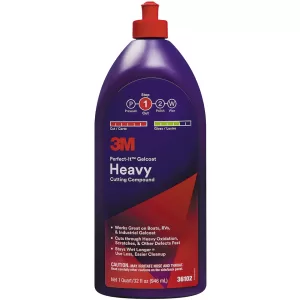
3M Heavy Cutting Compound is for heavy oxidation.
DO IT YOURSELF
If you decide to tackle a heavy restoration yourself, be sure to do more research online. Companies such as 3M, Meguiar’s, Car Guys, and others all offer some level of online and in-person training, which will be valuable. Some products can be applied by hand, but a high-quality polisher will make the work easier and more accurate. Remember that you are cutting the surface of the FRP, so accuracy counts.
Cutting and polishing pads come in several grades, usually denoted by color. Not all pads are created equal, and there isn’t really an industry standard linking pad color to abrasiveness level. It’s best to decide on one pad or abrasive manufacturer and stick with their system. In some cases, the systems include everything needed, from pads to products, all designed to work together.
An old friend of mine who was a full-time RVer would wax a different section of his Bounder motorhome each month, year-round. This rotating schedule made the chore less onerous and maintained a consistent wax on the coach.
The appearance of oxidation and chalkiness may not be a structural issue, at least to start. Still, it negatively affects the resale value of the RV and can reflect negatively on its owner. A clean machine is a happy machine and will last longer and have a better resale value if it’s kept up. An older RV that is shiny and well-maintained is a thing of pride! Enjoy the process!