
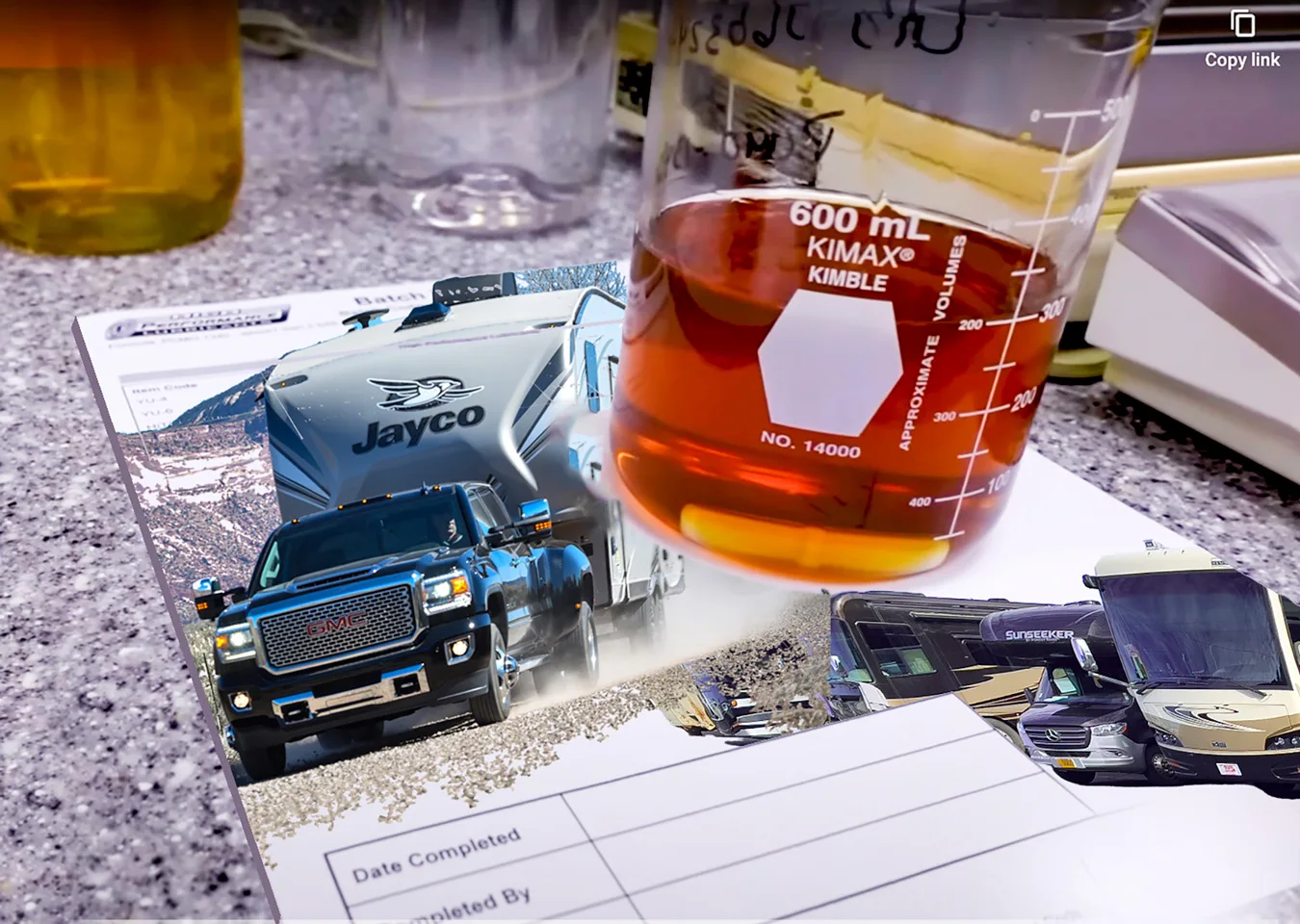
What RV owners need to know about these important maintenance tasks.
By Bruce W. Smith
May/June 2025
Changing the engine oil and filters is key when it comes to preventive maintenance for motorhomes and towing vehicles. Regardless of whether a vehicle is gas-powered or diesel-powered, if your goal is to maximize any engine’s performance, fuel economy, and service life, regular oil changes play a critical role in keeping that slippery lifeblood doing its job mile after mile.
This raises three basic questions for most RVers: Should I use conventional or synthetic oil? How often should engine oil be changed? What brand is the best? The simple answer to all three: It depends.

Changing the oil and filters in a motorhome or towing vehicle is a vital part of maintaining it.
ENGINE OIL: LOTS OF OPINIONS
When I first started driving, I followed my dad’s advice of changing the engine oil in my pickup every 3,000 to 3,500 miles. He used the same guideline when it came to oil changes in the family RV, a 1975 GMC motorhome. My dad’s oil of choice was Pennzoil, and it was used in all our vehicles, because he swore it was the best.
Meanwhile, our next-door neighbor would only use Quaker State. Several of my high school off-road buddies preferred Castrol in their 4x4s. One of my uncles said Havoline was the best brand, and another said nothing beat Amsoil.
Little has changed today when it comes to engine oil; every RVer has an opinion about which oil is best for their towing vehicle or motorhome, and how often engine oil needs to be changed. Some still follow the 3,500-mile routine, partly because countless oil-change businesses advise customers that’s what’s best (for their business, of course).
THE DIESEL EQUATION
Probably more than half the motorhomes and camper vans on the road today, as well as the pickups used as RV towing vehicles, have diesel engines. The owners of these vehicles need to be aware of the importance of oil change intervals and the benefits of oil analysis.
“The oil in a diesel engine does more than lubricate moving parts. It acts as a coolant, a cleaner, and even a sealant,” said Chris Crowel, Cummins Engine business leader — emergency and recreational vehicles. “Over time, this multitasking fluid changes chemistry, accumulates contaminants, and can start to lose its effectiveness. If neglected, this can spell major repairs for the engine in your tow vehicle or motorhome.”
THE TRUTH ABOUT OIL-CHANGE INTERVALS
Tremendous advances in both engines and lubrication technology over the past couple of decades have affected the types of oils recommended and the frequency of oil changes.

Motorhomes that tow another vehicle require more frequent oil changes.
Crowel said that in modern diesel engines, through validation involving newer engines and oil formulations, Cummins has been able to extend the oil change interval from the typical three months recommended in the 1990s to up to 18 months and 15,000 to 20,000 miles, as long as the engine mileage is not exceeded.
When I talked with engine experts and scientists at engine-oil analysis labs around the United States — all of which have extensive databases covering a wide range of gas and diesel vehicles, including RVs — the consensus is that science indicates the engine oil in motorhomes or towing vehicles may not need to be changed as often as one might think. It depends on how the oil is performing — and that can be determined only by oil analysis.
INSIDE ENGINE-OIL ANALYSIS
Used-oil analysis provides a detailed, scientific look at the engine’s wear, much like having a full blood workup done by your doctor. It shines a spotlight on what’s really going on under the hood.
The lab report shows the types and levels of contaminants in the oil, the possible causes of contamination, and whether the levels are within the tolerance limits for that particular vehicle. It also reveals indicators of engine component wear that may warrant further investigation.
In addition, the report provides a detailed summary of what the data means, simplifying the results so the vehicle owner can take necessary preventive measures — including changing to a different brand/type oil if that might work better over the long haul.
Multiple engine-oil analyses can then be used to determine how often the oil really needs to be changed in your motorhome, camper van, or towing vehicle. Oil change intervals depend on the engine, the vehicle it’s in, how it’s driven, the climate in which it’s used, and the terrain where it’s driven.
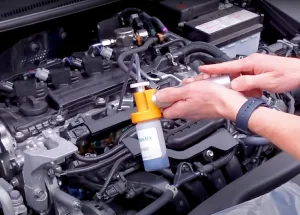
When a used-engine-oil sample is sent to a lab for testing, the lab provides a detailed report about its findings.
For example, gas-powered motorhomes subjected to high road miles every year, those towing a dinghy or trailer, vehicles driven over mountains, or ones that see frequent use in extreme climates (high heat or below-freezing temperatures) over the course of a year may need oil changes at intervals less than 3,500 miles. This can be discerned by a detailed lab analysis. The same applies to towing vehicles. RVs and towing vehicles that are relatively new, experience low mileage during the summer, are driven mostly over flatlands, and sit idle over the winter may only need two oil changes a year (spring and fall).
Again, only a series of used-oil analyses can scientifically determine the frequency for a particular vehicle and the type of oil being used. Otherwise, it’s just guesswork. Well, mostly.
ENGINE OIL-LIFE MONITORS
Nearly all modern-era motorhomes, camper vans, and towing vehicles come with some type of computerized engine oil-life monitoring (OLM) system, which takes some of the guesswork out. Mercedes-Benz, Ram Trucks, Jeep, Thor, Winnebago, Coachmen, Toyota, Mazda, Honda, and OEM RV engine builders integrate OLMs that use special diagnostic algorithms to alert the driver when it’s time to change the oil.
But should you trust what an OLM says? The general consensus of engine-oil lab experts is yes.
“We found GM and Ford engine OLM systems are conservative when we analyzed the used engine oil and compared it to the percentage displayed by the vehicle’s onboard computer. So, yes, they can be trusted,” said Lake Speed Jr., president of SPEEDiagnostix, a premier used-oil testing lab in Ohio. But there’s a caveat.
“As discussed in my recent video, “The Accuracy of Oil Life Indicators Revealed” (youtube.com/watch?v=t4e0oDBseqo), they do not check for oil contamination,” Speed said. “So, at minimum, an RVer should have an annual used-oil analysis done to make sure there are no hidden issues.”
WHAT TYPE OF ENGINE OIL IS BEST?
The question of whether petroleum-based (conventional) or synthetic oil is better for use in a towing vehicle or motorhome depends on the climate in which the vehicle is being operated.
“We like synthetics. We like conventional oil. In the end, what you use and how often you change your oil is completely your choice after the engine warranty time period,” said Ryan Stark, president of Blackstone Laboratories, one of the premier used-engine-oil analysis labs in the U.S. “As long as your vehicle’s engine is under warranty, you should change the oil however often the manufacturer says in the owners manual and use the specified oil. That way, if something goes wrong, they can’t blame you for lack of maintenance.”
For motorhomes and towing vehicles used in harsher conditions, such as spending a lot of time in parts of the country with single-digit winter temps or triple-digit summers, the synthetic oil is worth the higher cost.
“Full synthetic engine oils have superior high-temperature stability, oxidation resistance, and reduced engine wear — important for heavy-duty use such as pickups towing big RV trailers and coaches towing a trailer or second vehicle on a long summer road trip through the Midwest and desert Southwest,” said Ramón A. Caballero, lubricants technical support engineer with Mobil Oil.
“Synthetic oils also have better cold-flow properties, which aids in engine protection at startup in below-freezing temperatures,” Caballero said. “For vehicles towing heavy loads or subjected to long trips, the added protection justifies the cost, as it can help reduce wear and increase engine lifespan.”
Speed, aka “The Motor Oil Geek” on YouTube, wholly agrees: “We only run synthetics in our motorhomes and tow vehicles. Synthetic oil handles the heat better than conventional oil and lowers engine oil temperatures. Based on that, and the higher duty cycles of engines powering motorhomes and pickups towing travel trailers, synthetics are the way to go.”
SWITCHING ENGINE OIL BRAND/TYPE
The good news for those RV owners trying to save a few dollars on engine preventive maintenance is that, according to Stark, it’s okay to switch between oil types and brands.
“Petroleum-based and synthetic oils are designed to be compatible with one another. The oil change intervals wouldn’t necessarily be different, either. We base that on a few different factors like how well the engine is wearing in addition to how the oil is holding up physically, with viscosity and insolubles [solids].”
THE COST OF OIL ANALYSIS
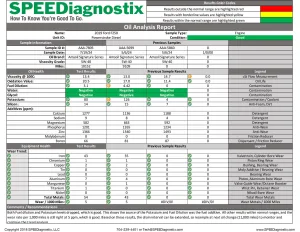
The oil-sample report includes recommendations based on the test numbers as compared to the lab’s extensive vehicle/engine files.
Is it worth the money to have samples of used engine oil analyzed? Remember, oil-related issues are the main reason for RV and towing-vehicle engine failure. So, you have to ask yourself whether it’s better to spend $50 to $100 per year on oil analysis, or face the potential of having the engine replaced or rebuilt a few years down the road because of oil-related factors. (Gas engine rebuilds can top $4,000, while a diesel rebuild can triple that amount.)
The cost of used-oil analysis varies from lab to lab and by the extent of the oil testing. But it typically ranges from $30 to $60. It’s best to shop around and compare apples to apples. Ask to see sample reports to determine whether you can read and understand the lab’s reports. Some are easier to decipher than others.
Also find out whether the used-oil test kit requires collecting the oil as it’s draining out of the oil pan or if the kit comes with a pump and tubing needed to suck the engine oil out of the oil pan without the need to drain the oil. The latter usually are sold separately from the oil-sample kit and are priced around $40. I use a Depepe 100-milliliter plastic syringe with four feet of clear plastic tubing (approximately $10 on Amazon) to siphon the oil from my vehicle for testing.
BEST ENGINE OIL BRAND
“Oil is oil. We still stand by that today.” That’s what Jim Stark, the founder of Blackstone Labs, is said to have told a customer who asked which oil brand is best back in 1985. Most oil experts agree the same applies today.
Several of the labs we contacted said as long as the oil you use is API-certified, and it’s the viscosity the OEM recommends, your RV or towing vehicle’s engine will be happy with a petroleum-based oil if it’s being driven in a temperate climate.
If you spend a lot of time driving your motorhome or towing vehicle in regions of the country that see extremes in temperatures, consider synthetic oil. It provides the best start-up protection in subfreezing temperatures and helps to keep the engine’s operating temperature cooler in the scorching summer heat.
Big-name brands, of course, are great. But so are house brands, because they are made by boutique oil manufacturers that blend engine oils to meet the requirements of retailers who put their name on the product.
For example, at the time I penned this article, Walmart Super Tech was made by the Warren Oil Company, while O’Reilly Auto Parts’ and Advance Auto Parts’ house-brand engine oils were produced by another arm of Warren called the United Lube Oil Company in Saudi Arabia.
ENGINE OIL RECOMMENDATIONS

For gas-powered coaches, camper vans, and towing vehicles, consider a full synthetic engine oil carrying the recent GM Dexos1 Gen3 seal of approval.
The most important thing to pay attention to when shopping for engine oil isn’t the brand, but rather the oil ratings listed on the container. Synthetics with only an API/ILSAC certification are not as good at protecting an engine and maximizing fuel economy as those that meet the more recent stringent requirements for GM Dexos1 Gen3 approval.
Owners of gas-powered and high-mileage RVs and towing vehicles that see a lot of highway miles every year, and are used in a wide range of temperatures, are well advised to consider using a synthetic oil with the newest Dexos1 Gen3 certification. If annual mileage is lower, and you are a penny-pincher, consider using a less expensive petroleum-based oil that meets the OEM’s API/ILSAC GF-6A rating in the viscosity recommended in the owners manual.
Diesel owners should look for engine oils that comply with the engine owners manual and that meet the GM DexosD or CK-4 requirements. Good brand choices include Chevron Delo, Castrol Vecton, Mobil Delvac 1, Shell Rotella T6, Swepco 310, Cam2 Blue Blood, Valvoline Premium Blue, and Amsoil Signature Series.
“Owners should always use the grade and type of oil specified in the owners manual and follow specified oil change intervals, paying attention to the severe-duty schedule if they regularly use their vehicle for towing,” said Dale Jewett, technology communications for Stellantis (Ram Trucks, Jeep, and other brands).
The bottom line on engine oil for any RV or towing vehicle is to set up an oil-change routine based on either the OEM oil-life monitor or the results of an annual or biannual used-oil analysis. Better still, do both. This will give the engine in your motorhome or towing vehicle the best shot at a long, trouble-free life.
How To Determine Oil-Change Frequency
For a step-by-step discussion detailing how to determine oil-change frequency, visit familyrvingmag.com/2025/02/26/using-engine-oil-analysis-to-determine-oil-change-frequency/.