
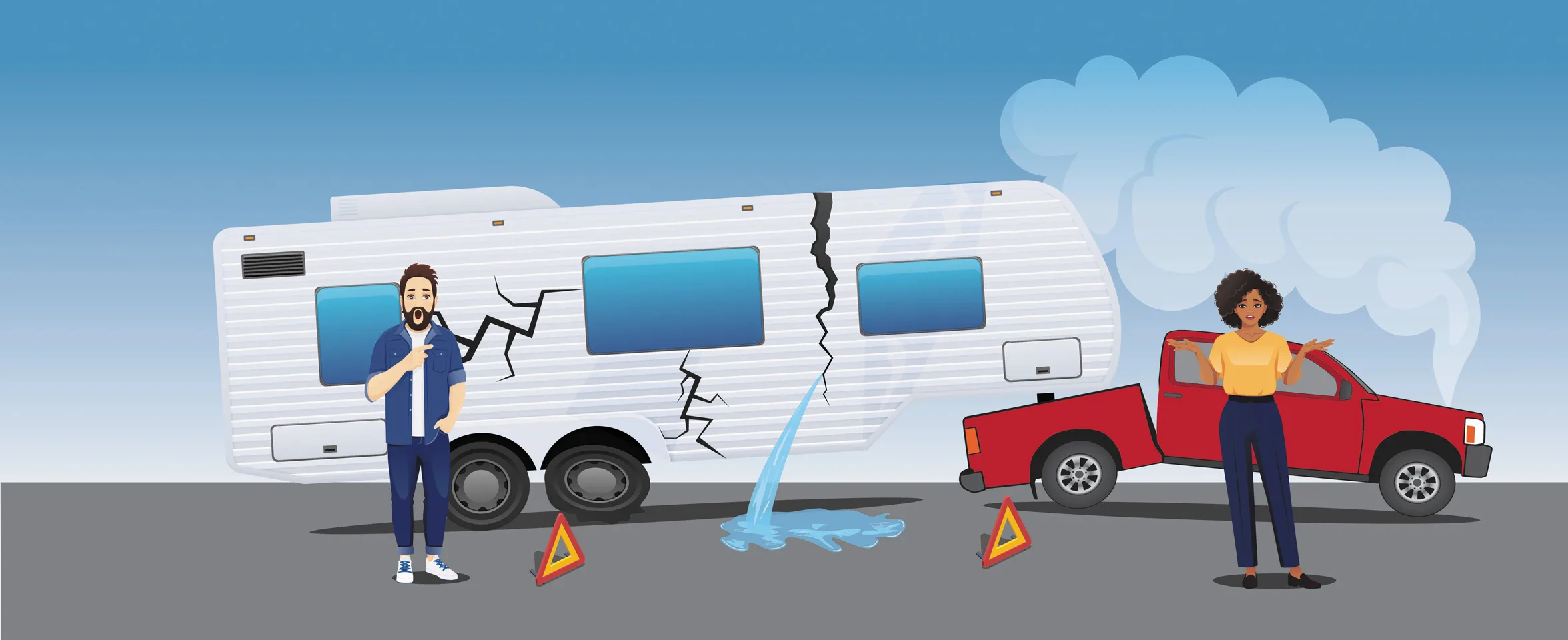
Examples of RV fiascoes caused by owner negligence, not product failure, along with some timely advice.
By Chris Dougherty, F263059
July/August 2025
Nothing can deflate one’s ego more than when the service writer gives you the bad news: The problem you have with your RV is significant, and the warranty does not cover it, because you caused it.
All kinds of things flood the mind when this occurs, and none of them are good. What is this going to cost? How did this happen? How can I pay for this? Will the fix be done before vacation?
While “stuff happens” that none of us can avoid, some issues can be prevented with thought and attention.
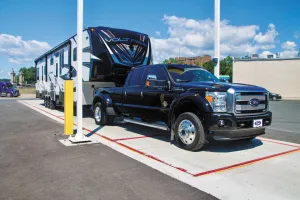
Knowing and staying within the weight ratings of your RV and towing vehicle (if applicable) is key to avoiding damage. A scale provides actual weights.
TIRES, SUSPENSION, BODY, AND FRAME
Over the past few years, the internet has been saturated with tales of owners suffering the consequences of RV structural problems and blown tires.
Major malfunctions and breakdowns can completely deflate the happy mood of RVers planning an escape from having the weight of the world on their shoulders. But keep in mind that the weight of your home on wheels rests on the chassis and tires.
Truckers, pilots, ship captains, and others are trained to consider the physical effects loading has on their vehicles. Improper loading and cargo management have led to many incidents, including plane crashes, ship and ferry sinkings, and truck rollovers.
Many vehicles suffer structural damage from improper loading. Search Google for “truck camper broken frame,” and you’ll see what I mean. Images clearly depict overloaded trucks with broken frames caused by carrying super-heavy triple-slideout campers.
Most of us are used to thinking about the RV as our (temporary or long-term) home, but we must remember that it’s not like a stationary home, so we can’t load it any way we want.
At the most basic, RV owners need to be aware of weight ratings, including gross vehicle weight, gross axle weight, gross combination weight, and cargo carrying capacities. Exceeding these ratings means that the expected engineering loads for the materials and structure of the RV are being exceeded — and that, my friends, is the exit for the “Highway to Hell.”
As they say, the road to hell is paved with good intentions. That would include telling the service writer, “I meant to weigh the RV.” Knowing your weights do not exceed the gross ratings is essential.
But that’s not all. Where items are stowed and where the weight is concentrated can also make a big difference.
I have seen large fifth wheels with big commercial-grade toolboxes in the front lower compartments, along with a lot of other gear. When I asked one owner about his storage arrangement, he insisted that the vehicle wasn’t overweight. But, I thought, what about the concentration of weight in that area? Could that lead to a structural failure? He’s hauling the trailer with a medium-duty truck that is well within its ratings, but what about the structure of the trailer?
Weight, balance, and loading all factor into how any manufactured structure will perform, whether an airplane, skyscraper, house, RV, or the RMS Titanic.
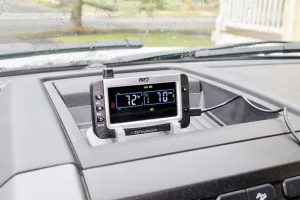
A tire pressure monitoring system helps the driver to keep watch on tire psi and temperature in real time.
Tire loading, inflation, and speed are common issues in RV land, especially with trailers, but motorhomes are not immune to these issues.
Tires contain the air that keeps you on the road. If you abuse them, they’ll abuse you. At the very least, tire failures cause damage, but they also can cause serious, even fatal, crashes. Sometimes, tire blowouts result from road debris or other unavoidable circumstances; however, many tire issues can be prevented.
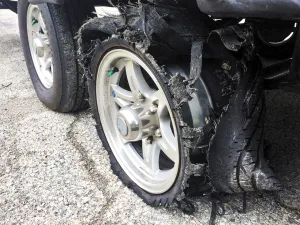
A TPMS can give an early warning and often help to prevent bigger tire issues such as this.
Following are some tips:
- RV tires age out before they wear out in most cases. The expected life of any tire is approximately 5 to 7 years from the date of manufacture, as indicated by the DOT code on the side of the tire. Many travel trailer tires have a much shorter life in real-world use.
- Proper inflation is key to avoiding tire problems. Ideally, the tire pressure should be adjusted to the actual weight of the loaded RV as measured with individual wheel position scales. However, when in doubt, inflate to the pressure indicated on the tire’s sidewall to minimize tire flex, overheating, and possible failure. While that may result in a slight increase in center tread wear, it is, in fact, safer than running on underinflated, overloaded tires.
- Keep an eye on your tires! Truckers inspect the tires on their vehicles at least daily, and so should you. Check the tire pressure every day before driving. Look at the tires during every stop. It’s always worth a quick walk around the RV to check things. Examine the tires for any damage, tread separation, belts showing, cracking, or abnormal wear patterns.
- A tire pressure monitoring system, or TPMS, is essential for RVers. It lets you keep watch on tire pressures in real time, and an alarm will sound if a tire’s pressure or temperature goes out of range. This can give you an early warning. TPMS have been required on cars and light trucks for years, but no such requirement exists for motorhomes and travel trailers.
- Cover and care for your tires! Keeping them clean and covered when in storage protects them from damage caused by UV rays.
Water damage is a frequent killer of RVs and another place where RV owners tend to fall down on the job. Roof and sealant maintenance is essential to prevent water damage; per some manufacturers, it must be done every 90 days! At the very least, the roof and sealants should be inspected annually. If you suspect your roof may have been damaged, have it physically checked immediately and repaired or sealed as needed.
So, unless you have had a solid one-piece roof membrane such as those from RV Armor, Crazy Seal, or FlexArmor installed, maintenance must be done. Even with these types of roofs, if you hit something, the roof must be checked for damage, and any issues found must be repaired and sealed.

Reducing UV exposure and keeping the RV washed and waxed can help prevent fading fiberglass.
Paint and fiberglass fading issues are common with RVs that do not have full-body paint, and by the time an RV gets to be around 8 to 10 years old, it’ll show its age, especially if it’s always been outside in the elements. Vinyl striping fades and cracks when it starts to weather and oxidize. Aluminum-sided RVs will do the same as the paint ages and becomes porous and oxidized.
It’s tough to prevent these conditions without covering the unit all the time. Keeping the RV washed and waxed is a big plus. Reducing hot sun and UV exposure is key to help mitigate this aging. While unlikely to happen during the warranty period, some units experience particularly bad gelcoat fading, especially on brown caps. Painting is the best fix in these circumstances.
Leveling versus stabilizing jacks: Yes, there is a difference, and if your dealer didn’t tell you about this during the walk-through, check the owners manual.
Stabilizing jacks exist for one reason: to remove the bounce from the suspension and make the RV more comfortable to live inside. When only stabilizing jacks are present, all unit leveling is done by driving the RV onto boards or blocks, period. Now, the landing or tongue jack on the trailer can help level it from front to back, but that’s it, and the wheels must be chocked, especially if the RV is on a slope of any kind.
Leveling jacks — which are usually hydraulic but may be electric — can lift the RV into a level position, and most have an “auto level” button on the control.
The collapse and subsequent damage from using stabilizer jacks to level an RV is never covered under warranty.
SYSTEMS AND PLUMBING
Here again, lack of maintenance can cause failures in some systems, not unlike what you might experience in your fixed home. Whether professionally performed or tackled as a DIY task, planning on annual systems service is in your best interest if you want to keep your land yacht on the road.
All refrigerators need to breathe. Over time, dirt, dust, and other debris can get caught up in the appliance’s cooling system, making it work harder, overheat, or even fail.
Ideally, residential and 12-volt-DC compressor models should be pulled out and vacuumed annually, especially if used heavily and pets are present. It is also highly recommended that the inside of the fridge be kept clean; Clorox wipes or something similar do a nice job and kill germs also.
The area behind absorption-type refrigerators needs to be vacuumed as well. Check that the upper vent is clear of nests or other obstructions. The burner area should be cleaned and checked by a trained professional to ensure there’s no damage and that everything is clean and clear.
Air conditioners don’t need much love, but they do need to be kept clean. The air distribution box on the ceiling has some kind of filter that must be cleaned whenever dust accumulates on the grille(s), or monthly during use. Coleman air conditioners have an optional HEPA filter model that will need occasional replacement, just like the central A/C at home.
The furnace area also needs to be kept clean, clear, and vacuumed. Never store anything in this area; never block the air inlet with any filter. Restricted airflow will cause the unit to overheat and cycle on and off. Have your certified technician service the furnace annually.
The fresh-water plumbing system can suffer user damage in a couple of ways. The first is overpressurization. While the PEX pipe can withstand much more pressure than we’ll ever put on it, the plastic fittings and faucets are another matter.
When the fresh plumbing system is checked during a predelivery inspection, it should be tested with 80 to 120 psi of air for 10 minutes. This is usually done with water in the system and should include the water heater. However, at some point, the RV might end up connected to a municipal water system that subjects it to static water pressure as high as 150 psi! The recommended water pressure for an RV is between 40 and 55 psi, although some can handle up to 60 psi. For that reason, we recommend that RV owners use a water pressure reducer. Options include plain, nonadjustable inline models; adjustable models; and built-in models that replace the city water inlet. Check the owners manual for the recommended pressure.
Another owner-caused failure is not adequately winterizing the RV, which can lead to a freeze-up. While this may seem obvious, it happens; some folks don’t winterize correctly, and damage occurs.
Not using a water filter can create problems, too. Any water system can have occasional solid material flow through it. At times, large amounts of sand or silt are injected into a system when there is a pump or water main problem. I worked on a motorhome whose water system filled with silt at a campground, and it required hours of work to repair. Further, filling the fresh-water tank without a filter can lead to “biology” entering the tank and growing, resulting in a Pleistocene goo that smells worse than it looks.
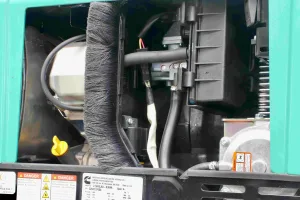
The best way to keep an RV generator operating properly is to exercise it by running it under a load (at least 50 percent) two hours per month.
CHASSIS, POWERTRAIN, AND GENERATOR
Any machine needs care and maintenance, and failure to take the required measures can cause breakdowns.
Moving an RV around requires considerable work from a towing vehicle or a diesel pusher. As such, the chassis or engine manufacturer may recommend following an advanced or severe-service schedule. These must be followed carefully for reliable and long-term operation.
Generators can be finicky, especially if they’re not used regularly. Old gasoline can cause carburetor issues, diesel fuel can gel in cold weather and grow algae in the filters, and moisture can lead to corrosion inside the unit. The best strategy for generators is to run them! Cummins Onan recommends exercising the generator at least 2 hours per month by operating it under a 50 percent load, but more is better. According to Cummins Onan officials, the same gen sets we have in our RVs are used in mobile commercial applications and can run tens of thousands of hours during their lifetime, often with no breakdowns. The most significant cause of issues with the RV models comes from sitting. So, if you have a gen set, go out and enjoy it!
IN THE END . . .
Remember, RVs are dwelling places and vehicles in one, and the lifestyle or hobby does come with some responsibilities as it relates to taking care of your equipment. Whether you do your own maintenance or have your favorite certified service provider perform the work, make sure it all gets done when it should.
Finally, if your service provider says the warranty does not cover something, please politely and respectfully ask for clarification. But remember, sometimes going out and using recreational machines leads to broken stuff. It comes with the territory.
It’s possible that an extended-service policy, if you have one, will cover something denied by warranty, so look for alternatives with your service provider. You may find a workable solution that satisfies everyone!