
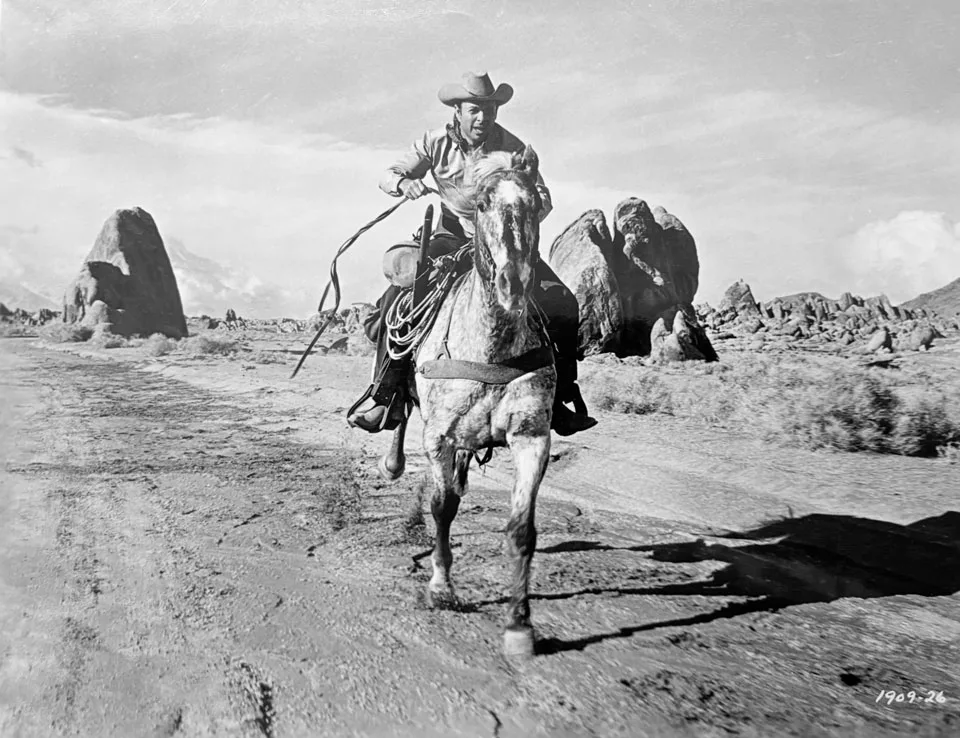
The remote town of Lone Pine, California, may not be a famous tourist stop, but its rugged landscape has starred in scores of hit movies and TV shows.
By Larry Keller
January-February 2026
Lone Pine, California, is an unpretentious and remote town of 1,300 with a single traffic light on its mile-long Main Street, also known as U.S. 395.
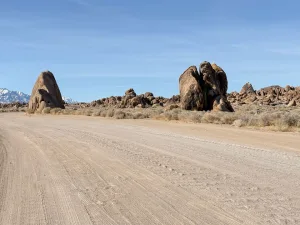
The Alabama Hills rocks of movie fame as they appear today.
Yet, bygone Western movie stars such as John Wayne, Roy Rogers, and Gene Autry bunked here. Others, such as Douglas Fairbanks Jr., ambled into town, while Oscar-winning actress Barbara Stanwyck literally dropped in — her remains were scattered over the area from a helicopter.
Little Lone Pine owes its Hollywood pedigree to one thing: geography. Just west of town are the cinematic Alabama Hills. Beyond them loom the Sierra Nevada mountains, capped by 14,505-foot Mount Whitney.
If you’re old enough to remember oaters such as How the West Was Won, Bad Day at Black Rock, and Maverick, or 1950s TV series like “The Lone Ranger” and “Hopalong Cassidy,” with their parched chaparral vistas punctuated by craggy promontories where bad guys hid in wait, you might recognize the Alabama Hills.
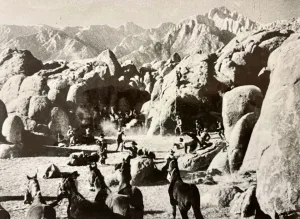
“The Lone Ranger” TV series began with an ambush in Lone Ranger Canyon.
This dramatic landscape of bulbous boulders is so rugged, so primordial, that it appeared prominently in memorable scenes from other movies, too. Humphrey Bogart, cast as Roy “Mad Dog Earle,” sped up Lone Pine’s main east-west road to the mountains with cops in hot pursuit in High Sierra.
Scenes from two Star Wars movies were shot here, while the hills doubled as the Northwest Frontier of India in Gunga Din, starring Cary Grant. More recently, the terrain was a stand-in for Afghanistan in 2008’s Iron Man and again in “The Old Man,” an FX cable series starring Jeff Bridges.
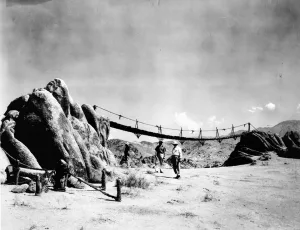
The bridge in Gunga Din stretched across two rock formations and was just 6 to 10 feet above the ground.
Still, Lone Pine is to buckaroo films what bolo ties are to Western attire. Its celluloid past, which dates back more than a century, is celebrated at the Museum of Western Film History and the 103-year-old Dow Villa Hotel.
The 10,500-square-foot Museum of Western Film History (museumofwesternfilmhistory.org) is a gem. Its collection includes dozens of movie posters, stills, memorabilia, and props. Exhibits are devoted to John Wayne, Tom Mix, Roy Rogers and Dale Evans, Gene Autry, and William “Hopalong Cassidy” Boyd, among others.
Some of Django Unchained was filmed nearby, and one of three dentist wagons constructed for the movie, with a giant tooth on top, is displayed at the museum. So is Quentin Tarantino’s director’s chair.
Elsewhere in the museum is the stagecoach used in the 1951 movie Rawhide, starring Tyone Power and Susan Hayward, as well as a vintage 1928 camera car.
There’s also a selection of cowboy hats autographed by William Holden, Tex Ritter, Alan Ladd, and other stars. Clayton Moore’s original Lone Ranger outfit is displayed as well, now worn by a mannequin.
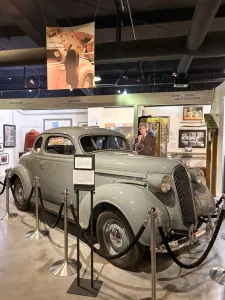
See the 1937 Plymouth that Humphrey Bogart drove during a chase scene in High Sierra at the Museum of Western Film History.
Some of the 1950s TV Western stars had extensive commercial tie-ins with kids’ merchandise. William Boyd may have been the king of these cowboys. His exhibit includes Hopalong watches, lunch boxes, clothing, and toys — even Hopalong Cassidy milk bottles. Hoppy’s drink of choice, however, was sarsaparilla, a soft drink that tastes similar to root beer.
“He was the first Hollywood figure in those days that really had a solid line on merchandising,” said Steve Latshaw, the museum’s historian and archivist. “We get a lot of traffic and emotion in our Hopalong Cassidy room, because there’s a lot of people . . . who grew up with Hopalong Cassidy on 1950s TV. It’s filled with so much memorabilia and toys from their childhoods,” Latshaw added.
Thirty-one Hopalong Cassidy flicks were filmed around Lone Pine, compared to runner-up Gene Autry’s 18, and 13 starring John Wayne.
With so much of this Western cinema dating back decades, “We have a larger percentage of older people — early 50s on up — who are specifically coming to the museum to touch base with something that they grew up with,” Latshaw noted.
“We also get a tremendous number of foreign visitors, and they frequently skew much younger. Overseas — China, Japan, Europe, the U.K. — they love this culture, and always have.”
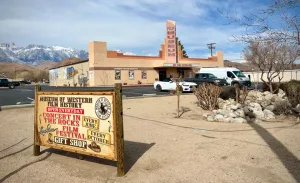
The Museum of Western Film History sponsors two major events each year.
Two of the most popular museum displays highlight films other than Westerns. One is the restored 1937 Plymouth that Bogie drove as he fled from cops in High Sierra. Another recalls the 1990 horror-comedy classic Tremors, featuring a miniature version of the town of Perfection, Nevada, and one of the creepy Graboids — an enormous deadly worm-like subterranean creature that terrorized residents.
Still, it’s the stunning hills and mountains around Lone Pine that moviemakers often visualized as the ideal backdrop for Westerns. Pick up a map at the museum or the Lone Pine Chamber of Commerce (lonepinechamber.org) for a self-guided driving tour and make the short drive to Movie Road. Along 1.5 mostly unpaved miles, the map lists sites such as Lone Ranger Canyon and Gary Cooper Rock where movie and TV series scenes were shot. You cannot determine precisely where, but you can pull over to explore and visualize the movie magic that occurred here.
Despite Lone Pine’s modest size and remote location, it has staged the Lone Pine Film Festival every October since 1990. Attendees have included actors Gregory Peck, Karl Malden, Anne Francis, and Jack Palance. Dale Evans was the parade’s grand marshal one year.
Lone Pine was discovered by moviemakers in 1920 when a silent Western titled The Round-Up starring Fatty Arbuckle was filmed here. Others followed. That spurred the construction of the Dow Villa Hotel in 1923.
The humble two-story inn (dowvillamotel.com) wears its history like a favorite old Stetson. It is short on luxury but long on Old West ambiance. The small rooms are warmed by old-fashioned steam radiators in the winter and rely on evaporative cooling units, sometimes known as swamp coolers, in the summer.
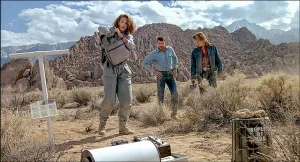
Little has changed at this Tremors shoot location.
In the cozy lobby, memorabilia lines the walls, including an autographed drawing of John Wayne. Signs posted outside a few rooms and suites declare the names of stars who were once guests, including John Wayne, Roy Rogers, William Boyd, and Gene Autry.
The hotel eventually expanded and an adjacent motel, also called Dow Villa, was added in the 1950s with larger, more modern rooms. The Duke’s last stay in Lone Pine was in an end unit set back from the highway.
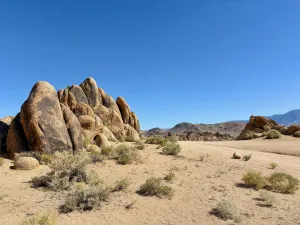
The Tremors shoot location.
Lone Pine’s homage to Old West movies and TV shows extends elsewhere, too. Dozens of framed photos fill the walls of the Mt. Whitney Restaurant. Many are autographed, including Clayton Moore’s and John Wayne’s. Some photos are unexpected, displaying Micky Dolenz of Monkees fame and Chubby Checker. Edd Byrnes, best known as the hair-combing teen idol Kookie from the 77 Sunset Strip series, even appeared in TV Westerns.
Sure, the heyday of Western movies and TV series has passed, but devotees needn’t despair. Take it from Tom Mix, the iconic Western movie star, who was in 291 mostly silent movies from 1909 to 1935.
“The Old West is not a certain place in a certain time; it’s a state of mind,” Mix said. “It’s whatever you want it to be.”
ALSO WORTH A VISIT
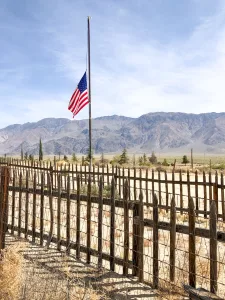
A mass burial site on the north end of town is the final resting spot for those killed in the 1872 earthquake.
The Lone Pine area offers more than movie lore to explore. A powerful earthquake shook the town in 1872, leveling the mud and adobe buildings and killing 26 people. The only known wall still standing is from a general store, found in an alley behind Lone Star Bistro at 107 N. Main St. It’s not much — less than 7 feet high and 12 feet long, located behind a chain-link fence.
An estimated 14 or more earthquake victims are buried in a mass grave at the north end of town, at 1435 N. Main St. Look for the historic marker on the west shoulder of the road and a U.S. flag flying at the simple cemetery perched atop a small hill.
Eleven miles north of Lone Pine along U.S. 395 is Manzanar National Historic Site (nps.gov/manz). It’s one of 10 internment camps where Japanese Americans were incarcerated during World War II — some 10,000 during its peak. An excellent visitor center recounts this history with photos, documents, and films. Visitors can take a self-guided driving tour of the site.
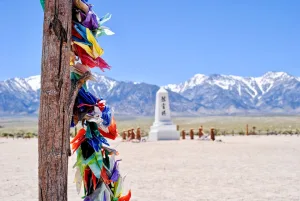
A monument at the Manzanar National Historic Site commemorates the Japanese who died at the relocation center during World War II.
WHEN TO GO
The best time to visit Lone Pine is in spring and fall. Twenty-degree temperatures are common from December through March. Highs in the upper 90s and over 100 degrees can be expected from June to August, and it is much hotter still in Death Valley National Park to the east.
It’s a 13-mile drive to the Mount Whitney trailhead from Lone Pine on Whitney Portal Road. While the town gets only a few inches of snow in winter, the road gains altitude and snowfall quickly. It’s usually open from May to early November. In winter, the last six miles of the road are not plowed.
Horseshoe Meadows Road, which intersects Whitney Portal Road, is steep and closed in the winter.
CAMPGROUND OPTIONS
Inyo National Forest — Lone Pine Campground
(877) 444-6777
fs.usda.gov/r05/inyo/recreation/lone-pine-campground
No hookups. Potable water available.
Seasonal: Check for exact dates.
Boulder Creek RV Resort
(760) 876-4243
bouldercreekrvresort.com
Full hookups; Wi-Fi, cable TV, propane, market. Open year-round.
Bureau of Land Management — Tuttle Creek Campground
(760) 872-5000
blm.gov/visit/tuttle-creek-campground
No hookups. Potable water and dump station available. Open year-round.
Inyo County — Diaz Lake Campground
(760) 873-5577
inyocounty.us/services/parks-recreation/diaz-lake-campground-0
No hookups. Potable water available. No dump station. Open year-round.