
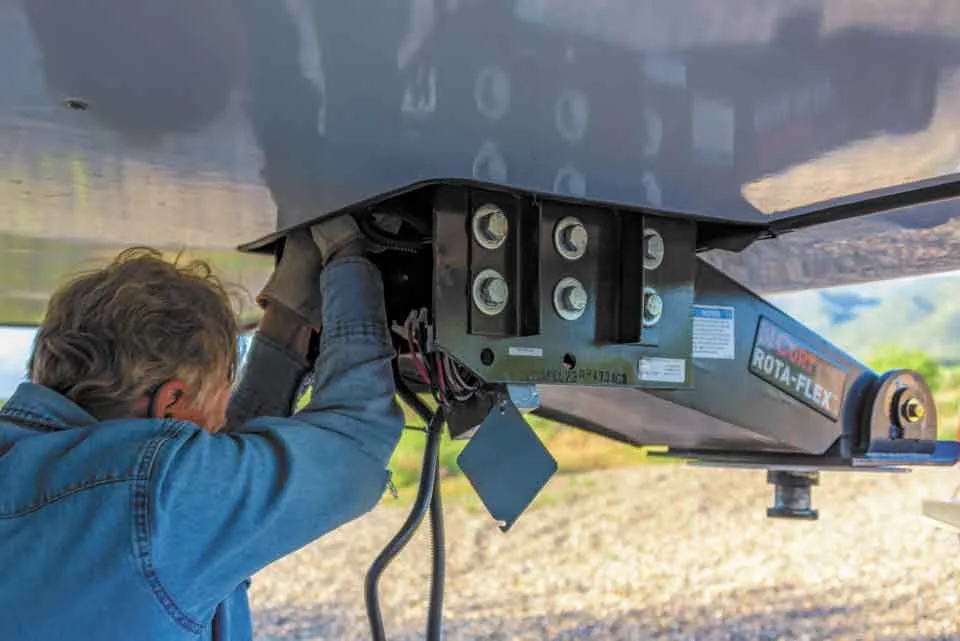
By replacing their RV’s traditional fifth-wheel hitch with a Reese Goose Box hitch, the author and her husband gained use of their pickup truck’s bed again without sacrificing a smooth towing experience.
By Emily Fagan, F547779
March-April 2026
One of the biggest frustrations for those who tow a fifth-wheel trailer is the loss of storage area in the pickup truck bed because of the fifth-wheel hitch plate. Sure, the hitch apparatus can be removed when not in use, but doing so can be difficult and time-consuming. But what if you were able to tow your trailer without using the traditional fifth-wheel hitch? We discovered that you can.
We installed a Reese Goose Box pin box hitch and paired it with a B&W Ram OEM gooseneck ball (2 5/16-inch). This upgrade was a total game changer for us. Suddenly, we had full use of our truck bed whenever we weren’t towing our trailer, and the air-ride system inside the Goose Box made for buttery smooth towing without any chucking. A wonderful surprise was the ease of hitching and unhitching the trailer. Frankly, we’d never go back to using a conventional fifth-wheel hitch even though we’ve owned several high-quality brands during the past 18 years.
FIFTH-WHEEL OR GOOSENECK HITCH?
Both fifth-wheel and gooseneck hitches work well for heavy-duty hauling. The fifth-wheel method is the standard for recreational vehicles, employing a kingpin attached to the nose of the trailer that locks into a large receiver mounted in the bed of the pickup truck. A gooseneck hitch is primarily used for commercial, agricultural, and livestock trailers. With this method, a gooseneck ball is installed in the bed of the truck, and the trailer receiver drops onto and locks to the ball.
Both methods utilize the pickup truck’s frame and axle to provide reliable support when towing. The fifth-wheel hitch has been the preferred method for RV towing because it offers a smoother, more controlled ride. The traditional gooseneck receiver drops straight down onto the ball without any stabilizers or shocks to cushion the connection between the trailer and truck. For this reason, most fifth-wheel RVs are equipped with the fifth-wheel hitch. The biggest drawback with a fifth-wheel hitch is that the installed rails and hitch plate occupy a good portion of the truck bed, leaving little usable space when the truck isn’t used to tow.
WHAT IS THE REESE GOOSE BOX?
This fifth-wheel trailer hitch replaces the trailer’s factory-installed kingpin and is designed to hitch onto a gooseneck ball instead of a fifth-wheel receiver. Once installed on the trailer, there is no need for a fifth-wheel plate in the truck bed. And unlike the rigid conventional gooseneck hitch, the Goose Box includes air-ride technology with an easy-to-fill airbag, dual shocks, and rubber springs all located inside the hitch to help make towing smoother and more comfortable.
RVers who have horse trailers with gooseneck hitches can switch between towing their fifth-wheel RV and their horse trailer with the same truck. If you have an emergency on the road and your fifth wheel needs to be towed, any truck with a gooseneck receiver can tow it. And if that truck doesn’t have a gooseneck ball, they can borrow yours. Plus, the hitch can be locked to the ball to prevent the trailer from being stolen.
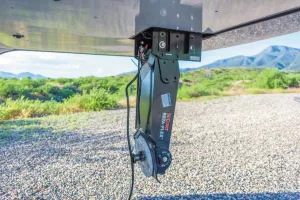
When most bolts were removed, the hitch fell to a vertical position.
REMOVING THE ORIGINAL KINGPIN
If you don’t have the physical ability or tools to perform this installation, any RV shop or mechanic should be able to switch out the hitches for you. It is a straightforward do-it-yourself project that my husband and I performed with the assistance of a friend who helped lift the Goose Box, which weighs 212 pounds, into the truck bed.
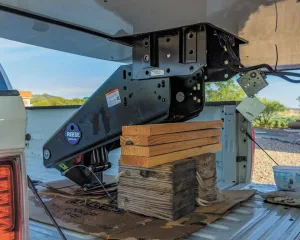
The Reese Goose Box was placed on boards in the truck bed and moved into position.
Removing the original kingpin from the trailer was the hardest part of the installation. First, we used CRC Knock’er Loose penetrating solvent spray to help loosen the bolts. Then we removed all the bolts except for two, one on each side of the mounting wings. When we loosened the final two bolts, the kingpin flipped down so it was hanging vertically, pin toward the ground. Next, we put a stack of boards on a floor jack under the pin to support the kingpin while we removed the final two bolts. When the last bolt came out, the kingpin fell to the ground.
Another removal technique would be to place a thick rubber mat in the truck bed, positioning the truck bed under the kingpin, stacking wood blocks in the bed under each end of the kingpin to support it, and then removing the bolts. Once the kingpin detaches from the trailer, an extra pair of hands would be needed to lift the kingpin out of the truck bed.
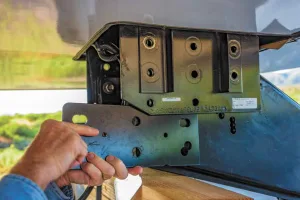
A spacer kit was added so the Goose Box fit snugly to the pin box wings
INSTALLING THE GOOSE BOX
We began the installation by placing the Goose Box in the truck bed on a large sheet of cardboard. Several boards were stacked under the back end of the Goose Box so it was standing in the bed exactly as it would be when hitched up. We then backed the truck under the fifth wheel overhang and slid the hitch around to align it correctly with the trailer mount. Next, we retracted the trailer’s landing jacks to lower the fifth wheel onto the Goose Box until the bolt holes lined up.
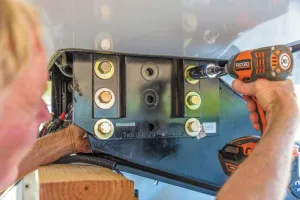
The bolts were reinstalled.
The Goose Box bolt holes match the wings of many trailer mounts. But because the wings on our Genesis Supreme toy hauler were slightly wider than the Goose Box, we used a Reese Sidewinder 5th Wheel Pin Box Spacer Kit (Part # 68200) to create a snug fit. Once the Goose Box and spacer kit were in place, the included fastening hardware was used to attach the Goose Box to the mount. Bolts were torqued to the recommended 210 foot-pounds.
Installing the B&W OEM gooseneck ball in the truck bed was a cinch. The gooseneck ball has a big handle for easy insertion and removal, so you don’t have to touch the greasy ball. It also comes with two anchors for safety chains and a suitcase in which to store the equipment. The anchors lock into the OEM pucks in the truck bed, and the gooseneck safety chains (sold separately) latch onto the anchors. The other ends of the safety chains bolt onto the Goose Box. When the trailer is unhitched and the chains are not in use, they hook onto two holders on the Goose Box.With the installation complete, it’s time to hitch up and get ready to go.
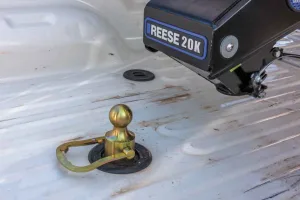
With the gooseneck ball installed, it’s time to hitch the Goose Box to the truck.
HITCHING THE GOOSE BOX
Unlike a traditional fifth-wheel system that requires the truck to be moved back and forth, left and right to align the fifth-wheel hitch with the trailer’s kingpin, the Goose Box is lowered onto the gooseneck ball in the truck bed using the trailer’s landing jacks. The truck is positioned so the gooseneck ball in the truck bed is directly under the hitch, then the trailer’s landing jacks are retracted to lower the pin box onto the ball.
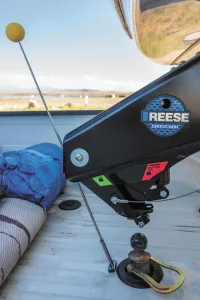
A magnetic telescoping alignment tool assists with placing the Goose Box.
To make hitching easier, we place a magnetic telescoping ball tool right in front of the gooseneck ball to help judge the alignment of the ball and hitch. Once in place, we open the truck’s tailgate and extend the landing jacks to raise the trailer high enough for the truck to back under the trailer. While backing in, when the front of the Goose Box touches the alignment tool and tips it forward, the truck is positioned correctly.
With the parts aligned, we retract the landing jacks to lower the Goose Box onto the gooseneck ball, which automatically locks in place. Making the connection is easier with a second person to help gauge the alignment. However, the driver can do it solo by getting out of the truck to visually check the positioning. Once the hitch is locked and the safety chains are attached to the anchors, the landing jacks are fully retracted into their towing position and we’re just about ready to go.
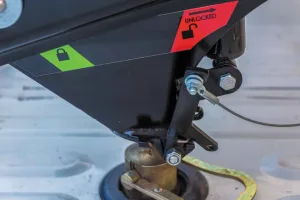
Once lowered onto the ball, the hitch locks into position automatically.
The last part of the process is to connect the breakaway brake cable and electrical connections for the trailer brakes to the Goose Box and inflate the air bags, using the viewing window to check the inflation status. When the air bags are deflated, the window is a black circle. As the bags inflate, a silver bar comes down from the upper left corner. When the bags are properly inflated, the bar crosses the middle of the viewing window on a slight angle.
TECHNIQUES FOR UNHITCHING
The first step when unhitching is to unlock the latching mechanism on the Goose Box by pulling the release cable that’s attached to the coupler handle. While holding the latch open, the trailer’s landing jacks are used to raise the Goose Box off the gooseneck ball. We’ve found that when our truck’s tailgate is open, it’s impossible to reach the coupler handle cable from the backof the truck. So, we made a simple extension by tying a cord onto the cable. This way, one person can unhitch the trailer by pulling the Goose Box latch open with one hand while simultaneously pressing the trailer’s landing jack extension button with the other to raise the trailer off the gooseneck ball.
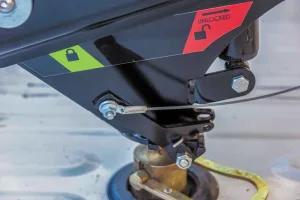
To unlock the hitch, pull the cable connected to the locking lever forward.
Our Ram truck has an auto-leveling system, so after raising the jacks and taking the trailer weight off the truck’s suspension, we wait for five to 10 seconds as the system senses the decreased weight and releases air to lower the truck bed. Then we extend the jacks until the Goose Box is completely clear of the gooseneck ball. At that point, we can either drive the truck from beneath the trailer or leave it where it is and finish leveling the trailer from front to back if it needs to be raised. If the Goose Box doesn’t pull away from the gooseneck ball smoothly when extending the jacks, we put the truck in Neutral for a moment to release any tension on the gooseneck ball.
OVERALL IMPRESSIONS
We towed our toy hauler more than 3,000 miles after we installed the Goose Box, traversing four Colorado mountain passes that topped 11,000 feet, snaking down gnarly rutted U.S. Forest Service dirt roads, driving on interstates and curvy back roads, backing into tight campsites, and hitching and unhitching in over 20 different locations.
We were floored by the silky smooth ride and ease of use. Our trailer floated along behind the truck, gently moving up and down or side to side regardless of the road conditions as the air bags soaked up the bumps in the road. Once we got the hang of it, hitching and unhitching were a breeze. We had never used a telescoping alignment tool with a fifth-wheel hitch, but it made all the difference with the Goose Box, because the positioning is so precise. Our Reese Goose Box is a keeper!
SPECIFICATIONS
Reese Goose Box 5th Wheel Pin Box (Part #94920)
Capacity: 20,000 lbs.
Pin weight: 4,000 lbs.
Product weight: 212 lbs.
Limited Lifetime Warranty
reeseprod.com/Product/94920_gooseneck-rv-coupler